Research report · 5 October 2026 · eighth check
Eighth check: we ran the map. A looming shadow, the fly's wiring and a simulated turn, plus four plain answers and 4 new entries
This check ran our own pre-registered test of the question people ask most about the digital fly: is it a brain or just a map? We showed a looming shadow to one eye of the Shiu et al. whole-brain model on the FlyWire map, let its turning neurons steer a simulated FlyGym fly, and compared the real map with scrambled maps and with no brain. It also re-tested the beginner guide, built a sourced evidence pack for four common questions, re-checked every verdict and added four catalogue entries.
Short answer
Lead scan: no claim promoted. Six videos passed an attention bar. Four are explainers with no claim of their own, the driving compilation (107,515 views) is already covered by the Flyhard verdict, and Gorilla Tag (868,853 views) still has no code.
Looming: with the real FlyWire map, a shadow on one eye turned our FlyGym fly away in 4 of 4 runs (mean 51.6°); with scrambled maps, 0 of 3. The pre-registered reading: "the turn away needs the wiring". The sentence we fixed in advance, with the numbers filled in:
We ran the map. A looming shadow on one eye turned our simulated fly away in 4 of 4 runs. With the same map scrambled (same number of connections per neuron) it turned away in 0 of 3. Here the map's wiring, not the stimulus or our code, makes the turn.
- Brain: fly67's own pass rule held on both sides in our Brian2 run ("reproduced in our Brian2 run"): giant fibre 111.5–120.5 Hz, DNa02 on the far side 23–44 Hz, on the near side 0 Hz (fly67's own engine: 114.8 / 120.3 Hz, 25 / 43 Hz). In all 3 degree-preserving shuffles the giant fibre and DNa02 stayed at 0 Hz.
- Body: scrambled retention 0.00 (the ledger's single-floor method: 0.0096); share of drive values at the clip 0; the 3 shuffles sent drives identical to the no-brain floor (1 unique drive); the brainless random arm "turned away" in 3 of 6 (below the noise flag); left shadows turned the fly right and right shadows left (2 of 2 each).
- Caveats: n is small because the pre-registered clock cuts fired (a looming trial took about 160 s, not 60–70 s): real seed 2, shuffle 5, the right-eye shuffle 4, the giant-fibre-off arm and the gain-matched arm did not run. The scrambled brains were much quieter (activity ratio 0.50), so the ledger rates the comparison "unfair" by its fixed rule. The "away" direction rests on our mapping's DNa02 sign and fly67's claim; it was not verified in real flies by us.
- Also: the beginner path passed its re-test (6 of 6 tests, 82.0 Hz bit-exact); four sourced answers (Is it AI? / brain or map? / can it suffer? / in my game?); 111 entries (4 new: Flight-test the fly A, FlyAim A, FlyArm B, FlyWireGBA C); 53 videos with a language field; ledger 38 studies, 30 with a wiring null: helps 13, no difference 8, worse 2, mixed 6, not scored 1; verdict freshness 13 current, 7 no code, 0 code changed.
What changed
- 4 of 4 vs 0 of 3looming: real map vs scrambled map, runs that turned away
- 107 → 111catalogue entries (4 new: 2 A, 1 B, 1 C)
- 34 → 38control studies in the ledger; 30 with a wiring null
- 52 → 53videos, each now with a language field
No grade changed, no verdict changed and no scoring rule changed.
We ran the map: looming
fly67, a browser fly (grade B), claims that a looming shadow on one eye excites the giant fibre and the far-side turning neurons DNa02, so its fly turns away. We asked whether that holds in the original model and, if it does, whether the turn needs the real wiring when a simulated body has to make it.
We ran the map. A looming shadow on one eye turned our simulated fly away in 4 of 4 runs. With the same map scrambled (same number of connections per neuron) it turned away in 0 of 3. Here the map's wiring, not the stimulus or our code, makes the turn.
Paths are drawn to scale from the thorax position every 50 ms after the shadow appears; forward is to the right and the fly's left is up. The scrambled-map paths lie exactly under the no-brain floor because their drives were identical. Circles: shadow on the left eye; squares: right eye. Pre-registered at 09:42:47 UTC on 5 Oct 2026, before the first looming trial.
Open the result card (SVG) to share it; it carries the sentence, the numbers, the caveat and its date.
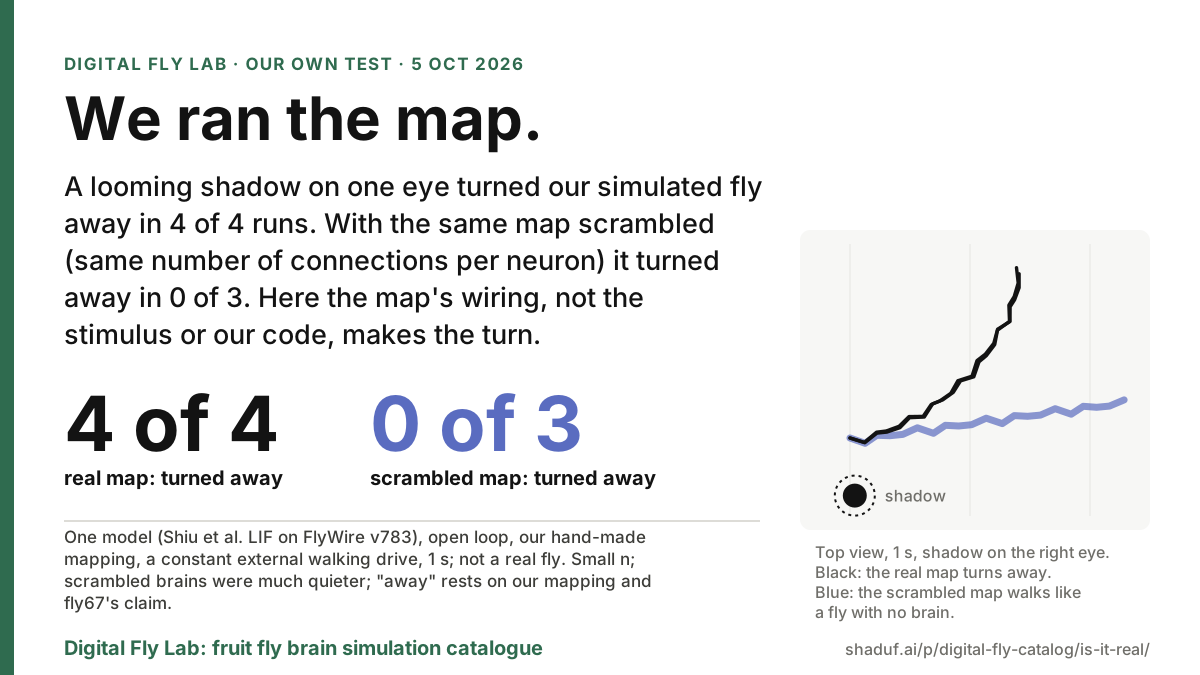
Read this before sharing. One model (Shiu et al. LIF on FlyWire v783), open loop, our hand-made mapping, a constant external walking drive, 1 s; not a real fly.
- Small n. A looming trial took about 160 s instead of the planned 60–70 s, so the pre-registered time limits fired: 4 real runs and 3 scrambled runs instead of 6 and 6, and the 3 scrambled runs sent drives identical to the no-brain floor, so in effect they are one walk. The "5 of 6" rule was applied as a share (4 of 4), a change decided before any body run.
- The scrambled brains were much quieter. They fired about half as many spikes as the real brain (activity ratio 0.50; outside the stimulated neurons about 1,000 vs 15,000). We could not run an activity-matched scramble in time, so our ledger rates the comparison unfair, with weak method, by its fixed rule.
- The direction. "Away" rests on our mapping's DNa02 sign and on fly67's claim. As we said before the test: "fly67's claim; the direction in real flies was not verified by us." A 2017 study of walking flies describes looming-evoked backing up and turning through other neurons (LC16 and MDN), not through DNa02.
- A strong, artificial stimulus: every LC4 and LPLC2 neuron of one eye at 80 Hz for 1 s, as fly67 does. A real approaching object recruits fewer cells, with timing. The giant-fibre-off and gain-matched arms were not run.
The brain part was reproduced. fly67's own pass rule held in our Brian2 run of the Shiu et al. model: giant fibre 111.5–120.5 Hz (fly67's engine: 114.8 / 120.3), DNa02 on the far side 23–44 Hz, near side 0 Hz. In all 3 scrambled brains every readout stayed at 0 Hz. Our test is not fly67's own control, so fly67 stays grade B.
Numbers behind the chart (all 14 body runs)
| Run | Group | Shadow on | Heading change (°) | Away (°) | Away beyond floor (°) | Turned away | Forward after onset (mm) |
|---|---|---|---|---|---|---|---|
| F (floor) | No brain, constant drive (floor) | – | -1.49 | – | – | – | 11.50 |
| L-real-0 | Real map | left eye | -33.61 | 33.61 | 32.12 | yes | 10.73 |
| L-real-1 | Real map | left eye | -40.63 | 40.63 | 39.14 | yes | 10.47 |
| R-real-0 | Real map | right eye | 64.06 | 64.06 | 65.55 | yes | 8.30 |
| R-real-1 | Real map | right eye | 68.29 | 68.29 | 69.78 | yes | 8.24 |
| L-D3 | Scrambled map (same drive as F) | left eye | -1.49 | 1.49 | 0.00 | no | 11.50 |
| L-D4 | Scrambled map (same drive as F) | left eye | -1.49 | 1.49 | 0.00 | no | 11.50 |
| R-D3 | Scrambled map (same drive as F) | right eye | -1.49 | -1.49 | 0.00 | no | 11.50 |
| rand-L0 | No brain, random steering | left eye | 6.58 | -6.58 | -8.07 | no | 11.35 |
| rand-L1 | No brain, random steering | left eye | 10.39 | -10.39 | -11.88 | no | 11.37 |
| rand-L2 | No brain, random steering | left eye | -1.10 | 1.10 | -0.38 | no | 11.25 |
| rand-R0 | No brain, random steering | right eye | 19.77 | 19.77 | 21.26 | yes | 11.21 |
| rand-R1 | No brain, random steering | right eye | 14.77 | 14.77 | 16.25 | yes | 11.01 |
| rand-R2 | No brain, random steering | right eye | 18.71 | 18.71 | 20.20 | yes | 10.89 |
Pre-registered reading: "the turn away needs the wiring" (scrambled retention 0.00 by the pre-registered floor method, 0.0096 in the ledger's single-floor method; both under the 0.1 line). Share of drive values at the ±1.2 clip: 0.00. Mapping (ours, hand-made, not fitted): drive_s = clip(0.8 − m_s − 0.5·(a_s − a_o), −1.2, 1.2), with a = DNa02 rate ÷ 100 Hz and m = mean MDN rate ÷ 100 Hz; the 0.8 is an external walking drive, not the brain.
The design, written down first
The design below was copied from our plan into the pre-registration at 09:42:47 UTC; the first looming trial started at 09:44:06 UTC. Later changes are deviations, listed below.
- Brain: the Shiu et al. 2024 LIF model (
model.pyat 91bdd1e7) with upstream defaults, FlyWire v783, Brian2 2.9.0 (numpy target), dt 0.1 ms, 1,000 ms per trial. - Stimulus: LOOM-L = every v783 neuron with cell type LC4 or LPLC2 on the left (expected 54 + 108 = 162), LOOM-R the same on the right (50 + 102 = 152); Poisson input at 80 Hz to each for the whole trial (fly67's rate).
- Wiring: real wiring with trial seeds 0, 1 and 2 per side; degree-preserving shuffles with shuffle seeds 3, 4 and 5 per side, interleaved so that a clock cut leaves balanced arms.
- Brain gate: fly67's own pass rule on the first real trial of each side: giant fibre above 50 Hz, and far-side DNa02 above 3 × the near side + 5 Hz.
- Body: FlyGym 2.1.0
HybridTurningController, flat terrain; 0.2 s settle, 0.2 s at the constant drive (0.8, 0.8), then the ten 100 ms brain bins. Mapping (ours, hand-made, not fitted):drive_s = clip(0.8 − m_s − 0.5·(a_s − a_o), −1.2, 1.2), a = DNa02 ÷ 100 Hz, m = mean MDN ÷ 100 Hz; the 0.8 is an external walking drive, not the brain. - Metric: the heading change away from the looming side over the 1.0 s after onset. A run "turns away" when it turns more than 10° beyond the floor's value for the same side.
- Arms: the floor F (constant drive, must walk 5 mm or more), real, scrambled (drives deduplicated: an identical drive is not re-run, because the physics is deterministic), random brainless steering (N(0, s) per bin, s = the RMS of the real turning terms), and a giant-fibre-off fill arm.
- Readings stated in advance: "the turn away needs the wiring" if scrambled retention ≤ 0.1 and the real brain turns away in at least 5 of 6 runs; "it does not" if retention ≥ 0.9; "partly" in between; "no reliable turn" if the real brain turns away in fewer than 5 of 6. Noise flag if random steering "turns away" in 5 or more of 6. One plain sentence was fixed for each reading; the one shown above is the "needs the wiring" sentence with the numbers filled in.
- Ledger: one new made-by-us study (byo-flygym-loom) under the fixed rules, with no override on our own row;
tuned_equallyfalse unless a gain-matched arm was reached.
Brain: step 0, the gate and the shuffles
Step 0 (our own script on the Schlegel et al. annotation table at commit a83b2776): LOOM-L = 54 LC4 + 108 LPLC2 = 162, LOOM-R = 50 LC4 + 102 LPLC2 = 152, all 314 present in the v783 table, none on the midline. This matches the expected counts. Readouts: one neuron per side for DNp01 (the giant fibre), DNa02, DNa01, DNp09 and DNg62, two MDN per side, and MN9.
| Trial | Shadow on | Giant fibre L / R (mean) | DNa02 L / R | LI | MDN (mean) | Whole-brain spikes | Active neurons | fly67's rule |
|---|---|---|---|---|---|---|---|---|
| fly67, the author's engine (committed, 45f62fd9) | left eye | – (114.8) | 0 / 25 | – | 0.8 | – | – | pass |
| fly67, the author's engine (committed, 45f62fd9) | right eye | – (120.3) | 43 / 0 | – | 3.3 | – | – | pass |
| Real map, seed 0 (our brain gate) (L-real-0) | left eye | 129 / 94 (111.5) | 0 / 23 | 0.96 | 0 | 27,367 | 657 | pass |
| Real map, seed 1 (L-real-1) | left eye | 129 / 99 (114) | 0 / 28 | 0.97 | 0 | 27,538 | 711 | pass |
| Real map, seed 0 (our brain gate) (R-real-0) | right eye | 89 / 149 (119) | 44 / 0 | 0.98 | 5.25 | 27,701 | 677 | pass |
| Real map, seed 1 (R-real-1) | right eye | 85 / 156 (120.5) | 44 / 0 | 0.98 | 3.5 | 27,509 | 682 | pass |
| Scrambled map, shuffle 3 (L-D3) | left eye | 0 / 0 (0) | 0 / 0 | 0.00 | 0 | 13,993 | 349 | fail |
| Scrambled map, shuffle 4 (L-D4) | left eye | 0 / 0 (0) | 0 / 0 | 0.00 | 0 | 13,938 | 336 | fail |
| Scrambled map, shuffle 3 (R-D3) | right eye | 0 / 0 (0) | 0 / 0 | 0.00 | 0 | 13,134 | 351 | fail |
| Not run (pre-registered time limits) | Real seed 2 (both eyes), shuffle 5 (both eyes) and shuffle 4 on the right eye (stopped at the kill time); the giant fibre silenced (GF-off) and the gain-matched scrambled brain (G). A looming trial took about 160 s instead of the planned 60–70 s. | |||||||
- Per side: the giant fibre on the shadowed side fires more (129 vs 94–99 Hz for a left-eye shadow; 149–156 vs 85–89 Hz for a right-eye shadow); fly67 reports the mean of both. DNp09 (P9) stays at 0–1 Hz and MN9 at 0 Hz in every looming trial.
- Shuffles: every property check passed (edge count, total synapses, in- and out-degree, counts travelling with the presynaptic neuron); each shuffle created 283–298 self-loops and 57,832–58,036 duplicate pairs. In every shuffle all readouts were 0 Hz. Whole-brain spikes fell to 13,134–13,993, of which 12,131–12,936 were the stimulated neurons themselves: outside the stimulated set a scrambled brain fired about 1,000 spikes against about 15,000 with the real wiring.
- Metrics: DNa02 lateralisation index 0.970 (mean of 4 real trials), 0 in shuffles; turn selectivity (display only) real 1.26, shuffles 0; activity ratio (whole-brain spikes, scrambled ÷ real) 0.497, "reduced".
- Time and memory: looming trials took 152–177 s of wall time against 72 s for the sugar gate, because upstream code adds one Poisson input object per stimulated neuron (152–162 here, 21 for sugar). Worker peak memory 0.76–0.78 GB.
Body: drives, deduplication and the reading
- Go: the floor walked 12.88 mm in the 1.2 s driven period (5 mm or more needed).
- Deduplication: all 3 shuffle drives were identical to the floor's constant drive, because the scrambled brains send 0 Hz to DNa02 and MDN. They were not re-run and take the floor's result. Disclosure: 3 shuffles gave identical drives, equal to the floor.
- Real brain: turned away in 4 of 4 runs (the rule, applied as a share for 4 runs, needs 4 of 4). Right-eye shadows turned the fly further (64–68° against 34–41°): DNa02 fired at 44 Hz for a right-eye shadow against 23–28 Hz for a left-eye one, and MDN added a little (3.5–5.25 Hz).
- Random brainless steering: 3 of 6. Every random run drifted left by 1–20° whatever its draw, so its three "away" runs are the right-eye runs: the body has a small built-in asymmetry under a varying drive that the constant floor does not show. Below the noise flag (5 of 6).
- Retention (pre-registered floor method, pooled): scrambled 0.00, random 0.12. The ledger's single floor value gives 0.0096. Clip share 0.00, so no "partly by construction" flag.
- Reading by the rule stated in advance: "the turn away needs the wiring".
Deviations and notes, in plain words
- Our scratch folder differed from the plan. No effect on the design.
- The runner used three helper agents for the lead scan, tracking and admission, and for reading the ledger studies of the new entries, so that those blocks ran beside the simulations. None ran a simulation; one simulation worker at a time was kept.
- Trial time (logged at 09:47:51 UTC, after the first trial and before any body run): about 160 s per looming trial instead of 60–70 s. The worker and the Poisson method were not changed, to stay comparable with the first trial and with upstream. The pre-registered clock cuts then left real seeds 0–1 and shuffles 3–4 per side (the right-eye shuffle 4 was stopped at the kill time); the giant-fibre-off and gain-matched arms did not start.
- Body rule for fewer than 6 real runs (fixed before any body run): "at least 5 of 6" was applied as a share, at least ceil(5/6 × n) of the n real runs that exist; with n = 4 that is 4 of 4.
- Random-arm generator (fixed before any body run): separate random draws for left- and right-eye runs.
- Notes added after the runs: the brain driver stopped at the kill time without logging the trials it never reached, so the runner added those log lines; the ledger stores one floor value per study, so its retention (0.0096) differs slightly from the pre-registered pooling (0.00), both under 0.1; the ledger's "unfair" verdict follows from
tuned_equallyfalse (no gain-matched arm reached) and the null losing, with no override.
What the literature says about the direction
| Claim used | Source | Status |
|---|---|---|
| LC4 conveys looming (angular velocity) to the giant fibre | von Reyn et al. 2017, Neuron, doi | verified (abstract) |
| LPLC2 and LC4 synapse directly onto the giant fibre; LPLC2 gives the size component | Ache et al. 2019, Current Biology, doi | verified (abstract) |
| DNa02 is a same-side turning neuron | Rayshubskiy et al. 2025, eLife, doi | verified on 2 Oct 2026 (reused) |
| Walking flies turn away from a looming stimulus on one side | not found as a direct primary statement in the time box. Closest: Sen et al. 2017, Current Biology, doi: "Insects, like most animals, tend to steer away from imminent threats"; looming-responsive LC16 neurons "elicit backward walking and turning" (through MDN, not DNa02) | not verified |
Caption, as pre-registered: "fly67's claim; the direction in real flies was not verified by us." In real flies the giant fibre triggers a take-off, not walking; our body reads only DNa02 and MDN.
Limits of this test
- Small n. 4 real runs (seeds 0–1 per side) and 3 shuffle runs with identical drives, not the planned 6 and 6.
- The shuffled brains are almost silent outside the stimulated neurons, so the null answers "does a random map with the same degrees carry the looming signal to the descending neurons?", not "does a map with the same activity turn the same way?". No gain-matched shuffle was reached, and the giant-fibre-off test did not run.
- The direction is built into our mapping's sign. That the far-side DNa02 fires is the model's result; that this means "away" rests on the mapping and on fly67's claim.
- Strong, artificial stimulus: every LC4 and LPLC2 of one eye at 80 Hz for 1 s, as fly67 does. A real looming object recruits fewer cells, with timing; a repository we deferred to the next check (programmingWTF/FlyBrain) reports that a different LIF model's giant fibre does not fire for a realistic stimulus size.
- One model, open loop, 1 s: the body does not feed back to the eyes; FlyGym's controller does the walking; the forward drive is external. The floor drifts by −1.5° in 1 s, which the floor-referenced rule removes.
Build your own: beginner re-test
Pass. The pins installed in 31 s and pip freeze equals the lock file; both data checksums match; 6 of 6 tests passed (61.6 s); the gate trial gave MN9 82.0 Hz, bit-exact with our earlier runs (13,372 spikes, 383 neurons active, identical descending-neuron bins). Our machine had no curl; the page's python3 -c "import urllib.request; …" download works. Next re-test due 19 Oct 2026. The new step "Add a sense: looming" is on Build your own with the exact commands.
Evidence pack: four plain questions
We built a sourced answer for each of the four questions people ask most (from our audience research), each with a one-line answer, a short paragraph, its evidence and an uncertainty line. They are published in Common questions on Is it real?
- Is it AI? The basic model is not trained AI: it copies the fly's wiring and sets one strength by hand. Many viral demos add trained AI parts around it.
- Is it a brain or just a map? It is a map (a fly brain scan) run with a simple neuron model. In our tests its wiring drove a reflex and a turn; body software did the walking.
- Can it suffer? We found no study that measured consciousness or suffering in these models, which leave out much biology. Fly larvae detect harmful heat and pressure; whether flies feel pain is open.
- Can I put it in my game? Yes for a non-commercial project, with credit (our reading of FlyWire's CC BY-NC 4.0). You must design yourself how the game talks to the brain.
| Trained part in the main path | Entries |
|---|---|
| None | 35 |
| A trained readout or decoder | 13 |
| Learning rules or a few settings found by search | 12 |
| The whole network or every synapse trained | 10 |
| A trained vision or text front end | 4 |
| A trained policy or a language model | 4 |
flybrain.app re-read (five plain page requests): its chat connection is a public tunnel to a caretaker server that receives the fly's drives, behaviour and position once per second; the page says "Claude plays two roles" (caretaker and "HR Partner"), and its approvals "drop food" or "dim the lights". So a language model acts on the fly's environment, not inside the brain model; the server code is not public. Grade C unchanged.
Licences in the catalogue (a rough bucketing of the data-licence texts of 111 entries): CC BY only 51, including CC BY-NC 37, other or not stated 21, not applicable 2.
Lead scan
Window since 3 Oct 2026, 09:35 UTC; decision written within the first 15 minutes, promotion rule unchanged. No claim promoted. Pax Factum (Russian, 169,140 views in 7 days), DenTrave (128,757), Kui (93,618) and Technology Untold's drone short (55,457) are explainers or essays with no checkable claim of their own; the driving compilation (107,515) is already mapped to Flyhard; Gorilla Tag (868,853) still links no code. No fly-brain Hacker News story, no news item with a new claim, no repository with 20 or more stars (the largest, LakoMoor/FlyWireGBA with 5 stars, went to admission), no new dataset release.
New search terms in French, Spanish and Russian found high-view videos the English scans never saw: CLOWNWAY (413,210 views), Vm granmisterio (Spanish, 488,305) and a Spanish edition of the Fiouze video (198,342). The two most-viewed Minecraft fly videos, Fiouze and Aywen (French, 575,059) and Bobicraft (Spanish, 475,569), do not map to a catalogued project: the French one credits a mod we excluded (a crypto token with no code), the Spanish one names no project and predates every catalogued Minecraft repository. Reddit search still answered HTTP 403.
Verdict freshness and row updates
All 20 verdict rows re-checked: 13 current (code unchanged since graded), 7 with no code, 0 with changed code. Row updates, no grade changes: Flyhard's compilation re-share 107,515 views (the match still rests on the thumbnail only); Gorilla Tag 868,853 views, description re-read, still no code (U); Terraria 42,229 views; FlyLeno's Vinesauce stream 49,331.
New entries and exclusions
| Entry | Grade | Controls / wiring effect | Why |
|---|---|---|---|
| Flight-test the fly | A | wiring null / helps (fair, strong) | The Shiu model on a 20,556-neuron v783 subcircuit steers an aircraft rudder through DNa02. Mean RMS yaw rate 3.19 deg/s against a median of 3.92 for 10 degree-preserving shuffles (95% interval of the difference −0.80 to −0.64); a classical yaw damper does far better (1.69), so the baseline is not beaten. |
| FlyAim | A | wiring null / no difference | The whole MaleCNS v1.0 in the author's own LIF model on a pre-registered aiming task: real 412.5 px from the target, one shuffle 430.9, a random walker 251.7. A clean negative result. |
| FlyArm | B | wiring null / no difference by the ledger rules | A frozen MaleCNS between a trained encoder and decoder drives a Franka arm. On the ledger's one metric (pick-and-place lift, 6 seeds) real 72.2% against 9 degree-preserving shuffles 55.9%, p = 0.125, and a GRU 56.9%. The author's "mixed" spans several tasks with different metrics. |
| FlyWireGBA | C | none / not tested | A Game Boy Advance game: a 128-neuron v783 subgraph only gates feeding through MN9; everything else is a heuristic controller. Data licence: FlyWire CC BY-NC 4.0. |
Deferred to the next check: programmingWTF/FlyBrain, an LC4/LPLC2 → giant fibre escape study on v783 with shuffle, cut and LC10 controls in the author's own LIF model. Its report says the giant fibre peaks at about 4.1 Hz at full LC4 drive and does not fire for a realistic stimulus size, a natural counterpoint to our 111–121 Hz under 80 Hz drive to every looming detector of one eye; its result files are not committed yet. Excluded: an off-topic Kinect tool. Also deferred: a mirror, a credited desktop-fly derivative and 42 small repositories under the skip rule.
Tracking
- Repositories: 94 checked without API calls: 85 unchanged, 8 changed, 1 gone (FlyDoom, a fourth "not found"; its record is kept). fly-dino now adds trained controls without a connectome (10 seeds each): mean completion 92.2 for the connectome controller and 92.2 for a 243-parameter plain network, and its README says "The task does not need the connectome"; still no rewired-circuit null, so its wiring effect stays "not tested" (grade C). fly-brain (Lulzx) adds degree- and side-preserving scrambles of the ventral cord (grade A unchanged; a possible new ledger study). Not material: flybrain-connectome-benchmark, kick-the-fly, making-fly-play-chess, open-fly, neurafly.
- Links: by entry, 103 ok, 2 redirect, 1 blocked, 1 gone, as on 3 Oct; four PubMed Central article pages now answer with a bot challenge (classed blocked, not dead).
- Videos: 52 of 52 available, none removed; 1 added (53). Every record now has a
languagefield (51 English, 2 Russian), documented in the published videos schema. The new card is DenTrave's Russian explainer (commentary on DOOMFLY, stonkfly, the Shiu model and MaleCNS). - PyPI: no pinned package has a release since 3 Oct 2026. Newer than our pins, unchanged: Brian2 2.10.1 (pin 2.9.0), numpy 2.5.3 (2.3.5), pandas 3.0.6 (2.3.3), mujoco 3.14.0 (3.9.0).
- Stars of young repositories refreshed from their pages: flybridge 10, fly-x-jev 6, fly-cartpole 1, fly-with-me 1.
Method and limits
- Brain: the beginner environment (pins of
requirements.lock, Shiu checkout at 91bdd1e7), 6 beginner tests, step 0, 12 worker tests before the first trial, then one fresh process per trial with the pre-registered clock cuts. Body: uv 0.9.0, CPython 3.12.11,requirements-body.lock(47 packages),MUJOCO_GL=disable. The brain environment was deleted before the body was installed, so the two never coexisted. - Memory: peak 2.20 GB for the whole sandbox during the brain queue (under the 2.7 GB stop line); brain worker 0.76–0.78 GB, body worker 0.25–0.28 GB; scratch peak about 0.8 GB.
- GitHub API: 4 core calls in total (metadata of the new entries); 18 paced search queries.
- The clock: every cut that fired was a pre-registered clock cut (fill start, core start and kill); no cut depended on a result.
- Limits: the looming limits are listed above. The trained-part classes are our reading of each project's files, and projects change after we read them. The lead scan, tracking and admission were done by helper agents; their results were read but not re-done by the runner. Reddit and Google Trends were not reachable.
Sources
- Brain model: philshiu/Drosophila_brain_model @ 91bdd1e7; Shiu et al. 2024, Nature, doi.
- fly67's looming rule and committed numbers: validation/circuits.json at 45f62fd9 (the author's own JavaScript engine).
- FlyWire annotations (Schlegel et al. 2024): flyconnectome/flywire_annotations, table at commit a83b2776 on 5 Oct 2026.
- Body: FlyGym 2.1.0 (Apache-2.0).
- Looming neurons: von Reyn et al. 2017, doi; Ache et al. 2019, doi; Sen et al. 2017, doi; DNa02: Rayshubskiy et al. 2025, doi.
- Nociception: PLoS ONE 2012, doi:10.1371/journal.pone.0030090.
- Data: projects.json (version 2026-10-05-run8), controls.json (study byo-flygym-loom), videos.json; the result card: we-ran-the-map-card.svg.
- Earlier checks: 3 Oct 2026, 2 Oct 2026 (Add a body), 1 Oct 2026 (fair test); all reports in Research.