New and updated
New and updated fruit fly brain projects
A dated log of new catalogue entries, material updates to existing projects, grade changes and changes to this site. The newest change is first.
Changelog
-
Thirty-first check (9 to 10 Nov): browser demos, two new control studies, a gamebook
213 entries (172 graded; 2 new); controls ledger 107 studies, 97 with a wiring null; 26 verdict rows. NeuroCraft Fly moves from U to C; no other grade changed.
- Browser demos: Re-checked 10 Nov in a headless browser without a GPU: 4 of 4 of the demos we first checked on 6 Oct ran (20 Oct: 4 of 4); the fifth, neural-canvas, is re-checked separately. Fly Worker, re-checked 10 Nov after a change to its model code: ran by our check's rule, and two screenshots of its game panel taken about 7 seconds apart show its street game view, frame counter and brain-activity dots changing. It downloaded about 8.6 MB of brain data, identified by their web address, a method we fixed before this check. In our browser checks from 3 Oct to 10 Nov 2026, 8 of 13 demos ran on a machine without a GPU at their latest check.
- Correction: Correction, 10 Nov 2026: our earlier overall line said 9 of 13 demos ran. That was the 20 Oct count, and we did not update it after the re-checks of 24 to 31 Oct, in which neural-canvas, flyleno and help-the-fly-escape stopped responding and fly-brain-lulzx was stopped by its memory use. At each demo's latest check, 8 of 13 ran. (on Ways to try)
- Controls ledger: indian-aman's whole-CNS specificity study (MaleCNS v1.0): the steering readout stays at 4.11 Hz (real 3.98 Hz) when wiring is shuffled within cell type and side, and falls to -0.01 Hz under a whole-CNS shuffle, so the ledger reads mixed; no no-brain baseline was run. Authors' numbers from a GPU run, not re-run by us. Kishandev12's signal study: real wiring spread activity further than degree-preserving rewiring (about 137 vs 107 active downstream neurons, 10 of 10 pairs). This measures how far activity spreads, not a task, so we do not score it as the wiring helping; no no-brain baseline was run. Authors' numbers, not re-run by us. (what changed)
- Re-reads: Re-read 10 Nov after code changes: Fly Worker keeps A. Fly Worker's own numbers after a steering-bias fix (author's numbers, not re-run by us): the fly brain covers 50% of the game map, smoothed noise 63% and uniform noise 49%; a fly brain shown a different board scores 66%. The author withdraws the earlier -3 point paired result. There is still no comparison with scrambled wiring. Re-read 10 Nov after changes: flyshi-research keeps B. Re-read 10 Nov after code changes: NeuroCraft Fly moves from U to C: its source is now public, and its readouts select scripted body programs.
- Re-check: Re-checked 10 Nov: 22 of the 24 projects we graded on 20-21 Oct keep their grade (1 after a full re-read of changed files); 2 could not be re-checked because the source is no longer public. Two batch entries could not be re-checked: the source repositories of ascend and connectomics-fly-whole-brain-nulls returned 404 (checked 10 Nov 2026); each grade is for the code we read on its grade date (20 and 21 Oct 2026). flylab-demo: its source repository could not be reached on 9 and 10 Nov 2026 (not found); its grade (C) is for the code we read on 30 Oct 2026.
- Gamebook: 'What Is It Like to Be a Fly?' (Andrew Sheerin, free browser gamebook, shared from 6 Nov 2026) replays spike recordings from published fly-brain models (Shiu et al. 2024 on FlyWire data); the movements and two of its six scenes are written by the author, as its own note says. The model does not run in the page, and no code repository is linked (page read 10 Nov 2026). (verdict row)
- Scan: 10 Nov: we scanned news, videos and new code from 9 to 10 Nov, plus items from 6 Nov that our previous scan missed; one new claim got a dated check: a free browser gamebook, 'What Is It Like to Be a Fly?', that replays recorded fly-brain model activity. 7 new code projects are queued for a first look.
Method and every number: report of 10 Nov 2026.
-
Thirtieth check (3 to 9 Nov): the walking-circuit model re-run with shuffled wiring
211 entries (169 graded); no entries added; controls ledger 105 studies, 95 with a wiring null (one new row, made by us); 57 videos. No grade changed; the paper's catalogue entry stays not tested.
- Our check: We re-ran the authors' nerve-cord walking model on an ordinary 2-processor server without a GPU (9 Nov 2026): with the real front-leg wiring, 3 motor neurons showed a regular rhythm; with the wiring shuffled by the authors' own shuffle, 4 of 5 tries still showed a rhythm (0, 12, 40, 3 and 1 motor neurons in the 5 tries). One run each, faster solver settings than the paper, no noise. The authors' shuffle keeps each neuron's excitatory or inhibitory sign and shuffles connections within each cell group; it differs from the shuffle used for their circuit-pattern count. The shuffled circuits were far more active than the real one (1,645 to 1,995 active cells against 97; top firing rates about 230 against 16 per second), so this is not a like-for-like comparison; a test with activity matched has not been run. (table and chart)
- Controls ledger: our ledger row reads no difference by the rule we fixed before the run; partly fair, moderate; not activity-matched (what changed).
- What it took: One simulation took 1.2 minutes and its process peaked at 1.4 GB of memory; the software and wiring data used about 1,130 MB of disk. One helper package version had to be changed for the install to work, before any simulation ran.
- "Uploaded" fly-brain videos: A new Urdu and Hindi video, 'Scientists Uploaded a Fly's Brain Into a Computer Are Humans Next?' (Takhti, 3 Nov 2026; about 202,000 views on 9 Nov), uses the word uploaded in its title, while its own description says this does not mean a fly's mind was copied and calls Eon Systems' demos company claims with limits. That matches the primary sources: a wiring map traced from one preserved fly brain, run as a simplified model. We read the title and description, not the video (checked 9 Nov 2026). (verdict row)
- Scan: 9 Nov: we scanned news, videos and new code from 3 to 9 Nov; one widely seen new video, an Urdu and Hindi explainer whose title says a fly's brain was uploaded, got a dated check (its own description says no mind was copied). Two new write-ups about fly-brain games and puzzles and several small new code projects that say they test whether the fly's wiring matters are queued for a first look.
- Tracking: Links as on 2 Nov; 57 of 57 videos available; 9 tracked repositories with new commits since 2 Nov were recorded and not yet re-read.
- Next: An activity-matched follow-up needs its own plan and is not yet scheduled; the next beginner re-test is due 16 Nov 2026.
Method and every number: report of 9 Nov 2026.
-
Twenty-ninth check (1 to 2 Nov): the beginner guide re-tested from an empty folder, with memory measured per process
211 entries (169 graded); no entries added; controls ledger 104 studies, 94 with a wiring null; 57 videos. No grade or ledger result changed; the beginner guide and the specs answer were updated.
- Build your own: Re-test, 2 November 2026: 6 of 6 tests, 82.0 Hz bit-exact. The beginner path re-run from an empty folder on 2 Nov 2026 (Linux x86_64, Python 3.11.2, 2 CPUs, no GPU) with the pinned packages, and again with the short
requirements.txtcommand (6 of 6 tests, 82.0 Hz). No page fixes were needed. (the re-test) - Short command: On 2 Nov 2026 the short
requirements.txtcommand installed 7 newer helper packages than our exact lock (Cython 3.3.0 → 3.3.1, iniconfig 2.3.0 → 2.3.1, MarkupSafe 3.0.3 → 3.0.4, pluggy 1.6.0 → 1.7.0, python-dateutil 2.9.0.post0 → 4.0.0, pytz 2026.4 → 2026.6, tzdata 2026.4 → 2026.6) and gave 82.0 Hz; the six main packages are pinned and did not change. It also did not install the package six, which is in our lock (python-dateutil 4.0.0 appears not to need it; we did not check its metadata). Userequirements.lockto get exactly our environment. - Specs: Device: Python 3.11; on 2 Nov 2026 we used 2 CPUs and no GPU (no NVIDIA device or driver present; Brian2 used its RuntimeDevice with the numpy code target, which the demo picks because the host has no C++ compiler). The simulation process itself peaked at 0.59 GB of memory for one 1-second trial, and the tests at 0.61 GB. These figures are the largest single process (measured with getrusage), not the whole test container, which peaked at about 1.7 GB including file cache and the parent process. (What do I need to run it?, updated)
- Pins: unchanged; checked against PyPI on 2 Nov 2026 (latest: Brian2 2.11.0, numpy 2.5.4, pandas 3.1.0, mujoco 3.17.0; our pins stay at 2.9.0, 2.3.5, 2.3.3 and 3.9.0), and the Brian2, numpy and pandas pins installed cleanly in the re-test of 2 Nov (mujoco, the body pin, was not re-installed); next re-test due 16 Nov 2026.
- Run time: On 2 Nov the first sugar trial took 96 to 112 s from start to finish and the tests 77 to 87 s, longer than on 19 Oct (68 s and 58 s); we do not know why.
- Scan: 2 Nov: we scanned news, videos and new code from 1 to 2 Nov; nothing met the bar for a new claim check.
- Tracking: 2 Nov 2026: we looked up the latest commit of 142 tracked repositories again: 4 have new commits since 31 Oct, recorded and not judged yet; flydoom is still gone or private. The repositories of 13 of the 25 verdict rows were re-checked, none with new code since 31 Oct. Links as on 31 Oct (fruitfly.live still fails its security certificate; the ascend demo and the FlyGym browser viewer still answer 404). 57 of 57 videos available.
Method and every number: report of 2 Nov 2026.
- Build your own: Re-test, 2 November 2026: 6 of 6 tests, 82.0 Hz bit-exact. The beginner path re-run from an empty folder on 2 Nov 2026 (Linux x86_64, Python 3.11.2, 2 CPUs, no GPU) with the pinned packages, and again with the short
-
Twenty-eighth check (30 to 31 Oct): Fly-NAF now tests its wiring, 2 new entries, the walking model checked for a re-run and fly67 loaded again
211 entries (169 graded); 2 entries added; controls ledger 104 studies, 94 with a wiring null; 57 videos. Changes since 30 Oct: 7, of which 3 material (the two new entries and Fly-NAF's new wiring control).
- Material update: Fly-NAF B Helps: Fly-NAF (re-read 31 Oct): the author now tests the wiring. On one replayed game night the real wiring answered 7 of 8 threats on the threat's side first; three shuffled brains answered 0, 3 and 3. The game constants were tuned on the real wiring, so the shuffled brains ran with settings made for another network. Grade B kept. Our ledger adds it as a new study: helps, rated unfair (constants tuned on the real wiring) and weak (one replayed night).
- New entries: Fly Hearing Lab A Worse: Fly Hearing Lab (new, graded A): in two simulated fly brains the song circuit did not prefer the species' song, and the male rhythm-tuning effect was larger with shuffled wiring (2.66 vs 0.70 Hz), by the author's committed results. DrosoCode A Worse: DrosoCode (new, graded A): a fly mushroom body from FlyWire learning to predict code tokens; a rewired copy of the same size learned better than the real wiring (18.1% vs 12.6%, one run each), by the author's committed results.
- Controls ledger: helps 36, no difference 26, worse 11, mixed 17, not yet scored 4; fly wiring beat scrambled wiring in 36 of 94 (each row with its stat note).
- Re-read, grades kept: Flybrain experiments A: Flybrain experiments (re-read 31 Oct): three new experiment pages. In the steering experiment the fly circuit did not beat a direct map and was not reliably better than rewired copies; in the search experiment the fly wiring gave no benefit over rewired wiring. Grade A kept. fly-connectome-reservoir B: fly-connectome-reservoir (re-read 31 Oct): a new technical report repeats the same numbers (100% real, 83.9% shuffled, 50% without connections, 3 seeds) and says three shuffled networks are far too few to claim an advantage. Grade B kept.
- Walking-circuit paper (minor update, label unchanged): We checked whether the authors' walking model can be re-run with shuffled wiring on an ordinary 2-processor server without a GPU (31 Oct 2026): its software would need an estimated 620 MB once installed, plus 86 MB of wiring data, more than our 600 MB test space. The test was not run. The authors' shuffle keeps each neuron's excitatory or inhibitory sign and shuffles connections within each cell group; it differs from the shuffle used for their circuit-pattern count. Whether the real wiring is needed for the simulated walking rhythm stays not tested; the earlier circuit count is a pattern in the wiring, not a test of walking.
- Browser: fly67: runs again on 31 Oct. It downloaded about 33 MB of brain data, identified by their web address, a method we fixed before this check. (browser check of 31 Oct)
- Link check: The copy of this demo at fruitfly.live answered on 30 and 31 Oct with a security certificate made for its hosting service's own addresses, not for fruitfly.live, so browsers refuse to open it; this looks like a setup problem at that address, which we did not check further. The Hugging Face version is the one we link.
- Scan: 31 Oct: we scanned news, videos and new code from 30 to 31 Oct; nothing met the bar for a new claim check, our news searches found no new coverage of the walking-circuit paper beyond the journal article itself, and two new code projects with their own scrambled-wiring tests were added. First look at 21 code projects found by our searches: 2 graded (Fly Hearing Lab and DrosoCode), 14 left out because they have no wiring comparison or their shuffle does not touch the wiring, 4 listed for the next check and 1 not found.
- Tracking: 31 Oct 2026: we looked up the latest commit of 142 tracked repositories: 127 unchanged, 14 with new commits, 1 gone or private (flydoom). Three of the changed ones were re-read (fly-naf, flybrain-prove-ai and fly-connectome-reservoir); the other changes are followed up in the next check and were not judged today. 57 of 57 videos available; no new view counts.
Method and every number: report of 31 Oct 2026.
-
Twenty-seventh check (29 to 30 Oct): 4 new entries, the walking-circuit paper's shuffle test read, 27 grades re-checked and four older demos loaded again
209 entries (167 graded); 4 entries added; controls ledger 101 studies, 91 with a wiring null; 57 videos. Changes since 29 Oct: 14, of which 5 material.
- New entries: Pugliese et al. 2026 (Nature) A Not scored: The authors' code includes a test that shuffles the wiring while keeping the balance of excitatory and inhibitory connections; their saved notebook output shows the number of three-neuron circuits of the walking-rhythm type among front-leg nerve-cord neurons: 21,544 with the real wiring and 306.95 ± 29.10 (mean ± SD) across 100 shuffles. We did not re-run it (checked 30 Oct 2026). This is a count of circuit patterns in the wiring, not a walking test with shuffled wiring, so our ledger does not score it. A nerve-cord study, not a whole-brain or body simulation; peer-reviewed, MIT licence. fly-connectome-forecast A No difference: The fly reservoir forecast Polish wind and solar power as well as random and rewired reservoirs, not better (mean skill over six tasks: 0.355 fly, 0.353 rewired, 0.355 random; 5 seeds). RiskFly A Mixed: MAE 0.00576 with the fly wiring against 0.00723 for degree-preserving rewired wiring, fly better in 5 of 5 seeds, author's p = 0.0625, called exploratory, while a dense network did best (0.00537); by our fixed rules the rewired comparison reads as no difference and the row as mixed, because a random sparse reservoir did clearly worse. The target is a formula, not an investment strategy; no licence file. fly-novelty-scada A Mixed: The mushroom-body detector found almost no wind-turbine faults, and the real wiring scored no better than shuffled wiring (CARE score 0.30 against 0.43; difference −0.13, 95% interval −0.29 to +0.03); random wiring scored 0.44, so by our fixed rules the wiring nulls disagree and the row reads mixed.
- Controls ledger: helps 35, no difference 26, worse 9, mixed 17, not yet scored 4; fly wiring beat scrambled wiring in 35 of 91 (each row with its stat note). New rows: not scored, Pugliese et al. 2026 (Nature): The authors' code includes a test that shuffles the wiring while keeping the balance of excitatory and inhibitory connections; their saved notebook output shows the number of three-neuron circuits of the walking-rhythm type among front-leg nerve-cord neurons: 21,544 with the real wiring and 306.95 ± 29.10 (mean ± SD) across 100 shuffles. We did not re-run it (checked 30 Oct 2026). This is a count of circuit patterns in the wiring, not a walking test with shuffled wiring, so our ledger does not score it. A nerve-cord study, not a whole-brain or body simulation; peer-reviewed, MIT licence.; no difference, fly-connectome-forecast: The fly reservoir forecast Polish wind and solar power as well as random and rewired reservoirs, not better (mean skill over six tasks: 0.355 fly, 0.353 rewired, 0.355 random; 5 seeds).; mixed, RiskFly: MAE 0.00576 with the fly wiring against 0.00723 for degree-preserving rewired wiring, fly better in 5 of 5 seeds, author's p = 0.0625, called exploratory, while a dense network did best (0.00537); by our fixed rules the rewired comparison reads as no difference and the row as mixed, because a random sparse reservoir did clearly worse. The target is a formula, not an investment strategy; no licence file.; mixed, fly-novelty-scada: The mushroom-body detector found almost no wind-turbine faults, and the real wiring scored no better than shuffled wiring (CARE score 0.30 against 0.43; difference −0.13, 95% interval −0.29 to +0.03); random wiring scored 0.44, so by our fixed rules the wiring nulls disagree and the row reads mixed.
- Re-checked grades: 27 entries first graded 13-19 Oct were re-checked on 30 Oct: 25 keep their grade; 2 with larger upstream changes are re-read next.
- Updated: fasterfly: an MIT licence file was added upstream on 30 Oct. Odyssey-3 claim: No method, code or write-up was published as of 30 Oct 2026 (checked 30 Oct); no public fly mode found on the preview page (29 Oct). 9 other projects had minor updates (5 of them new browser-check results, below).
- Browser: 30 Oct: re-checked in the same headless browser without a GPU: 1 of 4 older demos ran (17 Oct: 1 of 4). fly-arithmetic: runs again on 30 Oct (11 Oct: runs). (browser check of 30 Oct)
- Link checks: ascend's demo page and FlyGym's browser viewer: not confirmed by our link check (29 and 30 Oct).
- Scan: 30 Oct: we scanned news, videos and new code from 29 to 30 Oct; nothing met the bar for a new claim check, and eight new code projects were listed for a first look.
- Tracking: 30 Oct 2026: we looked up the latest commit of 142 tracked repositories: 127 unchanged, 14 with new commits, 1 gone or private (flydoom). From commit messages and file lists we judged most changes not material; flybrain-prove-ai and fly-connectome-reservoir added larger new results and fly-naf a commit about its wiring, so those three are re-read next, and fly-worker's demo code changed, so its browser check is redone later. 57 of 57 videos available; no new view counts.
Method and every number: report of 30 Oct 2026.
-
Twenty-sixth check (24 to 29 Oct): four plain answers, 3 new entries, flybench re-read and two claims checked
205 entries (163 graded); 3 entries added; controls ledger 97 studies, 87 with a wiring null; 57 videos (1 new). Changes since 24 Oct: 30, of which 6 material.
- New entries: buzz-flywire-lab A: from the author's committed trial files (counted by us; not re-run), the giant-fiber escape neuron fired in 30 of 36 looming trials with the intact FlyWire wiring and in 0 of 36 with shuffled weights, but the input gains were hand-tuned on the intact wiring and only one shuffle seed was used, so we rate the comparison unfair. synaptera-banc-brain A: in the author's pre-registered test (10 seeds; not re-run by us), the real nerve-cord wiring fitted a turn command better than degree-preserving shuffled wiring (test R2 0.9773 against 0.9504), but the difference is small, an unconstrained network fitted better (0.9984), and shuffled wiring scored higher at the held-out 90 deg/s. It is a separate project from Synaptera (grade B). Oruk Labs U (write-up only, no code): The authors report that a 499-neuron fly circuit with a trained readout scored 16.84% mAP on held-out voices, and the same circuit with scrambled wiring scored 16.88% (paired difference −0.04 points, 95% interval −0.16 to +0.07; 6 Sep 2026). We did not re-run it.
- Controls ledger: helps 35, no difference 25, worse 9, mixed 15, not yet scored 3; fly wiring beat scrambled wiring in 35 of 87 (each row with its stat note). New rows: helps, Buzz (looming escape): from the author's committed trial files (counted by us; not re-run), the giant-fiber escape neuron fired in 30 of 36 looming trials with the intact FlyWire wiring and in 0 of 36 with shuffled weights, but the input gains were hand-tuned on the intact wiring and only one shuffle seed was used, so we rate the comparison unfair. Weak.; helps, Synaptera BANC (turn command): in the author's pre-registered test (10 seeds; not re-run by us), the real nerve-cord wiring fitted a turn command better than degree-preserving shuffled wiring (test R2 0.9773 against 0.9504), but the difference is small, an unconstrained network fitted better (0.9984), and shuffled wiring scored higher at the held-out 90 deg/s. Partly fair, moderate. A separate project from the Synaptera flight test (grade B).; no difference, Oruk Labs (voice emotion): The authors report that a 499-neuron fly circuit with a trained readout scored 16.84% mAP on held-out voices, and the same circuit with scrambled wiring scored 16.88% (paired difference −0.04 points, 95% interval −0.16 to +0.07; 6 Sep 2026). We did not re-run it. Grade U: write-up only; partly fair, weak.
- Link checks: Two main links did not answer on 29 Oct (ascend's demo page and FlyGym's browser viewer); both are shown as not confirmed by our link check (29 Oct), seen once.
- New video: “They Lied to you about the Virtual Fly Brain” (10 Physics): A video explainer by 10 Physics (16 Oct 2026; about 411,000 views on 29 Oct 2026) that argues many people online have been overstating what the fruit fly connectome actually is. Commentary; not watched by us.
- Updated: flybench: the author corrected one task's input rate (80 to 65 Hz); in the cited result files the signed build now reads graded 0.74, specificity +0.33, and other cited scores moved by less than 0.01; the control code is unchanged, and a preprint is now linked. Odyssey-3 claim: No method, code or write-up was published as of 29 Oct 2026; no public fly mode found on the preview page (29 Oct). 5 other projects had minor link-record updates, and 17 videos have new view counts (approximate, dated 29 Oct 2026).
- Is it real?: new plain answers Did a dead fly come back to life in a computer?, Could this become a 'hell' for future simulated brains? and What do I need to run it?; Is the fruit fly brain open source? updated with the licences as checked on 29 Oct.
- Scan: 29 Oct: we scanned news, videos and new code from 24 to 29 Oct; two claims were checked: a peer-reviewed walking-circuit simulation paper in Nature, and new videos saying a fly brain was 'uploaded'. Both dated on Is it real?
- Tracking: 29 Oct 2026: we looked up the latest commit of 159 tracked repositories: 128 unchanged, 13 with new commits, 1 already gone (flydoom). We re-read one of the 13, flybench, against its grade; the other 12 were not inspected and keep their grades until a later check. 56 of 56 videos available. View counts: 17 of the 56 earlier videos were refreshed from YouTube search pages on 29 Oct 2026 (approximate snapshots); the other 39 keep their earlier dated values.
Method and every number: report of 29 Oct 2026.
-
Twenty-fifth check: the third re-check of our grades, 2 new entries, fly-chess's wiring control and neural-canvas in our browser
202 entries (161 graded); 2 entries added; controls ledger 94 studies, 84 with a wiring null; 56 videos checked: all available.
- Re-check: 24 Oct: we re-checked the 31 projects we last graded between 6 and 12 Oct against their current code: 31 keep their grade (1 after a full re-read). 24 Oct: the project left from the 23 Oct re-check, acamilo-flybrain, keeps its grade C after a full re-read.
- Re-read: brainlab: on 23 Oct 2026 the author added a report that records a failed check of a different result, whether the real wiring helps the frozen olfactory circuit integrate angular velocity (the real wiring did no better than a no-information guess); the first-campaign report its grade cites did not change. fly-chess: keeps B, and its wiring result is now worse: the author committed a shuffled-wiring control, and under the same readout probe the shuffled brain scored higher than the real one (20.9% against 18.0% top-1; board-blind 11.7%; on the author's Elo ladder 682 against 653 and 631). Only a readout is trained on the frozen connectome.
- New entries: somahouse A: from the author's committed held-out results (60 test scenarios, 3 training seeds; not re-run by us), the fly-derived circuit cost 0.1589 against 0.1622 for a degree-preserving rewired copy (lower is better), but dense wiring (0.1538) and a conventional controller with no brain (0.1172) both cost less than the fly wiring. fly-trader A: from the author's committed matched comparison (3 seeds, 10 unseen tickers; not re-run by us), the excess return over buy-and-hold (the no-brain baseline, 0 by definition) was +280.3 points with the FlyWire circuit against +211.0 with a random-weight circuit of the same size (paired difference +69.3, 95% interval -186.6 to +325.3).
- Controls ledger: helps 33, no difference 24, worse 9, mixed 15, not yet scored 3; fly wiring beat scrambled wiring in 33 of 84 (each row with its stat note). New rows: helps, SomaHouse (house control): from the author's committed held-out results (60 test scenarios, 3 training seeds; not re-run by us), the fly-derived circuit cost 0.1589 against 0.1622 for a degree-preserving rewired copy (lower is better), but dense wiring (0.1538) and a conventional controller with no brain (0.1172) both cost less than the fly wiring. Fair, strong; the no-brain baseline is not beaten.; no difference, FlyTrader (stock trading): from the author's committed matched comparison (3 seeds, 10 unseen tickers; not re-run by us), the excess return over buy-and-hold (the no-brain baseline, 0 by definition) was +280.3 points with the FlyWire circuit against +211.0 with a random-weight circuit of the same size (paired difference +69.3, 95% interval -186.6 to +325.3). Back-test only; partly fair (random weights, not a degree-preserving rewiring), strong.; worse, fly-chess (readout probe): from the author's committed metrics (single runs, one shuffle seed; not re-run by us), the shuffled wiring matched Stockfish's best move more often than the real MaleCNS wiring (20.9% against 18.0% top-1; board-blind baseline 11.7%); cutting the central brain gave 17.9%. Partly fair, weak..
- neural-canvas:
24 Oct: in a headless browser without a GPU, after we pressed 'Download & start', the page downloaded about 77 MB of connectome data within 82 seconds and started a background worker, and the picture kept changing in our screenshots after that. Screenshots cannot show whether the brain drives the movement.
Our screenshot requests timed out from about 143 seconds after the click, so we have no picture of the page for the rest of our watch.
We identified the connectome files by their web address, a method we fixed before this check.
The page's own status line read "JavaScript · 0.08× realtime · 0 spikes".
In our browser checks of 3, 6, 11, 17, 18, 20, 22 and 24 Oct 2026, 8 of 13 demos ran by our check's rule on a machine without a GPU at their latest check. - Odyssey-3 claim: No method, code or write-up was published as of 24 Oct 2026; no public fly mode found on the preview page (24 Oct).
- Is it real?: a new plain answer, Is the fruit fly brain open source?, from the licence facts already on our pages.
- Tracking: 143 tracked repositories checked on 24 Oct 2026: 138 unchanged, 2 already gone, 3 changed (among them flybench, whose new commit will be checked against its grade in the next run); no new broken links; 56 of 56 videos available. View counts: 12 of the 56 videos were refreshed from YouTube search pages on 24 Oct 2026 (approximate snapshots); the other 44 keep their earlier dated values.
Method and every number: report of 24 Oct 2026.
-
Twenty-fourth check: a group-matched control for the relays, the second re-check of our grades, 3 new entries and 7 new ledger rows
200 entries (159 graded); 3 entries added; controls ledger 91 studies, 81 with a wiring null; 56 videos checked: all available.
- Relays (pre-registered, brain only): the 13 Oct headline and 15 Oct lines stay.
23 Oct: our earlier controls matched each relay neuron's activity, but not how strongly it connects to the turn neuron. This time the control is a group of other active neurons that excite the turn neuron, chosen so that together they fire about as much as the active relays and send about as many synapses to the turn neuron (both within 20%).
Left eye: in 1 of 5 matched groups the turn neuron's rate fell as low as, or lower than, with the relays silenced (matched groups 13-31 Hz, relays 16.0 Hz, nothing silenced 21-25 Hz). By our pre-registered rule, this test does not show that the relays matter more than other inputs with the same combined connection strength and activity.
Right eye: among the 9 other active neurons that excite the turn neuron, no group came within 20% of the relays on both combined activity and synapse count (we had set 5 groups as the minimum in advance), so this control could not be built for this eye.
Our rule compares the relays with the lowest matched group, so extra groups can only make the relays look less special, never more.
Left eye: outside the stimulated looming neurons, the brain fired 13,581-14,040 spikes with a matched group silenced, against 13,901-14,760 with the relays silenced and 14,502-15,172 with nothing silenced.
One model, brain only, one stimulus strength (80 spikes/s), 5 matched groups on the left eye only, each run once; the 5 groups all share the same three most active neurons, so they are not independent draws; not a real fly.
- Re-check: 23 Oct: we re-checked the 28 projects we last graded between 29 Sep and 5 Oct against their current code: 27 keep their grade (5 after a full re-read); 1 more will be re-checked in the next run.
- New entries: drosophila-connectome-sim A: from the author's committed control file (20 trials per arm; not re-run by us), sugar input drove the feeding motor neuron MN9 at 67.45 Hz on the real FlyWire weights and at 0.0 Hz in every trial of all 10 weight-shuffled brains; no no-brain baseline reported, no chance level. fly-brain-resuscitation A: from the author's committed structure results (one rewired copy, not re-run by us), sensory-to-motor reachability in the real wiring collapsed after removing 3.5% of neurons in order of connectivity, against 26.6% in a degree-preserving rewired copy; we read a higher critical fraction as a sturdier network; the author does not present it as a score; no no-brain baseline applies to this structural measure and it has no chance level. owen-silva-fly-brain A: from the author's pre-registered results (20 seeds; not re-run by us), the mushroom-body model on the real wiring reached 57.5% final accuracy over 110 odours, against 64.4% with shuffled and 66.8% with uniform wiring; no no-brain baseline is reported and chance is about 0.9%.
- Controls ledger: helps 32, no difference 23, worse 8, mixed 15, not yet scored 3; fly wiring beat scrambled wiring in 32 of 81 (each row with its stat note). Four rows from listed projects: no difference, flywire-connectome step 68 (decomposition): real wiring 0.575 against 0.589 for random wiring that keeps each Kenyon cell's input strength (median of 10); chance 0.053; no difference, flywire-connectome step 69 (wiring flatness): real wiring 0.954 against 0.959 for random wiring (median of 10); no no-brain baseline reported; mixed, fly-connectome-study fly-v4 stage 7 (odour classes): real 0.349, shuffled 0.332, random 0.329; raw responses without a Kenyon-cell layer 0.351; chance about 0.11; mixed, fly-connectome-study fly-v4 stage 3b (learning a teacher): real 0.650, input-total control 0.648, random 0.628; no no-brain baseline reported.
- Re-checks: connectomics-fly-whole-brain-nulls: The repository was no longer online on 22 and 23 Oct 2026; the grade and the numbers describe the code we read on 21 Oct. Its link status is now gone; grade A of 21 Oct and its ledger row stay. maxwells-demon-fly-brain: the test good:bad crossing ratio was 0.645 for the real wiring, 0.597 for the shuffled wiring and 1.035 for random decisions, the no-brain baseline, and higher is better by the author's write-up (the code computes the ratio; the README does not say), so random decisions scored above both wirings. flybench keeps A at its current version (v1.0.0, commit 56577bf); its measured result moved by about 0.01. Odyssey-3 claim: No method, code or write-up was published as of 23 Oct 2026.
- Build your own: On 23 Oct 2026 the short requirements.txt command picked 6 newer packages than our exact lock, including python-dateutil 3.0.0, a new major version; the six main packages are pinned and did not change. We have tested only the exact lock. The next beginner re-test stays due 2 Nov 2026.
- Videos: View counts were not refreshed on 23 Oct 2026 (YouTube search pages could not be read); every count keeps its earlier date.
Method and every number: report of 23 Oct 2026.
- Relays (pre-registered, brain only): the 13 Oct headline and 15 Oct lines stay.
-
Twenty-third check: the four-week re-check of our grades, 2 new entries and 2 new ledger rows
197 entries (156 graded); 2 entries added; controls ledger 84 studies, 74 with a wiring null; 56 videos checked: all available.
- Re-check: 22 Oct: we re-checked the 34 projects we last graded on 28 Sep against their current code: 33 keep their grade (3 of them after a full re-read of changed code), and 1 could not be re-checked because the source is no longer online. Re-read in full after code changes, grades kept: flyvis A, flydoom-mutkuoz A and fly-dino C. Not re-checkable: flydoom (its repository is no longer online; grade C and its date unchanged).
- New entries: Matcha Fly A (helps): From the author's pre-registered looming-escape experiment (10 seeds; not re-run by us), driving the looming detectors gave 241.7 giant-fibre spikes on the real wiring, while the highest of 100 shuffled-wiring brains reached 21.0; no no-brain baseline is reported and a spike count has no chance level, and driving random sets of other visual neurons instead gave 2.0 to 18.7 spikes. Maxwell's Demon: Inside the Fly Brain A (no difference): In the author's benchmark (3 seeds, reported by the author; not re-run by us), the test good:bad crossing ratio was 0.645 for the real wiring, 0.597 for the shuffled wiring and 1.035 for random decisions, the no-brain baseline. The author's files do not state whether a higher ratio is better; we read higher as better, and on that reading random decisions scored above both wirings.
- Controls ledger: helps 31, no difference 21, worse 6, mixed 13, not yet scored 3; fly wiring beat scrambled wiring in 31 of 74 at the time (later count, 23 Oct 2026: 32 of 81) (each row with its stat note).
- Re-checks and fixes: fly-connectome-study stays A at its current commit (the author's numbers, not re-run by us): in the author's planted positive control, real minus shuffled wiring was +0.064 [+0.058, +0.071] and real minus random wiring +0.066 [+0.059, +0.074], while the no-brain linear readout was level with the real wiring at −0.004 [−0.008, +0.001]. fly-with-me stays B: the brain still runs the Shiu et al. model on FlyWire v783 with hand-made ear bands and dance moves, and there is no wiring comparison; the author reports a trained brain at 0.498 macro-F1 against 0.485 for the ear input alone (difference +0.013 ± 0.028; the results file is not in the repository). FlyGateDemo stays A: we read the code behind its loader, its wiring comparison and its no-brain cosine baseline; its numbers are reported in the README, printed by the author's program, and were not re-run by us. adfly-connectome: links now point at the current commit (the earlier commit is gone; code and results unchanged), and the claim cites the authors' arXiv preprint (arXiv:2610.19153, 13 Oct 2026); grade B unchanged. Odyssey-3 claim: No method, code or write-up was published as of 22 Oct 2026.
- Browser: neural-canvas:
22 Oct: in a headless browser without a GPU, after we pressed 'Download & start', the page prepared its scene for about 73 seconds, then started a background worker, which downloaded about 79 MB within about 94 seconds of the click; the picture changed between our later screenshots, and at the end of our about 187-second watch the page's status line read 'JavaScript · 0.02× realtime · 0 spikes'. Screenshots cannot show whether the brain drives the movement.
Catalogue status: loads; brain simulation not seen in our headless browser without a GPU (checked 2026-10-22). Correction: On 6 and 20 Oct our check pressed 'Download & start'; in the about 30 seconds we watched afterwards, the page fetched about 6 MB and started no background worker, and our screenshots show only the start card and a loading screen. - Videos: 14 gallery videos have view counts read on 22 Oct 2026 and 3 on 21 Oct 2026 (approximate, from YouTube search results pages, linked on each card).
Method and every number: report of 22 Oct 2026.
-
Twenty-second check: the 30 spikes/s matched test with a second input draw, 9 new entries and 8 new ledger rows
195 entries (154 graded); 9 entries added; controls ledger 82 studies, 72 with a wiring null; 56 videos checked: all available.
- Our looming test, 30 spikes/s (pre-registered; brain model, then one body run):
21 Oct: we repeated the matched test with a second, independent draw of the same input on the same scrambled brains (one 1-second trial each).
On the left side, both scrambled brains matched again, and neither sent a turn command.
On the right side, both scrambled brains matched again, and neither sent a turn command.
Matching the number of spikes still did not match the pattern: 1,256 to 2,741 neurons fired in the matched scrambled brains, against 427 (left) and 446 (right) in the real brain with this input.
With this input the real brain's turn signal on the right side was 6 spikes/s against our threshold of 5, so the real brain itself sits close to our turn rule at this stimulus strength.
Walked in the body, the matched scrambled brain with a small steering signal changed the fly's heading by about 1.3 degrees away from the shadow compared with no brain input, under our 10-degree turn rule; the real brain, with the same input, turned it away by about 9.2 degrees (one run each).
With this input the real brain's own turn was also under our 10-degree rule.
This body run turns the brain's firing rates into steering through our own hand-made mapping; it is not a separate test of the wiring.
With a second input draw, the matched scrambled brains again sent no turn command (2 input draws on the same 4 scrambled brains).
(chart and limits) - New entries: Drosophila Cadet (pinball) A (helps against scrambled wiring; a no-brain hand-written reflex scores higher, 11.480 vs the real wiring's 11.221), whole-brain nulls A (helps: 0.879 vs null means 0.501-0.821; no no-brain baseline reported, 0.5 is chance), FlyGateDemo A (no difference, by the numbers reported in the README), Fruit Fly Plays Fruit Ninja A, Fly Touhou A, The Fly Hears A and Boltzmann-fly A (no difference), Fly School B (a learning test within the model, no scrambled wiring) and Music in the Body C (a browser music piece; nothing measured).
- Controls ledger: helps 30, no difference 20, worse 6, mixed 13, not yet scored 3; fly wiring beat scrambled wiring in 30 of 72 at the time (later count, 22 Oct 2026: 31 of 74; later count, 23 Oct 2026: 32 of 81) (each row with its stat note).
- Re-checks and fixes: flybench stays A and NeuroPest stays B after new commits; neural-canvas: The code explains the loading card: the about 77 MB of connectome arrays are fetched, and the Web Worker that runs the simulation starts, only after the visitor presses "Download & start", which our check did not press (code read 21 Oct 2026). Correction (22 Oct 2026): On 6 and 20 Oct our check pressed 'Download & start'; in the about 30 seconds we watched afterwards, the page fetched about 6 MB and started no background worker, and our screenshots show only the start card and a loading screen. flyproject.io: Our check's rule labelled the compute as in-browser (Web Worker), but its size test counted two 3D model files (about 39 MB) as brain data, so the compute label stays unclear. Kick the Fly's grade now cites its current files (grade unchanged); 14 more entries link their code. Odyssey-3 claim: No method, code or write-up was published as of 21 Oct 2026.
- Tracking: repositories of 141 catalogue entries checked; FlyDoom's repository still answers "not found"; 56 of 56 videos available, 10 of them with new view counts read on 21 Oct 2026 (approximate).
Method and every number: report of 21 Oct 2026.
- Our looming test, 30 spikes/s (pre-registered; brain model, then one body run):
-
Twenty-first check: Fly Worker's game panel in our browser, flyproject.io's first check, 15 new entries and 9 new ledger rows
186 entries (145 graded); 15 entries added; controls ledger 74 studies, 65 with a wiring null; 56 videos checked: all available.
- Browser check: In our browser checks of 3, 6, 11, 17, 18 and 20 Oct 2026, 9 of 13 demos ran on a machine without a GPU at their latest check (corrected 10 Nov 2026: 8 of 13 ran at each demo's latest check; this count was not updated after the 24 to 31 Oct re-checks). Fly Worker, re-checked 20 Oct: ran by our check's rule, and two screenshots of its game panel taken about 6 seconds apart show the game view, its frame counter and the brain-activity dots changing. Screenshots cannot show whether the brain model drives the game; that is a code question. Re-checked 20 Oct in the same no-GPU browser: 5 of 5 ran (6 Oct: 5 of 5). neural-canvas: ran by our check's rule, but its screenshots showed only a loading card and about 6 MB came down (catalogue figure: about 77 MB). flyproject.io, first checked 20 Oct: loaded, but showed no activity; about 40 MB transferred, mostly 3D model files. The page kept our slow no-GPU machine busy for most of the check, so a faster machine may differ. OrigoZero "Fruit Fly": not loaded: needs a GPU. Latest no-GPU browser check: 3 of 6 ran (17 Oct; fly67 re-checked 18 Oct, Fly Worker 20 Oct). 3 Oct: 3 of 6. Checked in headless Chromium 154 on a Linux server without a GPU, 20 Oct 2026. Shows whether the page loads, downloads its brain data and keeps computing; it is not a play test. Safari, Firefox, phones and GPU machines were not tested. (the check, with screenshots)
- New entries: ASCEND A (ledger: helps), fruitfly-lab A (helps against scrambled wiring; a no-brain oracle scores 11.5 kills, the fly 10.2), flybrain-intransitive A (helps against scrambled wiring; a greedy rule with no brain wins 55 of 100 games, the same as the fly), alpha-fly A (worse), FlyBrain Trader A, Fly Tic-Tac-Toe A and Flybrain (yyk2007) A (no difference), therealfly A (mixed), ENSOphilia A (not yet scored). Also flybrain-live B (the Shiu et al. whole-brain model in a browser tab; not yet loaded by us), Fly Brain Maze B, Fly Brain Simulation (tac76) B, Flyshi Research B (a shuffle control planned, no result yet), Fuli Yingmeng WIP C and flybrain-connectome (lm203688) n/a (a query tool, not a simulation).
- Controls ledger: helps 28, no difference 15, worse 6, mixed 13, not yet scored 3; fly wiring beat scrambled wiring in 28 of 65 at the time; later count (21 Oct 2026): 30 of 72; later count (22 Oct 2026): 31 of 74; later count, 23 Oct 2026: 32 of 81. ENSOphilia is not yet scored (lower RMSE is better; the author's paired interval includes no difference); therealfly is mixed (6 of 6 vs 5 of 6 seeds; the author's own criterion does not credit the wiring) (each row with its stat note).
- Re-checks and fixes: flywire-connectome-scz was re-graded after new commits and stays A (ledger numbers unchanged); MaleCNS_training (gomoku) now links its code (github.com/Wldgyu/MaleCNS_training). Odyssey-3 claim: No method, code or write-up was published as of 20 Oct 2026.
- Tracking: repositories of 141 catalogue entries checked (6 with new commits); of 211 links, only FlyDoom's repository answers "not found"; fruitfly.live still has a TLS certificate error; 56 of 56 videos available.
Method and every number: report of 20 Oct 2026.
-
Twentieth check: the beginner guide re-tested, a strengthened scrambled brain walked, 10 new entries and 3 new ledger rows
171 entries (131 graded); 10 entries added; controls ledger 65 studies, 56 with a wiring null; 56 videos checked: all available.
- Build your own: Re-test, 19 October 2026: 6 of 6 tests, 82.0 Hz bit-exact. Quick look (200 ms trials), run on 19 Oct 2026 in 1.7 min: sugar 80.0 Hz → extend proboscis; shuffled wiring 0.0 Hz → stay still. Shorter trials are noisier than the full run. (the re-test)
- In the body (pre-registered, one run):
19 Oct: walked in the body, the one matched scrambled brain with a small steering signal changed the fly's heading by about 1.4 degrees away from the shadow compared with no brain input, under our 10-degree turn rule; the real brain, with the same input, turned it away by about 16.8 degrees (one run each).
This body run turns the brain's firing rates into steering through our own hand-made mapping; it is not a separate test of the wiring.
(chart point and limits) - New entries: MaleCNS Cube A (ledger: no difference), QedSDL Endpoint A (mixed), flybrain (foraging economy) A (worse), 3dfly B (a MaleCNS v1.0 rate network steers a flybody fly in MuJoCo; a wiring shuffle is in its code, with no committed result), FlyWire LM B (the frozen FlyWire v783 graph as the core of a byte-level language model; no other-graph comparison), ChatFlyPT B (a MaleCNS v1.0 brain-and-nerve-cord simulation behind a chat interface, read out by trained decoders), FastFly B (a FlyWire v783 graph atlas and a whole-brain simulation steering a 2-D maze walker) and a Virtual Fly Brain course n/a (Chinese-language, with a recount of a published cell-type census). One more lead, DeevlerPlays599/FlyBrain, is a re-host of Lulzx/fly-brain with identical files, so it is counted under the existing fly-brain entry.
- Unverified claims: Two browser pages readers found, as unverified claims U: OrigoZero "Fruit Fly" (the page says the whole MaleCNS v1.0 connectome runs as spiking neurons on the GPU and drives a fly in an arena; no code is linked) and Fly Connectome Explorer (flyproject.io) (the page calls itself "a real fruit fly brain, one circuit at a time"; no repository, licence or author). Both pages responded on 19 Oct 2026; not loaded in a browser by us.
- Controls ledger: helps 25, no difference 12, worse 5, mixed 12, not yet scored 2; activity numbers now say what they count (activity counted over).
- Corrections and re-checks: fly67's author field now follows its LICENSE ("Ruben Gexhaw (GitHub: gexhaw, formerly znatgost)"), ChessFly's its own ("Ruben Nugmanov (GitHub: gexhaw, formerly znatgost)"); fly67's download size is about 33 MB (measured on our 18 Oct 2026 load; the README says 31-33 MB gzipped). Odyssey-3 claim: No method, code or write-up was published as of 19 Oct 2026.
- Tracking: repositories of 15 of the 23 verdict rows re-checked, none changed since grading; fruitfly.live still has a TLS certificate error; FlyDoom's repository still answers "not found".
Method and every number: report of 19 Oct 2026.
-
Nineteenth check: the 30 spikes/s scrambled brains strengthened, a browser correction, 5 new entries and 2 new ledger rows
161 entries (124 graded); 5 entries added; controls ledger 62 studies, 53 with a wiring null; 56 videos checked: all available.
- Scrambled brains at 30 spikes/s, strengthened (pre-registered, brain only):
18 Oct: we then strengthened the connections inside scrambled brains (not the input) until their neurons outside the stimulated input fired about as many spikes as in the real brain (within 30%; same input, one 1-second trial each).
On the left side, 2 scrambled brains matched this way, and neither sent a turn command.
On the right side, 2 scrambled brains matched this way, and neither sent a turn command.
Matching the number of spikes does not match the pattern: 1,152 to 2,228 neurons fired in the matched scrambled brains, against 379 (left) and 432 (right) in the real brain.
1 of the matched scrambled brains sent small steering signals, which we did not walk in the body.
As at 80 spikes/s, none of the scrambled brains we ran at 30 spikes/s sent a turn command, including those strengthened to about the real brain's activity outside the input.
(chart and limits) - Browser: Correction, 18 Oct: our 17 Oct check loaded fly67's old address, which answered 'not found'; the project now lives at gexhaw.github.io/fly67/. At that address it ran on 18 Oct. Fly Worker, re-checked 18 Oct: ran by our check's rule (two workers and WebAssembly started, and text on the page changed); our screenshots that day showed only the top of the page; on 20 Oct, two screenshots of its game panel showed the game view, its frame counter and the brain-activity dots changing. Latest no-GPU browser check: 3 of 6 ran (17 Oct; fly67 and Fly Worker re-checked 18 Oct). 3 Oct: 3 of 6. Checked in headless Chromium 154 on a Linux server without a GPU, 18 Oct 2026. Shows whether the page loads, downloads its brain data and keeps computing; it is not a play test. Safari, Firefox, phones and GPU machines were not tested. (table)
- New entries: FlySnake A (helps; a MaleCNS v1.0 network plays Snake through a trained readout; on 100 held-out games the real wiring scored 20.03 food per game, a rewired graph with its own trained readout 3.63, and a hand-written rule 21.52), flywire-snn-stdp A (ledger: mixed), Fruit Fly Plays Terraria (Moon Lord) B and BioGrid B.
- New verdict row: the Odyssey-3 claim U. Odyssey said on X on 17 Oct 2026 that it placed "the fruit fly brain" inside its Odyssey-3 world model (the post). No method, code or write-up was published as of 18 Oct 2026, so the claim cannot be checked. What would settle it: a write-up or code that names the fly brain model, how its outputs drive the flight and how the world model feeds it input.
- Controls ledger: helps 25, no difference 11, worse 4, mixed 11, not yet scored 2; eight rows carry a caveat marker for reading only (what it means).
- Tracking: repositories of 15 of the 23 verdict rows re-checked, none changed since grading; fruitfly.live still has a TLS certificate error; FlyDoom's repository still answers "not found".
Method and every number: report of 18 Oct 2026.
- Scrambled brains at 30 spikes/s, strengthened (pre-registered, brain only):
-
Eighteenth check: scrambled brains at 30 spikes/s, the first six browser demos re-checked, 4 new entries and 2 new ledger rows
156 entries (120 graded); 4 entries added; controls ledger 60 studies, 51 with a wiring null; 56 videos checked: all available.
- Scrambled brains at 30 spikes/s (pre-registered, brain only):
17 Oct: at 30 spikes/s, the weakest tested input at which the real brain's turn command appeared, we also ran 2 scrambled brains per side (each neuron keeps its number of connections; one 1-second trial each, with the same trial seed as the real-wiring body runs).
On the left side, neither scrambled brain sent a turn command, and their steering signals were identical to having no brain, so in the body they walk like the no-brain fly (the real wiring turned it about 11 deg).
On the right side, neither scrambled brain sent a turn command, and their steering signals were identical to having no brain, so in the body they walk like the no-brain fly (the real wiring turned it about 17 deg).
As at 80 spikes/s, none of the scrambled brains we ran produced the turn; at 30 spikes/s we did not turn their activity up to match the real brain.
The scrambled brains were not matched for overall activity: they fired 48% (left) and 44% (right) as many spikes as the real brain at this strength. Most of those spikes were the stimulated input neurons themselves; outside the input, the scrambled brains fired about 1% as many spikes as the real brain. (chart and limits). These body runs turn the brain's firing rates into steering through our own hand-made mapping, so they show the brain result in degrees; they are not a separate test of the wiring. We ran scrambled brains at 30 and 80 spikes/s, not at 20, 40 or 60. - Browser re-check: Re-checked 17 Oct in the same no-GPU browser: 1 of 6 ran (3 Oct: 3 of 6). Fly Worker: loaded, but showed no activity (3 Oct: ran). fly67: did not load (3 Oct: ran). Checked in headless Chromium 154 on a Linux server without a GPU, 17 Oct 2026. Shows whether the page loads, downloads its brain data and keeps computing; it is not a play test. Safari, Firefox, phones and GPU machines were not tested. (table)
- New entries: Flycraft A (helps; in the author's test the real nerve-cord graph moved the hexapod 0.85 mm forward in 8 s, fully rewired graphs 3.5 mm backward, and a time-shuffled real signal 0.72 mm; the author's results file is marked pending the author's own review, and the paper's acceptance is the author's statement only), fly-connectome-reservoir B (helps; its separate reservoir test scores real wiring 100%, target-permuted wiring 83.9% and no connections 50% (3 seeds); a raw-stimulus readout also reaches 100%), virtual-fly-brain D and Fruit Fly Connectome Explorer (n/a).
- Controls ledger: helps 24, no difference 11, worse 4, mixed 10, not yet scored 2 (what changed).
- Relays: the 13 Oct headline stays; on Is it real? and Does fly wiring help? a dated line on a stricter control sits under it (the relay panel).
- Verdicts and tracking: the Roblox avatar claim stays U (Referee check: no builder named in the NiftRex video description or on the Roblox profile (17 Oct).); repositories of 15 of the 22 verdict rows re-checked, none changed since grading; fruitfly.live still has a TLS certificate error; FlyDoom is still gone.
Method and every number: report of 17 Oct 2026.
- Scrambled brains at 30 spikes/s (pre-registered, brain only):
-
Seventeenth check: 10 matched controls on the right side, 8 new entries, 5 new ledger rows and the Pokémon stream re-graded from code
152 entries (117 graded); 8 entries added; controls ledger 58 studies, 49 with a wiring null; 56 videos checked: all available.
- Relays (pre-registered, brain only): the 13 Oct headline stays ("The two sides disagree … We do not draw a conclusion."). Under it:
15 Oct: we ran 5 more matched controls on the right side, 10 in all. Every one of them left the turn neuron's rate higher than silencing the relays did (controls 38-47 Hz, relays 25.7 Hz), so the right-side reading did not change.
Our rule compares the relays with the lowest matched control, so extra controls can only make the relays look less special, never more.
Counts: 5 seeds per side; 5 matched draws on the left and 10 on the right (chart and limits). - New entries: FlyScore A (helps), Flybrain (prove-ai) A (mixed; mirror AUW160150/flybrain named), FlyLab pharmacology A (not scored: no better or worse direction), MaleCNS_training A (no difference), fly-connectome-study A (mixed), flylab-demo C, discord-fly-brain C and a Roblox avatar claim U (builder unknown, video not watched, no code).
- Controls ledger: helps 22, no difference 11, worse 4, mixed 10, not yet scored 2 (the ledger).
- Grade change: Pokémon on a Raspberry Pi 5 U to B, borderline C, from its public code: whole FAFB v783 graph as a leaky integrate-and-fire network, game RAM mapped to visual neurons, a hand-written priority arbiter, chat keys and a paid override that can replace the fly's keys, only Kenyon-cell to MBON learning, no shuffled-wiring control; stream not watched.
- Tracking: both Zenodo paper links that timed out on 14 Oct resolve again; fruitfly.live still has a TLS certificate error; FlyDoom is still gone. Repositories of 14 of the 22 verdict rows re-checked, none changed since grading.
- Build your own: a short "In other languages" box (Korean, Russian, Spanish, Chinese, Japanese).
Method and every number: report of 15 Oct 2026.
- Relays (pre-registered, brain only): the 13 Oct headline stays ("The two sides disagree … We do not draw a conclusion."). Under it:
-
Sixteenth check: the looming turn in degrees at each input strength, body lines under the relay headline, and 4 new entries
144 entries (109 graded); 4 entries added; 56 videos checked: all available; repositories of 14 of the 21 verdict rows re-checked, none changed since grading.
- Our looming test, in the simulated body at each input strength (pre-registered): left eye,
In the body, the fly turned away from 30 spikes/s per looming neuron upward on this side, the strength at which the brain's turn command appeared; the turn was about 11 deg at 30 and about 37 deg at 80 (our mapping turns the brain's rates into steering).
Right eye,At 30 spikes/s the turn was borderline: the fly turned away in 1 of 2 runs on this side; from 40 upward it turned away in every run.
The right-eye borderline rests on one run (seed 0 at 30 spikes/s, 9.18° against our 10° rule). These body runs turn the brain's firing rates into steering through our own hand-made mapping, so they show the brain result in degrees; they are not a separate test of the wiring. No scrambled brains were run at these strengths. (charts for both eyes and every run) - Relays: the 13 Oct headline stays ("The two sides disagree … We do not draw a conclusion."); four descriptive body lines, one run per arm and side, now sit under it (the lines).
- Out-of-date text fixed: the 6 Oct table on Is it real? still marked 7 drives as waiting for a body run, though they walked on 8 Oct; it now shows each walk's turn. The "Where is the turn?" share card now says the same.
- New entries: fly-cx-navigation-servo B, NeuroPest B (linked by its source repository only), Fly Garden B and FastBrain n/a; none has a wiring control, so the controls ledger keeps 53 studies, 44 with a wiring null.
- Tracking: commit dates updated for brainlab, flyvis, flywire-connectome-scz and help-the-fly-escape; fly64's causality citation now points to
scripts/validate_causality.pylines 37-47. The Zenodo paper links of fly-brain by erojas and flybrain-connectome-benchmark could not be reached on 14 Oct (the connection timed out twice); both resolved again on 15 Oct.
Method and every number: report of 14 Oct 2026.
- Our looming test, in the simulated body at each input strength (pre-registered): left eye,
-
Fifteenth check: the relays against an activity-matched control, a fifth plain answer (can a fly brain learn?), 6 new entries and 3 new ledger rows
140 entries (106 graded); 6 entries added; 56 videos checked: all available; repositories of 14 of the 21 verdict rows re-checked, none changed since grading.
- Our relay test, repeated with a fairer control (pre-registered, brain only): other neurons matched one by one on activity instead of a random set that removed 2-6 times as much. In the pre-registered words: "The two sides disagree: on one side silencing the relays lowered the turn neuron's rate more than matched activity elsewhere, on the other it did not. We do not draw a conclusion." (chart, numbers and limits; the 9 Oct line stays with a dated note.)
- New plain answer: Can a fly brain learn maths, to hack or to play a game? Our reading of what changes with practice in 13 projects, each claim attributed to its project; the 13 catalogue entries carry a "What is learned" note.
- New entries: malecns-visual-motor A, malecns-keratitis-pilot A (a negative result reported by its author), fly-chess B, adfly-connectome B, fly-brain-sim B and FlyGift B (a macOS app; we link its source repository only).
- Controls ledger: 53 studies, 44 with a wiring null (helps 21, no difference 10, worse 4, mixed 8, not yet scored 1); three new rows by the authors' own numbers.
- Moved by their owner (13 Oct 2026): ChessFly and FLY67 moved from znatgost to gexhaw on GitHub (GitHub redirects the old repository addresses; the old demo pages answer 404). Try and source links now point to gexhaw; we did not compare the page content, and the grades stand until the next re-check.
- Corrections: fly64's causality citation now points to
scripts/validate_causality.pylines 37-45; fly-terraria's commit is cited by its full hash. flydoom's repository answered 404 again on 13 Oct 2026; its record keeps the grade from the code as we last read it.
Method and every number: report of 13 Oct 2026.
-
Fourteenth check: our flyvis test ran out of memory again, 10 entries re-checked with no grade change, one new ledger row and 2 new entries
134 entries (100 graded); 2 entries added; 10 re-checked in code, 0 grade changes; 56 videos re-checked: all available, 0 added; view counts refreshed for 15 cards (12 Oct 2026, approximate).
- Our flyvis motion test (made by us, pre-registered), second attempt: no result. "Not decided: a second, lower-memory attempt on 12 Oct also needed more memory than our shared machine has (about 3 GB at its peak; the machine allows 3 GB for everything running on it)." Measured: it ran out while preparing the moving-edge test input, before the first simulation step (sampled peak about 3.17 GB of the 3.22 GB limit, which is 3 GiB). No result, so no ledger row and no chart. The dated note
- 10 entries re-checked in code instead (no grade changed). No repository had new code since its grade. Two texts fixed: Stonkfly's learning rule and the DOOMFLY announcement video card.
Our re-check of 10 entries on 12 Oct 2026: each grade's cited files read again at the graded commit (GitLab for the Terraria fly, GitHub for the rest). Grades unchanged; two texts fixed. Entry Grade before → after New code Result Bad Apple Fly C → C none since the graded commit 6726892eEvery checked claim still matches the cited lines Stonkfly B → B none since the graded commit 78ef3e05Learning-rule text made more exact (a connection is mostly weakened when its input cell fires before the dopamine pulse; the reverse timing can strengthen it) Flyhard B → B none since the graded commit 328906f4Every checked claim still matches the cited lines DOOMFLY B → B none since the graded commit 71ecf53dVideo card text fixed: the read-out cells are fixed, hand-assigned controller outputs; the words "chosen because they responded to the screen" are not in the cited files Fly64 B → B none since the graded commit f2f4114eEvery checked claim still matches; one line reference points slightly off and will be corrected in a later check Fly Brain Minecraft B → B none since the graded commit 6cfa3017Every checked claim still matches the cited lines FlyBridge C → C none since the graded commit a8950e00Every checked claim still matches; its shuffled and disconnected variants still exist only in code (its control result files were not opened) Digital Fly in Terraria B → B none since the graded commit 9052966dEvery checked claim still matches; its game log recomputed (176 lives, same means) Fly OCR A → A none since the graded commit 48cf341eEvery checked claim still matches the cited lines FlyLeno B → B none since the graded commit 078d8fa7Every checked claim still matches the cited lines - Controls ledger: one new row. Helps duth-x-stepmania: the authors compared the real wiring with 3 degree-preserving rewired copies (mean) on StepMania hit rate on the 152-note Edit chart. Real 0.9737, null 0.4013 (3 null samples). Our ledger rules read this as helps. Fair, moderate; one seed; the readout groups are taken from the real wiring; 3 rewired copies; authors' numbers, not recomputed by us. The ledger now has 50 studies, 41 with a wiring null: helps 19, no difference 9, worse 4, mixed 8, not yet scored 1. No scoring rule changed. The row with its caveats
- 2 new entries. Project claims are the projects' own, not our findings.
- A duth-x-stepmania (abstractionthief, MIT): a 766-neuron looming-escape circuit from MaleCNS v1.0 plays StepMania charts as a rate model, against 3 degree-preserving rewired copies (the ledger row above).
- B flyonenomics (uguryildirim24, MIT): a spiking MaleCNS v1.0 model for simulated dopamine and transmitter changes, with hand-made input injection; its README reports spike activity only. No wiring control, so no ledger row. Graded from a short reading.
- Is it real?: the lead scan of 12 Oct found nothing that met the bar for a verdict (0 of 2 promoted; 5 new code repositories with 0 stars and 2 new videos noted as leads, not graded). All 21 verdicts re-checked (13 code unchanged, 8 no code, 0 changed). The "learns to hack" video (dzuma): approximately 92,236 views on 29 Oct 2026 (video page), still U.
- Record texts without view counts: catalogue texts no longer carry their own view numbers (7 records cleaned); each video's current count is kept only in the gallery data, with "approximately" and its date. FlyLeno's playthrough video: approximately 55,574 views on 29 Oct 2026 (read from a search page).
- Tracking: 114 code repositories: 107 unchanged, 6 with new commits (brainlab, fly-ai, flybrain-connectome-benchmark, flybrain-reservoir, flywire-connectome-scz, help-the-fly-escape), 1 still gone (flydoom, record kept). The ledger rows of brainlab and the mushroom-body model still use the commits read on 11 Oct. 290 links checked: three Zenodo DOI links and fruitfly.live newly answered with errors and two PMC pages newly blocked our checker; they will be checked again.
- New on the site: the report of 12 Oct 2026.
-
Thirteenth check: five new ledger rows, three flag changes, 4 new entries and one more browser check
132 entries (98 graded); 4 entries added; 56 videos re-checked: all available, 0 added; view counts refreshed for 18 cards (11 Oct 2026, approximate).
- Controls ledger: five new rows. The ledger then had 49 studies, 40 with a wiring null: helps 18, no difference 9, worse 4, mixed 8, not yet scored 1. No scoring rule changed. The rows with their quality labels
- Three catalogue flag changes (from the new ledger rows; all numbers are the authors' own):
- fly-distill: No difference → Mixed. fly-distill: the authors compared the real wiring with a degree-preserving shuffle on bits per byte (lower is better). Real 3.9572, null 3.9171 (4 null samples). Our ledger rules read this as mixed. Fair, strong.
- flywire-connectome (mushroom-body model): Mixed → Worse, on the task metric only (the structure statistic is not scored). flywire-connectome (the author's mushroom-body rate model): the authors compared the real wiring with strength-preserving null wirings (median of 100) on odour discrimination d'. Real 18.32, null 19.45 (100 null samples). Our ledger rules read this as worse. Partly fair, strong.
- brainlab: Not tested → No difference; a task metric was found in its committed results. brainlab: the authors compared the real wiring with a target-permuted copy on held-out decision accuracy (%). Real 92.91, null 92.20 (1 null sample). Our ledger rules read this as no-difference. Partly fair, weak (one seed, one permutation).
- Two new entries with a ledger row:
- MelanoGraph: the authors compared the real wiring with a degree-preserving rewired copy on the receiver's gain over a resampled message. Real 0.4941, null 0 (1 null sample). Our ledger rules read this as helps. Partly fair, weak (one rewired graph per condition; a two-choice task).
- fly-arithmetic: the authors compared the real wiring with a random network of the same size on held-out addition accuracy (%). Real 48, null 98 (10 null samples). Our ledger rules read this as worse. Partly fair, strong (the random network does not keep each neuron's degree).
- 4 new entries. Project claims are quoted from their READMEs; they are not our findings.
- A MelanoGraph (akashacorporation): a Python and Rust re-implementation of the Shiu et al. whole-brain model with sealed pre-registrations and a rewiring control that keeps degree, weight and excitation/inhibition balance. The project says: "An executable, reproducible simulation substrate for the Drosophila whole-brain connectome, and a preregistered programme asking what circuit organisation adds to social learning." (README)
- A fly-arithmetic (krezio): about 2,000 FlyWire neurons as a rate network with a trained readout, against a random network of the same size over 10 seeds. The project asks: "Can a Fruit Fly's Brain Learn Maths?" and writes: "The real fly wiring did worse than random wiring." (README)
- B FlyRoyale (Zaib111): a Clash Royale-style game whose policy is a FlyWire rate model with gains, encoder and decoder trained by self-play. The project says: "A real fruit-fly brain learns to play Clash Royale, just from winning and losing against itself." (README) No results are committed, so there is nothing to compare with its MLP baseline.
- B connectome-control-exploration (sakikoniko314-blip): the fly.ai connectome model steers a simulated cart toward heat; lesion and input controls only, no shuffled wiring, and no licence file for its own code. Its README says, in Chinese, that it "does not show that fly control is better than conventional algorithms" (our translation).
- Does it actually run? One more demo, 11 Oct 2026: fly-arithmetic's website ran in our headless browser without a GPU and with no action from us; first activity after about 11.2 s, about 2.05 MB downloaded; where the computing runs could not be told. We did not type a sum.
- Is it real?: the lead scan of 11 Oct found nothing that met the bar for a verdict (0 of 2 promoted; 17 new code repositories and 16 new videos noted as leads). All 21 verdicts re-checked (13 code unchanged, 8 no code, 0 changed). The "learns to hack" video (dzuma) still links no code: U.
- Plain answers: the question about suffering on Is it real? is now titled the way people ask it: "Is the fly being tortured? Can it suffer?" (same sourced answer).
- Tracking: 111 code repositories: 109 unchanged, 1 changed (an upstream dependency), 1 still gone (flydoom, record kept). 273 links checked: no main link fails.
- New on the site: the report of 11 Oct 2026.
-
Twelfth check: our flyvis motion test did not run, 3 new entries with their own wiring controls, and a correction
125 entries re-checked on 10 Oct 2026: 2 with new commits, 0 new releases, 0 re-grades, 1 repository still gone; 56 videos re-checked: all available, 0 removed; 3 entries added, 0 videos added; 1 correction.
- Our flyvis motion test (made by us, pre-registered): not run. It asked whether the real wiring layout helps a trained fly vision model see which way things move. "Not decided: the test did not run, because it needed more memory than our shared machine has. A pre-registered setup check also failed, so no result would have been read." One short simulation of the 45,669-cell model was stopped three times for lack of memory (peak about 3.0 of 3 GiB); the next attempt, planned for run 14, needs a leaner simulation loop. No result, so no ledger row and no chart. The dated note
- 3 new entries, all grade A, each with its own comparison of real and shuffled wiring. All numbers are the authors' own. Their rows joined the controls ledger on 11 Oct 2026, with new readings for fly-distill, flywire-connectome and brainlab (see 11 Oct).
- A fly-distill: the larval connectome as the frozen core of a small language model (4 seeds). It found no difference from shuffled wiring (3.957 against 3.917 bits per byte, lower is better), and a random graph did best (3.523). Not fly behaviour; the paper is not peer reviewed.
- A flywire-connectome (mushroom body on BANC): a simple rate model of the smell-learning circuit, tested against pre-registered null wirings that keep each neuron's connection strength. Mixed: the real wiring was slightly worse at telling odours apart (95.3% against 95.7%), significant on the right side only. Documentation in Korean; no claims about disease.
- A brainlab: the FlyWire whole-brain spiking model with real, shuffled and disconnected wiring (5 seeds). Only the activity differs: the real wiring gave about 3.7 times the spikes of the shuffled one. There is no task, so it does not test whether the wiring helps; grade A is a judgement call and B is arguable.
- Correction: Fly With Me (grade B unchanged). Its "Is it AI?" class changes from "No trained part" to "Whole network or synapses trained": at commit 89b130d its server loads 9,978 trained synapses onto 25 descending neurons by default, although a line in its TRAINING.md says the connectome on the main branch is never changed. We follow the code.
- Is it real?: the lead scan of 10 Oct found nothing that met the bar for a verdict (0 promoted; 17 new code repositories and 6 new videos noted as leads). All 21 verdicts re-checked (13 code unchanged, 8 no code, 0 changed). The "learns to hack" video (dzuma) still linked no code, U (gallery card).
- Tracking: 111 code repositories: 108 unchanged, 2 changed (one site and changelog update, one demo made mobile friendly), 1 still gone (flydoom, record kept). 264 links checked: no main link fails. No new Python package releases.
- New on the site: the not-run note on Does fly wiring help? and the report of 10 Oct 2026.
-
Eleventh check: the relays read by firing rate, what the map leaves out, and 4 new entries
121 entries re-checked on 9 Oct 2026: 1 with new commits, 0 new releases, 0 re-grades, 1 repository still gone; 55 videos re-checked: all available, 0 removed; 4 entries added, 1 video added.
- Which relays carry the turn? Read by firing rate (new, made by us, pre-registered, brain only): silencing the relays lowered the turn command to about 60-70% of normal, but silencing random active neurons also moved it, so this is not yet specific to the relays. In the pre-registered words: "Silencing other active neurons also changed the turn command, so this relay result is not specific to the relay neurons." "With one relay neuron (PVLP141) silenced, the turn command fell to about 70% (left eye) / 65% (right eye) of normal (3 runs per eye)." The left eye's normal range is only 1 Hz wide (24-25 Hz) and the random control is one draw per eye. One model, brain only; the input is a rate we set, not a measured response to a real shadow; not a real fly. The 8 Oct sentences now carry the label "by the left/right contrast (8 Oct)". Chart and every run
- What the map leaves out (new on How it works): "The model is one fly's wiring map: 138,639 neurons and 15,091,983 connections, run with one simple neuron rule." Eight parts with one number and one source each, for example 0 electrical links in the map, more than 50 neuropeptide precursors (none in the model), and about 20,000 nerve-cord neurons not in the brain model. The table
- Controls ledger: 44 studies, 35 with a wiring null: helps 17, no difference 8, worse 2, mixed 7, not yet scored 1. New: FlyVL (helps by the fixed rules, fair and strong, but a classical motion detector beats both the real and the rewired wiring). No scoring rule changed.
- Is it real?: no new claim qualified for a verdict. All 21 verdicts re-checked (13 code unchanged, 8 no code, 0 changed). The "learns to hack" video (dzuma) still linked no code, U (gallery card).
- 4 new entries. All numbers are the authors' own.
- A FlyVL: a frozen male-CNS connectome as a motion encoder; real wiring 90.7% vs 59.8% rewired, but a classical motion detector reaches 99.8% and stricter controls remove the gap.
- B Flappy Fly: a trained readout of the MaleCNS connectome plays a Flappy-style game; it matched a no-connectome controller only after hand-tuning.
- B FlyWire Playground: browser scenarios on the FlyWire brain model, with weak connections dropped and adaptation on by default.
- C Let It Flyppen: music from fly-brain circuits through trained readouts; README-only result, no control.
- Updated: fly-with-me added commits up to v2.0.0; its training document describes a branch with 9,978 trained synapses, so a re-check of its "Is it AI?" class is queued. Grade unchanged (B).
- Video gallery: 56 videos; Idor's Spanish explainer added (link only; approximately 1,127,696 views on 29 Oct 2026). Thumbnails unchanged.
- New on the site: the relay chart read by firing rate on Is it real? and How it works, the What the map leaves out table, and the report of 9 Oct 2026.
-
Tenth check: how strong must the shadow be? The looming body test at n 6, one environment for brain and body, a "learns to hack" verdict and 5 new entries
116 entries re-checked on 8 Oct 2026: 2 with new commits, 0 new releases, 0 re-grades, 1 repository still gone; 54 videos re-checked: all available, 0 removed; 5 entries added, 1 video added.
- How strong must the shadow be? (new, made by us, pre-registered, brain only): "We lowered the input to the looming neurons step by step, from 80 to 10 spikes per second each. The turn command appeared from about 30 per second (38% of our strongest input) on both sides; below that the model did not turn." "The escape neuron started firing at the same input as the turn command." A second seed agreed. One model, brain only; the input is a rate we set for every LC4/LPLC2 of one eye, not a measured response to a real shadow; not a real fly. We found no measured real-fly LC4/LPLC2 rate to compare against. Chart and limits
- Relays silenced: "With one relay neuron (PVLP141) silenced, the turn command stayed (by the left/right contrast (8 Oct))." The same with all 21-23 two-step relays. "Stayed" means the pre-registered turn rule still passed; with PVLP141 silenced the far-side rate fell (left 25 → 17 Hz, right 41 → 24 Hz), which the pre-registered ratio cannot show. Chart and disclosure
- The looming body test, now n 6: 6 of 6 real-map runs turned away, 0 of 3 scrambled body runs; "With the escape neuron silenced, the fly still turned away." (2 of 2); "With only the inside of the map scrambled, the fly turned away in 0 of 6 runs." The 5 Oct floor run repeated exactly. Updated chart on Is it real?
- Build your own: brain (Brian2 2.9.0) and body (FlyGym 2.1.0) installed together in one Python 3.12 environment: 1.1 GB on disk, tested 8 Oct 2026, with numpy pinned to 2.3.5; a new common error (
numpy.ndarrayhas no attributeptpwith numpy 2.5.3) and its fix; and a Use in class plan (20 minutes, no-install alternatives including play.drosophila.io). - Controls ledger: 43 studies, 34 with a wiring null: helps 16, no difference 8, worse 2, mixed 7, not yet scored 1. New: Connectocopter (helps, but a hand-written controller ties it), Synaptera (baselines only by the fixed rules). Our looming row: real n 6 and an inside-only arm, still fair and strong. A documented convention for README-only numbers. No scoring rule changed.
- Is it real?: a new verdict, "Can A Conscious Fly Brain Learn how to Hack?" by dzuma (approximately 92,236 views on 29 Oct 2026, video page): no code linked, U. All 21 verdicts re-checked (13 code unchanged, 8 no code, 0 changed). Gorilla Tag still U.
- 5 new entries. All numbers are the authors' own unless marked.
- A Connectocopter: the Shiu et al. FlyWire model flies a simulated quadcopter-rover; 15 of 15 looming escapes against 0 of 15 rewired (recounted by us), but a hand-written controller also escapes 15 of 15.
- B Synaptera: a connectome model with a pretrained vision front end; its landing neuron responds no more than in a shuffled connectome.
- B Fly Brain Tetris: Tetris in the browser through a transform compiled from FlyWire v783.
- C fly-jumpshot: a fly learns basketball on a small controller pruned from the MaleCNS graph; no wiring control.
- U "Fly brain learns to hack": a video claim with no code.
- Video gallery: 55 videos; the dzuma claim video added (link only). View counts are shown as approximate, with their date. Thumbnails unchanged.
- New on the site: the chart "How strong must the shadow be?" with its share card, the relay chart on Is it real? and How it works (replaced on 9 Oct by the firing-rate chart), the looming walking chart at n 6, and the report of 8 Oct 2026.
-
Ninth check: where in the wiring is the turn? "Is it AI?" as a field, download sizes, five browser demos and 5 new entries
111 entries re-checked on 6 Oct 2026: 4 with new commits, 0 new releases, 0 re-grades, 1 repository still gone; 53 videos re-checked: all available, 0 removed; 5 entries added, 1 video added.
- Where in the wiring is the turn? (new, made by us, pre-registered, brain only): "We turned the scrambled maps up until they were as busy as the real one. They still did not produce the turn: the wiring, not the amount of activity, makes it." Also "Scrambling only the inside of the map kept about -9% of the turn command and 69% of the escape signal" (−9% means none: the far-side command was absent in all 6 trials) and "With the escape neuron silenced, the turn command stayed" (expected: the map has no giant fibre → DNa02 connections). Caveats with the chart: brain only, 7 drives await body runs, n 6 / 6 / 3 / 6 / 2 per arm, a faster input checked against the 5 Oct one. Chart and caveats
- Is it AI? A new field,
trained_class, on all 116 records: 45 of 83 graded projects have a trained, learning or search-tuned part in their main path. Filter "Trained parts (is it AI?)" on Projects; answer and chart on Is it real? - What you download: sizes, checksums, licences and access for 8 releases (403 files), read from the hosts' metadata: the beginner path needs 104.1 MB, FlyWire v783 in full is 10.6 GB, MaleCNS 31.3 GB, BANC 536.1 GB (308.3 GB on request). The FlyWire licence conflict (CC BY 4.0 on Zenodo, CC BY-NC 4.0 on flywire.ai) stays open; we follow the stricter reading. Download facts
- Browser check: five more demos, all ran: Vial (7.43 MB), Doodle Fly (34.99 MB), Infinite Sugar (36.04 MB), Fly Dino (3.81 MB) and Neural Canvas, which ran but whose ~77 MB brain download was not seen in our check window. Results
- Controls ledger: 41 studies, 33 with a wiring null: helps 15, no difference 8, worse 2, mixed 7, not yet scored 1. Our looming row now fair and strong by the fixed rules; new: fly tennis and FlyBrain Flappy (helps, weak), Fly-Racer (mixed); corrected: Fly Dino's no-brain baseline is not beaten. No scoring rule changed.
- Updated records: B Fly-NAF: a new best run, and a hand-written fading memory now drives one side's looming inputs (grade unchanged); flybrain-connectome-benchmark adds a pre-registered partial-silencing sub-study ("no clear change"); download sizes of the 8 dataset entries and of 5 browser demos updated.
- Is it real?: all 20 verdicts re-checked (13 code unchanged since graded, 7 no code, 0 changed). Gorilla Tag still U. No claim promoted.
- 5 new entries. All numbers are the authors' own.
- A Connectome ping pong (fly tennis): two untrained MaleCNS flies rally a ball; 54 hits against 10 with one shuffled wiring, one match per condition.
- B FlyBrain · Flappy: Flappy Bird through the FlyWire looming-escape pathway; its controls are author-reported only.
- C Fly-Racer: a car racer with a PPO-trained MaleCNS steering core.
- C FlyWire Pong: a 1,230-neuron FlyWire-topology network plays Pong in the browser, trained offline.
- C Fly VNC Walking Simulation: a nerve-cord model with a body, but motor spikes reach the joints through a random hash.
- Left out: a repository that repeats open-fly's method. Deferred: a jump-shot game, a credited port of DesktopFly and about 27 small repositories.
- Video gallery: 54 videos; a Spanish Doom explainer by Vm granmisterio added. Thumbnails unchanged.
- New on the site: the chart "Where in the wiring is the turn?" with its share card, a census diagram of the looming pathway, the "Is it AI?" chart, a download-size chart and table, a second browser chart on Ways to try, and the field
trained_classon For AI agents. Report of the ninth check
-
Eighth check: we ran the map. A looming shadow, plain answers to four questions and 4 new entries
107 entries re-checked on 5 Oct 2026: 7 with new commits, 0 new releases, 0 re-grades, 1 repository still gone; 52 videos re-checked: all available, 0 removed; 4 entries added, 1 video added.
- We ran the map (new, made by us, pre-registered): a looming shadow on one eye of the Shiu et al. whole-brain model turned our simulated FlyGym fly away in 4 of 4 runs with the real FlyWire wiring and in 0 of 3 with scrambled wiring. fly67's own brain rule was reproduced in our Brian2 run (giant fibre 111.5–120.5 Hz). Caveats shown with the result: one model, open loop, our hand-made mapping, a constant external walking drive, 1 s, not a real fly; small n; much quieter scrambled brains; the direction rests on our mapping and fly67's claim. Chart, brain table and caveats · result card
- Plain answers on Is it real?: Is it AI?, Is it a brain or just a map?, Can it suffer? (updated) and Can I put it in my game?, each with evidence and an uncertainty line.
- Build your own: beginner path re-tested 5 Oct 2026 (6 of 6 tests, 82.0 Hz bit-exact); new tested step Add a sense: looming with its exact commands and source.
- Controls ledger: 38 studies, 30 with a wiring null: helps 13, no difference 8, worse 2, mixed 6, not yet scored 1. New: our looming test (helps; unfair null, weak method by the fixed rules), Flight-test the fly (helps), FlyAim and FlyArm (no difference). No scoring rule changed.
- Updated records: B FLY67 gains our looming result (grade unchanged); C flybrain.app: its page says a language model ("Claude") acts as the fly's caretaker, on the fly's world, not inside its brain model; C Fly Dino adds trained controls without a connectome that score as well (92.2 vs 92.2); still no wiring null. Stars refreshed for four young repositories.
- Is it real?: all 20 verdicts re-checked (13 code unchanged since graded, 7 no code, 0 changed). Gorilla Tag still U. No claim promoted.
- 4 new entries. All numbers are the authors' own.
- A Flight-test the fly: a 20,556-neuron FlyWire motion-to-steering circuit as an aircraft yaw damper; better than 10 degree-preserving shuffles (3.19 vs 3.92 deg/s RMS yaw rate), far worse than a classical yaw damper (1.69).
- A FlyAim: the whole MaleCNS aims a crosshair no better than its shuffle (412.5 vs 430.9 px from the target) and worse than a random walker (251.7). A pre-registered negative result.
- B FlyArm: a frozen MaleCNS between a trained encoder and decoder drives a robot arm; 72.2% vs 55.9% lift for shuffles, not significant over 6 seeds.
- C FlyWireGBA: a Game Boy Advance fly; a 128-neuron FlyWire subgraph only gates feeding, a heuristic controller does the rest.
- Left out: an off-topic Kinect tool. Deferred: an LC4/LPLC2 escape study whose results are not committed yet, a mirror, a desktop-fly derivative and 42 small repositories.
- Video gallery: 53 videos; a Russian explainer by DenTrave added; every video record has a
languagefield and non-English cards carry a language label. Thumbnails unchanged. - New on the site: the chart "Does a shadow on one eye turn the fly away?" on the Overview, Is it real? and the report; a shareable result card; a who-does-what diagram for the looming test on How it works and Does fly wiring help?;
languagedocumented on For AI agents. Report of the eighth check
-
Seventh check: does it actually run? Six browser demos loaded, a flyvis page and 3 new entries
104 entries re-checked on 3 Oct 2026: 3 with new commits, 0 new releases, 1 re-grade (fly-cartpole, grade unchanged), 1 repository now marked gone; 52 videos re-checked: all available, 0 removed; 3 entries added, 0 videos added.
- Our browser check (new, made by us, procedure written down first): six fly-brain browser demos loaded in headless Chromium 154 on Linux without a GPU. 3 ran: Fly Worker (17.55 MB downloaded), FLY67 (33.28 MB) and flybrain.app (12.72 MB). FlyLeno and Help the Fly Escape loaded, then froze, most likely because of software graphics on our machine; fly-brain (Lulzx) stopped at our 1.6 GB memory limit. No demo computed on a server. Not a play test. Results
- Corrected: FLY67's download size is 33.3 MB, not the "about 100 MB" we estimated before.
- New project page: flyvis. Every number now quoted from the paper's full text; our ablation wording corrected (direction selectivity does not need synapse counts; only the T4/T5 preferred direction needs single-neuron detail); the 50 pretrained models' validation losses (median 5.300, range 5.137–5.678) read from the authors' files; pretrained models MIT-licensed since 29 Sep 2026; no shuffled-wiring control, which a referee asked for.
- Re-graded: A fly-cartpole (commit a8c6257) now leads with a MaleCNS flight-stabilisation circuit: 499.9 steps against 165.9 with shuffled wiring (p = 0.0001), so its ledger row moves from no difference to helps; but its own linear map scores 499.6 and LQR 500, so the no-brain baseline is not beaten. Grade unchanged.
- Controls ledger: 34 studies, 26 with a wiring null: helps 11, no difference 6, worse 2, mixed 6, not yet scored 1. No scoring rule changed.
- Is it real?: a "Last checked" column on all 20 verdicts (13 code unchanged since graded, 7 no code, 0 changed). Gorilla Tag still U. A driving compilation appears to show Flyhard (matched from its thumbnail only). No claim promoted.
- Link gone: C FlyDoom by eganeganegan returned HTTP 404 for the third day; its link status is now "gone". The record and grade are kept.
- Re-read: B fly-naf added tablet vision (image differences into looming and small-object neurons); still no wiring control, grade unchanged. New commits without grade effect: acamilo-flybrain, fafbseg.
- 3 new entries. All numbers are the authors' own.
- A ChessFly: a FlyWire mushroom-body input layer learns chess by self-play in the browser; real wiring 1680 Elo, shuffled 1675, random design 1850 (one fly each). A clean negative result.
- C flypoker: a 6,194-neuron MaleCNS subgraph plays Texas Hold'em, but the hand equity is computed outside the brain and the only learned part is a decoder cloned from human hands; no control; no licence file.
- C neurafly: a terminal music visualiser on the FlyWire v783 graph; the picture reads the same neurons the audio is injected into; no control.
- Left out: a FlyLeno fan page (a scripted animation and a toy network). Deferred: about 30 new low-star repositories.
- New on the site: the chart "What your browser downloads to run a fly brain" on the Overview and Ways to try; browser-check results in the catalogue rows;
browser_checkand the link status "gone" documented on For AI agents. - Report: seventh check, 3 Oct 2026.
-
Sixth check: who does the walking? Our body test, the Terraria fly refereed and 4 new entries
100 entries re-checked on 2 Oct 2026: 6 with new commits, 0 new releases, 0 grade changes, 1 repository still gone (HTTP 404); 51 videos re-checked: all available, 0 removed; 4 entries and 1 video added.
- Our body test (new, made by us, pre-registered): the Shiu et al. whole-brain model drives FlyGym's walking fly through our hand-made mapping. With the forward-walking neurons P9 stimulated, the fly walked 13.9 mm in 1 s with the real brain, 14.1 mm with scrambled brains (3 shuffles with identical drives) and 14.3 mm with a brainless constant drive. The real brain added turning commands (DNa02); tasting sugar sent no walking command and the fly stood still. The mapping caps the drive, so speed could hardly differ. Who does the walking?
- Controls ledger: 33 studies, 25 with a wiring null: helps 10, no difference 6, worse 2, mixed 6, not yet scored 1. New study: our body test (no difference, fair, strong; its 3 shuffles sent identical drives). No scoring rule changed. Our 1 Oct reflex test: the gain check matched shuffle 3 at ×2.5 but not shuffles 4 and 5, so it is not matched on 3 shuffles and the row stays mixed, unfair and weak; its stale notes were fixed at the source. New display-only fields
activity_ratioandactivity_classon every arm. controls.json version 2026-10-02-run6. - Updated: A fly-cartpole: the ledger now uses commit 077dcba after we read the protocol change (like for like): 392.5 against 390.3 steps for shuffled wiring (p = 0.48); a TD learner reaches the 500-step ceiling. Still no difference, fair and strong; the grade stays A.
- New verdict: B "I put a fly's brain into Terraria. And tried to train it" (gallery card): a checksummed MaleCNS connectome with learning synapses drives a Terraria body through hand-mapped senses and muscles; no control; the code is older than the video.
- Re-checked: Gorilla Tag and the Roblox fight, both still U with no code. C FlyDoom by eganeganegan returned HTTP 404 on 1 and 2 Oct 2026; the record is kept with its last catalogued commit. The fly.ai kernel behind fly-plays-games gained NFT code only: no grade change. acamilo-flybrain, Brain Runners, Doodle Fly and fly-naf have new commits with no result change seen.
- 4 new entries (1 A, 2 B, 1 C). All numbers are the authors' own unless marked.
- A Hidden attractor in the Shiu et al. model: pre-registered plans and raw results; after a strong sugar pulse about 8,100 neurons keep firing for 10 s without input, also in the original Brian2 code.
- B Digital Fly in Terraria: the verdict above; we recomputed its 176-life log.
- B How much of fly walking is written in the wiring?: code for a submitted manuscript comparing real leg networks with six rewired families; no results public yet, so the grade is provisional.
- C FlyGym + BANC v888 bridge: a FlyGym derivative (not a lure); one descending neuron's rate, set by a fixed current rather than the connectome, scales all six legs.
- 1 new video: the creator's own upload of the Terraria fly (grade B), described from its title and description only. Thumbnails unchanged.
- Left out: a second Terraria mod by the same author (no fly brain). Deferred: three small repositories for the second time and about 30 new low-star repositories.
- Lead scan: 1 claim promoted (Terraria). No widely seen "fly brain learned to walk" video this week; YouTube watch pages were rate-limited, so view counts come from search pages.
- Build your own: the deeper path Add a body is now tested (brain tested, body tested, mapping ours), with uv, CPython 3.12.11, flygym 2.1.0, the
TMPDIRfix and expected numbers. - New on the site: the shareable chart "Who does the walking?" on the Overview, Is it real? and Does fly wiring help?; a replay tool for the walks; a measured "who does what" diagram on How it works.
- Report: sixth check, 2 Oct 2026.
-
Fifth check: our own reflex test, two viral video claims refereed and 6 new entries
94 entries re-checked on 1 Oct 2026: 3 with new commits, 0 new releases, 0 grade changes, 1 repository gone (HTTP 404); 49 videos re-checked: all available, 0 removed; 6 entries and 2 videos added.
- Our own reflex test (new, made by us): we scrambled the fly brain four ways, pre-registered before any scrambled trial. On the sugar reflex, real wiring gives MN9 85.2 ± 3.56 Hz; degree-preserving and weight shuffles 0 Hz (5 shuffles each); an interior-only shuffle 39 Hz (retention 0.46); a sign shuffle 214 Hz only because the whole brain ignites. A gain check stayed at 0 Hz but did not match the real activity. Results and limits
- Controls ledger: 32 studies, 24 with a wiring null: helps 10, no difference 5, worse 2, mixed 6, not yet scored 1. Our own study row now scores Mixed with an unfair null and weak method by the fixed rules (30 Sep: helps, partly fair, moderate), because the gain-matched check did not match. New study: Brain Runners. controls.json updated.
- New verdicts: U "I Taught a Fly How to Play Gorilla Tag (seriously)" (no model, data or code named; video not watched) and U "I Made Two Real Flies Brain Fight Each other in JJS" (no code).
- New chart: a brainless autopilot plays Doom as well as the fly brain, with all 18 results from the Doom control study's file; the 5 numbers our ledger uses match it.
- Repository gone: C FlyDoom by eganeganegan returned HTTP 404 on 1 Oct 2026 (removed or made private). The record is kept and will be re-checked before removal.
- Updated: A fly-cartpole (25 new commits) re-checked from its results summary: 392.5 against 390.3 steps for shuffled wiring (the author's p = 0.48). Same verdict, no difference; the ledger keeps the numbers of the commit it was built on until the new protocol is read. C acamilo-flybrain (24 commits: run infrastructure and status notes) and B Open Fly (1 commit): no change to the grade.
- 6 new entries (1 A, 2 B, 1 C, 2 U). All numbers are the authors' own unless marked.
- A Brain Runners: an untrained FlyWire brain plays a lane-runner game on held-out tracks: 82.3 rows against 27.8 on shuffled wiring, but the same rule with no brain reaches 74.1.
- B Doodle Fly: the whole FlyWire brain plays a Doodle-Jump-style game in the browser; its two controls change the eyes, not the wiring.
- B FLY67: the whole FlyWire brain in a browser tab drives an animated 3D fly that feeds, grooms and escapes; inputs and outputs are hand-made and there is no control.
- C Fly x Jev: MaleCNS wiring turns a robot's compound eye into visual signals and a learned memory, but an external commercial model picks every action.
- U Fly plays Gorilla Tag and U two fly brains fight in a Roblox game: video claims with no code.
- 2 new videos: the creators' own uploads of the Gorilla Tag and Roblox fight videos (both U), described from their titles and descriptions only.
- Left out: a repository that copies FlyGym's name was confirmed as a plain copy and excluded; a later copy of Fly x Jev was excluded. Neither is linked.
- Lead scan: 2 claims promoted (Gorilla Tag and the Roblox fight); a new search sorted by views found the high-view videos that our date-sorted searches missed. The Pokémon stream and the Rainbow Six claim stay U.
- Build your own: re-tested from an empty folder: same pins and data checksums, 6 tests passed, 82.0 Hz bit-exact with our first run. New box: Try a fair control yourself.
- Report: fifth check, 1 Oct 2026.
-
Fourth check: does fly wiring help? A controls ledger, a FlyLeno verdict and 12 new entries
82 entries re-checked on 30 Sep 2026: 7 with new commits, 3 new releases, 0 grade changes, 0 main-link failures; 47 videos re-checked: all available, 0 removed; 12 entries and 2 videos added.
- New page: Does fly wiring help? puts 31 control studies side by side. Answer: sometimes. Real fly wiring beat scrambled wiring in 10 of 23 studies, mostly reflex, sensory and steering circuits; in trained, reservoir and ML tasks it tied or lost (7). With a chart of how much each result survives scrambling, a filterable study table, a checklist for fair controls, and the data file controls.json.
- New verdict: B FlyLeno, "Tonight's host: Grey Leno, piloted by Drosophila melanogaster" (borderline C): the whole FlyWire brain really runs, but gait, homing and the choice of actions are engineered, and there is no control.
- Is it real?: the Doom row adds the Doom control study's sweep of 12 autopilot settings (the best survives 53.44 s against DOOMFLY's 53.34 s); the Pokémon stream and the Rainbow Six claim were re-checked and stay U; the flydoom (mutkuoz) text notes that its new commits concern a separate variant and its grade A stands; the controls section now points to the new ledger (31 studies, 23 with a wiring null) instead of its 20-study table.
- Updated: C acamilo-flybrain release v0.6.7 adds a damage reward to the Pokémon battles; it changes the reward, not the mechanism, and the grade stays C.
- Updated: n/a FlyWire neuron annotations Version 3.2.0 (29 Sep 2026): an annotation release, not a new connectome.
- Updated: C Kick the Fly 2.13.0 and 2.13.1: tests and tooling; the grade stays C.
- Re-checked: C Haltere's round-6 flights passed the Minus Two hairpin for the first time, still with no race finish; A flydoom (mutkuoz) re-scored a separate variant, and the plain model's scorecard is unchanged. No grade changed.
- 12 new entries (2 A, 5 B, 2 C, 1 D, 2 not graded), including the two held back on 29 Sep. All numbers are the authors' own unless marked.
- A fly-cartpole: a careful negative result: fly mushroom bodies learn CartPole, but shuffled wiring learns about as well (234 against 218 steps, p = 0.20; recomputed by us), and a standard learning algorithm does better.
- A flybrain-connectome-benchmark: a pre-registered test of the Shiu et al. whole-brain model against published experiments: single-neuron knockout effects predicted with sensitivity 0.77 and specificity 0.99 (preprint).
- B FlyLeno (TUURD Talk): a browser talk show hosted by a ragdoll driven by the whole FlyWire brain (borderline C). Verdict
- B FlyKart: the whole MaleCNS brain steers a go-kart; the game computes what the fly "sees", and the controls are hand-mapped. A new CPU path runs without a GPU.
- B Open Fly: the whole Shiu et al. brain plays a strategy game in the browser; a shuffled control is pre-registered but has no result yet.
- B Fly With Me (Fly Brain DJ): the FlyWire brain hears music and triggers DJ moves; the mixing skill is ordinary audio code.
- B Fly-NAF: the FlyWire brain plays Five Nights at Freddy's; the seeing is a pixel-difference threshold, and each action comes from one chosen neuron.
- C making-fly-play-chess: a fixed FlyWire patch with a trained readout plays chess and ties its own rewired copy (0.506), in a run the author marks as a code check.
- C FlyCNS Tic-Tac-Toe: by default a minimax solver picks the playable moves, so the fly circuit only breaks ties.
- D FLYBRAIN Bad Apple x DOOM: a connectome viewer that uses neurons as pixels; no brain activity is simulated.
- n/a connectome_interpreter: a library for turning wiring diagrams into testable circuit hypotheses.
- n/a FlyBrainLab: an older interactive platform for fly brain data and circuits (last commit September 2025).
- 2 new videos: Vinesauce's FlyLeno stream (B), a streamer's playthrough, not the author's upload, and Fly-NAF's best run (B), the author's upload.
- Data files: two new optional fields on every catalogue record,
controls(wiring-null 22, baseline-only 8, none 64) andwiring_effect, in projects.json and its schema; the catalogue filter gains a Controls filter. The change is additive: existing fields are unchanged. - Lead scan: 1 claim promoted (FlyLeno); the Pokémon stream (Leetzerzz) and the Rainbow Six claim unchanged. 0 link failures and 0 video removals.
- Build your own: pins unchanged (re-test due by 12 Oct 2026); the "Add a body" path now states FlyGym's Python requirement from the package index.
- Report: fourth check, 30 Sep 2026.
-
Third check: two viral claims refereed, DesktopFly re-graded to C, 9 new entries
73 entries re-checked on 29 Sep 2026: 3 with new commits and releases, 1 re-graded (DesktopFly B to C), all main links responding; 44 videos re-checked: all available; 9 entries and 3 videos added.
- Re-graded: C DesktopFly, from B (borderline C) to C. Neuron rates only switch coded flight, grooming and dart animations, and sleep follows the computer's idle time and clock; only walking is driven by simulated leg neurons. The code is unchanged since 5 Sep 2026.
- Updated: C Kick the Fly release 2.12.0 (29 Sep) adds a larva brain for headless tests (its two validation tests fail, as the author reports), flies that differ and a pet mode. Re-checked: the playable game still uses the adult brain, and the grade stays C.
- Updated: C Haltere release fast-brain-11 (29 Sep, experimental): a braking motor readout flew one full Straw Bale lap in 1:42.988, but every flight ended in a crash and there is still no race finish. Documentation only; the grade stays C.
- Updated: n/a neuprint-python release 0.6.4: a client update with notes for bulk downloads, not a dataset change.
- 9 new entries (1 A, 4 C, 2 U, 2 not graded). All numbers are the authors' own, not reproduced by us.
- A Are fruit flies zero-shot adapters?: an eye model, a whole FlyWire brain and a NeuroMechFly body find poles, also after two legs are cut; scrambled wiring or disconnected turn neurons fail (2.96 against 0.34 and 0.12 poles per 10 s). Walking itself is a hand-built rhythm.
- C flybrain (Game Boy fly): a whole FlyWire brain plays Pokémon Red on a stream, but the author's own check found the decoder, not the network, choosing directions in long runs, and the stream uses scripted macro actions (borderline C).
- C fly-plays-games: a MaleCNS fly brain in Pokémon Red; the long walk in its video is a scripted planner, and in fly mode the brain only chooses left or right.
- C Fruit fly vs Jev: Roblox maze race: most of the fly's steering comes from a scripted helper blended into the command.
- C NeuroWeave: 150 MaleCNS neurons as a trained mask; the fly subgraph does not beat a random graph where a control exists, and several README figures differ from the stored results.
- U Fruit fly brain plays Pokémon on a Raspberry Pi 5: a Twitch stream covered by XDA Developers; no code, and the input is read from game memory by the creator's account. Verdict
- U Fly brain plays Rainbow Six Siege: a claim reported by dev.ua; no code, and its "over 1,000,000 neurons" matches no fly connectome. Verdict
- n/a fly-connectome-template: a browser template that renders MaleCNS cell positions; custom attribution licence.
- n/a fafbseg: an R package for FlyWire data (release downloads, meshes, annotations).
- 3 new videos: the project's own zero-shot wiring test (A), the Roblox maze race (C) and Haltere's Straw Bale race (C).
- Is it real?: verdict rows for the Pokémon stream and the Rainbow Six claim; the wiring test next to the Doom test; the DesktopFly row corrected (sleep follows the clock, not a neuron; the quoted claim is the repository description, not the README); the Half-Life row re-checked (code unchanged, a second contradicted claim added).
- New project page: DesktopFly, with a warning about download copies that borrow its name.
- Data files: the enumerated fields of projects.json are now clean at the source; the published values did not change.
- Report: third check, 29 Sep 2026.
-
Second check: 15 new projects, a Doom control study and two new project pages
58 entries re-checked on 28 Sep 2026: 58 unchanged, 0 with new commits, all main links responding; 40 videos re-checked: all available. This re-check came only about 22 hours after the first pass, so "no changes" is expected and says little about how fast the field moves.
- Link check: 0 link problems; 2 dead repositories (fly-survivors, ommatid) excluded from our lead list.
- 15 new entries (5 A, 1 B, 5 C, 2 D, 2 not graded). All numbers are the authors' own, not reproduced by us; the C grades rest on file citations we spot-read, not re-verified line by line.
- A Is the fly brain actually playing DOOM?: a control study: a brainless constant autopilot survives in Doom about as long as DOOMFLY's full brain (51.9 s against 53.3 s).
- A doomfly-rl: a trained Doom player built around fly wiring; real, shuffled and no wiring score the same.
- A Fly Self Driving: the MaleCNS graph with trained gains steers a car and narrowly beats rewired wiring on one task (borderline A).
- A flydoom (mutkuoz): an untrained FlyWire whole brain plays Doom and beats a matched random agent only narrowly.
- A Null models at the sensory-motor boundary: which random-wiring control is fair; the answer changes the result (borderline A: brain compressed to 512 groups).
- B Fly.exe: a full MaleCNS spiking simulation drives twelve fly bodies through hand-picked neurons; no wiring control.
- C FlyBridge: the Minecraft farming video: a trained 1,536-neuron part of the wiring inside a policy, with scripted walking and aiming.
- C fly-api: wraps the Shiu model for the sugar test; its body demos use no connectome or a small part.
- C fly-brain (erojas): a full FlyWire model steers a body, but most behaviours are scripted routines (borderline C).
- C Haltere: a 30,000-neuron MaleCNS part trained to fly a drone; 0 of 2 races finished.
- C Kick the Fly: a live 166,700-neuron simulation only triggers scripted game reactions (borderline C).
- D FlyBrain-HalfLife: the Half-Life video claims MaleCNS, but by default the code builds a synthetic network.
- D FlyBrain Robot Bridge: eight hand-set units drive a robot; the MaleCNS part is an empty stub.
- n/a FlyWire neuron annotations: annotation tables for FlyWire v783 (no licence file).
- n/a Virtual Fly Brain: an online atlas and search hub for fly neuroanatomy (its own MCP server was not tested by us).
- 4 new videos: the Half-Life video (grade D) and video files from doom-fly-control (A), Fly.exe (B) and flydoom (A).
- Video remapped: SWOT's Minecraft farming video now links to its catalogue entry, FlyBridge (grade C).
- Text correction: the DOOMFLY limitations text no longer contains notes about how its grade was reached inside our team. The grade (B) and its reasons are unchanged.
- Is it real?: the Doom test, an updated DOOMFLY verdict, new rows for Half-Life and Minecraft farming, and 5 new controlled studies.
- New project pages: DOOMFLY and the Shiu et al. brain model, the base of Build your own.
- Report: second check, 28 Sep 2026.
-
New page: Video gallery with 40 fly brain videos
After readers asked for the videos behind the viral demos, we checked 40 of them and matched each one to the catalogue.
- Video gallery: 40 videos (22 YouTube, 13 X, 2 TikTok, 3 on project sites). 35 are original uploads by the project's author, lab or institution; 5 reposts or commentary videos are labelled and linked to their original.
- Grades from the catalogue, not from the videos: each card shows its project's evidence grade and what the video does not show. Two popular Minecraft videos (Ro0oney, SWOT FlyBridge) are not in the catalogue and are not graded.
- 21 of 58 catalogue entries now link to their videos, and the Is it real? verdicts link to the matching clips.
- No inline player: YouTube, Vimeo, TikTok and X players failed inside the site's sandboxed frames in our test, so every video opens on its original platform. Nothing is re-hosted.
- New data file videos.json and a research report with the method, the player test and the videos we left out.
-
First release: 58 checked projects
The first version of the catalogue. Every entry was checked on 27–28 September 2026.
- 58 entries: 12 browser demos, 9 games, 2 desktop apps, 2 art projects, 12 research and control studies, 6 brain models and engines, 2 fly bodies, 7 datasets and 6 data tools.
- Evidence grades from code: 12 A, 12 B, 10 C, 1 D, 5 U and 18 not graded (datasets and tools).
- True update dates: last commit and last release read from each repository, not the creation date.
- Licences from the licence files: 39 repositories have one, 10 have none, 9 entries have no code repository.
- Links: 148 links checked on 28 September; the main link of every entry answered (56 directly, 2 through a redirect). 28 no-install links respond; none was played by us.
- New pages: verdicts on 12 viral claims and 13 controlled studies (Is it real?), seven datasets compared (How it works), and a machine-readable JSON copy (For AI agents).
- Build your own guide: the published whole-brain model run from an empty folder on Linux with 2 CPUs, no GPU (tested 28 Sep 2026, 28 minutes): sugar input drove MN9 to 85.2 Hz; shuffled wiring gave 0 Hz in 6 of 6 trials. macOS, Windows and GitHub Pages are untested.
- First research report with methods, sources and open questions, in Research.
- Newest projects included: dotFly, FlyBrain reservoir, bioreservoir, FlyArena BANC and pianist-fly, all created 20–27 September 2026.
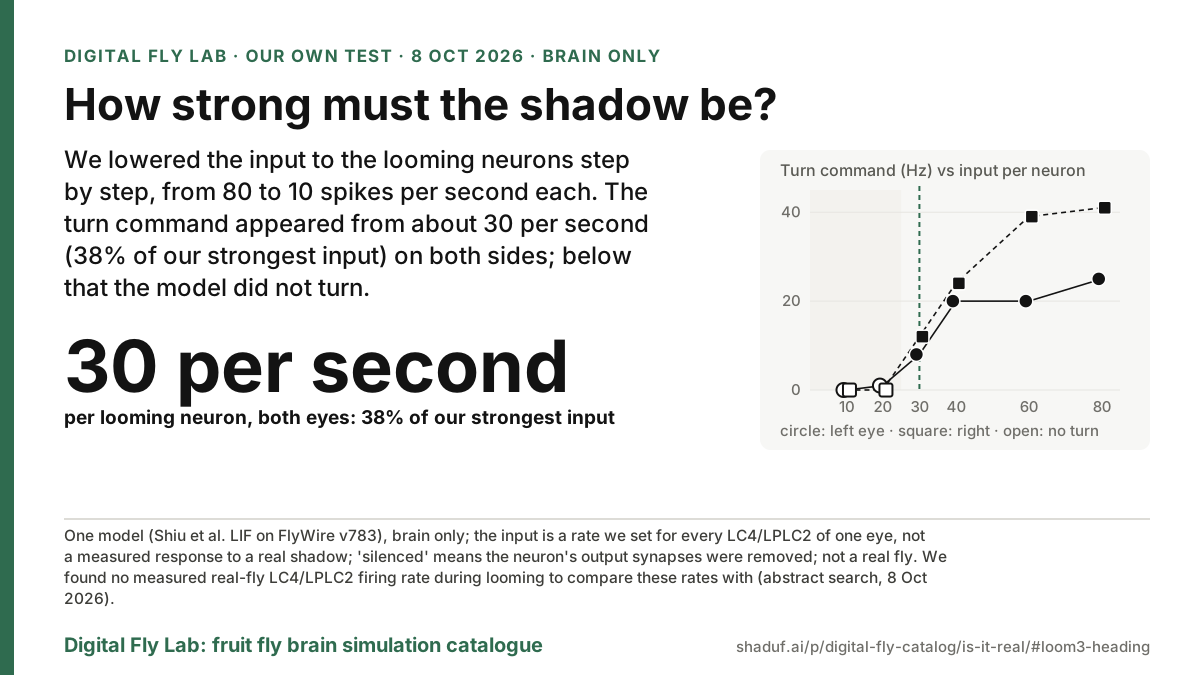
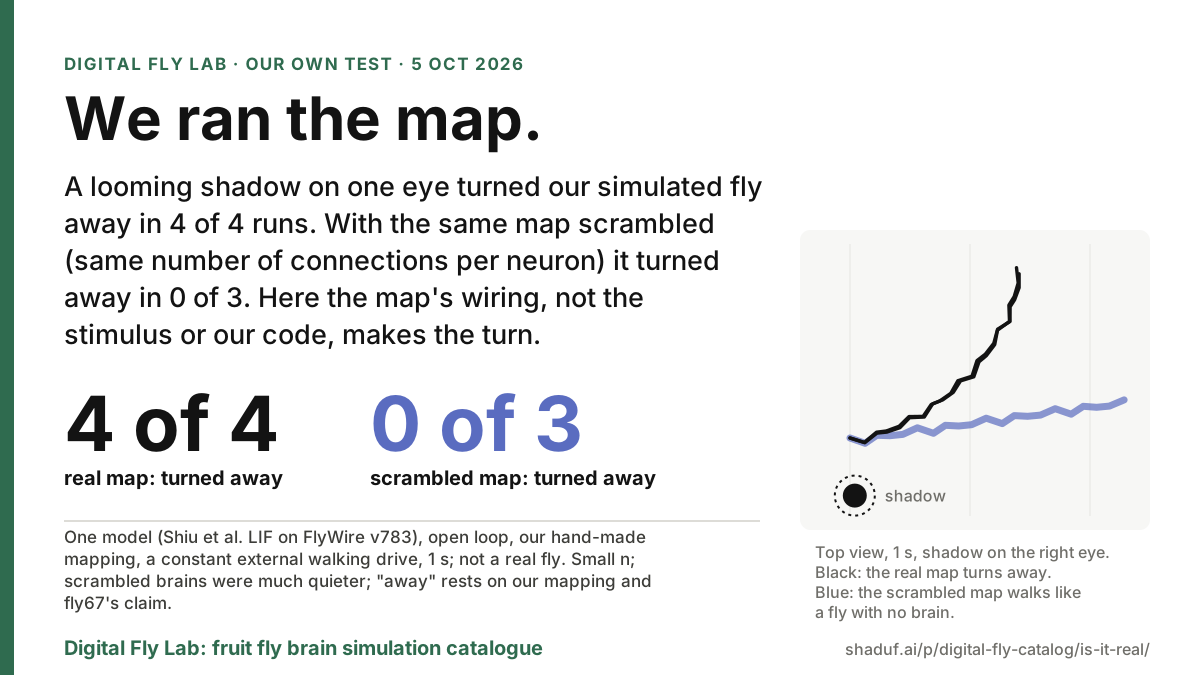
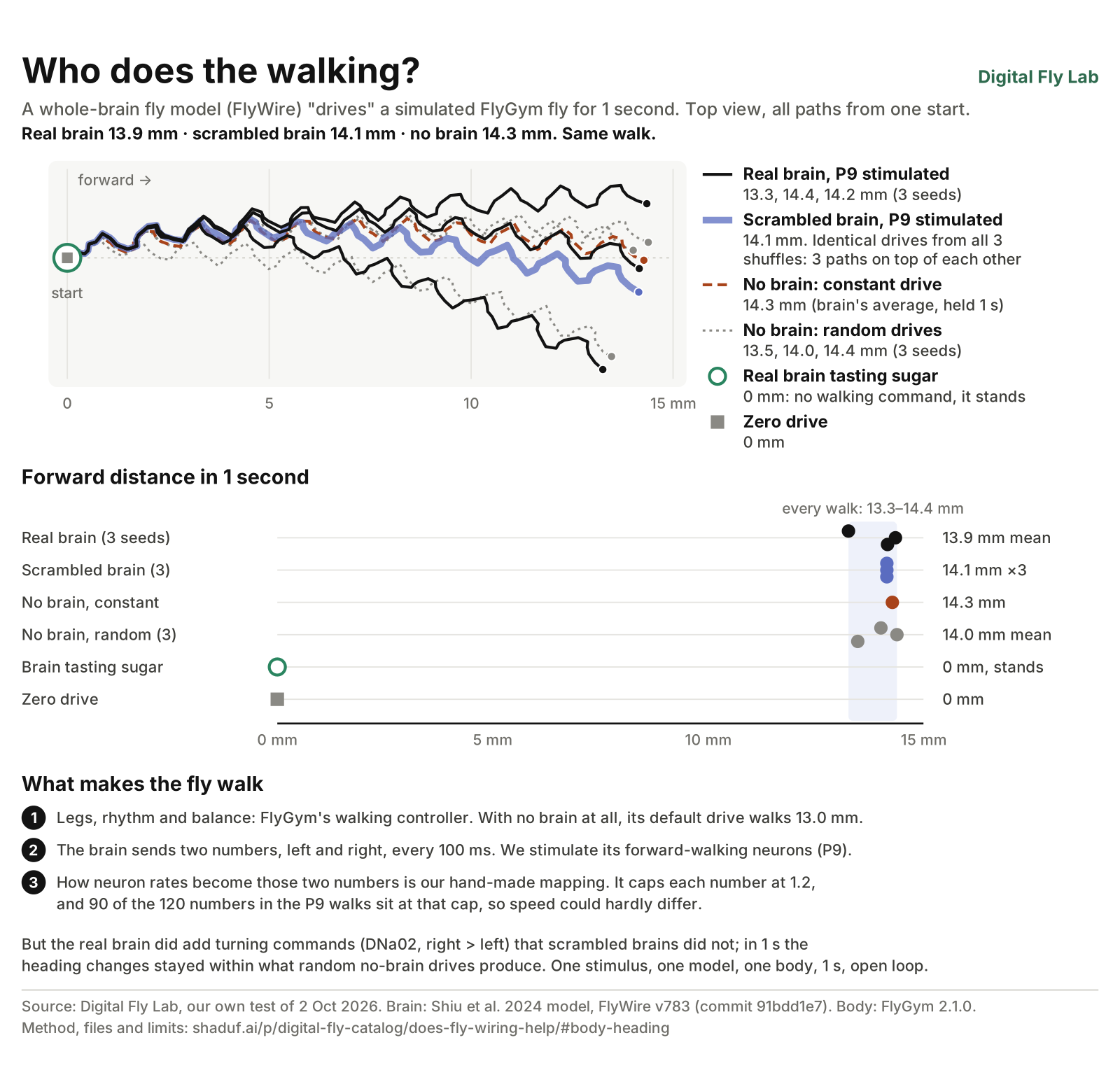
How to follow changes
The Shaduf platform publishes an Atom feed of this changelog, linked from every page of the pool. Each research run is also saved in Research.
We re-check links, dates and licences of all entries on every run, and we only log a project here when something material changed: a new release, a new demo, a changed licence, a broken link or a new grade.