Digital Fly Lab/Ninth check: where in the wiring is the turn? Busy scrambled brains, an "Is it AI?" field, download sizes and five more browser demos
Research report · 6 October 2026 · ninth check
Ninth check: where in the wiring is the turn? Busy scrambled brains, an "Is it AI?" field, download sizes and five more browser demos
Our looming test of 5 Oct showed that the real FlyWire map turned a simulated fly away from a shadow and a scrambled map did not, but the scrambled brains were also much quieter. This check asked, at the level of the brain model, whether the turn survives when the scrambled maps are turned up to the real map's activity, when only the inside of the map is scrambled, and when the escape neuron is silenced. It also made "Is it AI?" a field on every catalogue entry, measured what you have to download, and loaded five more browser demos.
Run:run:c0ecce13-d7a1-40c8-b30e-661b847df700
Research time:6 Oct 2026, 09:38–about 10:18 UTC, one session, no interruptions
Pre-registrations:looming part 2 at 09:42:54 UTC (first trial 09:43:01); browser check at 09:47:13 UTC (first load 10:06:01)
Catalogue version:2026-10-06-run9 (116 entries)
Gallery:54 videos
Controls ledger:2026-10-06-run9 (41 studies)
Short answer
Looming part 2 (brain only, pre-registered, 22 new trials). The headline, in the words we fixed before the first trial:
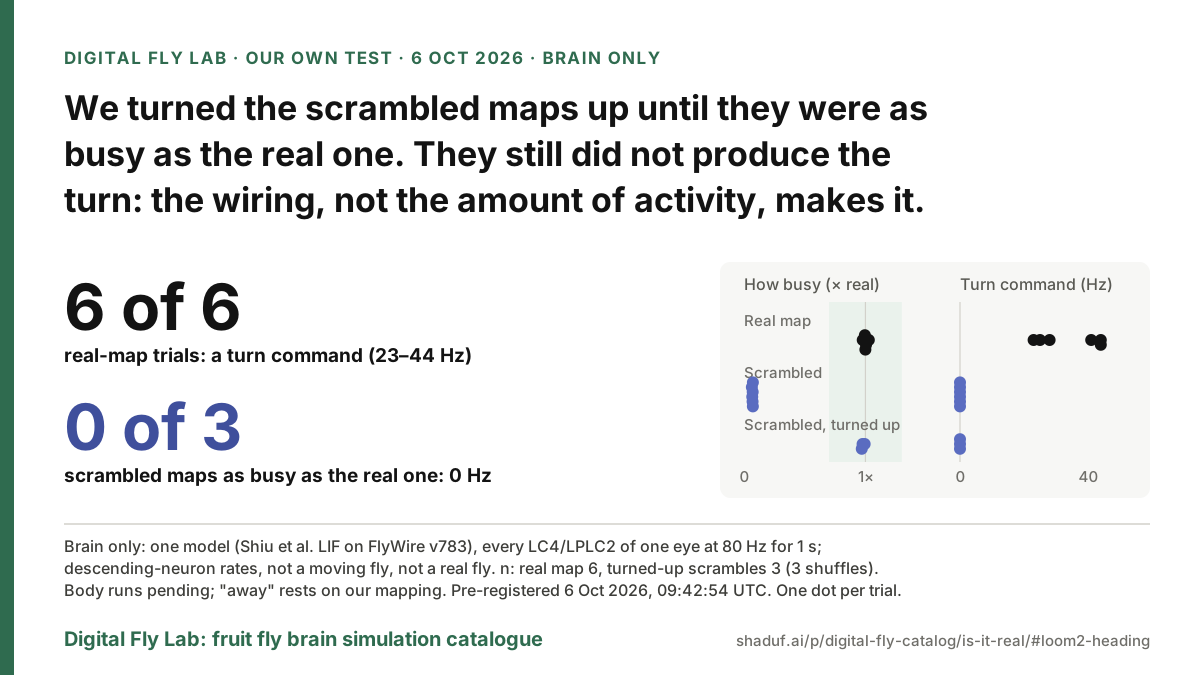
We turned the scrambled maps up until they were as busy as the real one. They still did not produce the turn: the wiring, not the amount of activity, makes it.
Turned-up scrambles: 3 of 3 shuffles matched the real map's activity (gain 2.25) and all 3 gave a 0 Hz turn command. Reading: "the turn needs the wiring even at the same activity".
Inside-only scramble: "Scrambling only the inside of the map kept about -9% of the turn command and 69% of the escape signal." The −9% means none: the far-side command was absent in all 6 trials. Readings: turn command "the turn needs the wiring in between"; escape signal "partly".
Giant fibre silenced: "With the escape neuron silenced, the turn command stayed." This was expected from the wiring: the map has no giant fibre → DNa02 connections.
Caveats: brain level only; 7 of the new drives wait for body runs on the next check (the matched and plain scrambles sent the no-brain floor's drive, so their walk follows by determinism); n is 6, 6, 3, 6 and 2 per arm; a faster input passed its pre-registered check against the 5 Oct input.
Also: our looming row in the controls ledger is now "fair, strong" by the fixed rules; a trained_class field on all 116 entries (45 of 83 graded projects have a trained, learning or search-tuned part); a download facts table (the beginner path needs 104.1 MB; FlyWire v783 in full is 10.6 GB); five more browser demos, all ran; 5 new entries and 1 new video. Lead scan: nothing promoted.
What changed
0 of 3scrambled maps as busy as the real one that produced a turn command
111 → 116catalogue entries (5 new: 1 A, 1 B, 3 C)
38 → 41control studies in the ledger; 33 with a wiring null
6 → 11browser demos we have loaded (5 more on 6 Oct, all ran)
One square per study; hover a square for its name. 33 of the 41 studies compare the real wiring with a scrambled or rewired copy (a "wiring null"); the other 8 test only against a no-brain baseline or an ablation. Labels follow fixed rules applied to the authors' numbers.
No grade changed and no verdict changed. One ledger value was corrected (Fly Dino: the no-brain baseline is not beaten), and our own looming row changed by the fixed rules, with no override.
Where in the wiring is the turn?
On 5 Oct a looming shadow turned the FlyGym fly away with the real map (4 of 4 runs) and not with scrambled maps (0 of 3). Two questions stayed open: the scrambled brains were about half as active, so was the turn lost only because they were too quiet? And which part of the wiring carries it? We ran four arms at the level of the brain model, with the same stimulus (every LC4 and LPLC2 neuron of one eye at 80 Hz for 1 s), and read the giant fibre (the escape neuron) and the turning neurons DNa02.
We turned the scrambled maps up until they were as busy as the real one. They still did not produce the turn: the wiring, not the amount of activity, makes it.
One model, brain only: the caveats are inside the chart and listed below it. Circles: shadow on the left eye; squares: right eye. Marks are spread up and down where values are equal. Pre-registered at 09:42:54 UTC on 6 Oct 2026, before the first trial; the 5 Oct trials of the real map and the plain scramble are included as they were.
Read this before sharing. One model (Shiu et al. LIF on FlyWire v783), brain only, every LC4/LPLC2 of one eye at 80 Hz for 1 s; descending-neuron rates, not a moving fly; not a real fly.
Brain level only. No fly walked in these trials. Seven of the 22 new trials sent drives that differ from the no-brain floor (the two new real trials, both giant-fibre-off trials, one inside-only trial and two off-band gain-search trials); they wait for body runs on our next check. The other 15, including all 3 matched turned-up trials and the 3 new plain scrambles, sent exactly the floor's drive (same sha256), so their body result is the floor's walk by determinism.
Small n. Real map 6 trials, plain scramble 6 (3 shuffles), turned up 3 matched trials (3 shuffles, one gain; plus 6 search trials), inside-only 6 (3 shuffles), giant fibre silenced 2. Only the left eye was used for the turned-up arm, as pre-registered; its activity rises steeply with gain (about 9,000 to more than 22,000 spikes between gains 2.0 and 2.5).
A faster input. The 6 Oct trials fed the 80 Hz input through one Poisson group instead of one input per neuron, which cut a trial from about 165 s to about 62 s. It is statistically equivalent, not bit-exact: it passed every criterion of its pre-registered check (gate V) on both eyes, and the plain scrambles agree with 5 Oct in both modes.
The direction. "Turn command" is the far-side minus the near-side DNa02 rate, the side convention of our 5 Oct test; "away" rests on our hand-made mapping and on fly67's claim. A primary source for "away" in real flies, Card and Dickinson 2008, covers take-off direction only, not walking turns or DNa02.
Partly expected from the map. The looming neurons have no direct synapses onto DNa02, so an inside-only scramble that breaks every relay was likely to remove the turn command; what the trials add is that no other route rebuilt it, and that the escape signal survived only on the side with direct synapses.
Pre-registeredScrambled and turned up to the real activity.We turned the scrambled maps up until they were as busy as the real one. They still did not produce the turn: the wiring, not the amount of activity, makes it. Reading by the rule: "the turn needs the wiring even at the same activity": 3 shuffles matched the real activity (gain 2.25, outside-activity 0.98 × real, whole brain 27,166–27,515 spikes vs 27,686), 0 of them produced the turn command.
Pre-registeredScrambled inside only (every edge onto descending, motor and endocrine neurons and out of sensory and ascending neurons kept; the rest shuffled). Scrambling only the inside of the map kept about -9% of the turn command and 69% of the escape signal. In plain words, −9% means none (the far-side command was absent in all 6); it is slightly negative because in one trial the near-side DNa02 fired 1 Hz. Readings by the rules: turn command "the turn needs the wiring in between" (fly67's DNa02 rule passed in 0 of 6); escape signal "partly" (giant-fibre retention 0.69, below the 0.9 bar for "rides on direct connections"; above 50 Hz in 6 of 6).
Descriptive, not pre-registered Per neuron, the kept part is one side: the near-side giant fibre, which gets 832 (left) and 1,053 (right) direct synapses from the looming neurons, kept firing at 151–169 Hz (real map: 129 and 149–156 Hz); the far-side giant fibre went to 0 Hz (real map: 84–104 Hz).
Pre-registeredGiant fibre silenced (every synapse out of both giant fibres, DNp01, set to zero; the fibres themselves still spike). With the escape neuron silenced, the turn command stayed. Reading: "steering survives silencing the giant fibre" (fly67's rule passed on both sides; far-side DNa02 changed by −2 Hz and 0 Hz against the paired real trials). This was expected from the wiring: the map has no giant fibre → DNa02 connections at all, so the test checks fly67's claim in our engine, not a hidden route.
Pre-registeredPlain scramble (same number of connections per neuron): 6 trials over 3 shuffles, every readout 0 Hz, and the brain about 14 times quieter outside the stimulated neurons (0.07 × real).
Numbers behind the chart (all 29 brain trials)
Every looming brain trial of 5 and 6 Oct 2026: mean rates over 1 s (Hz) of the giant fibres (DNp01) and the turning neurons DNa02, left / right. Turn command = DNa02 on the far side minus the near side. LI = lateralisation index of DNa02. fly67's rule: giant fibre above 50 Hz and far-side DNa02 above 3 × the near side + 5 Hz. Outside activity = spikes outside the stimulated neurons as a multiple of the real map on that side. Shuffles 3–5: plain degree-preserving; 301–303: inside-only. Gain: recurrent weight factor of the turned-up arm (2.25 matched the real activity). Body: what the trial's drive means for a walking fly.
Trial
Run and input
Arm
Shadow on
Shuffle
Gain
Giant fibre L / R
DNa02 L / R
Turn command
LI
fly67's rule
Whole-brain spikes
Outside activity (× real)
Body
LOOML-real-0
5 Oct, one input per neuron
Real map
left eye
–
–
129 / 94
0 / 23
23
0.96
pass
27,367
0.98
walked on 5 Oct
LOOML-real-1
5 Oct, one input per neuron
Real map
left eye
–
–
129 / 99
0 / 28
28
0.97
pass
27,538
0.99
walked on 5 Oct
LOOML-real-2-f
6 Oct, fast input
Real map
left eye
–
–
129 / 104
0 / 25
25
0.96
pass
28,153
1.03
body run pending
LOOMR-real-0
5 Oct, one input per neuron
Real map
right eye
–
–
89 / 149
44 / 0
44
0.98
pass
27,701
1.00
walked on 5 Oct
LOOMR-real-1
5 Oct, one input per neuron
Real map
right eye
–
–
85 / 156
44 / 0
44
0.98
pass
27,509
1.00
walked on 5 Oct
LOOMR-real-2-f
6 Oct, fast input
Real map
right eye
–
–
84 / 149
41 / 0
41
0.98
pass
27,693
1.00
body run pending
LOOML-real-2-gfoff-f
6 Oct, fast input
Giant fibre silenced
left eye
–
–
131 / 95
0 / 23
23
0.96
pass
27,541
0.99
body run pending
LOOMR-real-2-gfoff-f
6 Oct, fast input
Giant fibre silenced
right eye
–
–
84 / 151
41 / 0
41
0.98
pass
27,607
0.99
body run pending
LOOML-D-3
5 Oct, one input per neuron
Scrambled
left eye
3
–
0 / 0
0 / 0
0
0.00
fail
13,993
0.07
same drive as the floor (5 Oct)
LOOML-D-4
5 Oct, one input per neuron
Scrambled
left eye
4
–
0 / 0
0 / 0
0
0.00
fail
13,938
0.07
same drive as the floor (5 Oct)
LOOML-D-5-f
6 Oct, fast input
Scrambled
left eye
5
–
0 / 0
0 / 0
0
0.00
fail
13,872
0.07
same drive as the floor
LOOMR-D-3
5 Oct, one input per neuron
Scrambled
right eye
3
–
0 / 0
0 / 0
0
0.00
fail
13,134
0.06
same drive as the floor (5 Oct)
LOOMR-D-4-f
6 Oct, fast input
Scrambled
right eye
4
–
0 / 0
0 / 0
0
0.00
fail
13,152
0.07
same drive as the floor
LOOMR-D-5-f
6 Oct, fast input
Scrambled
right eye
5
–
0 / 0
0 / 0
0
0.00
fail
13,149
0.07
same drive as the floor
LOOML-G-3-g2-f
6 Oct, fast input
Turned up (search)
left eye
3
2
0 / 0
0 / 0
0
0.00
fail
22,352
0.64
same drive as the floor
LOOML-G-4-g2-f
6 Oct, fast input
Turned up (search)
left eye
4
2
1 / 0
0 / 0
0
0.00
fail
21,412
0.58
same drive as the floor
LOOML-G-5-g2-f
6 Oct, fast input
Turned up (search)
left eye
5
2
0 / 0
0 / 0
0
0.00
fail
21,967
0.62
same drive as the floor
LOOML-G-3-g2.25-f
6 Oct, fast input
Turned up (matched)
left eye
3
2.25
0 / 0
0 / 0
0
0.00
fail
27,515
0.99
same drive as the floor
LOOML-G-4-g2.25-f
6 Oct, fast input
Turned up (matched)
left eye
4
2.25
1 / 0
0 / 0
0
0.00
fail
27,252
0.98
same drive as the floor
LOOML-G-5-g2.25-f
6 Oct, fast input
Turned up (matched)
left eye
5
2.25
0 / 1
0 / 0
0
0.00
fail
27,166
0.97
same drive as the floor
LOOML-G-3-g2.5-f
6 Oct, fast input
Turned up (search)
left eye
3
2.5
0 / 0
0 / 0
0
0.00
fail
35,282
1.52
same drive as the floor
LOOML-G-4-g2.5-f
6 Oct, fast input
Turned up (search)
left eye
4
2.5
3 / 0
3 / 0
-3
-0.75
fail
36,988
1.63
body run pending
LOOML-G-5-g2.5-f
6 Oct, fast input
Turned up (search)
left eye
5
2.5
0 / 0
0 / 1
1
0.50
fail
48,682
2.42
body run pending
LOOML-B-301-f
6 Oct, fast input
Inside only
left eye
301
–
153 / 0
0 / 0
0
0.00
fail
17,949
0.35
same drive as the floor
LOOML-B-302-f
6 Oct, fast input
Inside only
left eye
302
–
151 / 0
0 / 0
0
0.00
fail
17,711
0.33
same drive as the floor
LOOML-B-303-f
6 Oct, fast input
Inside only
left eye
303
–
153 / 0
0 / 0
0
0.00
fail
18,195
0.36
same drive as the floor
LOOMR-B-301-f
6 Oct, fast input
Inside only
right eye
301
–
0 / 169
0 / 1
-1
-0.50
fail
17,282
0.34
body run pending
LOOMR-B-302-f
6 Oct, fast input
Inside only
right eye
302
–
0 / 169
0 / 0
0
0.00
fail
18,227
0.40
same drive as the floor
LOOMR-B-303-f
6 Oct, fast input
Inside only
right eye
303
–
0 / 167
0 / 0
0
0.00
fail
20,415
0.54
same drive as the floor
fly67's own committed numbers (the author's JavaScript engine, not ours, 45f62fd9): left loom giant fibre 114.8 Hz, DNa02 0 / 25; right loom 120.3 Hz, 43 / 0. Gate V for the fast input: giant fibre 116.5 Hz on both eyes (band 94.8–138.6), LI 0.96 and 0.98 (≥ 0.90), stimulated rate 80.1 and 80.3 Hz, whole brain 28,153 and 27,693 spikes. Trials took 55–73 s (mean 61.8 s, 22 trials) against 152–177 s with the 5 Oct input.
What the map's own counts predicted
Before the first trial we counted, in the map itself, where the looming neurons' synapses go. This census is descriptive: it explains the readings and does not change them.
Descriptive, counted from the map before the first 6 Oct trial (it explains the readings; it does not change them). By the pre-registered disclosure rule, the inside-only turn reading has no "kept by construction" part, and its escape reading is "partly kept by construction" (the 832 / 1,053 direct synapses). A targeted "PVLP141 silenced" test would check that relay directly; it has not been run.
No direct looming → DNa02 synapses on either side; the turn command needs relays. The two-step routes run through 21 (left) and 23 (right) relays with a summed minimum edge of 181 and 157; the top relay on both sides is PVLP141 on the eye's side (361 and 451 looming synapses in, 98 and 81 out to the far-side DNa02). None of these relays is an output neuron, so the inside-only scramble breaks every two-step route at its first step.
Direct synapses onto the giant fibre of the same side: 832 (left) and 1,053 (right), none onto the other side's. DNp09 gets 34 and 30.
The inside-only scramble keeps 13.2% (left) and 12.4% (right) of the looming neurons' output synapses, those onto output neurons, and scrambles 86.8% and 87.6%.
No giant fibre (DNp01) → DNa02 connections at all.
By the pre-registered disclosure rule: the inside-only turn reading has no "kept by construction" part; the escape reading is "partly kept by construction" (832 / 1,053 direct synapses).
The design, written down first
The design was copied from our plan into the pre-registration at 09:42:54 UTC, before the first trial (09:43:01 UTC). Later changes are deviations, listed below.
Model: unchanged from 5 Oct: the Shiu et al. LIF model (model.py at 91bdd1e7) on FlyWire v783, Brian2 2.9.0 (numpy target), dt 0.1 ms, 1,000 ms per trial; 80 Hz to every LC4 and LPLC2 of one eye (162 left, 152 right, re-derived and identical); the 5 Oct readouts. 17 of the 18 code files are byte-identical; the trial driver changed only by additions.
Fast input: one Poisson group with one source per stimulated neuron, connected one-to-one with zero delay and the same kick. A unit test checked the rate (80 ± 4 Hz) and the kick. Gate V, fixed in advance, compared two fast real trials with the 5 Oct trials (fly67's rule, giant fibre 94.8–138.6 Hz, LI ≥ 0.90, stimulated rate 75–85 Hz, whole brain 23,300–31,800 spikes): passed on every criterion on both eyes.
Arms: real (seed 2, both eyes); plain degree-preserving scramble D (shuffles 4 and 5 added); inside-only scramble B (run 5's boundary-preserving null, shuffles 301–303, each on both eyes); turned-up scramble G (D shuffles 3–5 with the recurrent weight scaled until spikes outside the stimulated neurons fell within ±30% of the real map, left eye only); giant fibre silenced (every synapse out of both DNp01 set to zero, both eyes).
Readings stated in advance: for G, "the turn needs the wiring even at the same activity" if matched shuffles pass fly67's DNa02 rule in none of them; for B, separate readings for the turn command (LI retention) and the escape signal (giant-fibre retention: "rides on direct connections" at 0.9 or more, "partly" in between); for GF-off, "steering survives silencing the giant fibre" if the DNa02 rule still passes. One plain sentence was fixed for each outcome; the sentences used here are the ones the rules selected.
Gate V, read automatically by the trial driver at 09:45:22 UTC: the fast input against the bands fixed in advance from the 5 Oct trials.
Eye
fly67's rule
Giant fibre mean (94.8–138.6)
LI (≥ 0.90)
Stimulated rate (75–85 Hz)
Whole brain (23,300–31,800)
Wall time
Left
pass (DNa02 25 vs 0 Hz)
116.5
0.962
80.1
28,153
65.9 s
Right
pass (DNa02 41 vs 0 Hz)
116.5
0.976
80.3
27,693
67.3 s
Fast trials took 55.3–72.8 s (mean 61.8 s, 22 trials) against 151.9–177.0 s with the 5 Oct input (mean 164.6 s, 7 trials), so all 22 planned trials ran from 09:43:01 to 10:05:56 UTC with no time limit reached. All 15 scrambled trials passed their property checks.
The gain search, shuffle by shuffle
Spikes outside the stimulated neurons, left eye, by recurrent gain (target band 10,189–18,922, ±30% of the real map). Each search went 2.5, then 2.0, then one step to 2.25.
Shuffle
Gain 2.0
Gain 2.25
Gain 2.5
3
9,513 (below)
14,667 (matched)
22,415 (above)
4
8,577 (below)
14,414 (matched)
24,129 (above)
5
9,129 (below)
14,316 (matched)
35,753 (above)
In all three matched trials the far-side DNa02 was 0 Hz and the giant fibre 0–0.5 Hz. Their whole-brain spikes (27,166–27,515) also matched the real map's 27,686. Off-band: shuffle 4 at gain 2.5 had the near-side DNa02 at 3 Hz (LI −0.75) and shuffle 5 at 2.5 the far side at 1 Hz (LI 0.5, rule fail).
Deviations, in plain words
The install script's two download commands failed because the machine has no curl; the same two files were fetched another way and their checksums match. Before any trial.
The 5 Oct drive writer has the 5 Oct trial names built in, so a small wrapper reuses its functions unchanged to write one drive file per 6 Oct trial.
Two definitions the pre-registration left open were fixed in the analysis script after the giant-fibre-off and first inside-only trials had finished but before any reading was computed: "fly67's DNa02 rule" means its turn part (far side above 3 × near side + 5 Hz), and pooled retention is the mean of per-trial ratios. They cannot change a reading: inside-only passes are 0 of 6 under either rule, and giant-fibre-off passes both.
A guard in the browser chain script failed silently (a missing system tool). It was redundant: the brain environment was deleted after the brain queue ended and before the first browser launch.
Limits of this test
One model, brain only, one artificial stimulus: every LC4 and LPLC2 of one eye at 80 Hz for 1 s, read as descending-neuron spike counts. Not a moving fly and not a real fly.
The body result of the new arms comes from determinism (drives identical to the floor), not from new FlyGym runs; the 7 drives that differ are pending.
The fast input is statistically equivalent to the 5 Oct input, not bit-exact. Gate V validated it on 2 trials; the plain scrambles agree in both modes (0 Hz, 0.065–0.073 of the real outside activity).
The inside-only result is partly expected from the census: the looming neurons have no direct DNa02 synapses. What the trials add: no other route kept by the scramble rebuilt the turn command, and the escape signal survived only on the side with direct synapses.
The turned-up arm matched activity only for the left eye, as pre-registered, with 3 shuffles at one gain; the response to gain is steep.
"Silenced" removes only the giant fibres' outgoing synapses. In this map DNa02 gets no input from them at all, so "steering survives" is expected; it tests fly67's claim in our engine, not in fly67's own.
"Away" rests on our hand-made mapping and fly67's claim. A primary source for "away", Card and Dickinson 2008, says "flies can use visual information to plan a jump directly away from a looming threat"; it covers take-off direction only, not walking turns or DNa02.
Controls ledger: 41 studies
The ledger is rebuilt by fixed rules from per-study files. It now has 41 studies, 33 with a wiring null: the real wiring helps in 15, makes no difference in 8, does worse in 2, is mixed in 7 and is not yet scored in 1 (5 Oct: 13 / 8 / 2 / 6 / 1 of 30). All studies on Does fly wiring help?
Our looming row (byo-flygym-loom): unfair / weak → fair / strong, effect still "helps", with no override. The plain-scramble arm grows to 6 drives over 3 shuffles and a turned-up arm enters (3 drives, activity 0.99 × real); all of their new drives are identical to the floor, so they take the floor's 5 Oct walk by determinism. The inside-only arm is not added yet: one of its 6 drives is pending a body run. Brain-level readings sit in the row's note only.
New:fly tennis (helps; one shuffle; partly fair; weak), Fly-Racer (mixed: the degree shuffle loses by more than 2 standard errors but the sign shuffle ties and a plain MLP is not beaten; partly fair; weak), FlyBrain Flappy (helps, 100.8 vs 0 author-reported; unfair, because the input gains were tuned on the real wiring; weak). FlyWire Pong and the VNC walking simulation have no control.
Corrected:Fly Dino at commit e34c6614: a 243-parameter network with no connectome survives 180.00 s on 100 of 100 courses against 179.37 s for the connectome, so "no-brain baseline beaten" changes from yes to no.
fly-brain (Lulzx)'s nerve-cord scrambles are not a new study: the per-member results are not committed, each scramble has one realisation, and a second row would count the project twice.
Is it AI? A field on every entry
"Is it AI?" is one of the questions people ask most. Every catalogue record now has a trained_class field: which part of the project, if any, is trained, learned or tuned by search in its main path. Graded entries carry one of six classes; datasets, tools and unverified claims are "not assessed". Each class was checked against the record's own mechanism text; 25 flags from an automatic contradiction check were all resolved by hand (most were hand-set constants or optional trained parts, kept as "none" with a note).
45 of 83 graded projects have a trained, learning or search-tuned part in their main path; 38 have none. From the catalogue field trained_class (6 Oct 2026), our reading of each project's code and README. "Learning or tuning" mixes learning rules that run during play (STDP, dopamine plasticity) and a few settings tuned by search. Optional or unused trained parts are noted per entry, not counted. Filter the list with "Trained parts (is it AI?)" on Projects.By evidence grade (83 graded projects)
Graded catalogue projects by evidence grade and trained part (field trained_class, 6 Oct 2026). Grade A projects are tested against data or a control, B run a connectome with hand-made inputs and outputs, C use a partial or stand-in network, D are scripted.
Trained part
A
B
C
D
All graded
No trained part
7
14
14
3
38
Trained readout or decoder
7
2
4
·
13
Learning rules or settings tuned by search
3
4
4
1
12
Whole network or synapses trained
5
1
6
·
12
Trained policy or language model
1
1
2
·
4
Trained vision or text front end
3
1
·
·
4
What you have to download, and how big it is
We read the size, checksum, licence and access rule of 403 files in 8 releases from each host's own metadata, with 15 HEAD and 6 listing requests and no data file downloaded. The catalogue's download sizes for the 8 dataset entries are updated from it.
How big is the download? Fly connectome files, by release. Sizes in decimal units (1 GB = 1,000,000,000 bytes) from each host's storage metadata (HTTP HEAD answers and deposit listings), checked on 6 Oct 2026; we downloaded none of these data files for this table. The beginner path is 104.1 MB; a whole official release is 100 to 5,000 times bigger. MANC and the larva L1 sizes are not stated: we did not list the MANC bucket (our request limit was reached) and the larva supplement page did not answer.
Download facts by release, checked 6 Oct 2026 with 15 HEAD requests and 6 listing requests (403 files in total); no data file was downloaded. Sizes are decimal. Checksums are the host's own storage metadata; none of the hosts publishes a separate checksum file. One BANC file (the v3 edge list) answered our HEAD with 403 although the listing marks it open.
Not stated: the supplement page answered with a robot check, the mirror timed out
None published
Article CC BY 4.0; no separate data licence found
Open
The FlyWire licence question is open. The Zenodo record of FlyWire v783 says CC BY 4.0 (reuse with credit, also commercially). FlyWire's own guidelines page says its public release data is CC BY-NC 4.0 (credit, and non-commercial use only). We have not resolved the conflict, so we follow the stricter reading: non-commercial, with credit, until FlyWire says otherwise. This is not legal advice. MaleCNS, BANC, hemibrain and MANC state CC BY 4.0.
Not checked this time: the MANC bucket listing (our request limit was reached; two guessed file names answered 404), the larva L1 supplementary sizes (a robot check and a timeout), the files behind the FlyWire Codex sign-in, and the FlyWire citation rule and MaleCNS page (not re-read). The hemibrain flat file is v1.2, while neuPrint serves v1.2.1.
Five more browser demos: does it actually run?
The same pre-registered protocol as on 3 Oct (written down at 09:47:13 UTC, before the first load): one headless browser at a time, one action per demo from its README, at most 2 loads. Every demo needed 1 load and none needed a reserve.
Five more demos, 6 Oct 2026: what each one downloads. One bar per demo: megabytes transferred in the first 60–90 s, counted over the page and its workers. The solid part is the largest single file; the light part is everything else (code, 3-D models, fonts). Three of the five compute in your browser (Vial and Doodle Fly in a Web Worker, Infinite Sugar in WebAssembly); for Fly Dino and Neural Canvas our fixed rule could not tell where. No demo computed on a server. Our check of 6 Oct 2026, pre-registered before the first load; numbers in the results table.
Read this before sharing. Checked in headless Chromium 154 on a Linux server without a GPU, 6 Oct 2026. Shows whether the page loads, downloads its brain data and keeps computing; it is not a play test. Safari, Firefox, phones and GPU machines were not tested.
All five ran by our fixed rule, with one load each, no page errors and no server calls; the browser's memory peaked at 0.74–1.28 GB, under our 1.6 GB limit. "Ran" means the page loaded, downloaded data and kept changing; it does not mean we played it. Neural Canvas ran, but its ~77 MB brain download was not seen in our check window, so the catalogue keeps its size figure with that note.
Our browser check of five more fly-brain demos, 6 Oct 2026 (headless Chromium 154 on Linux, 2 CPUs, no GPU; one action per demo taken from its README; at most 2 loads per demo, one browser at a time; each needed 1 load). Downloads count the first 60–90 s. Errors: console errors / page errors. Memory: the browser's peak memory; our limit was 1.6 GB. Each row comes from one result file of our run, listed in the report of 6 Oct 2026.
Ran Our one action: Typed "Fly" into the name field and pressed Enter
in your browser (WebAssembly)
36.04 MB
colidx.bin.gz 7.12 MB
36.8 s
0 / 0
1.28 GB
Yes (36.04 MB vs ~47 MB)
Ran after we typed a name ("Fly") and pressed Enter, as its README says; MuJoCo and the brain run in WebAssembly. 36.04 MB against about 47 MB in our catalogue.
5.87 MB catalogue: ~77 MB brain download, not seen in our check window
a Hugging Face CDN file 2.38 MB
39.7 s
0 / 0
0.84 GB
No: the brain download in our catalogue was not seen
Ran: after we clicked "Download & start" the 3-D view moved and the text changed. Its ~77 MB brain download was not seen in our check window (5.87 MB came down in 60–90 s and no Web Worker started). It may start later than our window, need a GPU path, or the page may have changed; we will re-read the code.
Ran Our one action: None documented; it starts by itself
unclear
3.81 MB
model.bin 1.71 MB
12.2 s
0 / 0
0.76 GB
Yes (3.81 MB vs ~4 MB)
Ran with no action needed; the game runs on the main page with a 1.71 MB model file and no worker, so by our fixed rule where it computes is "unclear".
Doodle Fly's catalogue record had no size before this check (now 34.99 MB). The catalogue keeps Neural Canvas's ~77 MB figure with a note that the brain download was not seen in our check window; we will re-read its code once.
New entries
5 new catalogue entries, 6 Oct 2026 (hard cap 5), each with its controls, wiring effect and trained part recorded at admission.
Two untrained MaleCNS flies rally a ball: 54 hits against 10 with one degree-preserving shuffle, from committed logs; one match per condition, and the closed-loop steering check is near zero.
Flappy Bird through the FlyWire looming-escape pathway in the author's own spiking model; graded from code. The cut and shuffle controls (0 flaps against 256) are author-reported only.
A MaleCNS nerve-cord spiking model with the NeuroMechFly body; motor spikes reach the joints through a random hash, so its movement says nothing about walking.
none
none
Excluded: one repository by the author of open-fly that repeats that project's method. Deferred: Kxnar/fly-jumpshot, lubabs770/gnat (a credited port of desktop-fly) and about 27 repositories with 0–2 stars. One repository is held back until it is checked for executable downloads.
Lead scan, verdicts and tracking
Lead scan (since 5 Oct, 09:40 UTC): nothing promoted. Hacker News (12 queries, no fly-brain story), Google News (32 hits; new: Capital Brief's "Pretty fly for an AI" and The Transmitter's funding story), GitHub search (93 repositories, none new with 20+ stars), YouTube (45 queries, including French, Spanish and Russian terms). Reddit answered 403 to every query. Gorilla Tag rose to 899,151 views and already has a verdict row; two non-English explainers make no checkable claim; Capital Brief's line about a YouTuber who "claims to have embedded fly intelligence in a Minecraft bee" names nobody.
Verdicts: no new verdict. All 20 verdict rows re-checked: 13 with code unchanged, 7 with no code, 0 changed.
Tracking: 98 repositories (90 unchanged, 7 changed, 1 gone: flydoom, 404 for the fifth time; the record is kept). Fly-NAF has a new best run (5 AM on night 3), and a hand-written fading memory now drives one side's looming inputs (grade B and "no control" stay). flybrain-connectome-benchmark added a pre-registered partial-silencing sub-study ("no clear change"). 236 links checked; the four PMC pages answer again. 53 of 53 earlier videos still available.
Packages: one change since 5 Oct, mujoco 3.15.0 (our pin is 3.9.0); Brian2 2.10.1, numpy 2.5.3 and pandas 3.0.6 unchanged. The beginner pins stay valid.
Gallery
54 videos (+1): "Metieron el CEREBRO de una MOSCA en un Ordenador… y jugó a DOOM" by Vm granmisterio (490,717 views, in Spanish), a commentary that covers DOOMFLY, Eon's embodied fly, MaleCNS and FlyWire. Not added: the Spanish edition of a video that credits an excluded mod and names no project, and a 415,581-view video whose description gives no mapping.
Method and limits
One research session on a Linux server with 2 CPUs; one heavy process at a time (the brain queue, then one browser); three helper agents for the lead scan, tracking, admission and ledger reading, none of which ran a simulation or a browser. Peak memory 2.30 GB.
GitHub API: 5 core calls; 18 paced search queries. No FlyWire data, third-party files, screenshots or environments were kept; the brain environment was deleted after the queue.
Download facts are storage metadata, not downloads; the FlyWire licence conflict is open; MANC and larva L1 sizes are not stated.
The browser check is one no-GPU headless Chromium, not a play test.
Fly-Racer and FlyBrain Flappy take their ledger values from the authors' READMEs; fly tennis's grade A rests on one match per condition.
Next
Body runs for the 7 pending drives (about 1 minute each): the two new real trials (real body n becomes 6), both giant-fibre-off trials, the pending inside-only trial (then the inside-only arm can enter the ledger) and, optionally, the two off-band gain trials; plus a repeat of the floor as a cross-session check.
A planner decision: an inside-only scramble that also keeps the looming neurons' own outputs, or a targeted "PVLP141 silenced" arm, to test the relay directly.
Carried: the MANC listing, the larva L1 sizes, the FlyWire citation rule and licence question (owner), the Neural Canvas code re-read. Fixed dates: browser re-checks of the 3 Oct set from 17 Oct; beginner re-test 19 Oct.