Does fly wiring help? · controls ledger, 6 Oct 2026
Does real fly wiring help? What 41 control studies found when the connectome was scrambled
A fly brain simulation can look impressive for many reasons: the game helps, a script helps, training helps. The fair test is to run the same thing with the fly's wiring scrambled. If the scrambled brain does just as well, the real wiring was not doing the work. We collected every study in our catalogue that runs such a control and put their numbers side by side, and we ran three tests of our own, all pre-registered: four kinds of scrambling on a reflex (1 Oct 2026), a brain driving a walking body (2 Oct 2026) and a looming shadow that turns it (5 Oct 2026, with a brain-only follow-up on 6 Oct).
Short answer
Sometimes: fly wiring beat scrambled wiring in 15 of 33 studies, mostly untrained reflex, sensory and steering circuits (including our looming test); in trained, reservoir, ML, game, robot-arm and our walking tests it tied or lost (10).
Of 41 control studies in our catalogue, 33 compare the real wiring with a scrambled or rewired copy (a "wiring null"). The real wiring helps in 15, makes no difference in 8, does worse in 2, gives mixed results in 7, and is not yet scored in 1. The clear wins are untrained reflex, sensory and steering circuits. Networks trained for machine-learning or game tasks usually do as well with scrambled wiring. No scoring rule changed this week; the counts moved because of three new studies: fly tennis and FlyBrain Flappy (helps, one shuffle each, weak method) and Fly-Racer (mixed). What changed on 6 Oct
The answer depends on how you scramble. In our own pre-registered test of the sugar reflex, degree-preserving and weight shuffles silence it (0 Hz against 85 Hz), keeping the sensory and motor boundary keeps about 46% of it, and a sign shuffle makes the whole brain fire. See the test
Our own tests (1, 2, 5 and 6 Oct 2026): a reflex scrambled four ways (the answer depends on the scramble), a walking body (the legs do the walking, not the wiring) and a looming shadow on one eye: with the real wiring our simulated fly turned away in 4 of 4 runs, with scrambled wiring in 0 of 3. On 5 Oct that row scored Helps with an unfair null, because the scrambled brains were much quieter. On 6 Oct we turned the scrambled brains up to the real activity, at brain level: "We turned the scrambled maps up until they were as busy as the real one. They still did not produce the turn: the wiring, not the amount of activity, makes it." By the same fixed rules the row now reads fair, with a strong method; the runs are still few and one model. See the looming test
Our walking test, 2 Oct: who does the walking? We let the same whole-brain model drive a simulated FlyGym fly. With its forward-walking neurons stimulated, the fly walked 13.9 mm in 1 s with the real brain, 14.1 mm with a scrambled brain and 14.3 mm with a brainless constant drive. The legs, rhythm and balance come from FlyGym's controller, and our hand-made mapping caps the drive, so the result says more about the stimulus and the body than about the wiring. See the test and its limits
And beating a scrambled brain is not the same as beating a simple controller. Where the wiring helps, a brain-free baseline often matches the fly anyway: in Doom the fly survives 53.3 s, shuffled wiring 6.8 s, and a brainless autopilot 51.9 s (the doom-fly-control by gabrycina). Across the 22 studies that test a no-brain baseline, the fly network beats it in only 4: our looming test (against random steering), two untrained game demos with one match or shuffle each, and a hash function that loses to its own wiring nulls.
New 6 Oct 2026 · three studies by other people (their numbers), one correction and our own row re-scored by the fixed rules
Changed on 6 Oct: two game wins on one shuffle, a mixed racer, a correction
- Helps Our looming test (made by us): now fair, strong, after the turned-up scrambles of 6 Oct; the effect is unchanged. Details below.
- Helps Fly tennis (grade A): two untrained MaleCNS flies rally 54 hits in one 40 s match against 10 with one shuffled wiring and 14 for a parked fly, from committed logs. One match per condition, and the logged closed-loop steering check is near zero: partly fair, weak.
- Helps FlyBrain Flappy (grade B): Flappy Bird through the looming-escape pathway scores 100.8 against 0 with shuffled or cut wiring, author-reported in the README. Unfair: the two input gains were tuned on the real wiring only. Weak.
- Mixed Fly-Racer (grade C): a PPO-trained MaleCNS steering core scores 903.2 against 883.7 for a degree shuffle (beyond 2 standard errors) but 896.9 for a sign shuffle (a tie), and a plain MLP reaches 894.0. README numbers, one seed each: partly fair, weak.
- Corrected: Fly Dino at commit e34c6614: a 243-parameter network with no connectome survives 180.00 s on 100 of 100 courses against 179.37 s for the connectome, so "no-brain baseline beaten" changes from yes to no. Still no wiring null.
Changed on 5 Oct: four new rows
- Helps Our looming test (made by us): a looming shadow on one eye turned the FlyGym fly away in 4 of 4 real-brain runs and 0 of 3 scrambled runs. Unfair null and weak method by the fixed rules on 5 Oct; fair and strong since 6 Oct.
- Helps Flight-test the fly (grade A): a 20,556-neuron FlyWire motion-to-steering circuit damps an aircraft's yaw better than 10 degree-preserving shuffles (3.19 vs 3.92 deg/s), but a classical yaw damper does far better (1.69): the no-brain baseline is not beaten. Fair null, strong method.
- No difference FlyAim (grade A): the whole MaleCNS aims a crosshair no better than its shuffle (412.5 vs 430.9 px from the target), and a random walker does better (251.7 px). Pre-registered by its author.
- No difference FlyArm (grade B): a frozen MaleCNS between a trained encoder and decoder lifts objects with a robot arm in 72.2% of episodes against 55.9% for 9 shuffles, not significant over 6 seeds (p = 0.125). The author wrote "mixed" across several tasks; on the ledger's one metric the fixed rules say no difference.
Changed on 3 Oct: a flip and a clean negative
fly-cartpole: no difference → helps, but the baseline is not beaten
The author redesigned fly-cartpole around a MaleCNS flight-stabilisation circuit (5,459 linear units; only the sensor gains are tuned). With degree-preserving shuffled wiring the cart-pole score drops from 499.9 to 165.9 steps (20 seeds, one shuffle each, the author's p = 0.0001), so by our fixed rules the real wiring now "helps".
But a much simpler controller does as well. The circuit replaced by its own linear map, tuned the same way, scores 499.6, and LQR, a textbook controller designed from the cart-pole equations, scores 500. The fly circuit does not beat its no-brain baseline, and its real score sits at the 500-step ceiling. Grade A unchanged; the earlier mushroom-body result (392.5 vs 390.3, p = 0.48) is still in the repository. We did not recompute these numbers.
ChessFly: a clean negative result
ChessFly (new, grade A) feeds a chess board into the real FlyWire mushroom-body input layer (285 projection neurons, 5,177 Kenyon cells) and lets it learn by self-play. After 10,000 games each, the real wiring rates 1680 Elo, shuffled wiring 1675, and the author's original random design 1850.
The real wiring is no better than shuffled wiring and a little worse than a random design. The design is fair in spirit (same learning rule and schedule for every wiring), but there is one fly and one shuffle per arm and the exams have 40 games, so differences of tens of Elo are within noise: method quality weak.
New 1 Oct 2026 · made by us · pre-registered
We scrambled the fly brain four ways
Almost every number on this page is someone else's. This one is ours. We took the sugar reflex from our Build your own guide: 21 sugar-taste neurons firing at 150 Hz drive MN9, the motor neuron that moves the proboscis for feeding, in the Shiu et al. whole-brain model on FlyWire v783. We ran it on the real wiring and on four scrambled versions, five shuffles each. The design, the arms and the rules for reading them were written down at 10:51 UTC on 1 Oct 2026, before the first scrambled trial started (10:58 UTC).
- 85.2 Hzreal wiring, ± 3.56 over 5 trials; our re-runs gave the same spikes, bit for bit
- 0 Hzdegree-preserving and weight shuffles, 5 shuffles each: silent
- 39 Hzinterior-only (boundary-preserving) shuffle: keeps 46% of the response
- 214 Hzsign shuffle: above real, but only because the whole brain ignites
Numbers behind the chart
| Arm | What it keeps | MN9 (Hz), mean ± sd | Per shuffle (Hz) | Response kept | Activity vs real | Neurons active | Reading |
|---|---|---|---|---|---|---|---|
| Real wiring | The measured FlyWire v783 connectome | 85.2 ± 3.56 (5 trials) | 82, 89, 81, 86, 88 | 1 | 1× (13,372–14,284 spikes) | 366–385 | reference |
| Degree-preserving | Keeps partner counts | 0 ± 0 | 0, 0, 0, 0, 0 | 0 | 0.291× | 103 | silent |
| Weight shuffle | Keeps who connects to whom | 0 ± 0 | 0, 0, 0, 0, 0 | 0 | 0.388× | 109 | silent |
| Boundary-preserving | Keeps sensory and motor wiring | 39 ± 1.22 | 38, 39, 39, 41, 38 | 0.458 | 0.648× | 215 | partly |
| Sign shuffle | Swaps excite and inhibit | 214.2 ± 43.27 | 268, 188, 191, 253, 171 | 2.514 | 257.637× | 60,501 | runaway |
| Gain check on degree-preserving shuffles 3–5 (1 and 2 Oct) | As degree-preserving, with every synapse ×1.5 to ×3 | 0 at every gain | shuffle 3 ×1.5: 0, shuffle 3 ×2: 0, shuffle 3 ×2.5: 0, shuffle 3 ×3: 0, shuffle 4 ×2.5: 0, shuffle 5 ×2.5: 0 | 0 | 0.37×, 0.50×, 0.73×, 1.74×, 1.76×, 2.12× | 193, 349, 709, 4,257, 2,776, 4,104 | not matched on 3 shuffles: ×2.5 put shuffle 3 within ±30% of the real activity (10,138 spikes), shuffles 4 and 5 above it |
What each scrambled brain keeps, and what happened
-
Degree-preserving silent activity reduced 0.29×
Keeps every neuron's number of inputs and outputs, and its sign. Changes who its partners are.
MN9 0 ± 0 Hz in all 5 shuffles. The brain goes quiet: about 29% of the real spikes, about 100 active neurons and almost no motor or descending neurons, although the sugar neurons still fire at about 150 Hz.
-
Weight shuffle silent activity reduced 0.39×
Keeps who connects to whom. Changes which synapse strength sits on which connection.
MN9 0 ± 0 Hz in all 5 shuffles, with about 39% of the real spikes. By our pre-registered reading, both silent arms mean the reflex needs the specific wiring these nulls destroy.
-
Boundary-preserving partly activity comparable 0.65×
Keeps every output of the sensory and ascending neurons and every input to motor, descending and endocrine neurons. Changes only the wiring in between.
MN9 39 ± 1.22 Hz (retention 0.46) with about two thirds of the real spikes. Part of the reflex runs on boundary pathways that this null keeps; the central wiring matters for the rest.
-
Sign shuffle runaway activity runaway 258×
Keeps the whole graph and every synapse size; each neuron still has one sign (Dale's law). Changes which neurons excite and which inhibit.
MN9 214 ± 43 Hz, above the real rate, but only because the whole brain ignites: about 3.6 million spikes (258 times the real run), about 60,500 active neurons, and about 1,033 of the 1,299 descending neurons. The real assignment of excitation and inhibition is what keeps the response selective.
Why our own study row scores lower
By the fixed ledger rules, our study row is now Mixed, with an unfair null and weak method; on 30 Sep, with 2 shuffles, it was "helps", partly fair and moderate. Without a matched gain the rules cannot mark the scrambled brains as "tuned equally", so a null that loses counts as unfair (lower excitability could explain the loss), and "unfair" caps the method at weak. And on the ledger's single metric, the MN9 rate where higher is better, the sign-shuffle runaway counts as "the null does better", so the wiring effect comes out mixed.
We did not override the rules for our own study, and no scoring rule changed on 2 Oct: the gain check above ran as measured and did not match, so the row stays mixed, unfair and weak. What we added instead is display-only: each arm now shows how active the whole brain was against the real one, so readers can see that the sign shuffle is a runaway. These labels never enter any score: degree-preserving reduced 0.29×, weight shuffle reduced 0.39×, boundary-preserving comparable 0.65×, sign shuffle runaway 258×. Our row in the ledger
What it shows
- For this reflex, the specific wiring matters: two standard scrambles silence it, and a more excitable scrambled brain does not bring it back.
- Keeping the sensory and motor boundary keeps about half of the response, so the reflex runs partly through boundary pathways and partly through the central wiring.
- Flipping excitation and inhibition does not make a better reflex. It makes a brain that fires everywhere.
Limits
- One reflex (sugar to MN9) in one model (Shiu et al. leaky integrate-and-fire, upstream parameters), 1 s trials.
- One trial per shuffle at one trial seed; 5 shuffles per arm.
- MN9 rate is the only metric, and it cannot tell selective drive from global ignition. That is why the chart shows the brain's activity next to it.
- The gain check found no gain that matches the real activity on 3 shuffles: ×2.5 matched shuffle 3 only (2 Oct 2026).
- The boundary split comes from FlyWire's cell-class annotation (138,625 of 138,639 neurons matched). The 581 neurons of the combined "sensory_ascending" class were counted as input side, a class the pre-registration had not named. Two of the five degree-preserving shuffles are those of our 28 Sep run, re-used as planned.
The model is philshiu/Drosophila_brain_model at commit 91bdd1e7, with its default settings. Want to try a smaller version? See Try a fair control yourself. Full method and deviations: research report of 1 Oct 2026; the gain check of 2 Oct: report of 2 Oct 2026.
New 2 Oct 2026 · made by us · pre-registered
Who does the walking? We gave the brain a body
Viral videos say a fly brain "learned to walk". So we connected the same whole-brain model to the walking fly of FlyGym 2.1.0 (NeuroMechFly v2), the most-used simulated fly body, and compared a real brain, scrambled brains and no brain at all. FlyGym's walking controller takes two numbers, one per side, that set how strongly each side's legs step. We stimulated the brain's forward-walking command neurons P9 (DNp09) at 150 Hz, recorded what its descending neurons sent down every 100 ms, and turned those rates into the two numbers with a mapping we wrote by hand. The design was written down at 09:35 UTC on 2 Oct, before the first trial.
- 13.9 mmreal brain, ± 0.58 over 3 seeds, in 1 s of walking
- 14.1 mmscrambled brain, 3 shuffles with identical drives: in effect one walk
- 14.3 mmno brain: a constant drive matched to the brain's average
- 0 mmreal brain tasting sugar: MN9 82 Hz, every walking command 0 Hz
What makes the fly walk. (1) Legs, rhythm and balance come from FlyGym's walking controller. (2) The brain sends two numbers, left and right, every 100 ms. (3) How neuron rates become those two numbers is our hand-made mapping. Paths are drawn to scale from the thorax position every 10 ms; forward is to the right. The three scrambled-brain paths coincide because their drives were identical. Our test of 2 Oct 2026, pre-registered before the first trial.
Open the chart as an image (SVG) to share it; it carries its own title, numbers and source line.
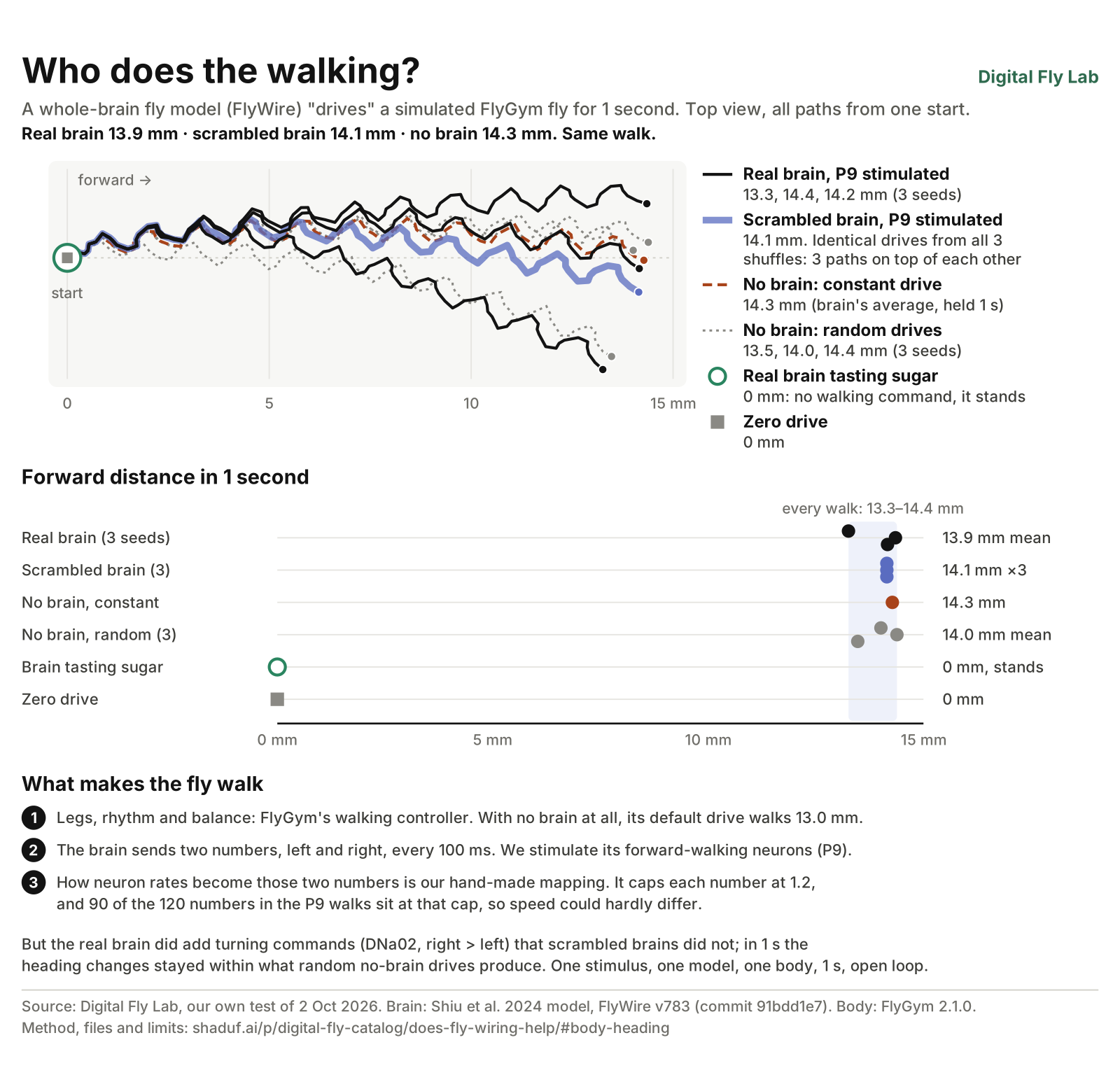
Read this before sharing. The fly walks because we stimulate its forward-walking neurons (P9); P9 fires at the same rates whether the rest of the brain is real or scrambled. Our mapping caps each drive number at 1.2, and 90 of the 120 drive values of the six P9 walks (75%) sit exactly at the 1.2 clip, so forward speed could hardly differ between conditions by construction. Another hand-made mapping could let the wiring matter more. One stimulus, one model, one body, 1 s of walking, open loop (the body never feeds back to the brain).
The brain is not doing nothing. Only the real wiring recruited the turning neurons DNa02, more on the right than the left in all three seeds; the scrambled brains recruited no mapped neuron. That turned the real-brain fly by −0.4° to −26°, but random no-brain drives turned it by −7° to −27° in the same second, so 1 s of walking cannot tell the two apart. Sugar: the same brain tasting sugar fires its feeding neuron MN9 at 82 Hz while every walking command neuron stays at 0 Hz, so the fly stands.
Numbers behind the chart (all 18 runs)
| Run | Group | Forward (mm) | Heading (°) | Path (mm) | Drive L / R | Brain sends (Hz) | Files |
|---|---|---|---|---|---|---|---|
| Real brain, P9, trial seed 0 | Real brain | 13.26 | -26.3 | 18.89 | 1.20 / 1.00 | P9 130/162, DNa02 7/29, MDN 0/0 | body/P9-real-0.json drives/P9-real-0.json brain/P9-real-0.json |
| Real brain, P9, trial seed 1 | Real brain | 14.35 | -0.4 | 19.64 | 1.16 / 1.11 | P9 146/132, DNa02 11/21, MDN 0/0 | body/P9-real-1.json drives/P9-real-1.json brain/P9-real-1.json |
| Real brain, P9, trial seed 2 | Real brain | 14.17 | -14.4 | 19.50 | 1.19 / 1.06 | P9 141/136, DNa02 10/25, MDN 0/0 | body/P9-real-2.json drives/P9-real-2.json brain/P9-real-2.json |
| Scrambled brain, P9, shuffle 3 | Scrambled brain | 14.15 | -14.6 | 19.52 | 1.20 / 1.06 | P9 130/162, DNa02 0/0, MDN 0/0 | body/P9-D3.json drives/P9-D3.json brain/P9-D-3.json |
| Scrambled brain, P9, shuffle 4 | Scrambled brain | 14.15 | -14.6 | 19.52 | 1.20 / 1.06 | P9 130/162, DNa02 0/0, MDN 0/0 | body/P9-D4.json drives/P9-D4.json brain/P9-D-4.json |
| Scrambled brain, P9, shuffle 5 | Scrambled brain | 14.15 | -14.6 | 19.52 | 1.20 / 1.06 | P9 130/162, DNa02 0/0, MDN 0/0 | body/P9-D5.json drives/P9-D5.json brain/P9-D-5.json |
| No brain, constant drive (L 1.18, R 1.06) | No brain | 14.28 | -11.3 | 19.49 | 1.18 / 1.06 | no brain | body/matched.json drives/matched.json |
| No brain, random drive, seed 0 | No brain | 14.01 | -9.7 | 19.07 | 1.16 / 1.05 | no brain | body/random-0.json drives/random-0.json |
| No brain, random drive, seed 1 | No brain | 14.39 | -7.5 | 19.65 | 1.18 / 1.08 | no brain | body/random-1.json drives/random-1.json |
| No brain, random drive, seed 2 | No brain | 13.48 | -27.2 | 18.81 | 1.19 / 0.97 | no brain | body/random-2.json drives/random-2.json |
| Real brain tasting sugar | Sugar | 0.00 | -0.0 | 0.12 | 0.00 / 0.00 | P9 0/0, DNa02 0/0, MDN 0/0 | body/SUG-real-0.json drives/SUG-real-0.json brain/SUG-real-0.json |
| Zero drive | Floor | 0.00 | -0.0 | 0.12 | 0.00 / 0.00 | no brain | body/zero.json drives/zero.json |
| FlyGym default drive (1, 1), sanity check | No brain (sanity) | 13.01 | 6.7 | 17.48 | 1.00 / 1.00 | no brain | body/const-1.json drives/const-1.json |
| Scrambled brain tasting sugar, shuffle 3 | Sugar (fill) | 0.00 | -0.0 | 0.12 | 0.00 / 0.00 | P9 0/0, DNa02 0/0, MDN 0/0 | body/SUG-D3.json drives/SUG-D3.json brain/SUG-D-3.json |
| Scrambled brain tasting sugar, shuffle 4 | Sugar (fill) | 0.00 | -0.0 | 0.12 | 0.00 / 0.00 | P9 0/0, DNa02 0/0, MDN 0/0 | body/SUG-D4.json drives/SUG-D4.json brain/SUG-D-4.json |
| Scrambled brain tasting sugar, shuffle 5 | Sugar (fill) | 0.00 | -0.0 | 0.12 | 0.00 / 0.00 | P9 0/0, DNa02 0/0, MDN 0/0 | body/SUG-D5.json drives/SUG-D5.json brain/SUG-D-5.json |
| Real brain, left P9 only | Real brain (fill) | -4.77 | 254.2 | 12.75 | -0.07 / 1.11 | P9 131/0, DNa02 14/0, MDN 0/0 | body/P9L-real-0.json drives/P9L-real-0.json brain/P9L-real-0.json |
| Scrambled brain, left P9 only, shuffle 3 | Scrambled brain (fill) | -2.18 | 210.3 | 10.16 | 0.00 / 1.11 | P9 131/0, DNa02 0/0, MDN 0/0 | body/P9L-D3.json drives/P9L-D3.json brain/P9L-D-3.json |
Retention, (null − zero) / (real − zero) on the mean forward distance: scrambled 1.016, brainless constant 1.025, brainless random 1.002. Mapping (ours, hand-made, not fitted): drive_s = clip(pbar − 0.5·(p_s − p_o) − m_s − 0.5·(a_s − a_o), −1.2, 1.2) with p, m, a = DNp09, MDN and DNa02 rates ÷ 100 Hz.
Replay it, 100 ms at a time
Pick runs and step through the second: what the brain sends down, the two numbers our mapping makes of it, and where the fly goes.
What the brain sends down
Tasting sugar sends no walking command at all. P9 fires because we stimulate it, at the same rates in real and scrambled brains. What only the real wiring adds is turning: it recruits DNa02, more on the right than the left in every seed, and the scrambled brains recruit no mapped neuron. No trial sent a backward command (MDN).
| Trial | MN9 (feeding) | Whole-brain spikes | Active descending neurons (of 1,299) | P9 (forward) | DNa02 (turning) | MDN (backward) |
|---|---|---|---|---|---|---|
| Sugar, real wiring (our gate trial) | 82 Hz | 13,372 | 65 | 0 / 0 | 0 / 0 | 0 / 0 |
| Sugar, scrambled (shuffle 3) | 0 Hz | 3,937 | 3 | 0 / 0 | 0 / 0 | 0 / 0 |
| Sugar, scrambled (shuffle 4) | 0 Hz | 4,152 | 4 | 0 / 0 | 0 / 0 | 0 / 0 |
| Sugar, scrambled (shuffle 5) | 0 Hz | 4,043 | 1 | 0 / 0 | 0 / 0 | 0 / 0 |
| P9, real wiring, seed 0 | 0 Hz | 1,370 | 41 | 130 / 162 | 7 / 29 | 0 / 0 |
| P9, real wiring, seed 1 | 0 Hz | 1,037 | 25 | 146 / 132 | 11 / 21 | 0 / 0 |
| P9, real wiring, seed 2 | 0 Hz | 1,364 | 44 | 141 / 136 | 10 / 25 | 0 / 0 |
| P9, scrambled (shuffle 3) | 0 Hz | 1,055 | 4 | 130 / 162 | 0 / 0 | 0 / 0 |
| P9, scrambled (shuffle 4) | 0 Hz | 1,016 | 2 | 130 / 162 | 0 / 0 | 0 / 0 |
| P9, scrambled (shuffle 5) | 0 Hz | 1,013 | 5 | 130 / 162 | 0 / 0 | 0 / 0 |
| Left P9 only, real wiring | 0 Hz | 393 | 9 | 131 / 0 | 14 / 0 | 0 / 0 |
| Left P9 only, scrambled (shuffle 3) | 0 Hz | 393 | 2 | 131 / 0 | 0 / 0 | 0 / 0 |
Whose is each part of the walk?
What it shows
- In this model and body, the walk comes from the stimulated command neurons and FlyGym's controller: a scrambled brain and a brainless constant drive walk as far as the real brain.
- The real wiring is not idle: it adds turning commands (DNa02) that scrambled brains lack. In 1 s those turns are as large as the turns of random brainless drives, so they cannot be told apart yet.
- Tasting sugar drives the feeding neuron, not the legs: the fly stands.
Limits
- The mapping is ours and decides how much the wiring can matter. It caps each drive at 1.2, and 90 of the 120 drive values of the six P9 walks sit at the cap, so forward speed could hardly differ by construction.
- One stimulus (P9 at 150 Hz), one model, one body, 1 s of walking, open loop: the body never feeds back to the brain.
- 3 trial seeds; 3 shuffles that behaved as one.
- Changed before the first body run: the turning sign of P9, to match Bidaye et al. 2020 (FlyGym turns toward the slower side). Details in the report of 2 Oct 2026.
Build it yourself: Add a body on Build your own has the tested commands, pins and expected numbers.
New 5 Oct 2026, brain-only follow-up 6 Oct 2026 · made by us · both pre-registered before the first trial
We ran the map: a looming shadow on one eye
We ran the map. A looming shadow on one eye turned our simulated fly away in 4 of 4 runs. With the same map scrambled (same number of connections per neuron) it turned away in 0 of 3. Here the map's wiring, not the stimulus or our code, makes the turn.
The walking test above showed that FlyGym's legs walk with or without a brain. So this time we fixed the walking drive (a constant 0.8 on both sides, ours, not the brain's) and asked whether the brain can steer: every LC4 and LPLC2 neuron of one eye, the fly's looming detectors, fired at 80 Hz for 1 s, and the brain's turning neurons (DNa02) and backward neurons (MDN) set the difference between the two sides through our hand-made mapping. The chart with every path, the brain table with fly67's own numbers and the full caveats are on Is it real?
- 4 of 4real map: turned away, 34–68° (mean 51.6°); left shadows right, right shadows left
- 0 of 3scrambled maps: every readout 0 Hz, the same drive as no brain, so in effect one walk
- 3 of 6no brain, random steering: "turned away" by chance (all three were right-eye runs)
- 0.50activity of the scrambled brains relative to the real one on 5 Oct: much quieter
Whose is each part of the turn?
6 Oct: as busy as the real brain, still no turn
The 5 Oct scrambles were much quieter than the real brain, so we went back to the brain model alone (no body) and ran four arms with the same shadow. Every sentence below was fixed before the first trial; the rules picked which one applies. The chart, the census of the map and every caveat are on Is it real?
- Pre-registered Scrambled and turned up to the real activity.
We turned the scrambled maps up until they were as busy as the real one. They still did not produce the turn: the wiring, not the amount of activity, makes it.
Reading by the rule: "the turn needs the wiring even at the same activity": 3 shuffles matched the real activity (gain 2.25, outside-activity 0.98 × real, whole brain 27,166–27,515 spikes vs 27,686), 0 of them produced the turn command. - Pre-registered Scrambled inside only (every edge onto descending, motor and endocrine neurons and out of sensory and ascending neurons kept; the rest shuffled).
Scrambling only the inside of the map kept about -9% of the turn command and 69% of the escape signal.
In plain words, −9% means none (the far-side command was absent in all 6); it is slightly negative because in one trial the near-side DNa02 fired 1 Hz. Readings by the rules: turn command "the turn needs the wiring in between" (fly67's DNa02 rule passed in 0 of 6); escape signal "partly" (giant-fibre retention 0.69, below the 0.9 bar for "rides on direct connections"; above 50 Hz in 6 of 6).Descriptive, not pre-registered Per neuron, the kept part is one side: the near-side giant fibre, which gets 832 (left) and 1,053 (right) direct synapses from the looming neurons, kept firing at 151–169 Hz (real map: 129 and 149–156 Hz); the far-side giant fibre went to 0 Hz (real map: 84–104 Hz).
- Pre-registered Giant fibre silenced (every synapse out of both giant fibres, DNp01, set to zero; the fibres themselves still spike).
With the escape neuron silenced, the turn command stayed.
Reading: "steering survives silencing the giant fibre" (fly67's rule passed on both sides; far-side DNa02 changed by −2 Hz and 0 Hz against the paired real trials). This was expected from the wiring: the map has no giant fibre → DNa02 connections at all, so the test checks fly67's claim in our engine, not a hidden route. - Pre-registered Plain scramble (same number of connections per neuron): 6 trials over 3 shuffles, every readout 0 Hz, and the brain about 14 times quieter outside the stimulated neurons (0.07 × real).
The ledger row after 6 Oct: helps, fair, strong. Our row byo-flygym-loom was "unfair, weak" on 5 Oct because the scrambled brains were much quieter and no activity-matched scramble had run. By the same fixed rules, with no override, it now reads Helps fair, strong:
- Plain scramble arm: 6 drives over 3 shuffles (3 walked on 5 Oct; the 3 new ones are identical to the no-brain floor, so they take its walk by determinism), turn away 0.0° beyond the floor.
- New turned-up arm: 3 drives over 3 shuffles at gain 2.25, activity 0.99 × real; all identical to the floor, so the same walk.
- The inside-only arm is not in the row yet: one of its 6 drives waits for a body run, and the rule adds an arm only when all its drives are settled.
- Brain-level readings (inside-only, giant fibre silenced) are written in the row's note only; they do not change its effect.
Read with the result: one model (Shiu et al. LIF on FlyWire v783), open loop, our hand-made mapping, a constant external walking drive, 1 s; not a real fly. 4 real body runs; the new scrambled drives take the floor's walk by determinism, and 7 new drives wait for body runs. The direction rests on our mapping's DNa02 sign and fly67's claim; as written before the test: "fly67's claim; the direction in real flies was not verified by us." Retention 0.00 by the ledger's floor method.
Build it yourself: Add a sense: looming on Build your own has the tested commands.
The 41 studies at a glance
- 41control studies in our catalogue, 38 by other people and 3 our own tests
- 15 of 33with a wiring null: the real wiring beats scrambled wiring
- 10tie (8) or lose (2) against scrambled wiring: trained, reservoir, ML, game and robot-arm tasks, and our walking test
- 4 of 22with a no-brain baseline: the fly network beats it
Where the wiring helps: by task family
The split follows the kind of task. Three of the four reflex-circuit studies find that the real wiring helps; the fourth, our own test, is "mixed" by rule because a sign shuffle makes the whole brain fire. No machine-learning benchmark or reservoir study does, and the language-model and forecasting studies have no scored wiring null. In steering a body, our open-loop walking test is the first "no difference": the walk came from the stimulus and the body controller. Games are split: two untrained game demos added on 6 Oct beat one shuffle each (weak method), while trained game players mostly tie.
| Task family | Helps | No difference | Worse | Mixed | Not tested | Studies |
|---|---|---|---|---|---|---|
| Reflex circuits | 3 | · | · | 1 | · | 4 |
| Sensory models | 2 | · | · | · | 1 | 3 |
| Steering a body | 4 | 2 | · | 1 | 2 | 9 |
| Playing games | 4 | 4 | · | 3 | 4 | 15 |
| Machine-learning benchmarks | 1 | 2 | 1 | 1 | · | 5 |
| Reservoir computing | · | · | 1 | · | · | 1 |
| Language models | · | · | · | · | 1 | 1 |
| Forecasting | · | · | · | · | 1 | 1 |
| Graph analysis, no simulation | 1 | · | · | · | · | 1 |
| Evolved controllers | · | · | · | 1 | · | 1 |
| All studies | 15 | 8 | 2 | 7 | 9 | 41 |
How much survives when the wiring is scrambled?
To compare studies that measure very different things (hertz, seconds, accuracy), we use one number per study, null retention: how much of the real wiring's result the scrambled copy keeps. 0 means the scrambled brain does no better than no network at all. 1 means it does as well as the real wiring. Above 1, the scrambled copy does better.
The diamond adds the second question: how well does a no-brain baseline do, as a share of the fly network's result? Look at the Doom row. Scrambled wiring keeps almost nothing (0.03), so this brain needs its wiring to act at all. But a brainless autopilot reaches 0.97 of the fly's survival time, so the task does not need the brain.
The formula is (null − floor) / (real − floor) when a study has a "no network" floor, and null / real otherwise. The chart uses each study's degree-preserving null where it has one (29 of the 33 studies with a wiring null), because it answers the question most readers ask: does who connects to whom matter, beyond how many connections each neuron has?
Explore the studies
Filter by wiring effect, task family, method quality or null fairness, and sort by retention. Every study also has a row in the table below, with links to its catalogue entry and its upstream source.
All 41 studies
| Study | Task family | Result: real wiring vs null | Retention | Wiring effect | Null and method | Numbers from |
|---|---|---|---|---|---|---|
| Reflex circuits (4) | ||||||
| drosophila-brain-mlx A Reimplemented Shiu model: MN9 67.3 Hz on real wiring, silent on all 5 degree-preserving shuffles with identical input. Catalogue entry · Upstream source |
Reflex circuits open-loop |
MN9 67.3 Hz with real wiring; 0 Hz on all 5 degree-preserving shuffles with the same input. | 0.00 | Helps | Fair null Weak method |
README or docs commit e417b33 checked 30 Sep 2026 |
| Drosophila_brain_model (Shiu et al. 2024) A Real FlyWire weights activate MN9 in every run; shuffled weights in 1 of 100: a large, clean wiring effect on one reflex. Project page · Catalogue entry · Upstream source |
Reflex circuits open-loop |
MN9 active in 100% of real-wiring runs vs 1 of 100 runs with shuffled weights (paper). | 0.01 | Helps | Partly fair null Weak method |
paper commit 91bdd1e checked 30 Sep 2026 |
| fly-brain A Weight-shuffled MaleCNS scores 0.40 (0.56 after refit) vs 0.80 on the fitted 17-assay benchmark; real counts matter. Catalogue entry · Upstream source |
Reflex circuits open-loop |
Benchmark score 0.796 real vs 0.559 with shuffled weights after the readout was re-fitted (12 seeds). | 0.70 | Helps | Partly fair null Moderate method |
result files commit 08cf866 checked 30 Sep 2026 |
| Build your own: sugar to MN9 against four scrambled-wiring nulls (our run) Our run A Our run: real wiring 85 Hz; degree-preserving 0 Hz; weight shuffle 0 Hz; interior-only shuffle 39 Hz; sign shuffle runaway. Build your own: control test · Upstream source |
Reflex circuits open-loop |
MN9 85.2 ± 3.56 Hz with real wiring; degree-preserving and weight shuffles 0 Hz (5 shuffles each); interior-only (boundary-preserving) shuffle 39 Hz (retention 0.46); sign shuffle 214 Hz only because the whole brain ignites. Pre-registered; the gain-matched arm was not matched on 3 shuffles (×2.5 matched shuffle 3 only), and MN9 stayed at 0 Hz at every gain. Brain activity vs real (display only): degree-preserving 0.291× reduced; weight shuffle 0.388× reduced; sign shuffle 257.637× runaway; boundary-preserving 0.648× comparable |
0.00 | Mixed | Unfair null Weak method |
our run commit 91bdd1e checked 2 Oct 2026 |
| Sensory models (3) | ||||||
| flydoom A Smell drives the lateral horn +14 Hz with real wiring, ~0 with a degree-preserving shuffle; in-game the fly narrowly beats a command-matched random agent. Catalogue entry · Upstream source |
Sensory models open-loop |
Smell response +14.06 Hz real vs +0.009 Hz with one degree-preserving shuffle; in the game the fly beats a matched random agent only narrowly. | 0.00 | Helps | Unfair null Weak method |
files, recomputed by us commit 86d99a4 checked 30 Sep 2026 |
| Fly OCR A Intact MaleCNS digit pilot 82% beats three degree-preserving target rewirings (mean 61%), but raw-pixel linear readout (99%) beats the fly circuit. Catalogue entry · Upstream source |
Sensory models offline |
Digit accuracy 82% intact vs 61% over 3 rewirings (200-image pilot); a plain pixel classifier reaches 99%. | 0.71 | Helps | Fair null Strong method |
files, recomputed by us commit 48cf341 checked 30 Sep 2026 |
| flyvis A Connectome-constrained optic-lobe model beats decoder-alone and random-parameter models; ablation values are figure-only, no wiring shuffle. Project page · Catalogue entry · Upstream source |
Sensory models offline |
Predicts the contrast preference of 32 of 32 cell types and beats decoder-only and random-parameter models; no wiring shuffle, ablation values only in a figure. | none | No wiring null | Partly fair null Weak method |
paper commit 92b3845 checked 3 Oct 2026 |
| Steering a body (9) | ||||||
| Build your own, Add a sense: a looming shadow turns the FlyGym fly (our run) Our run A Our test: a looming shadow turned the fly away in 4 of 4 real-brain runs, 0 of 3 scrambled body runs (+3 floor-identical); our mapping. Our looming test · Chart and caveats · Build your own: Add a sense · Upstream source |
Steering a body open-loop |
A looming shadow on one eye (every LC4 and LPLC2 neuron of that eye at 80 Hz) turned the FlyGym fly away in 4 of 4 real-brain runs (mean 51.6°; 34–41° for left looms, 64–68° for right looms) and in 3 of 6 brainless random-steering runs. The scrambled map turned it away in 0 of 3 scrambled body runs (+3 drives from 6 Oct identical to the no-brain floor, whose walk follows by determinism). On 6 Oct the gain-matched arm was added: scrambled maps turned up until they were as busy as the real one (activity ratio 0.99, 3 shuffles) still sent the floor's drive, so the row now counts as fair with a strong method by the fixed rules. Pre-registered; brain-level readings of 6 Oct (interior-only scramble, giant fibre silenced) are not in the effect. The rate-to-drive mapping and the constant 0.8 walking drive are ours, and the "away" direction rests on our mapping's DNa02 sign and fly67's claim. Brain activity vs real (display only): degree-preserving 0.4972× reduced; G-degree-preserving-gain-matched 0.9864× comparable |
0.00 No-brain baseline: 0.12 |
Helps | Fair null Strong method |
our run commit 91bdd1e checked 6 Oct 2026 |
| Flight-test the fly A Fly yaw-damper circuit: RMS yaw rate 3.19 deg/s vs 3.92 median of 10 degree-preserving shuffles (best 3.31); classical damper 1.69, bare airframe 3.92. Catalogue entry · Upstream source |
Steering a body closed-loop |
An aircraft yaw damper: RMS yaw rate 3.19 deg/s with the real T4/T5-to-DNa02 subcircuit vs 3.92 for the median of 10 degree-preserving shuffles (best shuffle 3.31) on 20 held-out turbulence seeds. The bare airframe gives 3.92 and a classical yaw damper 1.69, so the no-brain baseline is not beaten. | 0.00 No-brain baseline: 3.07 |
Helps | Fair null Strong method |
files, recomputed by us commit d3fa996 checked 5 Oct 2026 |
| Are fruit flies zero-shot adapters? A Scrambled wiring silences DNa02 steering: 0.34 vs 2.96 poles per 10 s for real wiring, barely above unplugged turn neurons (0.12). Catalogue entry · Upstream source |
Steering a body closed-loop |
2.96 poles per 10 s real vs 0.34 scrambled (2 shuffles) and 0.125 with the turn neurons disconnected. | 0.08 | Helps | Partly fair null Moderate method |
files, recomputed by us commit 0c63ba5 checked 30 Sep 2026 |
| FLY-lab: What a fly connectome adds to controlling a body A Connectome beats degree-preserving shuffles on turning (100% vs 53% after readout re-fit, 0% right turns), but a two-line rule ties it; replay fails. Catalogue entry · Upstream source |
Steering a body closed-loop |
Left turns in 100% of episodes real vs 52.7% over 5 shuffles with a re-fitted readout (31.3% without re-fit); a two-line rule also scores 100%. | 0.53 No-brain baseline: 1.00 |
Helps | Fair null Strong method |
files, recomputed by us commit c9ee19f checked 30 Sep 2026 |
| FlyArm B Frozen MaleCNS arm controller: pick-and-place lift 72% vs 56% for degree-preserving shuffles over 6 seeds (p 0.125); grasp tied, kitchen ahead, dexterous tie. Catalogue entry · Upstream source |
Steering a body closed-loop |
A robot arm driven through a frozen MaleCNS between a trained encoder and decoder: pick-and-place lift 72.2% with the real wiring vs 55.9% for 9 degree-preserving shuffles over 6 seeds (p = 0.125) and 56.9% for a GRU. No difference by our fixed rules on this one metric; the author also says the wiring advantage is not established. | 0.77 No-brain baseline: 0.79 |
No difference | Fair null Strong method |
files, recomputed by us commit ab3922e checked 5 Oct 2026 |
| Build your own, Add a body: FlyWire brain drives FlyGym walking (our run) Our run A Our test: FlyGym fly walks 13.9 mm with real brain, 14.1 mm scrambled, 14.3 mm with a brainless constant drive; the mapping is ours. Our body test · Build your own: Add a body · Upstream source |
Steering a body open-loop |
FlyGym fly walks 13.93 ± 0.58 mm in 1 s with the real brain (3 seeds), 14.15 mm with 3 degree-preserving shuffles that sent identical drives (in effect one walk), 14.28 mm with a brainless constant drive and 13.96 ± 0.46 mm with brainless random drives. P9 stimulated; the rate-to-drive mapping is ours. Brain activity vs real (display only): degree-preserving 0.818× comparable |
1.02 No-brain baseline: 1.03 |
No difference | Fair null Strong method |
our run commit 91bdd1e checked 2 Oct 2026 |
| Fly.exe (MaleCNS Virtual Fly) B Regime-matched degree-preserving shuffle still drives the giant fibre but loses left/right selectivity (+2.0 vs -0.1); one seed. Catalogue entry · Upstream source |
Steering a body closed-loop |
Left/right selectivity +2.0 real vs -0.1 shuffled; the giant fibre still fires after shuffling; one seed. | none | Mixed | Partly fair null Weak method |
files, recomputed by us commit cc25411 checked 30 Sep 2026 |
| Flyhard (The Driving Fly) B Trained fly-topology rate network steers a wheel on 100/100 held-out targets vs 0/100 untrained; no wiring null or non-fly baseline. Catalogue entry · Upstream source |
Steering a body closed-loop |
Wheel steering 100 of 100 held-out targets after training vs 0 of 100 untrained; no wiring null or non-fly baseline. | none | No wiring null | Partly fair null Weak method |
result files commit 328906f checked 30 Sep 2026 |
| NeuroCraft Fly U A shuffled-weights run is shown on video, but no numbers or code are published, so the control cannot be checked. Catalogue entry · Upstream source |
Steering a body closed-loop |
A shuffled-weights run is shown in a video; no numbers or code are published. | none | No wiring null | Unclear null Weak method |
catalogue text only commit d121466 checked 29 Sep 2026 |
| Playing games (15) | ||||||
| FlyBrain · Flappy (escape reflex) B Untrained FlyWire whole brain flaps from DNp01: mean score 100.8 over 40 games vs 0.00 and no flaps for shuffled or cut wiring; README only. Catalogue entry · Upstream source |
Playing games closed-loop |
Flappy Bird through the FlyWire looming-escape pathway: mean score 100.8 over 40 games with the real wiring vs 0.00 with shuffled wiring or the direct LC4/LPLC2-to-giant-fibre edges cut (author-reported, README). The two input gains were tuned on the real wiring and not re-tuned for the scrambled graphs, so the null is unfair by the fixed rule. | 0.00 No-brain baseline: 0.00 |
Helps | Unfair null Weak method |
README or docs commit 7a8b601 checked 6 Oct 2026 |
| Is the fly brain actually playing DOOM? (control experiments) A Untrained fly brain beats shuffled wiring in Doom (53 s vs 7 s), but a brainless autopilot nearly matches; trained RL shows no wiring effect. Catalogue entry · Upstream source |
Playing games closed-loop |
Survival 53.3 s real vs 6.8 s over 3 shuffles; the brainless matched autopilot survives 51.9 s, and the best of 12 autopilot settings 53.4 s. | 0.03 No-brain baseline: 0.97 |
Helps | Fair null Strong method |
files, recomputed by us commit 6b22922 checked 30 Sep 2026 |
| Connectome ping pong (fly tennis) A Untrained MaleCNS flies play ping pong: 54 hits in one 40 s match vs 10 with shuffled wiring and 14 parked; one match each. Catalogue entry · Upstream source |
Playing games closed-loop |
Two untrained MaleCNS flies rally a ball: 54 hits in one 40 s match with the real wiring vs 10 with one degree-preserving shuffle and 14 with a parked fly that does not steer (committed logs). One match per condition, one seed; the logged closed-loop steering check is near zero, so the long rally is not shown to come from tracking. | 0.19 No-brain baseline: 0.26 |
Helps | Partly fair null Weak method |
result files commit c0b5e17 checked 6 Oct 2026 |
| Brain Runners A An untrained fly brain survives 82 rows against 28 on shuffled wiring, but a brainless version of the same rule reaches 74. Catalogue entry · Upstream source |
Playing games closed-loop |
Rows survived 82.34 with real wiring vs 27.84 on one shuffled wiring; the same rule with no brain reaches 74.05 (held-out seeds). | 0.34 No-brain baseline: 0.90 |
Helps | Unfair null Weak method |
README or docs commit 79d8039 checked 1 Oct 2026 |
| making-fly-play-chess C FlyWire-patch chess agent ties its rewired twin (0.506, CI spans 0.5) and loses to a material counter; author-labelled code-check run. Catalogue entry · Upstream source |
Playing games closed-loop |
Match score 0.506 vs 0.494 for its rewired twin (the interval spans 0.5); a material-count player scores 0.694. | 0.98 No-brain baseline: 1.37 |
No difference | Fair null Strong method |
files, recomputed by us commit 4ddc9b5 checked 30 Sep 2026 |
| ChessFly A Chess-learning mushroom body: real FlyWire wiring rates 1680, shuffled claws 1675 and a random design 1850 after 10,000 games (one fly each). Catalogue entry · Upstream source |
Playing games closed-loop |
Chess rating after 10,000 self-play games: real FlyWire mushroom-body wiring 1680 Elo, shuffled claws 1675, the original random design 1850 (one fly and one shuffle per arm, 40-game exams). A clean negative result. | 1.00 | No difference | Partly fair null Weak method |
result files commit 52276aa checked 3 Oct 2026 |
| doomfly-rl A Doom agent with MaleCNS-49k backbone scores like its degree-preserving shuffle and below a no-connectome model after GRPO; negative result. Catalogue entry · Upstream source |
Playing games closed-loop |
Episode return 6.57 real vs 6.71 with one shuffle; a model without the connectome scores 7.39. | 1.02 No-brain baseline: 1.13 |
No difference | Partly fair null Moderate method |
files, recomputed by us commit 334d915 checked 30 Sep 2026 |
| FlyAim A Whole MaleCNS LIF aiming a crosshair: 412.5 px mean target distance vs 430.9 shuffled (p 0.66); both worse than a random walker (251.7). Catalogue entry · Upstream source |
Playing games closed-loop |
Aiming a crosshair with the whole MaleCNS, pre-registered: mean distance to the target 412.5 px with the real wiring vs 430.9 px with one shuffle (lower is better; not different, p = 0.66). A uniform random walker reaches 251.7 px and a PID controller 155.8 px. | none | No difference | Partly fair null Moderate method |
files, recomputed by us commit 15d800f checked 5 Oct 2026 |
| Fly Self Driving A Trained fly graph drives streets 97% vs 80% rewired and 90% for a small MLP; one seed, and the flat-road task showed no wiring advantage. Catalogue entry · Upstream source |
Playing games closed-loop |
Streets completed: 96.7% real vs 80% rewired (one seed) and 90% for a small MLP. | 0.83 No-brain baseline: 0.93 |
Mixed | Partly fair null Weak method |
README or docs commit 3516a09 checked 30 Sep 2026 |
| Fly-Racer C PPO car racer on a 3,350-neuron MaleCNS core: 903 mean score vs 884 shuffled, 897 sign-shuffled, 894 MLP; one seed each, README only. Catalogue entry · Upstream source |
Playing games closed-loop |
CarRacing score 903.2 with a 3,350-neuron MaleCNS steering-pathway core trained by PPO vs 883.7 for a degree-preserving shuffle, 896.9 for shuffled signs and 894.0 for a plain MLP (100 held-out episodes, one training seed per core). README numbers only; the run files are not committed. | 0.98 No-brain baseline: 0.99 |
Mixed | Partly fair null Weak method |
README or docs commit 71ede00 checked 6 Oct 2026 |
| fly-plays-games (Pokémon Red chapter; formerly fly-plays-pokemon) C In Arkanoid a weight-shuffled fly brain plays as well as the real one (both hit the 1500-frame cap); rewired or silenced wiring fails by 204. Catalogue entry · Upstream source |
Playing games closed-loop |
Arkanoid: 1,500 frames (the cap) with real and weight-shuffled wiring; rewired or silenced wiring fails at 204; a scripted tracker reaches 1,372. | 1.00 No-brain baseline: 0.90 |
Mixed | Partly fair null Weak method |
README or docs commit ecb95f7 checked 30 Sep 2026 |
| DOOMFLY B DOOMFLY's controls only show that its outputs depend on edges and input (forward 16.7 intact, 0 without edges); wiring specificity untested here. Project page · Catalogue entry · Upstream source |
Playing games closed-loop |
Forward command 16.7 intact vs 0 without edges in one 500 ms trial: the output depends on the edges, but wiring specificity is untested. | none | No wiring null | Unclear null Weak method |
result files commit 71ecf53 checked 30 Sep 2026 |
| Fly Dino (flyjump) C 80-neuron fly circuit plus trained readout survives 179 s on held-out Dino courses; a 243-parameter network without the connectome survives 180 s. Catalogue entry · Upstream source |
Playing games closed-loop |
Survives 179.37 s on 100 held-out 180 s courses with the 80-neuron circuit and a trained readout; a 243-parameter network with no connectome, trained the same way, survives 180.00 s (147 parameters: 176.89 s); a hand-written rule 46.49 s. No wiring null. Corrected on 6 Oct 2026: the no-brain baseline is not beaten (it was listed as beaten). | none No-brain baseline: 1.00 |
No wiring null | Partly fair null Moderate method |
files, recomputed by us commit e34c661 checked 6 Oct 2026 |
| Fly Worker A Whole-brain fly explores 42% of a game map vs 61% for smoothed noise; adding the connectome to noise changes nothing (-3 points). Catalogue entry · Upstream source |
Playing games closed-loop |
Map coverage 42% for the whole-brain fly vs 61% for smoothed noise; no wiring null. | none No-brain baseline: 1.51 |
No wiring null | Unclear null Weak method |
README or docs commit 83b9104 checked 30 Sep 2026 |
| Haltere C Connectome brain finished 0 of 2 frozen races; a plain PD controller finished 1 of 2. No wiring null. Catalogue entry · Upstream source |
Playing games closed-loop |
Races finished: 0 of 2 for the connectome brain, 1 of 2 for a PD controller; no wiring null. | none | No wiring null | Unclear null Weak method |
README or docs commit 3e3e7b5 checked 30 Sep 2026 |
| Machine-learning benchmarks (5) | ||||||
| fly-cartpole A Fly flight circuit balances CartPole (499.9 steps) and shuffled wiring drops it to 165.9 (p = 0.0001), but its own linear map also reaches 499.6. Catalogue entry · Upstream source |
Machine-learning benchmarks closed-loop |
Redesigned on 3 Oct 2026 (commit a8c6257) around a MaleCNS flight-stabilisation circuit: 499.9 steps with the real circuit vs 165.9 with degree-preserving shuffled wiring (20 seeds, p = 0.0001). But the circuit's own linear map, tuned the same way, scores 499.6 and LQR 500: the no-brain baseline is not beaten. The real arm sits at the 500-step ceiling. The earlier mushroom-body result (392.5 vs 390.3, p = 0.48) is still in the repository. | 0.30 No-brain baseline: 1.00 |
Helps | Fair null Strong method |
result files commit a8c6257 checked 3 Oct 2026 |
| Does the larval connectome beat its own shuffles? (connectome-null-models) A Larval connectome reservoir ties its degree-preserving shuffles, Erdos-Renyi and weight shuffles on CIFAR-10 and MNIST; only removing recurrence hurts. Catalogue entry · Upstream source |
Machine-learning benchmarks offline |
CIFAR-10 accuracy 43.04% real vs 42.95% over 15 degree-preserving shuffles (p = 0.51). | 1.00 | No difference | Fair null Strong method |
files, recomputed by us commit be301d9 checked 30 Sep 2026 |
| NeuroWeave C 150-neuron MaleCNS mask scores 98% versus 99-100% for configuration-model, random and dense masks on a ceiling task; single seed. Catalogue entry · Upstream source |
Machine-learning benchmarks offline |
Accuracy 98% for the fly mask vs 99% for a configuration-model null; one seed, near the ceiling. | 1.01 | No difference | Partly fair null Weak method |
result files commit 518f162 checked 30 Sep 2026 |
| The Fly's Hash Function A Real hemibrain PN-to-KC wiring hashes worse than degree-preserving and random FlyHash nulls on MNIST, Fashion-MNIST and correlated odours; beats SimHash. Catalogue entry · Upstream source |
Machine-learning benchmarks offline |
Precision@16 0.499 real vs 0.552 degree-preserving: the real wiring hashes worse; it beats SimHash (0.241). | 1.11 No-brain baseline: 0.48 |
Worse | Fair null Strong method |
files, recomputed by us commit 271cc85 checked 30 Sep 2026 |
| flybench A Benchmark of 28 circuit tasks: real FlyWire scores 0.60 vs 0.40 on one degree-preserving rewiring (specificity +0.20). Catalogue entry · Upstream source |
Machine-learning benchmarks open-loop |
Mean task score 0.599 real vs 0.399 for one rewiring, over 28 circuit tasks. | 0.67 | Mixed | Partly fair null Weak method |
files, recomputed by us commit 3052ce5 checked 30 Sep 2026 |
| Reservoir computing (1) | ||||||
| flybrain-reservoir A Whole fly CNS reservoir remembers far less than its degree-preserving shuffle (2.2 vs 15.5); spectral-radius scaling around an antennal-lobe hot spot explains it. Catalogue entry · Upstream source |
Reservoir computing offline |
Memory capacity 2.2 real vs 15.5 for a degree-preserving shuffle (10 seeds). | 7.05 | Worse | Fair null Weak method |
README or docs commit 6da6325 checked 30 Sep 2026 |
| Language models (1) | ||||||
| FLM - Fly Language Model A Fly-graph residual lowers LLM loss slightly, but a parameter-matched direct-input adapter does as well or better; no refit wiring null. Catalogue entry · Upstream source |
Language models offline |
Loss 1.3598 nats per token with the fly graph vs 1.3593 for a parameter-matched adapter without it; no re-fitted wiring null. | none No-brain baseline: 1.02 |
No wiring null | Partly fair null Weak method |
paper commit 7251a89 checked 30 Sep 2026 |
| Forecasting (1) | ||||||
| BioReservoir B Fly-brain oracle answers sit at p(yes)~0.50 like the no-brain baseline; controls exist but no forecast outcomes are scored yet. Catalogue entry · Upstream source |
Forecasting offline |
Mean forecast 0.4996 real vs 0.5009 rewired and 0.50 without a brain; the questions resolve on 15 Dec 2026. | none | Not yet scored | Partly fair null Moderate method |
files, recomputed by us commit ac0253e checked 30 Sep 2026 |
| Graph analysis, no simulation (1) | ||||||
| Wired Different (ConnectomeLens) n/a Real MaleCNS topology predicts sex-related cell types better than all 500 degree-preserving rewirings, though neuropil location carries most of the signal. Catalogue entry · Upstream source |
Graph analysis, no simulation offline |
AUC-PR 0.759 real vs 0.712 over 500 rewirings (p = 0.002); brain-region location alone gives 0.722. | 0.93 No-brain baseline: 0.95 |
Helps | Fair null Strong method |
files, recomputed by us commit 03d9c5c checked 30 Sep 2026 |
| Evolved controllers (1) | ||||||
| Null-model treatment of the sensory-motor boundary changes an evolutionary connectome comparison A Standard nulls beat the connectome after evolution, but boundary-preserving nulls tie it: the choice of null flips the verdict. Catalogue entry · Upstream source |
Evolved controllers closed-loop |
Fitness 1.57 for the connectome vs 1.78 and 1.77 for standard nulls, and 1.58 and 1.62 for nulls that keep the sensory-motor boundary. | 1.13 | Mixed | Fair null Strong method |
result files commit 2f5683d checked 30 Sep 2026 |
Which null is fair?
"Scrambled wiring" can mean many things, and the choice changes the answer. A weight shuffle keeps who connects to whom and only moves the synapse strengths, so it tests weights, not wiring. A random graph of the same size destroys hubs and structure, so almost anything beats it. A degree-preserving rewiring keeps each neuron's number of inputs and outputs and changes only its partners. A boundary-preserving null keeps every sensory-input and motor-output connection and shuffles only the wiring in between: the fairest test of the central brain, but a hard one.
| Null | Keeps | Destroys | Pitfall | Studies |
|---|---|---|---|---|
| Weight shuffle | Who connects to whom, degrees, the weight distribution | Which synapse strength sits on which connection | Tests weights, not wiring; papers often do not say whether the graph was kept. | 8 |
| Degree-preserving rewiring | Every neuron's number of inputs and outputs (often weights and signs too) | Which partners each neuron has | Rewires the sensory and motor interface too, which can open input-to-output shortcuts; one shuffle is not enough. | 29 |
| Random graph | Neuron and connection counts | Hubs, degree structure, modules, partners | Easy to beat, so a win overstates how specific the wiring is. | 7 |
| Target permutation | Each neuron's outputs, weights and signs | Where each output goes; input counts change | Activity levels shift, not only routing. | 2 |
| Sign shuffle | The graph and synapse sizes | Which synapses excite and which inhibit | A loss can come from runaway or silent activity, not lost computation. In our test it caused runaway. | 3 |
| Boundary-preserving | All sensory-input and motor-output connections | Only the central wiring | Fairest for "does the central brain matter?", but it can erase effects other nulls find. | 3 |
Five cases where the choice of null changed the result
-
Evolved controllers: the verdict flips
flyconnectome-nulls evolves controllers on a compressed FlyWire connectome. Standard nulls do better than the real wiring (1.78 and 1.77 against 1.57), because rewiring opens direct smell-to-motor shortcuts. Nulls that keep the sensory-motor boundary tie it (1.58 and 1.62). "Worse" becomes "no difference" with a fairer null.
flyconnectome-nulls (grade A), fitness after 600 generations, the author's committed results (HEAD 2f5683d). The vertical line marks the connectome. Standard nulls do better than the real wiring (95% intervals of the difference [-0.34, -0.06] and [-0.41, -0.11]); nulls that keep every sensory-input and motor-output edge tie it (intervals [-0.04, +0.05] and [-0.10, +0.05]). -
Arkanoid: weights vs wiring
In fly-plays-games, a weight shuffle keeps the graph and plays as long as the real brain (both hit the 1,500-frame cap). A random rewiring fails at 204 frames, the same as a silenced brain. The weight shuffle tested synapse strengths, not wiring.
-
A body task: give the null the same fitting
In FLY-lab, five shuffled brains turn left in 31.3% of test episodes with a fixed readout, against 100% for the real wiring. Re-fit the readout for each shuffle, as was done for the real brain, and they reach 52.7%. The gap shrinks from 69 to 47 points: still real, but a null that skips the fitting step looks worse than it is.
-
Reservoirs: compare at the same gain
The FlyBrain reservoir remembers far less than its shuffle (2.2 against 15.5), because scaling the whole matrix lets one dense hot spot dominate the real wiring. The larva study fixes the gain for every network and finds no difference (43.04% against 42.95%, p = 0.51). fly-cartpole shows the same for a learning circuit: shuffled mushroom bodies learn CartPole about as well (390 against 392 steps, p = 0.48).
-
Doom: scrambled brain vs no brain
In the Doom control study, shuffled wiring collapses survival from 53.3 s to 6.8 s (3 shuffles). But a brainless autopilot with the fly's average commands survives 51.9 s, and the best of 12 autopilot settings survives 53.4 s. More in the Doom test on Is it real?
A sixth worked example is our own test: on one reflex, four nulls give four different answers, from silent (0 Hz) through partly (0.46) to runaway (2.51). And our walking test shows the opposite trap: a null can tie the real wiring because the readout (here our capped mapping) leaves the wiring little room to matter.
A four-point checklist for a fair control
Use it on any fly brain demo or paper. Since 6 Oct one study in the ledger passes all four and shows the real wiring beating both its null and its no-brain baseline on a behaviour: our own looming test, with 4 real runs, one model and our own mapping, and with scrambled drives that take the no-brain walk by determinism rather than in new body runs. No study by other people does yet.
- Keep the degrees and signs. The scrambled brain should keep each neuron's number of inputs and outputs and whether it excites or inhibits. A random graph or a weight shuffle answers a different, easier question.
- Give the null the same chance. Same inputs and readout, same gain, and the same training or readout fitting as the real wiring. If only the real brain was tuned, a win proves little.
- Use several nulls and report the spread. At least 3 independent shuffles, with a standard deviation, interval or p-value. One shuffle is an anecdote.
- Include a no-brain baseline, and say whether the fly beat it. A scripted rule, autopilot, random policy or plain model on the same task shows whether the task needs a brain at all.
Replayed or live?
A recording of brain activity played back into a body can look like a working controller. Two studies test that directly, and in both the live closed loop is what works.
FLY-lab: brain and body
- 100%turning success with the brain live in the loop
- 0 of 30when the recorded brain output is replayed
Zero-shot steering
- 2.96poles per 10 s, live, real wiring
- 0.34 / 0.125scrambled wiring / turn neurons disconnected
No study in the ledger shows a replayed sequence matching live performance. Replay is an honest control only when it is reported next to the live run.
Brain vs no brain
22 studies compare the fly network with a controller that has no brain: a scripted rule, an autopilot, noise, or a plain model without the fly graph. The fly network beats it in only 4: our looming test (against random steering), fly tennis and FlyBrain Flappy (one match or one shuffle each, weak method), and the hash function, which loses to its own wiring nulls. On 6 Oct Fly Dino moved to the other side: a network with no connectome does as well. The newest, Brain Runners (1 Oct 2026), fits the pattern: its untrained fly brain survives 82 rows against 28 on shuffled wiring, but the same rule with no brain reaches 74. Our own walking test adds one more: a brainless constant drive walks 14.3 mm against the brain's 13.9 mm. And fly-cartpole, which now beats its shuffled wiring (499.9 vs 165.9 steps), ties its own linear map (499.6) and LQR (500).
- Fly wins Build your own, Add a sense: a looming shadow turns the FlyGym fly (our run): brainless random steering turned away in 3 of 6 runs (mean 6.2°) vs the real brain's 4 of 4 (mean 51.6°).
- Fly wins Connectome ping pong (fly tennis): a parked fly that does not steer gets 14 hits vs 54 (one match each).
- Fly wins FlyBrain · Flappy (escape reflex): no control (free fall) scores 0 vs 100.8.
- Fly wins The Fly's Hash Function: beats SimHash (0.499 vs 0.241) while losing to its wiring nulls.
- Baseline matches or wins Build your own, Add a body: FlyWire brain drives FlyGym walking (our run): a brainless constant drive walks 14.3 mm vs the brain's 13.9 mm.
- Baseline matches or wins Flight-test the fly: a classical yaw damper 1.69 deg/s vs the fly circuit's 3.19 (lower is better).
- Baseline matches or wins FLY-lab: What a fly connectome adds to controlling a body: a two-line rule also turns correctly in 100% of episodes.
- Baseline matches or wins FlyArm: a GRU with the same trained interface 56.9% vs 72.2% lift; not significant over 6 seeds (p = 0.125), so not counted as beaten.
- Baseline matches or wins Brain Runners: the same rule with no brain reaches 74.05 rows vs 82.34.
- Baseline matches or wins Is the fly brain actually playing DOOM? (control experiments): matched autopilot 51.9 s vs 53.3 s; best autopilot setting 53.4 s.
- Baseline matches or wins doomfly-rl: a model without the connectome: 7.39 vs 6.57.
- Baseline matches or wins Fly Dino (flyjump): a 243-parameter network with no connectome survives 180.0 s vs the circuit's 179.4 s (corrected 6 Oct; no wiring null).
- Baseline matches or wins fly-plays-games (Pokémon Red chapter; formerly fly-plays-pokemon): a scripted tracker 1,372 vs 1,500 frames, within the spread of 4 runs.
- Baseline matches or wins Fly-Racer: a plain MLP scores 894.0 vs 903.2 (one seed each).
- Baseline matches or wins Fly Self Driving: a small MLP 90% vs 97% (one seed).
- Baseline matches or wins Fly Worker: smoothed noise covers 61% of the map vs 42%.
- Baseline matches or wins FlyAim: a uniform random walker gets closer to the target (251.7 px vs 412.5 px).
- Baseline matches or wins Haltere: a PD controller finished 1 of 2 races vs 0 of 2.
- Baseline matches or wins making-fly-play-chess: loses to a material-count player (0.694).
- Baseline matches or wins fly-cartpole: the circuit's own linear map 499.6 and LQR 500 vs the circuit's 499.9 steps.
- Baseline matches or wins FLM - Fly Language Model: a parameter-matched direct-input adapter does as well (1.3593 vs 1.3598).
- Baseline matches or wins Wired Different (ConnectomeLens): brain-region location alone gives 0.722 vs 0.759.
The clearest case: Doom
In the Doom control study, a brainless autopilot that turns, walks and shoots at the fly brain's average rates survives 51.93 s against the fly brain's 53.34 s, and the best of 12 autopilot settings survives 53.44 s. Scrambled wiring collapses the fly brain to 6.75 s, so this brain needs its wiring, but the task does not need a brain.
All 19 rows of the source file
| Arm | Key in the file | Seconds survived (mean) | 95% interval | Episodes | Kills (mean) |
|---|---|---|---|---|---|
| DOOMFLY, real wiring | real | 53.34 | 49.73–56.78 | 20 | 12.1 |
| Matched spray autopilot (no brain) | spray_matched | 51.93 | 45.32–57.28 | 20 | 11.75 |
| Spray autopilot setting t0_f0 | spray_t0_f0 | 6.11 | 5.63–6.67 | 16 | 1.625 |
| Spray autopilot setting t0_f10 | spray_t0_f10 | 8.59 | 7.65–9.57 | 16 | 1.625 |
| Spray autopilot setting t0_f20 | spray_t0_f20 | 9.63 | 8.47–10.89 | 16 | 1.875 |
| Spray autopilot setting t1_f0 | spray_t1_f0 | 5.68 | 5.35–6 | 16 | 0.9375 |
| Spray autopilot setting t1_f10 | spray_t1_f10 | 26.7 | 21.91–31.43 | 16 | 6.6875 |
| Spray autopilot setting t1_f20 | spray_t1_f20 | 53.44 | 48.81–57.31 | 16 | 13.25 |
| Spray autopilot setting t2_f0 | spray_t2_f0 | 5.46 | 5.18–5.76 | 16 | 0.25 |
| Spray autopilot setting t2_f10 | spray_t2_f10 | 9.65 | 8.29–10.99 | 16 | 2.625 |
| Spray autopilot setting t2_f20 | spray_t2_f20 | 21.09 | 16.55–26.08 | 16 | 5.0625 |
| Spray autopilot setting t4_f0 | spray_t4_f0 | 5.28 | 5.06–5.53 | 16 | 0.25 |
| Spray autopilot setting t4_f10 | spray_t4_f10 | 7.6 | 6.73–8.52 | 16 | 1.5 |
| Spray autopilot setting t4_f20 | spray_t4_f20 | 11.41 | 9.39–13.59 | 16 | 3.125 |
| Shuffled wiring, seed 0 | shuf0 | 5.48 | 4.99–5.97 | 4 | 0.25 |
| Shuffled wiring, seed 1 | shuf1 | 9.29 | 7.1–11.47 | 4 | 1.5 |
| Shuffled wiring, seed 2 | shuf2 | 5.48 | 4.99–5.97 | 4 | 0.25 |
| No connections | noconn | 5.5 | 5.24–5.76 | 8 | 0.375 |
| No vision (blind) | blind | 10.46 | 8.84–12.83 | 8 | 2.5 |
What would change the answer
- A study by other people that passes all four checks. A behavioural task with 3 or more degree-preserving shuffles, tuned the same way, and a no-brain baseline, in which the real wiring beats both. Only our own looming test does so far, with few runs and one model. An independent one would turn "sometimes" into a clear yes for that task.
- Boundary-preserving nulls on the reflex studies. If they erase the reflex effects, as they erased the null advantage in the evolution study, "helps" would shrink to "the input and output wiring matters".
- Independent replications. Every study except ours is a single author's, and 39 of 41 are not peer-reviewed.
- Finishing our own reflex test. Our fair test still leaves the excitability question formally open: ×2.5 matched one shuffle but not three. A per-shuffle gain search, with one gain for each shuffle inside the band and written down before it runs, would settle whether the scrambled brains lose only because they are quieter (they stayed at 0 Hz at every gain so far). A selectivity measure next to the MN9 rate would tell a reflex from a runaway, but needs a new pre-registration.
- A body test where the wiring could matter. Our walking test capped the drive, so speed could hardly differ. A pre-registered mapping without the cap, P9 at lower rates, longer walks and a closed loop (the body feeding back to the brain) would give the wiring room to matter.
- Finishing our looming test. Our looming test has 4 real body runs; the gain-matched scramble and the giant fibre silenced ran on 6 Oct at brain level. Body runs for the 7 pending drives, a test of the relay PVLP141, and a realistic stimulus instead of every looming detector of one eye at 80 Hz would show how far "helps" carries.
- Pending results. Open Fly has pre-registered a shuffled control with no result yet, fly-walking-wiring compares real fly leg networks with six rewired families under coded rules but has not published its results, and bioreservoir's forecast questions resolve on 15 Dec 2026.
Method and limits
How the ledger was built
- One study per catalogue entry that compares its fly wiring with a wiring null or a no-brain baseline, plus our own three Build your own tests. Read on 30 Sep 2026 (our reflex test and Brain Runners: 1 Oct; our body test: 2 Oct; ChessFly, fly-cartpole at commit a8c6257 and flyvis: 3 Oct; our looming test, Flight-test the fly, FlyAim and FlyArm: 5 Oct; fly tennis, Fly-Racer, FlyBrain Flappy and Fly Dino's correction: 6 Oct; one study: 29 Sep) at the commits listed in the data file.
- Numbers come from committed files (or, for our own tests, our run files) for 37 studies, papers for 3 (Shiu et al., FLM, flyvis) and catalogue text for 1 (NeuroCraft Fly, which reports no numbers). 10 of the file-based studies rest on README or docs tables rather than result files.
- "Helps" or "worse" needs a gap larger than twice the combined standard error. Spreads "across tasks" do not count as uncertainty. One label was set by hand: Fly.exe is "mixed", because its selectivity index can be negative.
- Fairness (fair 15, partly fair 18, unclear 4, unfair 4) and quality (strong 13, moderate 6, weak 22) follow fixed yes/no rules: degrees kept, input-output boundary kept, tuned equally, number of null samples, no-brain baseline, held-out test, reported uncertainty, results in files. The rules did not change on 2, 3, 5 or 6 Oct.
- Since 2 Oct 2026 every arm also carries
activity_ratioandactivity_class(whole-brain activity of the null against the real wiring: reduced, comparable, elevated, runaway or not reported). They are display only and never enter a score; only our three tests report them so far.
Limits
- We re-ran none of the other studies; our own three tests are the only ones we ran. The Shiu paper result is "weak" only because the paper text does not give the shuffle count or spread.
- The flyvis ablation values sit in a figure and were not extracted, so flyvis has no retention.
- Retention compares very different measurements on one scale; it shows direction and size, not significance.
- The ledger covers our catalogue only. Studies we have not found or admitted are missing, and new ones are added as the catalogue grows.
Data: the full ledger, with every arm, source file and rule output, is published as controls.json with its JSON Schema; field notes are on For AI agents. Catalogue records carry the matching controls and wiring_effect fields. The method and the sources are in the research report of 30 Sep 2026; our own tests are in the report of 1 Oct 2026 (reflex) and the report of 2 Oct 2026 (body, gain check).