Is it real?
Is the fruit fly brain simulation real? What is measured, modelled, hand-made or scripted
Videos of a "fly brain" playing Doom or walking in a virtual world spread quickly. Some are driven by a real simulated brain. Others use the brain as decoration, or were never shown in code at all. Here is how to tell the difference, and our verdicts on the most shared claims. To see the clips themselves, open the Video gallery.
Short answer
Partly. The wiring is real: it was measured from electron-microscope images of one fly. The brain activity is a simplified model that leaves out many parts of biology. In most viral demos, a person chose which neurons see the game and which neurons press the buttons, and in several demos scripts or trained parts make most of the visible movement.
No fly has been "uploaded", and no study has shown that these models are conscious. None of the viral game demos we checked tests its own fly against shuffled wiring. The first outside test of one of them, doom-fly-control by gabrycina, found that a brainless autopilot survives in Doom about as long as the full fly brain (see below). Across 41 control studies, the real wiring beat scrambled wiring in 15 of the 33 that test it, mostly reflex, sensory and steering circuits, including a closed-loop test in which scrambled wiring fails; in trained, reservoir and machine-learning tasks it tied or lost. In our own pre-registered test, the answer for one reflex depended on how the wiring was scrambled, and when we gave the same brain a walking body, a scrambled brain and no brain at all walked as far as the real one. But when we ran the map with a looming shadow on one eye, the real wiring turned the simulated fly away in 4 of 4 runs and scrambled wiring in 0 of 3 (small n, one model, our own mapping; caveats below). In a brain-only follow-up, scrambled maps turned up until they were as busy as the real one still gave no turn command (3 of 3). The full comparison is on Does fly wiring help?
This week · 6 Oct 2026
- Last full check of all 20 verdicts: 6 Oct 2026
- Code unchanged since graded 13
- Code changed: re-check queued 0
- No code to re-check 7
All 20 verdicts were re-checked on 6 Oct 2026; none changed, and no new claim qualified for a verdict. The new item is our own again: where in the wiring is the turn? A brain-only follow-up of our looming test, pre-registered before the first trial:
We turned the scrambled maps up until they were as busy as the real one. They still did not produce the turn: the wiring, not the amount of activity, makes it.
- Read with it: brain level only, no new body runs yet; 3 turned-up scrambles, 6 real trials; one model, one strong artificial stimulus. Scrambling only the inside of the map and silencing the escape neuron are in the same section, with every caveat beside the chart.
- Is it AI? Now a field on every catalogue entry: 45 of 83 graded projects have a trained, learning or search-tuned part in their main path. And a new answer: What do I have to download? (the beginner path: 104.1 MB).
- Re-checked: Gorilla Tag reached 899,151 views (+30,353 in a day) and still shows no code: U. The compilation we matched to Flyhard now shows another title on the search page; we have not re-read it yet. The Terraria fly has 44,474 views and its code is unchanged.
New test: is the fly brain really playing Doom?
Added 28 Sep 2026, chart of all 18 results added 1 Oct 2026 · third-party numbers, not reproduced by us
DOOMFLY is the viral "fly brain plays Doom" demo. A third-party study by gabrycina, doom-fly-control (grade A; code), ran DOOMFLY's own code again with its eyes, brain and button mapping unchanged, and compared it with controls. One of them is a brainless autopilot: it always turns a little, walks forward and holds the trigger, at constant rates.
All 19 rows of the source file
| Arm | Key in the file | Seconds survived (mean) | 95% interval | Episodes | Kills (mean) |
|---|---|---|---|---|---|
| DOOMFLY, real wiring | real | 53.34 | 49.73–56.78 | 20 | 12.1 |
| Matched spray autopilot (no brain) | spray_matched | 51.93 | 45.32–57.28 | 20 | 11.75 |
| Spray autopilot setting t0_f0 | spray_t0_f0 | 6.11 | 5.63–6.67 | 16 | 1.625 |
| Spray autopilot setting t0_f10 | spray_t0_f10 | 8.59 | 7.65–9.57 | 16 | 1.625 |
| Spray autopilot setting t0_f20 | spray_t0_f20 | 9.63 | 8.47–10.89 | 16 | 1.875 |
| Spray autopilot setting t1_f0 | spray_t1_f0 | 5.68 | 5.35–6 | 16 | 0.9375 |
| Spray autopilot setting t1_f10 | spray_t1_f10 | 26.7 | 21.91–31.43 | 16 | 6.6875 |
| Spray autopilot setting t1_f20 | spray_t1_f20 | 53.44 | 48.81–57.31 | 16 | 13.25 |
| Spray autopilot setting t2_f0 | spray_t2_f0 | 5.46 | 5.18–5.76 | 16 | 0.25 |
| Spray autopilot setting t2_f10 | spray_t2_f10 | 9.65 | 8.29–10.99 | 16 | 2.625 |
| Spray autopilot setting t2_f20 | spray_t2_f20 | 21.09 | 16.55–26.08 | 16 | 5.0625 |
| Spray autopilot setting t4_f0 | spray_t4_f0 | 5.28 | 5.06–5.53 | 16 | 0.25 |
| Spray autopilot setting t4_f10 | spray_t4_f10 | 7.6 | 6.73–8.52 | 16 | 1.5 |
| Spray autopilot setting t4_f20 | spray_t4_f20 | 11.41 | 9.39–13.59 | 16 | 3.125 |
| Shuffled wiring, seed 0 | shuf0 | 5.48 | 4.99–5.97 | 4 | 0.25 |
| Shuffled wiring, seed 1 | shuf1 | 9.29 | 7.1–11.47 | 4 | 1.5 |
| Shuffled wiring, seed 2 | shuf2 | 5.48 | 4.99–5.97 | 4 | 0.25 |
| No connections | noconn | 5.5 | 5.24–5.76 | 8 | 0.375 |
| No vision (blind) | blind | 10.46 | 8.84–12.83 | 8 | 2.5 |
What it shows
- The wiring is needed to make the fly move. With shuffled wiring (6.75 s) or no connections (5.5 s) the fly hardly acts and dies quickly.
- But the full brain is not needed to play this well. The brain's output is close to a constant "turn slightly right, walk, shoot" command. It presses fire almost all the time (attack fraction 0.94). A constant command survives 51.9 s against the brain's 53.3 s, and the best of 12 autopilot settings in the same results file survives 53.4 s.
What it does not show
- It does not show that the brain does nothing. The autopilot's constants were taken from the real fly's average output. So the test shows that a constant policy reproduces the behaviour, not that no brain-driven policy exists.
- The shuffled groups are small (4 runs per seed), and shuffled brains are much quieter overall. A control with matched activity is still missing; the study's author says so.
Two other Doom projects with controls point the same way. In doomfly-rl (grade A), a network wired like part of the fly brain is trained to play; real, shuffled and no wiring score the same, both in the author's tests and in doom-fly-control's 100-game re-run. In flydoom by mutkuoz (grade A), an untrained FlyWire whole-brain model beats a random agent with matched commands only narrowly, in one purpose-built arena, and mirroring its eyes removes that advantage. Its author's commits of 29 Sep re-score a separate "everything applied" variant, whose extra health turned out to come from the arena; the plain model's vision control and its grade A stand.
Our verdict on DOOMFLY stays at B: a real connectome runs and drives the game, with hand-made input and output, and there is no evidence of skilled play. More on the DOOMFLY project page.
The counterpoint: a closed loop where the real wiring matters
Added 29 Sep 2026 · the authors' numbers, means recomputed by us from their per-fly table, not re-run
A new study, "Are fruit flies zero-shot adapters?" (grade A), connects three published parts: the FlyVis eye model, the Shiu et al. whole-brain model on FlyWire v783 with unchanged weights, and a NeuroMechFly body. The fly walks toward dark poles; two of its legs are removed mid-walk, and it keeps finding them. The same flies are then run with scrambled wiring and with the turn neurons disconnected.
Set next to the Doom test, the two studies ask the same question and get opposite answers. Both include a baseline in which the brain does not steer (dashed bars): in Doom, a constant command plays as well as the brain; here, a fly that walks without brain steering almost never reaches a pole.
What it shows
- The mapped wiring carries the steering signal. Intact flies reach 2.96 poles per 10 s with the real wiring, 0.34 with scrambled wiring and 0.12 with the turn neurons disconnected.
- It holds after the leg cut. With two legs removed: 3.14 real, 0.12 scrambled, 0.52 disconnected. The brain was not retrained for the new body.
What it does not show
- The brain does not walk. Walking comes from a hand-built rhythm generator; the brain only sets turning, through one hand-set formula on the DNa02 neurons with a gain tuned on separate training flies.
- The controls are strong but small. Scrambling every connection is a big perturbation, and the scrambled comparison after the cut has 16 flies from a single shuffle. Only the per-fly summary table is stored.
This is the kind of test the viral game demos lack. It still does not show skilled behaviour beyond steering toward a dark object, a classic fly reflex. Full details in the catalogue entry and in its row on Does fly wiring help?
We ran the map: is it a brain or just a map?
Added 5 Oct 2026 · made by us · pre-registered at 09:42:47 UTC before the first trial · it changes no grade
We ran the map. A looming shadow on one eye turned our simulated fly away in 4 of 4 runs. With the same map scrambled (same number of connections per neuron) it turned away in 0 of 3. Here the map's wiring, not the stimulus or our code, makes the turn.
"It's just a map" is the most common reply to the viral fly videos, and it is half right: the connectome is a wiring map of one fly, not a living brain. So we asked what the map does when it runs. FLY67, a browser fly, claims that a looming shadow on one eye makes its fly turn away: the eye's looming detectors (LC4 and LPLC2) excite the escape neuron (the giant fibre) and the turning neurons DNa02 on the far side. We rebuilt that test with the Shiu et al. whole-brain model on FlyWire v783, showed the shadow to one eye, and let the brain's turning neurons steer a simulated FlyGym fly through a rule we wrote by hand, on top of a constant walking drive that is also ours. Then we did the same with scrambled maps that keep every neuron's number of connections, with no brain at all, and with random steering.
We ran the map. A looming shadow on one eye turned our simulated fly away in 4 of 4 runs. With the same map scrambled (same number of connections per neuron) it turned away in 0 of 3. Here the map's wiring, not the stimulus or our code, makes the turn.
Paths are drawn to scale from the thorax position every 50 ms after the shadow appears; forward is to the right and the fly's left is up. The scrambled-map paths lie exactly under the no-brain floor because their drives were identical. Circles: shadow on the left eye; squares: right eye. Pre-registered at 09:42:47 UTC on 5 Oct 2026, before the first looming trial.
Open the result card (SVG) to share it; it carries the sentence, the numbers, the caveat and its date.
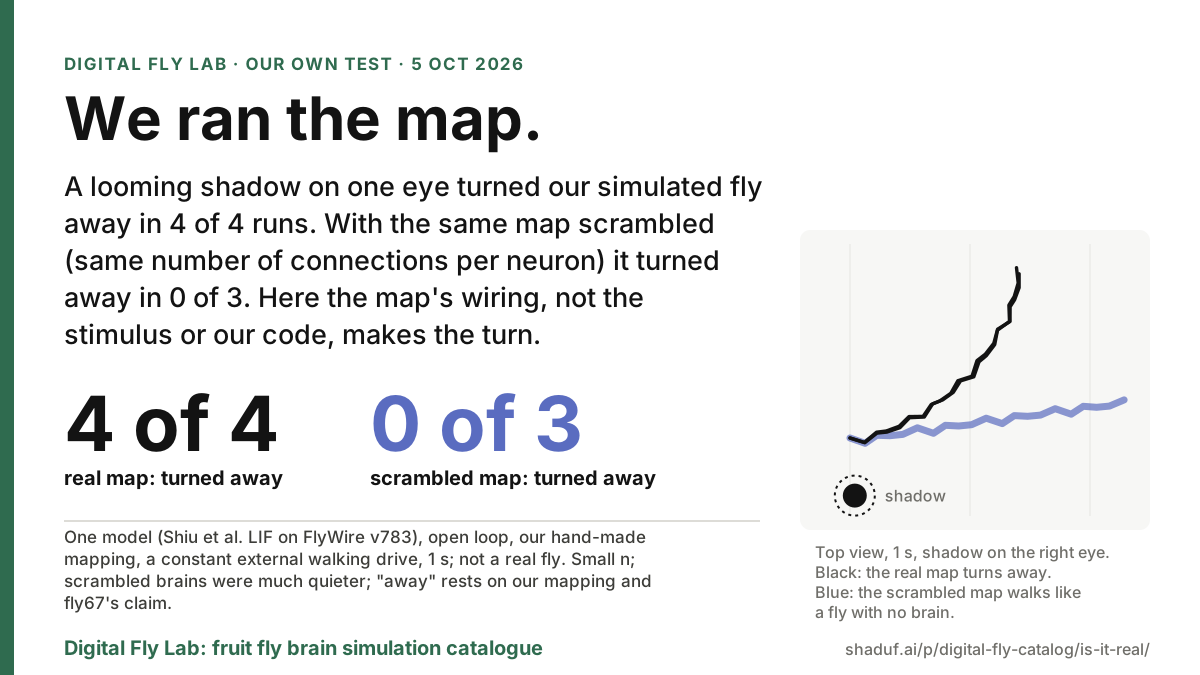
Read this before sharing. One model (Shiu et al. LIF on FlyWire v783), open loop, our hand-made mapping, a constant external walking drive, 1 s; not a real fly.
- Small n. A looming trial took about 160 s instead of the planned 60–70 s, so the pre-registered time limits fired: 4 real runs and 3 scrambled runs instead of 6 and 6, and the 3 scrambled runs sent drives identical to the no-brain floor, so in effect they are one walk. The "5 of 6" rule was applied as a share (4 of 4), a change decided before any body run.
- The scrambled brains were much quieter. They fired about half as many spikes as the real brain (activity ratio 0.50; outside the stimulated neurons about 1,000 vs 15,000). On 5 Oct we could not run an activity-matched scramble in time, so the ledger first rated the comparison unfair, with weak method. On 6 Oct we ran it, brain only: scrambled maps turned up until they were as busy as the real one still sent no turn command (3 of 3), and their drives equal the no-brain floor, so by its fixed rules the ledger now rates the row fair, with a strong method (details).
- The direction. "Away" rests on our mapping's DNa02 sign and on fly67's claim. As we said before the test: "fly67's claim; the direction in real flies was not verified by us." A 2017 study of walking flies describes looming-evoked backing up and turning through other neurons (LC16 and MDN), not through DNa02.
- A strong, artificial stimulus: every LC4 and LPLC2 neuron of one eye at 80 Hz for 1 s, as fly67 does. A real approaching object recruits fewer cells, with timing. The giant-fibre-off and gain-matched arms ran on 6 Oct at brain level only; no new body runs yet.
The brain part was reproduced. fly67's own pass rule held in our Brian2 run of the Shiu et al. model: giant fibre 111.5–120.5 Hz (fly67's engine: 114.8 / 120.3), DNa02 on the far side 23–44 Hz, near side 0 Hz. In all 3 scrambled brains every readout stayed at 0 Hz. Our test is not fly67's own control, so fly67 stays grade B.
Numbers behind the chart (all 14 body runs)
| Run | Group | Shadow on | Heading change (°) | Away (°) | Away beyond floor (°) | Turned away | Forward after onset (mm) |
|---|---|---|---|---|---|---|---|
| F (floor) | No brain, constant drive (floor) | – | -1.49 | – | – | – | 11.50 |
| L-real-0 | Real map | left eye | -33.61 | 33.61 | 32.12 | yes | 10.73 |
| L-real-1 | Real map | left eye | -40.63 | 40.63 | 39.14 | yes | 10.47 |
| R-real-0 | Real map | right eye | 64.06 | 64.06 | 65.55 | yes | 8.30 |
| R-real-1 | Real map | right eye | 68.29 | 68.29 | 69.78 | yes | 8.24 |
| L-D3 | Scrambled map (same drive as F) | left eye | -1.49 | 1.49 | 0.00 | no | 11.50 |
| L-D4 | Scrambled map (same drive as F) | left eye | -1.49 | 1.49 | 0.00 | no | 11.50 |
| R-D3 | Scrambled map (same drive as F) | right eye | -1.49 | -1.49 | 0.00 | no | 11.50 |
| rand-L0 | No brain, random steering | left eye | 6.58 | -6.58 | -8.07 | no | 11.35 |
| rand-L1 | No brain, random steering | left eye | 10.39 | -10.39 | -11.88 | no | 11.37 |
| rand-L2 | No brain, random steering | left eye | -1.10 | 1.10 | -0.38 | no | 11.25 |
| rand-R0 | No brain, random steering | right eye | 19.77 | 19.77 | 21.26 | yes | 11.21 |
| rand-R1 | No brain, random steering | right eye | 14.77 | 14.77 | 16.25 | yes | 11.01 |
| rand-R2 | No brain, random steering | right eye | 18.71 | 18.71 | 20.20 | yes | 10.89 |
Pre-registered reading: "the turn away needs the wiring" (scrambled retention 0.00 by the pre-registered floor method, 0.0096 in the ledger's single-floor method; both under the 0.1 line). Share of drive values at the ±1.2 clip: 0.00. Mapping (ours, hand-made, not fitted): drive_s = clip(0.8 − m_s − 0.5·(a_s − a_o), −1.2, 1.2), with a = DNa02 rate ÷ 100 Hz and m = mean MDN rate ÷ 100 Hz; the 0.8 is an external walking drive, not the brain.
What the brain sends down, beside fly67's own numbers
fly67's own pass rule held in our Brian2 run, so the brain part is reproduced in a second engine: giant fibre 111.5–120.5 Hz (fly67's engine: 114.8 and 120.3 Hz), DNa02 on the far side 23–44 Hz, on the near side 0 Hz. In every scrambled map all of these stayed at 0 Hz. fly67 stays grade B: our test is not the author's own control.
| Trial | Shadow on | Giant fibre L / R (mean) | DNa02 L / R | LI | MDN (mean) | Whole-brain spikes | Active neurons | fly67's rule |
|---|---|---|---|---|---|---|---|---|
| fly67, the author's engine (committed, 45f62fd9) | left eye | – (114.8) | 0 / 25 | – | 0.8 | – | – | pass |
| fly67, the author's engine (committed, 45f62fd9) | right eye | – (120.3) | 43 / 0 | – | 3.3 | – | – | pass |
| Real map, seed 0 (our brain gate) (L-real-0) | left eye | 129 / 94 (111.5) | 0 / 23 | 0.96 | 0 | 27,367 | 657 | pass |
| Real map, seed 1 (L-real-1) | left eye | 129 / 99 (114) | 0 / 28 | 0.97 | 0 | 27,538 | 711 | pass |
| Real map, seed 0 (our brain gate) (R-real-0) | right eye | 89 / 149 (119) | 44 / 0 | 0.98 | 5.25 | 27,701 | 677 | pass |
| Real map, seed 1 (R-real-1) | right eye | 85 / 156 (120.5) | 44 / 0 | 0.98 | 3.5 | 27,509 | 682 | pass |
| Scrambled map, shuffle 3 (L-D3) | left eye | 0 / 0 (0) | 0 / 0 | 0.00 | 0 | 13,993 | 349 | fail |
| Scrambled map, shuffle 4 (L-D4) | left eye | 0 / 0 (0) | 0 / 0 | 0.00 | 0 | 13,938 | 336 | fail |
| Scrambled map, shuffle 3 (R-D3) | right eye | 0 / 0 (0) | 0 / 0 | 0.00 | 0 | 13,134 | 351 | fail |
| Run on 6 Oct 2026 (brain only) | The trials missing here (real seed 2, shuffles 4 and 5, the giant fibre silenced and the gain-matched scrambled brain) ran on 6 Oct with a faster input that passed a pre-registered check against these trials, plus a new interior-only scramble. Their numbers are in Where in the wiring is the turn? | |||||||
What it shows
- The map's wiring carries the signal. With the real wiring, the escape neuron and the far-side turning neurons fire; in scrambled maps with the same number of connections per neuron they stay silent, and the fly walks exactly as if it had no brain.
- Not the stimulus or our code alone. Every arm got the same shadow, the same mapping and the same body; only the wiring differed. Left shadows turned the fly right and right shadows turned it left (2 of 2 each).
- fly67's brain-level claim holds in a second engine (our Brian2 run of the same model).
What it does not show
- That a real fly turns this way. The direction rests on our mapping's DNa02 sign and on fly67's claim. Our caption, fixed before the test: "fly67's claim; the direction in real flies was not verified by us." In real flies the giant fibre triggers a take-off, not walking.
- A large test. 4 real runs and 3 scrambled runs (in effect one walk), and on 5 Oct the scrambled brains were much quieter (activity ratio 0.50). The activity-matched scramble and the giant-fibre-off arm followed on 6 Oct, at brain level only (below); with them the ledger now rates the row fair, with a strong method.
- That the map is a brain. One model (Shiu et al. LIF on FlyWire v783), open loop, our hand-made mapping, a constant external walking drive, 1 s; not a real fly. As in Who does the walking?, the legs are FlyGym's.
Share it with its caveats: the result card (SVG) carries the sentence, the numbers and the caveat. The ledger row: Does fly wiring help? · build it: Add a sense: looming · method and every run: report of 5 Oct 2026.
Where in the wiring is the turn?
Added 6 Oct 2026 · made by us · brain only · pre-registered at 09:42:54 UTC before the first trial · it changes no grade
The looming test above left two questions. The scrambled brains were about half as active as the real one, so was the turn lost only because they were too quiet? And which part of the wiring carries it? We went back to the brain model alone (no body) with the same shadow and asked three things: does a scrambled map turned up to the real map's activity produce the turn command? Does scrambling only the inside of the map, while keeping every connection onto the output neurons, remove it? And does the turn need the escape neuron?
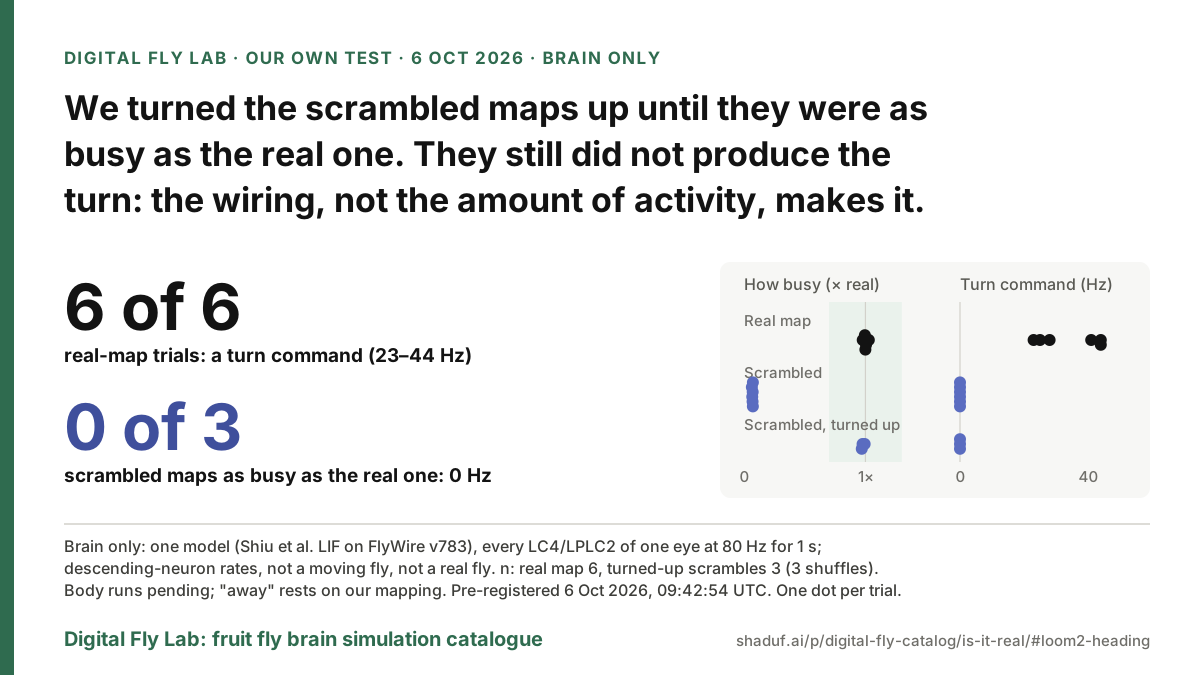
We turned the scrambled maps up until they were as busy as the real one. They still did not produce the turn: the wiring, not the amount of activity, makes it.
One model, brain only: the caveats are inside the chart and listed below it. Circles: shadow on the left eye; squares: right eye. Marks are spread up and down where values are equal. Pre-registered at 09:42:54 UTC on 6 Oct 2026, before the first trial; the 5 Oct trials of the real map and the plain scramble are included as they were.
Read this before sharing. One model (Shiu et al. LIF on FlyWire v783), brain only, every LC4/LPLC2 of one eye at 80 Hz for 1 s; descending-neuron rates, not a moving fly; not a real fly.
- Brain level only. No fly walked in these trials. Seven of the 22 new trials sent drives that differ from the no-brain floor (the two new real trials, both giant-fibre-off trials, one inside-only trial and two off-band gain-search trials); they wait for body runs on our next check. The other 15, including all 3 matched turned-up trials and the 3 new plain scrambles, sent exactly the floor's drive (same sha256), so their body result is the floor's walk by determinism.
- Small n. Real map 6 trials, plain scramble 6 (3 shuffles), turned up 3 matched trials (3 shuffles, one gain; plus 6 search trials), inside-only 6 (3 shuffles), giant fibre silenced 2. Only the left eye was used for the turned-up arm, as pre-registered; its activity rises steeply with gain (about 9,000 to more than 22,000 spikes between gains 2.0 and 2.5).
- A faster input. The 6 Oct trials fed the 80 Hz input through one Poisson group instead of one input per neuron, which cut a trial from about 165 s to about 62 s. It is statistically equivalent, not bit-exact: it passed every criterion of its pre-registered check (gate V) on both eyes, and the plain scrambles agree with 5 Oct in both modes.
- The direction. "Turn command" is the far-side minus the near-side DNa02 rate, the side convention of our 5 Oct test; "away" rests on our hand-made mapping and on fly67's claim. A primary source for "away" in real flies, Card and Dickinson 2008, covers take-off direction only, not walking turns or DNa02.
- Partly expected from the map. The looming neurons have no direct synapses onto DNa02, so an inside-only scramble that breaks every relay was likely to remove the turn command; what the trials add is that no other route rebuilt it, and that the escape signal survived only on the side with direct synapses.
Open the share card (SVG): the sentence, the numbers, the caveats and the date on one image.
- Pre-registered Scrambled and turned up to the real activity.
We turned the scrambled maps up until they were as busy as the real one. They still did not produce the turn: the wiring, not the amount of activity, makes it.
Reading by the rule: "the turn needs the wiring even at the same activity": 3 shuffles matched the real activity (gain 2.25, outside-activity 0.98 × real, whole brain 27,166–27,515 spikes vs 27,686), 0 of them produced the turn command. - Pre-registered Scrambled inside only (every edge onto descending, motor and endocrine neurons and out of sensory and ascending neurons kept; the rest shuffled).
Scrambling only the inside of the map kept about -9% of the turn command and 69% of the escape signal.
In plain words, −9% means none (the far-side command was absent in all 6); it is slightly negative because in one trial the near-side DNa02 fired 1 Hz. Readings by the rules: turn command "the turn needs the wiring in between" (fly67's DNa02 rule passed in 0 of 6); escape signal "partly" (giant-fibre retention 0.69, below the 0.9 bar for "rides on direct connections"; above 50 Hz in 6 of 6).Descriptive, not pre-registered Per neuron, the kept part is one side: the near-side giant fibre, which gets 832 (left) and 1,053 (right) direct synapses from the looming neurons, kept firing at 151–169 Hz (real map: 129 and 149–156 Hz); the far-side giant fibre went to 0 Hz (real map: 84–104 Hz).
- Pre-registered Giant fibre silenced (every synapse out of both giant fibres, DNp01, set to zero; the fibres themselves still spike).
With the escape neuron silenced, the turn command stayed.
Reading: "steering survives silencing the giant fibre" (fly67's rule passed on both sides; far-side DNa02 changed by −2 Hz and 0 Hz against the paired real trials). This was expected from the wiring: the map has no giant fibre → DNa02 connections at all, so the test checks fly67's claim in our engine, not a hidden route. - Pre-registered Plain scramble (same number of connections per neuron): 6 trials over 3 shuffles, every readout 0 Hz, and the brain about 14 times quieter outside the stimulated neurons (0.07 × real).
Numbers behind the chart (all 29 brain trials)
| Trial | Run and input | Arm | Shadow on | Shuffle | Gain | Giant fibre L / R | DNa02 L / R | Turn command | LI | fly67's rule | Whole-brain spikes | Outside activity (× real) | Body |
|---|---|---|---|---|---|---|---|---|---|---|---|---|---|
| LOOML-real-0 | 5 Oct, one input per neuron | Real map | left eye | – | – | 129 / 94 | 0 / 23 | 23 | 0.96 | pass | 27,367 | 0.98 | walked on 5 Oct |
| LOOML-real-1 | 5 Oct, one input per neuron | Real map | left eye | – | – | 129 / 99 | 0 / 28 | 28 | 0.97 | pass | 27,538 | 0.99 | walked on 5 Oct |
| LOOML-real-2-f | 6 Oct, fast input | Real map | left eye | – | – | 129 / 104 | 0 / 25 | 25 | 0.96 | pass | 28,153 | 1.03 | body run pending |
| LOOMR-real-0 | 5 Oct, one input per neuron | Real map | right eye | – | – | 89 / 149 | 44 / 0 | 44 | 0.98 | pass | 27,701 | 1.00 | walked on 5 Oct |
| LOOMR-real-1 | 5 Oct, one input per neuron | Real map | right eye | – | – | 85 / 156 | 44 / 0 | 44 | 0.98 | pass | 27,509 | 1.00 | walked on 5 Oct |
| LOOMR-real-2-f | 6 Oct, fast input | Real map | right eye | – | – | 84 / 149 | 41 / 0 | 41 | 0.98 | pass | 27,693 | 1.00 | body run pending |
| LOOML-real-2-gfoff-f | 6 Oct, fast input | Giant fibre silenced | left eye | – | – | 131 / 95 | 0 / 23 | 23 | 0.96 | pass | 27,541 | 0.99 | body run pending |
| LOOMR-real-2-gfoff-f | 6 Oct, fast input | Giant fibre silenced | right eye | – | – | 84 / 151 | 41 / 0 | 41 | 0.98 | pass | 27,607 | 0.99 | body run pending |
| LOOML-D-3 | 5 Oct, one input per neuron | Scrambled | left eye | 3 | – | 0 / 0 | 0 / 0 | 0 | 0.00 | fail | 13,993 | 0.07 | same drive as the floor (5 Oct) |
| LOOML-D-4 | 5 Oct, one input per neuron | Scrambled | left eye | 4 | – | 0 / 0 | 0 / 0 | 0 | 0.00 | fail | 13,938 | 0.07 | same drive as the floor (5 Oct) |
| LOOML-D-5-f | 6 Oct, fast input | Scrambled | left eye | 5 | – | 0 / 0 | 0 / 0 | 0 | 0.00 | fail | 13,872 | 0.07 | same drive as the floor |
| LOOMR-D-3 | 5 Oct, one input per neuron | Scrambled | right eye | 3 | – | 0 / 0 | 0 / 0 | 0 | 0.00 | fail | 13,134 | 0.06 | same drive as the floor (5 Oct) |
| LOOMR-D-4-f | 6 Oct, fast input | Scrambled | right eye | 4 | – | 0 / 0 | 0 / 0 | 0 | 0.00 | fail | 13,152 | 0.07 | same drive as the floor |
| LOOMR-D-5-f | 6 Oct, fast input | Scrambled | right eye | 5 | – | 0 / 0 | 0 / 0 | 0 | 0.00 | fail | 13,149 | 0.07 | same drive as the floor |
| LOOML-G-3-g2-f | 6 Oct, fast input | Turned up (search) | left eye | 3 | 2 | 0 / 0 | 0 / 0 | 0 | 0.00 | fail | 22,352 | 0.64 | same drive as the floor |
| LOOML-G-4-g2-f | 6 Oct, fast input | Turned up (search) | left eye | 4 | 2 | 1 / 0 | 0 / 0 | 0 | 0.00 | fail | 21,412 | 0.58 | same drive as the floor |
| LOOML-G-5-g2-f | 6 Oct, fast input | Turned up (search) | left eye | 5 | 2 | 0 / 0 | 0 / 0 | 0 | 0.00 | fail | 21,967 | 0.62 | same drive as the floor |
| LOOML-G-3-g2.25-f | 6 Oct, fast input | Turned up (matched) | left eye | 3 | 2.25 | 0 / 0 | 0 / 0 | 0 | 0.00 | fail | 27,515 | 0.99 | same drive as the floor |
| LOOML-G-4-g2.25-f | 6 Oct, fast input | Turned up (matched) | left eye | 4 | 2.25 | 1 / 0 | 0 / 0 | 0 | 0.00 | fail | 27,252 | 0.98 | same drive as the floor |
| LOOML-G-5-g2.25-f | 6 Oct, fast input | Turned up (matched) | left eye | 5 | 2.25 | 0 / 1 | 0 / 0 | 0 | 0.00 | fail | 27,166 | 0.97 | same drive as the floor |
| LOOML-G-3-g2.5-f | 6 Oct, fast input | Turned up (search) | left eye | 3 | 2.5 | 0 / 0 | 0 / 0 | 0 | 0.00 | fail | 35,282 | 1.52 | same drive as the floor |
| LOOML-G-4-g2.5-f | 6 Oct, fast input | Turned up (search) | left eye | 4 | 2.5 | 3 / 0 | 3 / 0 | -3 | -0.75 | fail | 36,988 | 1.63 | body run pending |
| LOOML-G-5-g2.5-f | 6 Oct, fast input | Turned up (search) | left eye | 5 | 2.5 | 0 / 0 | 0 / 1 | 1 | 0.50 | fail | 48,682 | 2.42 | body run pending |
| LOOML-B-301-f | 6 Oct, fast input | Inside only | left eye | 301 | – | 153 / 0 | 0 / 0 | 0 | 0.00 | fail | 17,949 | 0.35 | same drive as the floor |
| LOOML-B-302-f | 6 Oct, fast input | Inside only | left eye | 302 | – | 151 / 0 | 0 / 0 | 0 | 0.00 | fail | 17,711 | 0.33 | same drive as the floor |
| LOOML-B-303-f | 6 Oct, fast input | Inside only | left eye | 303 | – | 153 / 0 | 0 / 0 | 0 | 0.00 | fail | 18,195 | 0.36 | same drive as the floor |
| LOOMR-B-301-f | 6 Oct, fast input | Inside only | right eye | 301 | – | 0 / 169 | 0 / 1 | -1 | -0.50 | fail | 17,282 | 0.34 | body run pending |
| LOOMR-B-302-f | 6 Oct, fast input | Inside only | right eye | 302 | – | 0 / 169 | 0 / 0 | 0 | 0.00 | fail | 18,227 | 0.40 | same drive as the floor |
| LOOMR-B-303-f | 6 Oct, fast input | Inside only | right eye | 303 | – | 0 / 167 | 0 / 0 | 0 | 0.00 | fail | 20,415 | 0.54 | same drive as the floor |
fly67's own committed numbers (the author's JavaScript engine, not ours, 45f62fd9): left loom giant fibre 114.8 Hz, DNa02 0 / 25; right loom 120.3 Hz, 43 / 0. Gate V for the fast input: giant fibre 116.5 Hz on both eyes (band 94.8–138.6), LI 0.96 and 0.98 (≥ 0.90), stimulated rate 80.1 and 80.3 Hz, whole brain 28,153 and 27,693 spikes. Trials took 55–73 s (mean 61.8 s, 22 trials) against 152–177 s with the 5 Oct input.
What the map's own counts already said
Before the first trial we counted where the looming neurons' synapses go in the map. They reach the turning neurons DNa02 only through relays, the strongest being PVLP141 on the eye's side, while they synapse directly onto the giant fibre of their own side. That is why the inside-only scramble could break the route to DNa02 while the direct route to the giant fibre stayed, and why silencing the giant fibre could not touch the turn: the map has no giant fibre → DNa02 connections.
What it shows
- Not just a quieter brain. Scrambled maps turned up to the real map's activity (0.98 × outside the stimulated cells, and the same whole-brain spike count) still sent no turn command in 3 of 3. In this model the turn needs the wiring, not only the amount of activity.
- The turn runs through the inside of the map. "Scrambling only the inside of the map kept about -9% of the turn command and 69% of the escape signal." The −9% means none: the far-side command was absent in all 6 trials.
- Steering does not need the escape neuron in this map: with the giant fibre's outputs silenced, the turn command stayed (23 and 41 Hz).
What it does not show
- A moving fly. These are spike counts of descending neurons in one model over 1 s. No body ran; 7 new drives wait for body runs.
- A surprise about the escape neuron. The map has no giant fibre → DNa02 connections, so "steering survives" was expected; it checks fly67's claim in our engine.
- A real fly. One model on one fly's map, with a strong artificial stimulus; "away" rests on our mapping and fly67's claim. Which relay matters most (PVLP141 is the top candidate) has not been tested directly.
Share it with its caveats: the share card (SVG). Every trial, the gain search and the deviations: report of 6 Oct 2026 · the ledger row: Does fly wiring help?
Who does the walking?
Added 2 Oct 2026 · our own test, pre-registered · context for embodied claims; it changes no grade
"The fly brain learned to walk" is the most common embodied claim: Eon's embodied fly, the Gorilla Tag video ("learned to move around as a gorilla") and FLY67, whose browser fly turns the rates of the walking neurons P9, DNa02 and MDN into an animated walk with hand-set gains. We could not inspect Eon's or Gorilla Tag's code, so we built the setup ourselves: the Shiu et al. whole-brain model (FlyWire) drives FlyGym's walking fly, the most-used simulated fly body, through two numbers every 100 ms.
What makes the fly walk. (1) Legs, rhythm and balance come from FlyGym's walking controller. (2) The brain sends two numbers, left and right, every 100 ms. (3) How neuron rates become those two numbers is our hand-made mapping. Paths are drawn to scale from the thorax position every 10 ms; forward is to the right. The three scrambled-brain paths coincide because their drives were identical. Our test of 2 Oct 2026, pre-registered before the first trial.
Open the chart as an image (SVG) to share it; it carries its own title, numbers and source line.
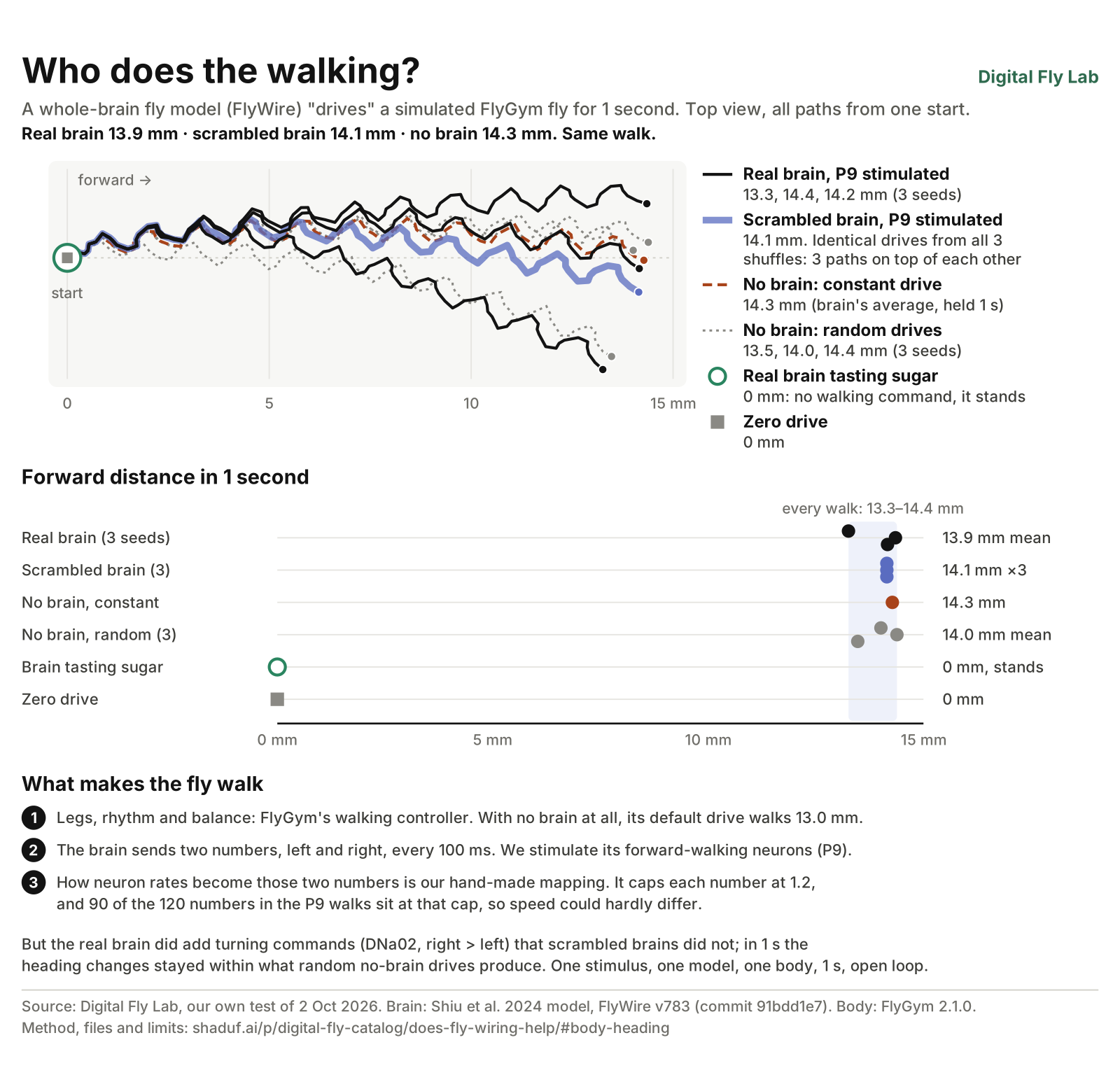
Read this before sharing. The fly walks because we stimulate its forward-walking neurons (P9); P9 fires at the same rates whether the rest of the brain is real or scrambled. Our mapping caps each drive number at 1.2, and 90 of the 120 drive values of the six P9 walks (75%) sit exactly at the 1.2 clip, so forward speed could hardly differ between conditions by construction. Another hand-made mapping could let the wiring matter more. One stimulus, one model, one body, 1 s of walking, open loop (the body never feeds back to the brain).
The brain is not doing nothing. Only the real wiring recruited the turning neurons DNa02, more on the right than the left in all three seeds; the scrambled brains recruited no mapped neuron. That turned the real-brain fly by −0.4° to −26°, but random no-brain drives turned it by −7° to −27° in the same second, so 1 s of walking cannot tell the two apart. Sugar: the same brain tasting sugar fires its feeding neuron MN9 at 82 Hz while every walking command neuron stays at 0 Hz, so the fly stands.
Numbers behind the chart (all 18 runs)
| Run | Group | Forward (mm) | Heading (°) | Path (mm) | Drive L / R | Brain sends (Hz) | Files |
|---|---|---|---|---|---|---|---|
| Real brain, P9, trial seed 0 | Real brain | 13.26 | -26.3 | 18.89 | 1.20 / 1.00 | P9 130/162, DNa02 7/29, MDN 0/0 | body/P9-real-0.json drives/P9-real-0.json brain/P9-real-0.json |
| Real brain, P9, trial seed 1 | Real brain | 14.35 | -0.4 | 19.64 | 1.16 / 1.11 | P9 146/132, DNa02 11/21, MDN 0/0 | body/P9-real-1.json drives/P9-real-1.json brain/P9-real-1.json |
| Real brain, P9, trial seed 2 | Real brain | 14.17 | -14.4 | 19.50 | 1.19 / 1.06 | P9 141/136, DNa02 10/25, MDN 0/0 | body/P9-real-2.json drives/P9-real-2.json brain/P9-real-2.json |
| Scrambled brain, P9, shuffle 3 | Scrambled brain | 14.15 | -14.6 | 19.52 | 1.20 / 1.06 | P9 130/162, DNa02 0/0, MDN 0/0 | body/P9-D3.json drives/P9-D3.json brain/P9-D-3.json |
| Scrambled brain, P9, shuffle 4 | Scrambled brain | 14.15 | -14.6 | 19.52 | 1.20 / 1.06 | P9 130/162, DNa02 0/0, MDN 0/0 | body/P9-D4.json drives/P9-D4.json brain/P9-D-4.json |
| Scrambled brain, P9, shuffle 5 | Scrambled brain | 14.15 | -14.6 | 19.52 | 1.20 / 1.06 | P9 130/162, DNa02 0/0, MDN 0/0 | body/P9-D5.json drives/P9-D5.json brain/P9-D-5.json |
| No brain, constant drive (L 1.18, R 1.06) | No brain | 14.28 | -11.3 | 19.49 | 1.18 / 1.06 | no brain | body/matched.json drives/matched.json |
| No brain, random drive, seed 0 | No brain | 14.01 | -9.7 | 19.07 | 1.16 / 1.05 | no brain | body/random-0.json drives/random-0.json |
| No brain, random drive, seed 1 | No brain | 14.39 | -7.5 | 19.65 | 1.18 / 1.08 | no brain | body/random-1.json drives/random-1.json |
| No brain, random drive, seed 2 | No brain | 13.48 | -27.2 | 18.81 | 1.19 / 0.97 | no brain | body/random-2.json drives/random-2.json |
| Real brain tasting sugar | Sugar | 0.00 | -0.0 | 0.12 | 0.00 / 0.00 | P9 0/0, DNa02 0/0, MDN 0/0 | body/SUG-real-0.json drives/SUG-real-0.json brain/SUG-real-0.json |
| Zero drive | Floor | 0.00 | -0.0 | 0.12 | 0.00 / 0.00 | no brain | body/zero.json drives/zero.json |
| FlyGym default drive (1, 1), sanity check | No brain (sanity) | 13.01 | 6.7 | 17.48 | 1.00 / 1.00 | no brain | body/const-1.json drives/const-1.json |
| Scrambled brain tasting sugar, shuffle 3 | Sugar (fill) | 0.00 | -0.0 | 0.12 | 0.00 / 0.00 | P9 0/0, DNa02 0/0, MDN 0/0 | body/SUG-D3.json drives/SUG-D3.json brain/SUG-D-3.json |
| Scrambled brain tasting sugar, shuffle 4 | Sugar (fill) | 0.00 | -0.0 | 0.12 | 0.00 / 0.00 | P9 0/0, DNa02 0/0, MDN 0/0 | body/SUG-D4.json drives/SUG-D4.json brain/SUG-D-4.json |
| Scrambled brain tasting sugar, shuffle 5 | Sugar (fill) | 0.00 | -0.0 | 0.12 | 0.00 / 0.00 | P9 0/0, DNa02 0/0, MDN 0/0 | body/SUG-D5.json drives/SUG-D5.json brain/SUG-D-5.json |
| Real brain, left P9 only | Real brain (fill) | -4.77 | 254.2 | 12.75 | -0.07 / 1.11 | P9 131/0, DNa02 14/0, MDN 0/0 | body/P9L-real-0.json drives/P9L-real-0.json brain/P9L-real-0.json |
| Scrambled brain, left P9 only, shuffle 3 | Scrambled brain (fill) | -2.18 | 210.3 | 10.16 | 0.00 / 1.11 | P9 131/0, DNa02 0/0, MDN 0/0 | body/P9L-D3.json drives/P9L-D3.json brain/P9L-D-3.json |
Retention, (null − zero) / (real − zero) on the mean forward distance: scrambled 1.016, brainless constant 1.025, brainless random 1.002. Mapping (ours, hand-made, not fitted): drive_s = clip(pbar − 0.5·(p_s − p_o) − m_s − 0.5·(a_s − a_o), −1.2, 1.2) with p, m, a = DNp09, MDN and DNa02 rates ÷ 100 Hz.
What it shows
- The legs walk by themselves. FlyGym's controller makes the steps, rhythm and balance; with no brain at all, its default drive walks 13.0 mm in 1 s.
- The brain does not need to be real for this walk. Stimulating P9 makes the fly walk about 14 mm whether the rest of the brain is real, scrambled or absent.
- The real brain does add turning commands (DNa02) that scrambled brains lack, the same neurons the steering study above uses. In 1 s their effect is within what random drives produce.
What it does not show
- It is not a test of Eon's, Gorilla Tag's or any other demo's code. It shows where the walking comes from in the most common setup, so a claim of a brain that "learned to walk" needs its own control.
- Our mapping caps the drive, so speed could hardly differ by construction. One stimulus, one model, one body, 1 s, open loop.
Questions to ask of a "brain walks" video: who chose which neurons to stimulate? Does the body have its own walking controller? How do neuron rates become leg commands, and who wrote that rule? Does the same body walk with a scrambled brain, or with no brain? Full test: Does fly wiring help? · build it: Add a body.
Five questions to ask about any fly brain demo
-
Which wiring does it load?
Look for a named dataset and version, such as a FlyWire connectome release. "Inspired by the fly brain" or "based on the connectome" without a file or version is a warning sign.
- Measured, if a real release is loaded
-
What turns the wiring into activity?
There must be a neuron model that runs over time. If the code only draws the network, or picks neurons at random for display, the brain is decoration.
- Modelled
-
Who chose the inputs and outputs?
In most games, the author decides which neurons "see" the screen and which neurons press which keys. That choice can matter more than the brain itself.
- Hand-made
-
Was anything trained, or scripted?
A trained readout or controller can learn to play well with almost any network behind it. Animation or game code can make a fly move without any neuron firing.
- Trained
- Scripted
-
Was it compared with anything?
The strongest projects compare their result with real fly experiments, or run the same test with shuffled or random wiring. If the shuffled brain does just as well, the real wiring did not help.
Our evidence grades
- ATested against data or a control
A named connectome release runs in a neuron model, and the output is compared with real fly experiments or with a proper control such as shuffled wiring. Methods and code or data are public. A careful negative result also gets grade A.
- BConnectome runs, hand-made inputs and outputs
The code loads a named connectome release and simulates activity that drives the behaviour. The author chose which neurons get the input and which neurons control the output. Trained readouts are allowed but flagged. No control or benchmark.
- CPartial, stand-in or decorative network
A small hand-picked circuit with set or trained weights, a network that is not taken from the connectome, or a real connectome whose activity only triggers scripted movements. The network is not the main source of the behaviour.
- DScripted or ordinary game logic
The behaviour comes from normal code, animation, a controller without connectome limits, or a language model. Any neurons on screen are cosmetic.
- UUnverified claim
We could not inspect how it works: there is no code, the code does not match the claim, or there is only a video or post. We record the claim and its source.
- n/aInfrastructure
Datasets, bodies, simulators, analysis tools and directories. We do not grade them for behaviour; they get licence, maintenance and setup notes instead.
We give the lowest grade whose conditions all hold, and we grade from code, configuration, data loading or paper methods that we inspected, never from a README headline alone.
Verdicts on viral fly brain claims
Each row splits a viral claim into its parts: what the simulated brain really does, and what a person chose, trained or scripted. We inspected the code on 28 September 2026 and re-checked the rows on 29 and 30 September and 1, 2, 3 and 5 October; the last column shows each row's latest check. On 2 October the Terraria fly was added at the top, the first viral video claim this week with code; on 1 October two video claims were added, Gorilla Tag and a Roblox fight, both without code; on 30 September the FlyLeno claim was added and the Doom row gained the autopilot sweep. Results are the authors' own numbers; we did not re-run these projects. "Watch" links open the matching cards in the Video gallery.
| Claim and source | What the simulated brain does | Hand-made, trained or scripted | Measured result (by the authors) | Grade | Last checked |
|---|---|---|---|---|---|
| New 2 Oct 2026 "I put a fly's brain into Terraria. And tried to train it" YouTube video by George Ostrobrod (in Russian), uploaded 29 Sep 2026; 42,229 views on 5 Oct 2026 (32,632 on 3 Oct, 3,580 on 1 Oct) video · code (GitLab) · entry fly-terraria Watch: YouTube, length not recorded |
The MaleCNS v1.0 connectome (166,700 neurons, 25,088,107 signed connections; the input files' checksums are enforced) runs as a sparse spiking model with adaptation. Synapses change with reward-modulated plasticity, rewarded by the body's own energy, water and harm signals. | Game light, smell, touch, pain and balance are injected into hand-picked sensory neuron groups (the author calls the receptor assignment "approximate"); motor neuron groups are decoded into turning, walking, feeding, grip and adhesion with fixed hand-set functions. Grip and adhesion have documented scripted fall-backs when the graph lacks those neurons. The 2-D body is a Terraria mod. | One 13.7-hour run, 176 lives; we recomputed the log: mean lifespan 278.4 s, and the median rose from 102.8 s (first 44 lives) to 163.3 s (last 44; our permutation p = 0.037). No control: the author's own report says there was no plasticity-off control and that the world changed during the run. What would change it: paired plastic and plasticity-disabled runs from the same start (the author's own suggestion), or the same body with scrambled wiring; code that matches the video. |
B Graded 2 Oct 2026 from the files at commit 9052966d (26 Sep), which is older than the video. Real and candid, but the "learning" is not separated from luck. |
Code unchanged since graded Checked ; graded 2 Oct 2026; GitLab HEAD still the graded commit 44,474 views on 6 Oct 2026 |
| New 1 Oct 2026 "I Taught a Fly How to Play Gorilla Tag (seriously)" YouTube video by SuperCatCrazeGT, uploaded 26 Sep 2026; 899,151 views on 6 Oct 2026 (868,853 on 5 Oct, 724,625 on 3 Oct, 527,756 on 1 Oct, 415,612 on 30 Sep) video · entry fly-gorilla-tag Watch: YouTube, length not recorded |
Not stated. The description says: "Using Its OPEN SOURCE BRAIN, The Fly Learned To Move Around As A Gorilla … It Even Learned How To Play INFECTION!" No connectome release, neuron model or project is named. "Open source brain" fits several catalogued projects, such as the Shiu et al. model and its browser ports, but none is named. | Claimed: the fly "learned" over seven chapters; the method is not stated. How game input reaches neurons and how neurons move the avatar is not stated. The same channel's earlier video, "I Trained an AI to Beat Gorilla Tag's Fastest Player", trained an ordinary AI on the game. | None. No code found: the only description link is a linktr.ee page with 76 links (game maps, socials, sponsors), none naming a fly, brain or connectome; four GitHub searches returned nothing. We have not watched the video, so its on-screen claims are not recorded. What would change it: the controller code with the brain model named, so it can be graded from files; a named base project alone would not raise the grade. |
U Unverified (1 Oct 2026; re-checked 2 Oct: still no code). The most-viewed fly-brain claim in our scans, with no project or code behind it; "the fly learned" may describe a trained controller rather than fly wiring. For how much of a simulated walk a brain itself provides, see our body test (context only). |
No code to re-check Checked ; graded 1 Oct 2026; grade U: nothing to inspect 868,853 views on 5 Oct 2026 |
| New 1 Oct 2026 "I Made Two Real Flies Brain Fight Each other in JJS" YouTube video by Evoke, uploaded 21 Sep 2026; Jujutsu Shenanigans is a Roblox fighting game; 144,054 views on 3 Oct 2026 (141,595 on 2 Oct, 139,364 on 1 Oct) video · entry fly-jjs-fight Watch: YouTube, length not recorded |
Not stated ("real flies brain"). No connectome release, neuron model or project is named. | Claimed: two fly brains control two Roblox fighters. Any coupling would be the creator's own client script, which is not published. | None. The description links only a Discord invite and a Roblox group; three GitHub searches found nothing related (the Roblox script repositories they return are unrelated and not linked). We have not watched the video. What would change it: the controller script and the brain model it calls; the same fight with scrambled wiring or a random-input bot. |
U Unverified (1 Oct 2026): nothing can be inspected. |
No code to re-check Checked ; graded 1 Oct 2026; grade U: nothing to inspect 144,054 views on 3 Oct 2026 |
| New 30 Sep 2026 "Tonight's host: Grey Leno, piloted by Drosophila melanogaster" FlyLeno (TUURD Talk) by AgitationSkeleton, a browser show; Vinesauce's stream of it had 49,331 views on 5 Oct 2026 (36,763 on 30 Sep) show · repository · entry flyleno Watch: YouTube, streamer's playthrough, 1:55:44 |
The whole FlyWire v783 brain (138,639 neurons, every connection kept) runs live and untrained in the browser as the Shiu et al. spiking model. Its descending neurons drive walking, turning, startle, grooming and feeding, and a dopamine signal from its own neurons changes the synapses onto the voice neurons while the show runs. | Show events, thrown objects, music and food stimulate hand-picked sensory neurons; descending-neuron rates are turned into movements with fixed hand-set gains. Engineered layers, labelled as such by the author: a walking rhythm generator, balance "puppet strings", saccades, food seeking, homing, sleep, and an action selector outside the connectome that picks what Leno does next (talk, stroll, turn, rest…) and stimulates the matching neurons. The show itself is ordinary code. | None: no scrambled-wiring or no-brain control. Our browser check (3 Oct 2026): the page fetched the 31.4 MB connectome into a Web Worker and its counters started, then it froze in our headless browser without a GPU (most likely software graphics). This fits the row: the brain runs in the page. Not a play test; details. What would change it: up to A with a scrambled-wiring or no-brain run of the same show and a measured behaviour (for example startle latency, eating decisions or time spent in each action); down to C with evidence that the engineered layers drive most of what is on screen. |
B Borderline C (graded 30 Sep 2026 from the code at commit 078d8fa). The brain is real and really running, but the show is mostly built around it. The viral video is a streamer's playthrough; the claim graded here is the site's and the repository's own. |
Code unchanged since graded Checked ; graded 30 Sep 2026; last commit on or before the grade date 50,377 views on 6 Oct 2026 |
| New 29 Sep 2026 "A digital fly's brain on a Raspberry Pi 5 plays Pokémon" Twitch stream by Leetzerzz; XDA Developers, 28 Sep 2026 XDA article · stream · entry fly-pokemon-pi5-stream |
Claimed: all 139,255 neurons of FlyWire v783 (connections of five or more synapses), simulated on the Pi next to the mGBA emulator. A full brain may well run there; we cannot check it, because no code is published. | By the creator's own account, walls, doors and people are read from the game's memory and fed to looming-detector neurons ("there's no retinotopy"), so the fly does not see the screen. The button decoder and any helper scripts are not published, and chat steers learning by zapping reward and punishment neurons. | None published. The stream title reports game progress (Wartortle level 35, Brock beaten; 29 Sep 2026), but not how much of it comes from the fly, the decoder, chat or other code. Two open-source "fly plays Pokémon" projects, both grade C: acamilo/flybrain (the author's own check found the decoder, not the network, picking directions in long runs, and its streamed runs move by scripted macros) and fly-plays-games (the long walk in its video is a scripted planner). Neither is the stream's code. Their input, emulator or dataset differ from the creator's description and no link names either; this rests on those mismatches, not on proof. |
U No code to inspect (checked 29 Sep 2026; re-checked 30 Sep 2026: still no repository under the creator's name, no recording or follow-up found). The creator describes the limits openly; the stream simply cannot show what the fly contributes. |
No code to re-check Checked ; graded 29 Sep 2026; grade U: nothing to inspect |
| New 29 Sep 2026 "A fly's digital brain plays Rainbow Six Siege" dev.ua, 28 Sep 2026, reporting an X post of 26 Sep by the caster Oleksandr "GHOOD_BHOY" Samoilenko dev.ua report · entry fly-brain-rainbow-six-siege |
Claimed: "over 1,000,000 simulated neurons". That matches no fly connectome: MaleCNS v1.0 has 166,700 neurons and FlyWire v783 has 139,255, so either most of the network is not fly wiring or the number is wrong. | Claimed: about a month of training on "more than 20 TB" of professional players' gameplay. That is ordinary machine learning; any skill would come from the training unless a control shows otherwise. | One in-game kill, described on social media, with no baseline. We read the dev.ua text only through search summaries, because the site blocks our fetches, and X cannot be read without a login. | U Nothing published: no code, model or write-up (searched 29 Sep 2026; re-checked 30 Sep 2026: no clip, code or follow-up). Unlikely to be a fly brain at work. |
No code to re-check Checked ; graded 29 Sep 2026; grade U: nothing to inspect |
| "First embodied fly upload" Eon Systems, March 2026 Eon page · entry eon-embodied-fly Watch: X, 0:43, project site, 0:40, YouTube repost, 1:16, TikTok repost, 1:30 |
By Eon’s own description: the Shiu whole-brain LIF model (FlyWire) plus flyvis vision in a NeuroMechFly body. | A few hand-picked neurons switch pre-trained, imitation-learned walking controllers; sensory rates and gains were "chosen by hand"; Eon calls the vision "somewhat decorative". | None for the embodied fly. The "91%" Eon cites is the brain-only 2024 result. | U Body code not released (checked 28 Sep 2026). If the description is accurate, the mechanism would be grade C. Context, not evidence about Eon's code: in our own body test the walk came from the body controller and the stimulated neurons. |
No code to re-check Checked ; graded 28 Sep 2026; grade U: nothing to inspect |
| "Fly brain plays Doom" DOOMFLY repository · project page · entry doomfly Watch: X, 0:07, X, 0:10 |
The full MaleCNS v1.0 model (166,700 neurons) receives game frames, and its spikes drive the game. | Screen-to-photoreceptor input is an engineered adapter. The four read-out neurons were chosen because they responded to the screen; the biologically expected steering neurons gave zero actions. | Negative: a dopamine "learning" version survived 3.66 s against 5.83 s without learning (two episodes each). The author says learning failed. Removing all connections stops all control. Third-party control (new, 28 Sep 2026): real wiring 53.3 s survival, shuffled wiring 6.75 s, no connections 5.5 s, and a brainless constant autopilot 51.9 s (51.93 s, with its commands matched to the fly's average). The same results file (results/a2/summary.json) also holds a sweep of 12 autopilot settings: the best one survives 53.44 s, slightly longer than DOOMFLY's 53.34 s (checked by us on 30 Sep 2026). The autopilot's constants come from the real fly's average output, so this shows that a constant policy reproduces the behaviour, not that the brain does nothing. Chart · entry doom-fly-control |
B Honest, but no sign of skilled play. The outside controls do not raise the grade. Other Doom projects with controls: doomfly-rl (A: real, shuffled and no wiring score the same) and flydoom by mutkuoz (A: beats a matched random agent only narrowly). |
Code unchanged since graded Checked ; graded 28 Sep 2026; last commit on or before the grade date |
| "I put a real fruit fly brain into Half-Life" FlyBrain-HalfLife, Yusuf Temel; the video says it uses "the biological connectome … MaleCNS v1.0" with 12,260 neurons. A second video (23 Sep 2026) adds: "There is no scripted game AI or traditional reinforcement learning at play here." repository · entry flybrain-halflife Watch: YouTube, 6:26 |
No connectome by default. The released code builds a synthetic 12,260-neuron network with brain-region labels from region sizes. It uses real data only if the user supplies a connectome file (an npz file) themselves. | Steering, attacks and escapes are computed outside the network from image rules and scripted reflexes, then pushed into the output neurons, so the neurons mostly pass the decision on. | None beyond speed benchmarks; no controls. | D Both video claims are contradicted by the code. Re-checked 29 Sep 2026: still commit 0ba5548, unchanged since our 28 Sep check, with no new connectome loader. 139,436 views on 29 Sep 2026. |
Code unchanged since graded Checked ; graded 28 Sep 2026; last commit on or before the grade date 151,759 views on 5 Oct 2026 |
| "A fly’s brain in Minecraft" NeuroCraft Fly post · entry neurocraft-fly Watch: X, 0:09 |
Claimed: all 166,700 MaleCNS v1.0 neurons. | The README says read-outs "select and modulate scripted body programs"; the body moves even with inputs off; some responses survive weight shuffling. | Only numbers reported by the author; no code to check. | U The public repository has documents and two videos only; code and mod "coming soon". |
No code to re-check Checked ; graded 28 Sep 2026; grade U: nothing to inspect |
| Fly Brain Minecraft mod blendi-remade repository · entry fly-brain-minecraft Watch: X, 0:13 |
MaleCNS v1.0 LIF model, using connections with 5 or more synapses. | A reflex layer (odour following, random bouts, collision turns) is on by default and acts when the brain is silent. Looming and motion signals are computed from the game and injected into visual neurons. | Sanity checks against the Shiu model (sugar input drives MN9 at 30–90 Hz); no wiring control. | B | Code unchanged since graded Checked ; graded 28 Sep 2026; last commit on or before the grade date |
| "A fly's brain learned to farm in Minecraft" FlyBridge, SWOT; a third Minecraft project repository · entry flybridge Watch: YouTube, 34:00 |
A 1,536-neuron smell-pathway part of the FlyWire v783 wiring (about 1% of the brain) works as one layer inside a larger policy network. | Every connection strength in that layer is trained, together with trained image encoders and a trained readout. A scripted controller does the walking, aiming and clicking. | The author reports 12 of 12 checks passed in fresh worlds. No stored result compares it with the shuffled or disconnected versions in the code. | C New 28 Sep 2026. The file citations for this grade were spot-read by us, not re-checked line by line. |
Code unchanged since graded Checked ; graded 28 Sep 2026; last commit on or before the grade date 199,171 views on 5 Oct 2026 |
| "No behaviour is scripted" FlyCraft for Minecraft Education repository · entry flycraft |
The FlyWire v783 brain (138,639 neurons); feeding and escape really pass through the network. | Walking, seeking, homing and sleep are decided in Python and injected into the same descending neurons that are read out. | Removes a scripted drive, not the connectome. | C The headline is contradicted by the code. |
Code unchanged since graded Checked ; graded 28 Sep 2026; last commit on or before the grade date |
| "Fly brain plays Beat Saber" viral post, about 23 million views on 28 Sep 2026 post · entry beat-saber-fly Watch: X, 0:31 |
Unknown. | In replies (seen only in search summaries), the author says the motor output was fitted to a replay of one song and that visual training was still running. | None. | U No code, weights or method. |
No code to re-check Checked ; graded 28 Sep 2026; grade U: nothing to inspect |
| "Bad Apple on a fly brain" viral post, about 20.8 million views post · entry bad-apple-fly Watch: X, 0:38 |
A MaleCNS v1.0 LIF model runs. | The picture is mostly the stimulus: neurons under dark video pixels are forced to fire. The README says it is "not a real brain simulation". The body uses pre-programmed FlyGym steps and hand-written gestures. | None. | C | Code unchanged since graded Checked ; graded 28 Sep 2026; last commit on or before the grade date |
| "Playing Mario 64 using a fly’s brain" Fly64 repository · entry fly64 Watch: X, 1:20 |
MaleCNS v1.0 LIF model (166,700 neurons); the stick and buttons come from chosen neurons. | The eye-to-pixel map is partly estimated; stick smoothing, dead zone and jump cooldown are ordinary code; the author’s own coarse model settings. | None: no goal, benchmark or control. | B | Code unchanged since graded Checked ; graded 28 Sep 2026; last commit on or before the grade date |
| "The fly trades bitcoin" Stonkfly repository · entry stonkfly Watch: X, 0:10 |
MaleCNS v1.0 LIF model; profit and loss are sent as dopamine pulses. | The price-to-neuron input and the buy/sell decoder are hand-made; risk limits can block orders; paper trading by default. | The README says "profitable learning has not been demonstrated". | B | Code unchanged since graded Checked ; graded 28 Sep 2026; last commit on or before the grade date |
| "Driven by a live spiking simulation of the real FlyWire connectome" DesktopFly (macOS, with a Windows port); the sentence is the GitHub repository description ("About"), not the README repository · project page · entry desktop-fly |
A 668-neuron FlyWire v783 circuit, plus a 1,045-neuron MaleCNS leg circuit since v1.1.0. | The 23,210 "neurons" on screen are display points. An ordinary state machine switches walk, idle, groom, fly and sleep when neuron rates cross hand-set thresholds; flight, grooming and darting are coded animation, and sleep follows the computer's idle time and the clock, not a neuron. Only walking is driven by the simulated leg neurons. | Only in-model checks. | C Re-graded from B (borderline C) on 29 Sep 2026 after a line-by-line check; the code is unchanged since 5 Sep 2026. No official app downloads exist: see the safety note on the project page. |
Code unchanged since graded Checked ; graded 29 Sep 2026; last commit on or before the grade date |
| "A fruit fly’s wiring diagram is flying this drone" FlyDrones demo · entry flydrones |
The browser demo runs MiniFly, a synthetic 850-neuron network with real cell-type names, not connectome data. | A fixed flight bias, a fixed escape programme, a safety governor and the drone’s own flight controller. | None. | C MaleCNS is only an optional path with no published run. |
Code unchanged since graded Checked ; graded 28 Sep 2026; last commit on or before the grade date |
| "A fly learns to drive and park a car" Flyhard Re-shared on 2 Oct 2026 in a compilation, "Scientists Teach A Fly How To Drive" (Daily Dose of Science; 63,935 views 14 hours after upload, 107,515 on 5 Oct 2026), described as "a simulation of a fly's brain is driving a car". Its thumbnail appears to show Flyhard in its CARLA town; we matched it from the thumbnail only, without watching the video. On 6 Oct 2026 the search page showed this video under another title, "How Your Brain Changes What You Hear" (115,553 views); whether the video itself changed is not known, and the match is flagged for a re-check. compilation repository · entry flyhard Watch: X, 0:25 |
The MaleCNS v1.0 wiring (165,122 traced neurons) as a rate network. | All of its about 25.7 million connection gains were trained to copy a teacher; random fixed input and output maps; turn requests are scripted; no vision. | Steering 100/100 after training against 0/100 before; parallel parking 0/50. | B Trained parts flagged. |
Code unchanged since graded Checked ; graded 28 Sep 2026; last commit on or before the grade date |
The pattern: a real connectome is usually loaded and simulated, but a person decides which neurons see the game and which neurons press which button. In several demos, scripts or trained parts produce most of the visible movement, and one (Half-Life) does not load a connectome at all. None of the viral game demos tests its own behaviour against shuffled wiring; the first outside test of one (DOOMFLY) found that a constant autopilot does about as well. The Pokémon-on-a-Raspberry-Pi and Rainbow Six claims publish no code at all. FlyLeno is the opposite case: its code is open and its brain really runs, but engineered layers shape most of the show. Gorilla Tag and a Roblox fight are videos with hundreds of thousands of views and no project or code behind them that anyone can inspect. The newest, the Terraria fly, is the opposite: open code and a real connectome, but no control. And our own body test shows why a walking body is weak evidence on its own: the body controller walks with or without a real brain.
Claims we could not check (grade U)
- UGorilla Tag (YouTube)
No model, data or code is named; the only link is a page of game maps and socials, and four GitHub searches found nothing (1 Oct 2026). Re-checked 6 Oct 2026 at 899,151 views: still no code. We have not watched the video.
- UTwo fly brains fight in a Roblox game (YouTube)
Only Discord and Roblox-group links; three GitHub searches found nothing related (1 Oct 2026).
- UPokémon on a Raspberry Pi 5 (Twitch)
No code is public: we found no code under the creator's name, and neither the article nor the stream page links any (searched 29 Sep 2026). The input is game memory, not vision, by the creator's own account.
- URainbow Six Siege fly brain
No code, model or write-up; known only from one news report of a social-media post, which we could read only through search summaries.
- UBeat Saber fly
No code, weights or method were published. The author's explanation (motor output fitted to a replay of one song) is known to us only through search summaries of replies.
- UNeuroCraft Fly (Minecraft)
The public repository holds documents, a licence and two videos. The simulation code and mod are "coming soon". The README itself says read-outs select scripted body programs.
- UEon's embodied fly
The body and embodiment code are not released; the public Eon repository is brain-only. Eon's own description points to pre-trained controllers switched by a few hand-picked neurons.
- ULoihi 2 fly brain (Sandia)
A preprint with no code link that we could find.
- Uflybrain.info Lab
The in-browser Lab plays back eight pre-computed runs; the model code behind them is not published.
Common questions
Plain answers to the questions people ask most, each with its evidence and what we are unsure about. Last checked 6 Oct 2026.
Is the fruit fly brain simulation AI?The basic model is not trained AI: it copies the fly's wiring and sets one strength by hand. Many viral demos add trained AI parts around it.
The best-tested model (Shiu et al. 2024) learns nothing: every connection comes from the fly's wiring map, and one strength value is set by hand. Many demos add trained parts. Of 83 graded projects in our catalogue, 45 have a trained, learning or search-tuned part in the main path: 13 a trained readout, 12 train the whole network, 4 a trained vision or text front end, 4 a policy or language model, 12 learning rules or tuned settings; 38 have none. One example: flybrain.app's page says a language model ("Claude") acts as the fly's caretaker; it changes the fly's world (food, light), not its brain model.
trained_class (6 Oct 2026), our reading of each project's code and README. "Learning or tuning" mixes learning rules that run during play (STDP, dopamine plasticity) and a few settings tuned by search. Optional or unused trained parts are noted per entry, not counted. Filter the list with "Trained parts (is it AI?)" on Projects.Since 6 Oct 2026 every catalogue entry carries this as a field, trained_class; on Projects you can filter by "Trained parts (is it AI?)".
Evidence: the field trained_class on the 83 graded entries (report of 6 Oct 2026); the Shiu et al. model entry (trained parts: none; one synapse weight, 0.275 mV, set by hand); the flybrain.app entry (page read 5 Oct 2026).
How sure: the classes come from our reading of each project's code and README; "learning rules or tuned settings" mixes several kinds of tuning, and projects change after we read them.
Is it a brain or just a map?It is a map (a fly brain scan) run with a simple neuron model. In our tests its wiring drove a reflex and a turn; body software did the walking.
The connectome is a map of one adult fly's brain, traced from electron-microscope images: which neurons connect, and through how many synapses. Models run this map with simple neurons and leave out gap junctions, neuromodulators and internal state. Run on our computer, the map gives a sugar reflex (the feeding neuron fires at 82 Hz) that scrambled maps lose (0 Hz), and in our looming test:
We ran the map. A looming shadow on one eye turned our simulated fly away in 4 of 4 runs. With the same map scrambled (same number of connections per neuron) it turned away in 0 of 3. Here the map's wiring, not the stimulus or our code, makes the turn.
A brain-only follow-up on 6 Oct asked whether that was only because scrambled brains are quieter: "We turned the scrambled maps up until they were as busy as the real one. They still did not produce the turn: the wiring, not the amount of activity, makes it." And where in the map: "Scrambling only the inside of the map kept about -9% of the turn command and 69% of the escape signal." (−9% means none: the far-side command was absent in all 6 trials.)
A body simulator, not the brain, does the walking: with its forward-walking neurons stimulated, the FlyGym fly walked 13.9 mm in 1 s with the real brain, 14.1 mm with a scrambled brain and 14.3 mm with no brain.
Evidence: Shiu et al. 2024, which "does not account for gap junctions, non-spiking neurons, internal state or long-range neuropeptides"; the FlyWire entry; our sugar test (four scrambles, re-run bit-exact on 5 Oct 2026); Who does the walking?; We ran the map; Where in the wiring is the turn?
How sure: one model, one fly's map, short open-loop tests with our own hand-made input and output choices; other models or real flies may differ. The looming body test had 4 real and 3 scrambled runs; the 6 Oct follow-up is brain-only, with 3 turned-up scrambles.
Is it alive or conscious? Can it suffer?We found no study that measured consciousness or suffering in these models, which leave out much biology. Fly larvae detect harmful heat and pressure; whether flies feel pain is open.
The model is a computer program: simplified neurons that copy the wiring map of one fly's brain. We found no study that measured or even claimed consciousness or suffering in these models, and they leave out internal state, neuromodulators and non-spiking dynamics. A game demo usually runs between a few hundred and 166,700 simplified model neurons, with inputs and outputs chosen by a person. Real fruit flies are a different question: their larvae have nociceptors, sensory neurons that detect harmful heat and pressure. Detecting harm is not the same as feeling pain, and science has not settled whether flies feel it.
Evidence: Shiu et al. 2024 (what the model leaves out); PLoS ONE 2012: "The Drosophila TRPA channel Painless is required for the function of polymodal nociceptors which detect noxious heat and noxious mechanical stimuli."
How sure: whether insects feel pain is debated; detecting harm is shown in fly larvae, felt pain is not shown either way. Our statement about the models covers the studies and projects we read, not every project.
Can I put the fly brain in my game?Yes for a non-commercial project, with credit (our reading of FlyWire's CC BY-NC 4.0). You must design yourself how the game talks to the brain.
The FlyWire brain data is licensed CC BY-NC 4.0 in FlyWire's guidelines: credit, non-commercial. The male fly data (MaleCNS) is CC BY 4.0, which allows commercial use with credit. The Shiu et al. model code and fly67 are MIT, FlyGym is Apache-2.0. A browser demo downloads 3.8–36 MB in its first minute and can run the whole brain in your browser; in Python, one simulated second took us 55–177 s on 2 CPUs, and the model needs two files, 104.1 MB (see What do I have to download?). You choose which neurons the game stimulates and which neurons move the character, and that choice is yours, not the fly's. In our catalogue 51 entries use data under CC BY only, 37 include CC BY-NC data, and 21 use other or unstated terms (a rough bucketing of the licence texts).
Evidence: FlyWire guidelines; licences in Build your own; our browser checks (download sizes, 3 and 6 Oct 2026); our looming steps (run times); the catalogue (each entry's licences).
How sure: not legal advice. FlyWire's guidelines say CC BY-NC 4.0 while its Zenodo v783 record says CC BY 4.0; which applies is an open question with FlyWire, so we follow the stricter, non-commercial reading. Check each project's own licence too.
What do I have to download, and how big is it?To run the brain model yourself: two files, 104.1 MB. The full official FlyWire release is 10.6 GB; the biggest public fly dataset is 536 GB.
The Shiu et al. model needs two files from its repository: Connectivity_783.parquet (100,804,642 bytes, the wiring) and Completeness_783.csv (3,327,347 bytes, the neuron list), plus the Python packages. You do not need the full FlyWire v783 release, which is 10.6 GB in 5 files. The male fly's brain and nerve cord (MaleCNS v1.0) is 31.3 GB in 11 files, of which the wiring alone is 508 MB; BANC is 536.1 GB in 379 files, 308.3 GB of them on request. A browser demo downloads 3.8–36 MB in its first minute instead.
Evidence: our download facts table of 6 Oct 2026, read from each host's storage metadata without downloading the data (How it works; Build your own); our browser checks.
How sure: sizes are the hosts' own figures on 6 Oct 2026 and can change with new releases. The MANC and larva L1 sizes are not stated: we did not list the MANC bucket and the larva supplement page did not answer. FlyWire's licence is open: its Zenodo record says CC BY 4.0, its guidelines CC BY-NC 4.0; we follow the stricter reading.
Has a fruit fly been "uploaded" to a computer?
No. What exists is (1) a measured wiring diagram of one fly's brain (FlyWire, 139,255 neurons in v783) or whole nervous system (MaleCNS v1.0, 166,700 neurons), and (2) simplified models that run on that wiring.
The best-tested model, Shiu et al. 2024, "does not account for gap junctions, non-spiking neurons, internal state or long-range neuropeptides, and assumes that the basal firing of each neuron is zero", and "neuromodulation … is not accounted for", in the authors' words. By Eon's own account, its embodied fly moves with pre-trained controllers switched by a few hand-picked neurons, and that code is not public.
Sources: Shiu et al. 2024; Eon Systems.
What do the "91%" and "95%" numbers refer to?
Both come from Shiu et al., Nature 2024, and describe the brain-only model, not an embodied fly or a game.
- 91%: "Across 164 predictions we were able to test empirically, 91% were consistent with our empirical results." Without the optogenetic screen, the accuracy is 84%.
- 95% is not an accuracy. "Decreasing the strength of inhibition results in predictions consistent with 95% of those of the default model; accuracy drops from 91% to 88%." It compares two versions of the model with each other.
A third-party repository (not Eon's) claims "95% motor behavior accuracy" for an embodied fly. We found no measurement behind that number.
Source: Shiu et al. 2024, full text.
Will a mouse or human brain be next?
Not soon. The largest mammal connectome so far, MICrONS, covers about one cubic millimetre of mouse visual cortex, with more than 200,000 cells and about 523 million synapses (Nature, April 2025; figures from a search summary). That is a tiny part of a mouse brain, and it was made for anatomy, not whole-brain simulation.
The fly results depend on the complete wiring of a whole nervous system plus experiments that check the model's predictions. Neither exists yet for a mouse or a human. For a field-wide view, see the State of Brain Emulation Report 2025.
Controlled tests: does the real wiring matter?
The most useful projects run the same test with shuffled or random wiring. If the shuffled brain does just as well, the real wiring did not help. We keep every such study in one ledger: 41 studies, 33 of them with a wiring null. The real wiring helps in 15, makes no difference in 8, does worse in 2, gives mixed results in 7, and 1 is not yet scored. New on 6 Oct 2026: our looming test is now "helps" with a fair null and strong method by our fixed rules, after the activity-matched scramble; fly tennis and FlyBrain Flappy ("helps", one shuffle each, weak), Fly-Racer ("mixed"); and Fly Dino corrected: a network with no connectome does as well.
- Reflexes, senses and steering: mostly yesFor fly-like reflexes, such as sugar taste driving the feeding neuron, for sensory circuits and for steering a simulated body toward a target, the real wiring beats scrambled wiring. It is a low bar: most of these tests ask whether a pathway still carries a signal after rewiring.
- Trained, reservoir and ML tasks: noFor reservoir computing, hashing, chess (two studies) and trained Doom players, the fly wiring did no better than shuffled wiring, and sometimes worse. The one machine-learning exception, a redesigned CartPole flight circuit (3 Oct 2026), beats its shuffled wiring but ties its own linear map. And in Doom, a brainless autopilot plays about as well as the untrained fly brain.
Only 13 of the 41 studies reach "strong" method quality, every number except our own three tests is the authors', and none is replicated. Our own pre-registered reflex test counts as "mixed" with an unfair null and weak method by our fixed rules, because its gain-matched check did not match on 3 shuffles; no rule was changed to rescue it. The chart, the counts by task family, a filterable table of all 41 studies with links, and a checklist for fair controls are on Does fly wiring help? The table that stood here until 29 Sep 2026 (20 studies) is replaced by that ledger.