Ways to try the fly
Try a fly brain in your browser: online demos and no-install options
You do not need to install anything to see a simulated fruit fly brain at work. We found 45 pages that run in a browser or a free online notebook (one of them is a live stream), and on 3, 6 and 11 Oct 2026 we loaded twelve of the browser demos in a real browser to see whether they actually run; on 17 Oct we loaded the first six again, on 18 Oct fly67 (at its current address) and Fly Worker once more, and on 20 Oct Fly Worker, the five demos of 6 Oct and, for the first time, flyproject.io. Start with a browser demo, move to a notebook if you want to change something, and download code only when you are ready to run it yourself.
Want to see a demo before you open one? Watch the demos in the Video gallery: 56 videos, each with the project's evidence grade and what the video does not show.
Fly brain simulators you can try online: does it actually run?
A link that answers is not a demo that works. So we open online fly-brain simulators in a real browser, a few at a time, with a procedure written down before the first load: 13 so far; at each demo's latest check, 8 ran (latest check of each demo). In none did we confirm the brain computed on a server; on 10 Nov our tool labelled Fly Dino's computing "server", which we have not confirmed.
10 Nov 2026: five demos again, and every demo's latest check
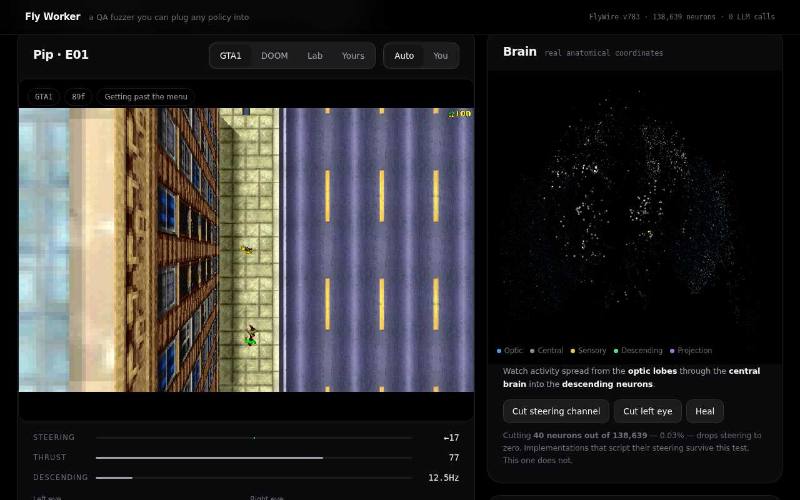
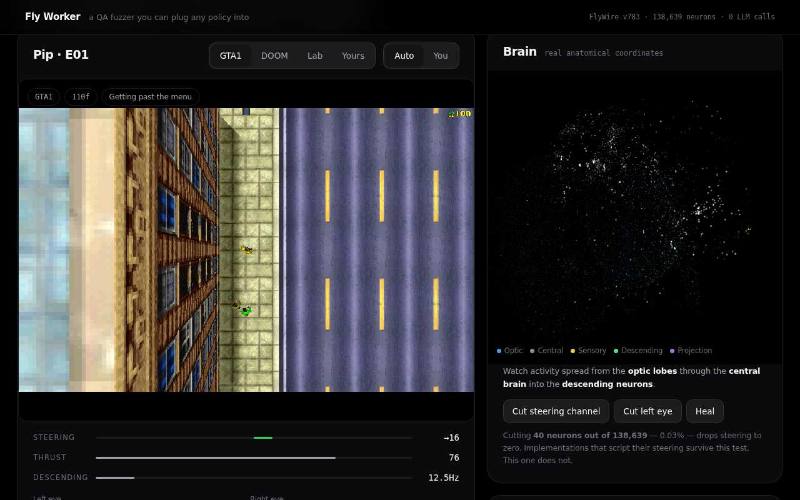
Re-checked 10 Nov in a headless browser without a GPU: 4 of 4 of the demos we first checked on 6 Oct ran (20 Oct: 4 of 4); the fifth, neural-canvas, is re-checked separately. Fly Worker, re-checked 10 Nov after a change to its model code: ran by our check's rule, and two screenshots of its game panel taken about 7 seconds apart show its street game view, frame counter and brain-activity dots changing. It downloaded about 8.6 MB of brain data, identified by their web address, a method we fixed before this check. For the other four we did not identify which files were brain data, so we give no brain-data figure for them.
In our browser checks from 3 Oct to 10 Nov 2026, 8 of 13 demos ran on a machine without a GPU at their latest check.
Correction, 10 Nov 2026: our earlier overall line said 9 of 13 demos ran. That was the 20 Oct count, and we did not update it after the re-checks of 24 to 31 Oct, in which neural-canvas, flyleno and help-the-fly-escape stopped responding and fly-brain-lulzx was stopped by its memory use. At each demo's latest check, 8 of 13 ran.
- 30 Oct 2026fly-arithmetic: a 2,000-neuron FlyWire rate network as a reservoir for XOR and digit arithmetic, vs a random network: ran
- 30 Oct 2026FlyBrain: ran
- 31 Oct 2026FLY67: ran
- 10 Nov 2026Doodle Fly: ran
- 10 Nov 2026Fly Dino (flyjump): ran
- 10 Nov 2026Fly Worker: ran
- 10 Nov 2026Infinite Sugar: ran
- 10 Nov 2026Vial (fly-vial): ran
- 20 Oct 2026Claim: Fly Connectome Explorer (flyproject.io): loaded, no activity seen
- 24 Oct 2026Neural Canvas (Fruit Fly Simulation): page stopped responding
- 30 Oct 2026fly-brain: stopped: memory use
- 30 Oct 2026FlyLeno (TUURD Talk): page stopped responding
- 30 Oct 2026Help the Fly Escape: page stopped responding
Checked in headless Chromium 156.0.8078.79 on a Linux server without a GPU, 10 Nov 2026. Shows whether the page loads, downloads its brain data and keeps computing; it is not a play test. Safari, Firefox, phones and GPU machines were not tested. Method and per-demo numbers: report of 10 Nov 2026.
Not a live simulation: the gamebook "What Is It Like to Be a Fly?" replays recorded spike output from published fly-brain models; no neuron model runs in the page (verdict row).
31 Oct 2026: fly67 again, and a note on neural-canvas's second address
We loaded fly67 B again, alone, with the same kind of browser, the same click ("Feed it sugar") as on 18 Oct and a procedure written down before the load. fly67: runs again on 31 Oct. It downloaded about 33 MB of brain data, identified by their web address, a method we fixed before this check.
- 18 Oct 2026Ran
- 31 Oct 2026Ran
| Measure | 31 Oct 2026 |
|---|---|
| Status | Ran (18 Oct: ran) |
| First activity on the page | 11.72 s after loading |
| Downloaded in total | 33.28 MB |
| Brain data, identified by web address | about 33.01 MB (two wiring files and one neuron file) |
| Errors on the page | 0 |
Checked in headless Chromium 154.0.8037.57 on a Linux server without a GPU, 31 Oct 2026. Shows whether the page loads, downloads its brain data and keeps computing; it is not a play test. Safari, Firefox, phones and GPU machines were not tested.
neural-canvas's second address: The copy of this demo at fruitfly.live answered on 30 and 31 Oct with a security certificate made for its hosting service's own addresses, not for fruitfly.live, so browsers refuse to open it; this looks like a setup problem at that address, which we did not check further. The Hugging Face version is the one we link. (catalogue entry)
30 Oct 2026: the four older demos again, and fly-arithmetic
We loaded the four demos that were re-checked on 17 Oct again, one at a time, with the same kind of browser and a procedure written down before the first load. 30 Oct: re-checked in the same headless browser without a GPU: 1 of 4 older demos ran (17 Oct: 1 of 4).
- 17 Oct 20261 of 4 ran
- 30 Oct 20261 of 4 ran
| Demo | 17 Oct 2026 | 30 Oct 2026 | What we saw on 30 Oct |
|---|---|---|---|
| flybrain.app C | Ran | Ran | flybrain.app: runs again on 30 Oct. It downloaded about 12.4 MB of brain data, identified by their web address, a method we fixed before this check. |
| Help the Fly Escape B | Loaded, then froze in our no-GPU browser | Loaded, then froze in our no-GPU browser | Help the Fly Escape: loaded, then froze in our no-GPU browser again on 30 Oct. |
| FlyLeno B | Loaded, then froze in our no-GPU browser | Loaded, then froze in our no-GPU browser | FlyLeno: loaded, then froze in our no-GPU browser again on 30 Oct. It downloaded about 32 MB of brain data, identified by their web address, a method we fixed before this check. |
| fly-brain-lulzx A | Stopped at our browser memory limit | Stopped at our browser memory limit | fly-brain-lulzx: stopped at our browser memory limit again on 30 Oct. It downloaded about 34 MB in total. |
Also loaded on 30 Oct, not counted among the four: fly-arithmetic: runs again on 30 Oct (11 Oct: runs). (catalogue entry)
Checked in headless Chromium 154.0.8037.57 on a Linux server without a GPU, 30 Oct 2026. Shows whether the page loads, downloads its brain data and keeps computing; it is not a play test. Safari, Firefox, phones and GPU machines were not tested.
24 Oct 2026: neural-canvas, its connectome download seen
One demo, one load, with the same browser and a procedure written down before the load. In our browser checks of 3, 6, 11, 17, 18, 20, 22 and 24 Oct 2026, 8 of 13 demos ran by our check's rule on a machine without a GPU at their latest check. neural-canvas is not counted among them: our check's rule marks a page as unresponsive when its screenshot requests fail, and on 24 Oct our screenshot requests timed out from about 143 seconds after the click, so we have no picture of the page for the rest of our watch.
24 Oct: in a headless browser without a GPU, after we pressed 'Download & start', the page downloaded about 77 MB of connectome data within 82 seconds and started a background worker, and the picture kept changing in our screenshots after that. Screenshots cannot show whether the brain drives the movement.
Our screenshot requests timed out from about 143 seconds after the click, so we have no picture of the page for the rest of our watch.
We identified the connectome files by their web address, a method we fixed before this check.
The page's own status line read "JavaScript · 0.08× realtime · 0 spikes".
Catalogue status now: runs in a headless browser without a GPU (checked 2026-10-24; not a play test)
. The 22 Oct check stays below.
22 Oct 2026: neural-canvas, watched for about three minutes after the click
One demo, one load, with the same browser and a procedure written down before the load; this time we kept watching for about 187 seconds after pressing the start button. In our browser checks of 3, 6, 11, 17, 18, 20 and 22 Oct 2026, 9 of 13 demos ran by our check's rule on a machine without a GPU at their latest check (corrected 10 Nov 2026: 8 of 13 ran at each demo's latest check; this count was not updated after the 24 to 31 Oct re-checks); for neural-canvas, our rule's "ran" does not mean we saw its brain simulation.
22 Oct: in a headless browser without a GPU, after we pressed 'Download & start', the page prepared its scene for about 73 seconds, then started a background worker, which downloaded about 79 MB within about 94 seconds of the click; the picture changed between our later screenshots, and at the end of our about 187-second watch the page's status line read 'JavaScript · 0.02× realtime · 0 spikes'. Screenshots cannot show whether the brain drives the movement.
Catalogue status now: loads; brain simulation not seen in our headless browser without a GPU (checked 2026-10-22)
.
Correction. On 6 and 20 Oct our check pressed 'Download & start'; in the about 30 seconds we watched afterwards, the page fetched about 6 MB and started no background worker, and our screenshots show only the start card and a loading screen. Our 21 Oct note said our check had not pressed the button; the saved records show it did.
20 Oct 2026: Fly Worker's game panel, the five demos of 6 Oct, and flyproject.io
We loaded seven demos with the same browser and a procedure written down before the first load, one page at a time. In our browser checks of 3, 6, 11, 17, 18 and 20 Oct 2026, 9 of 13 demos ran on a machine without a GPU at their latest check (corrected 10 Nov 2026: 8 of 13 ran at each demo's latest check; this count was not updated after the 24 to 31 Oct re-checks).
- Fly Worker: Fly Worker, re-checked 20 Oct: ran by our check's rule, and two screenshots of its game panel taken about 6 seconds apart show the game view, its frame counter and the brain-activity dots changing. Screenshots cannot show whether the brain model drives the game; that is a code question.
- The five demos of 6 Oct: Re-checked 20 Oct in the same no-GPU browser: 5 of 5 ran (6 Oct: 5 of 5).
- neural-canvas: ran by our check's rule, but its screenshots showed only a loading card and about 6 MB came down (catalogue figure: about 77 MB).
- flyproject.io: first checked 20 Oct: loaded, but showed no activity; about 40 MB transferred, mostly 3D model files. The page kept our slow no-GPU machine busy for most of the check, so a faster machine may differ.
- OrigoZero "Fruit Fly": not loaded: needs a GPU (the page says the simulation runs on the GPU, and our check machine has none). Not counted.
- The first six demos (3 Oct): Latest no-GPU browser check: 3 of 6 ran (17 Oct; fly67 re-checked 18 Oct, Fly Worker 20 Oct). 3 Oct: 3 of 6.
| Demo | 20 Oct 2026 | Downloaded | Where the brain ran | Before | What the screenshots show |
|---|---|---|---|---|---|
| Fly Worker A | Ran | 17.55 MB | In your browser (Web Worker) | Ran (18 Oct) | Two screenshots of its game panel, about 6 seconds apart: the game view, its frame counter (89 to 110 frames) and the brain-activity dots changed. About 3 frames per second on our machine. |
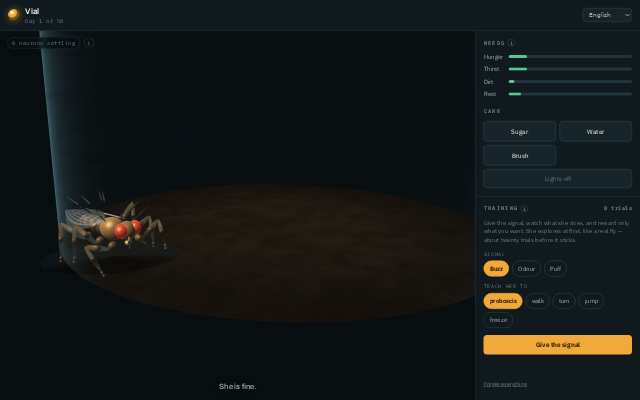
| Vial B | Ran | 7.43 MB | In your browser (Web Worker) | Ran (6 Oct) | Between 30 and 60 s the 3D fly moved to the other side of its vial and turned. |
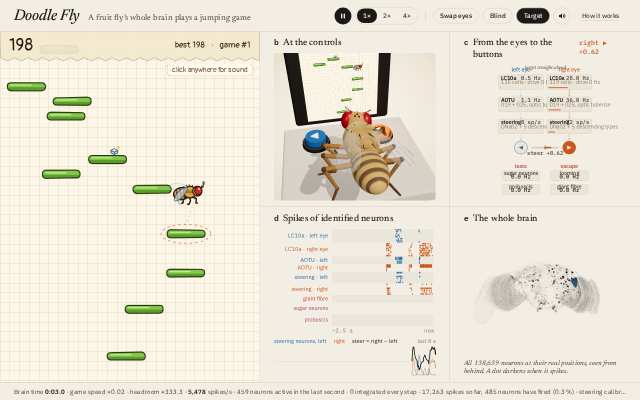
| Doodle Fly B | Ran | 34.99 MB | In your browser (Web Worker) | Ran (6 Oct) | A jumping game: between 30 and 60 s the cartoon fly moved to another platform, the score went from 133 to 198 and the spike raster changed. |
| Infinite Sugar B | Ran | 36.04 MB | In your browser (WebAssembly) | Ran (6 Oct) | At 30 s a name prompt; at 60 s the running scene, mostly covered by an About box. |
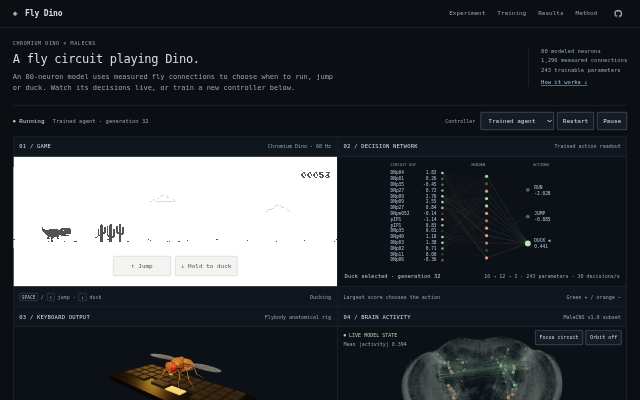
| Fly Dino C | Ran | 3.81 MB | Unclear | Ran (6 Oct) | A dino-style runner: between 30 and 60 s the score went from 28 to 53, the runner ducked near cacti and the network panels changed. |
| neural-canvas B | Ran | 5.96 MB | Unclear | Ran (6 Oct) | Ran by our rule, but the screenshots show only a "Preparing the scene" loading card, and no worker started. |
| flyproject.io U | Loaded, but showed no activity | 40.42 MB | Not stated: most of the download was 3D model files | First check | Only the landing page. The page kept our machine busy for 81 of 85 s, and the "see live brain" button was not found. |
| OrigoZero "Fruit Fly" U | Not loaded: needs a GPU | - | - | - | The page says the simulation runs on the GPU, and our check machine has none. Not counted. |
Checked in headless Chromium 154 on a Linux server without a GPU, 20 Oct 2026. Shows whether the page loads, downloads its brain data and keeps computing; it is not a play test. Safari, Firefox, phones and GPU machines were not tested.
18 Oct 2026: fly67 at its current address, and Fly Worker again
We loaded two of the six demos again with the same browser and the same written procedure. Latest no-GPU browser check: 3 of 6 ran (17 Oct; fly67 and Fly Worker re-checked 18 Oct). 3 Oct: 3 of 6.
- fly67: Correction, 18 Oct: our 17 Oct check loaded fly67's old address, which answered 'not found'; the project now lives at gexhaw.github.io/fly67/. At that address it ran on 18 Oct.
- Fly Worker: Fly Worker, re-checked 18 Oct: ran by our check's rule (two workers and WebAssembly started, and text on the page changed); our screenshots that day showed only the top of the page. Re-checked 20 Oct: two screenshots of its game panel taken about 6 seconds apart show the game view, its frame counter and the brain-activity dots changing (see the 20 Oct check above).
| Demo | 17 Oct 2026 | 18 Oct 2026 | Address loaded on 18 Oct | Downloaded | What we saw on 18 Oct |
|---|---|---|---|---|---|
| fly67 B | Did not load (at the old address znatgost.github.io/fly67/) | Ran | gexhaw.github.io/fly67/ | 33.28 MB | The page loaded its brain data in 1 worker, the fly first moved at 14.3 s, and every saved check image differed; the "Feed it sugar" click worked. The download was about 33 MB, close to the 33.3 MB in our catalogue record. |
| Fly Worker A | Loaded, but showed no activity | Ran | hwkim3330.github.io/flyworker/ | 17.55 MB | Two workers and WebAssembly started and the page text we track changed between 30 and 60 s, so our rule reads "ran". Our four screenshots are identical and show only the static top of the landing page (headline and intro text). On 20 Oct we also took screenshots of its game panel (see the 20 Oct check above). |
Checked in headless Chromium 154 on a Linux server without a GPU, 18 Oct 2026. Shows whether the page loads, downloads its brain data and keeps computing; it is not a play test. Safari, Firefox, phones and GPU machines were not tested.
17 Oct 2026: the first six, re-checked
We loaded the six demos of 3 Oct again, with the same browser, the same written procedure and the same one action per demo, after our simulations had finished. Re-checked 17 Oct in the same no-GPU browser: 1 of 6 ran (3 Oct: 3 of 6).
- Fly Worker: loaded, but showed no activity (3 Oct: ran).
- fly67: did not load (3 Oct: ran).
- 3 Oct 20263 of 6 ran
- 17 Oct 20261 of 6 ran
| Demo | 3 Oct 2026 | 17 Oct 2026 | Downloaded (3 Oct / 17 Oct) | What we saw on 17 Oct |
|---|---|---|---|---|
| Fly Worker A | Ran | Loaded, but showed no activity changed | 17.55 / 17.55 MB | The page loaded (17.55 MB) and the "Hire a fly" click worked, but the on-page text we track and the screenshots did not change between 30 and 60 s. The tracked text may have been static labels after a page change; we did not check by eye. |
| fly67 B | Ran | Did not load changed | 33.28 / 0.01 MB | The page answered HTTP 404 on both loads. Our browser loaded the address it had on 3 Oct (znatgost.github.io); our link check of the same day found its current address (gexhaw.github.io) answering 404 too. We did not check whether the site moved again. Correction, 18 Oct: at gexhaw.github.io/fly67/ it ran on 18 Oct (see the 18 Oct block above). |
| flybrain.app C | Ran | Ran | 12.72 / 12.72 MB | Ran again; first movement at 14.3 s. |
| Help the Fly Escape B | Loaded, then froze in our no-GPU browser | Loaded, then froze in our no-GPU browser | 2.57 / 2.57 MB | Same as on 3 Oct. Its code changed upstream since 3 Oct; the README still names the same action. |
| FlyLeno B | Loaded, then froze in our no-GPU browser | Loaded, then froze in our no-GPU browser | 33.95 / 33.94 MB | Same as on 3 Oct. |
| fly-brain (Lulzx) A | Stopped at our 1.6 GB memory limit | Stopped at our 1.6 GB memory limit | 33.93 / 33.93 MB | Same as on 3 Oct: the browser passed our 1.6 GB memory limit. |
Checked in headless Chromium 154 on a Linux server without a GPU, 17 Oct 2026. Shows whether the page loads, downloads its brain data and keeps computing; it is not a play test. Safari, Firefox, phones and GPU machines were not tested.
11 Oct 2026: fly-arithmetic, ran
fly-arithmetic's website (grade A, catalogue entry) reruns a 2,000-neuron FlyWire rate network in the browser and lets visitors train their own readout. Same browser and rules as on 3 and 6 Oct.
| Demo | Status | First activity | Downloaded | Where it computes | What we did not do |
|---|---|---|---|---|---|
| fly-arithmetic | Ran | about 11.2 s | about 2.05 MB | unclear (one worker and WebGL canvases; our fixed rule could not decide) | We did not type a sum or train a readout. |
0 console errors and 0 page errors. Safari, Firefox, phones and GPU machines were not tested. The website's own claim is the project's, not ours; the author's results on addition are in the controls ledger.
6 Oct 2026: five more demos, all ran
Vial, Doodle Fly, Infinite Sugar, Fly Dino and Neural Canvas, with the same browser and rules as on 3 Oct. They downloaded between 3.8 and 36 MB in their first minute.
- 5 of 5 ranone load each, no page errors, memory peak 0.74–1.28 GB (our limit: 1.6 GB)
- 3 compute in your browserVial and Doodle Fly in a Web Worker, Infinite Sugar in WebAssembly; for Fly Dino and Neural Canvas our rule could not tell where
- 1 catalogue size not seenNeural Canvas ran, but its ~77 MB brain download was not seen in our check window
Read this before sharing. Checked in headless Chromium 154 on a Linux server without a GPU, 6 Oct 2026. Shows whether the page loads, downloads its brain data and keeps computing; it is not a play test. Safari, Firefox, phones and GPU machines were not tested.
All five ran by our fixed rule, with one load each, no page errors and no server calls; the browser's memory peaked at 0.74–1.28 GB, under our 1.6 GB limit. "Ran" means the page loaded, downloaded data and kept changing; it does not mean we played it. Neural Canvas ran, but its ~77 MB brain download was not seen in our check window, so the catalogue keeps its size figure with that note.
Results of 6 Oct
| Demo and grade | In our browser | Where it computes | Downloaded | Largest file | First movement | Errors | Memory peak | Matches our catalogue? | What we saw |
|---|---|---|---|---|---|---|---|---|---|
| Infinite Sugar B Open the demo |
Ran Our one action: Typed "Fly" into the name field and pressed Enter |
in your browser (WebAssembly) | 36.04 MB | colidx.bin.gz 7.12 MB | 36.8 s | 0 / 0 | 1.28 GB | Yes (36.04 MB vs ~47 MB) | Ran after we typed a name ("Fly") and pressed Enter, as its README says; MuJoCo and the brain run in WebAssembly. 36.04 MB against about 47 MB in our catalogue. |
| Doodle Fly B Open the demo |
Ran Our one action: None documented; it starts by itself |
in your browser (Web Worker) | 34.99 MB | graph.bin.gz 31.48 MB | 12.1 s | 0 / 0 | 0.98 GB | Yes (34.99 MB) | Ran with no action needed; a 31.48 MB brain graph loads into a Web Worker. Our catalogue had no size before this check. |
| Vial B Open the demo |
Ran Our one action: None documented; it starts by itself |
in your browser (Web Worker) | 7.43 MB | conn.bin.gz 6.84 MB | 10.6 s | 0 / 0 | 0.74 GB | Yes (7.43 MB vs ~8 MB) | Ran with no action needed; its 6.84 MB wiring file (conn.bin.gz) loads into a Web Worker. |
| Neural Canvas B Open the demo |
Ran Our one action: Clicked "Download & start" |
unclear | 5.87 MB catalogue: ~77 MB brain download, not seen in our check window |
a Hugging Face CDN file 2.38 MB | 39.7 s | 0 / 0 | 0.84 GB | No: the brain download in our catalogue was not seen | Ran: after we clicked "Download & start" the 3-D view moved and the text changed. Its ~77 MB brain download was not seen in our check window (5.87 MB came down in 60–90 s and no Web Worker started). It may start later than our window, need a GPU path, or the page may have changed; we will re-read the code. |
| Fly Dino C Open the demo |
Ran Our one action: None documented; it starts by itself |
unclear | 3.81 MB | model.bin 1.71 MB | 12.2 s | 0 / 0 | 0.76 GB | Yes (3.81 MB vs ~4 MB) | Ran with no action needed; the game runs on the main page with a 1.71 MB model file and no worker, so by our fixed rule where it computes is "unclear". |
3 Oct 2026: the first six
Re-checked on 17 Oct 2026: 1 of 6 ran; fly67 (at its current address) and Fly Worker again on 18 Oct: 3 of 6 ran at the latest check. The results below are those of 3 Oct.
On 3 Oct 2026 we opened six online fly-brain simulators in a headless Chrome browser (Chromium 154 on a Linux server with 2 CPUs and no GPU), took one action from each README, and recorded what the page downloaded, whether it kept computing and where the brain ran: they downloaded between 2.6 and 34 MB in their first minute. We wrote the procedure down before the first load.
- 3 of 6 ranFly Worker (17.55 MB), FLY67 (33.28 MB) and flybrain.app (12.72 MB)
- 0 on a serverno demo computed its brain on a server; where we could locate it, it ran in a Web Worker in your browser tab
- 2 froze, 1 hit our memory limitmost likely because our machine has no GPU (software WebGL); not tested on GPU machines
Read this before sharing. Checked in headless Chromium 154 on a Linux server without a GPU, 3 Oct 2026. Shows whether the page loads, downloads its brain data and keeps computing; it is not a play test. Safari, Firefox, phones and GPU machines were not tested.
Every 3-D page fell back to software WebGL because our machine has no GPU. The two freezes most likely come from that, not from the demos; on a computer with a graphics card they may run normally. "Stopped at our 1.6 GB memory limit" means our test machine's limit was reached, not that the demo is faulty. A frozen or stopped page may also have downloaded less than it would on a GPU machine.
Results of 3 Oct
| Demo and grade | In our browser | Where the brain ran | Downloaded | Largest file | First movement | Errors | Memory peak | Matches our catalogue? | What we saw |
|---|---|---|---|---|---|---|---|---|---|
| FlyLeno B Open the demo |
Loaded, then froze in our no-GPU browser Our one action: Start without music (the page did not answer) |
in your browser tab (Web Worker) | 33.95 MB brain data 31.36 MB |
connectome.bin.gz 31.36 MB (worker) | 10.4 s | 0 / 0 | 1.04 GB | Unclear: the page did not run to the end (froze) | Its 31.4 MB connectome reached a Web Worker and the counters started; then the 3-D stage stopped answering after about 10 s. |
| fly-brain (Lulzx) A Open the demo |
Stopped at our 1.6 GB memory limit Our one action: Play (clicked) |
unclear | 33.93 MB brain data 14.63 MB |
graph.flyg 14.63 MB (service worker) | not seen in screenshots | 2 / 0 | 1.63 GB | Unclear: the page did not run to the end (memory stop) | Fetched its 14.6 MB MaleCNS graph and WebAssembly and started 4–5 workers, then passed our 1.6 GB browser memory limit on both loads (at 29 s and 44 s). |
| FLY67 B Open the demo |
Ran Our one action: Feed it sugar (worked) |
in your browser tab (Web Worker) | 33.28 MB brain data 31.24 MB |
connectome.bin.gz.part00 15.74 MB (worker) | 11.6 s | 0 / 0 | 1.00 GB | No: our catalogue said about 100 MB (an estimate); corrected to 33.3 MB. The mechanism matches. | Two connectome parts (15.7 + 15.5 MB) load into a Web Worker; the fly moved and the sugar button worked. Our old "~100 MB" estimate was wrong. |
| Fly Worker A Open the demo |
Ran Our one action: Hire a fly (worked) |
in your browser tab (Web Worker) | 17.55 MB brain data 7.55 MB |
carnage3D.data 8.18 MB | not seen in screenshots | 0 / 0 | 1.09 GB | Yes (worker seen; 17.55 MB vs ~13 MB) | Its 7.6 MB brain file runs in a Web Worker and the on-page simulation numbers kept changing; 8.2 MB more is GTA1 game data. |
| FlyBrain (flybrain.app) C reserve, replaced fly-brain (Lulzx) Open the demo |
Ran No documented action |
unclear also tries a chat WebSocket and chat server (both failed here) |
12.72 MB brain data 12.45 MB |
connectome.bin.gz 12.45 MB | 10.9 s | 2 / 0 | 0.87 GB | Yes (worker seen; 12.72 MB vs ~12.4 MB) | Its 12.5 MB connectome loads and a Web Worker runs; the page also tries a chat WebSocket and a chat server (both failed here), so where the brain runs is unclear by our fixed rule. |
| Help the Fly Escape B Open the demo |
Loaded, then froze in our no-GPU browser Our one action: Release the flies (the page did not answer) |
unclear | 2.57 MB its 9.9 MB brain graph never arrived |
index-DzgoIUHH.js 1.56 MB | not seen in screenshots | 0 / 0 | 0.86 GB | Unclear: the page did not run to the end (froze) | Loaded its WebAssembly (1 MB) and a worker, but stopped answering from the first screenshot; its 9.9 MB brain graph never arrived in 84 s. |
| webgpu-fly C extra 20 s record, not the full check |
Did not start: needs WebGPU | not reached | 0.29 MB fonts only |
fonts | none in 20 s | 0 / 0 | 0.72 GB | Yes: the catalogue says it needs a GPU with WebGPU | Chrome logged "No available adapters.", its WebGPU message: our browser has no GPU adapter. Our script's fixed rule called this "loads, no activity". |
- flybrain.app: the page also tries to open a chat WebSocket and a chat server (both failed in our browser), so we cannot say for sure that nothing runs elsewhere; by our fixed rule, where its brain runs is "unclear".
- webgpu-fly needs WebGPU. In a 20 s extra record it loaded 0.29 MB and did not start: Chrome reported no graphics adapter, as expected without a GPU.
- Our correction: our catalogue said FLY67 downloads about 100 MB. It downloaded 33.3 MB, and the entry is fixed.
- Not tested: Safari, Firefox, phones and computers with a GPU. A GPU or a different software-graphics setting would change the test, so it needs its own written plan before we repeat it.
Four levels of effort
- Level 1Open in a browserNothing to install. Watch or play with a demo that runs in the page.Browser demos
- Level 2Run a notebookA free online notebook runs real research code for you. You can change a number and run it again.Notebooks
- Level 3Download and runInstall Python or an app and run a project on your own computer.Download and run
- Level 4Build your ownFollow our guide from an empty folder to your own small project.Build your own
What our check labels mean
- Page respondsThe link answered on the check date (HTTP 200), but we did not load the demo in a browser. It may still need a special browser, a sign-in or a fast computer.
- RanIn our headless browser check (no GPU) the page loaded its brain data and kept computing. Not a play test: we took one action and watched for 60–90 s.
- Loaded, then froze in our no-GPU browserThe page loaded, then stopped answering. Most likely our machine's software graphics (no GPU), not the demo; it may run on your computer.
- Stopped at our 1.6 GB memory limitThe page used more memory than our test machine allows. A computer with more memory may run it.
- Loaded, but showed no activityThe page loaded, but what we track on it (on-page text and screenshots) did not change. Our tracking may miss a changed page layout; it is not a play test.
- Did not loadThe page itself did not answer with content on the check date (for example HTTP 404). It may be temporary or the site may have moved; we do not read it as gone.
- DownloadNeeds an install. We give the platform and download size when the authors state them.
A demo that opens is not the same as a demo driven by the fly's brain. Each row also shows the project's evidence grade: A and B mean a real connectome drives the behaviour; C, D and U mean most of what you see comes from other code, or we could not check.
No-install options (levels 1 and 2)
Grouped by what you can do. Inside each group, the best-supported projects come first.
Browser demos where the simulated brain drives what you see (19)
A real connectome runs in the page (grades A and B). People still chose which neurons get the input and which neurons move the fly.
| Name | What it is | Grade | What you need | Our check | Links |
|---|---|---|---|---|---|
| alpha-fly: the full MaleCNS v1.0 wiring with trained per-synapse gains and linear input and output maps, taught chess by AlphaZero-style self-play, with a degree-preserving shuffled-partner control run turlockmike (Michael Darmousseh) Catalogue entry alpha-fly |
The whole MaleCNS v1.0 graph (166,700 neurons, synapses with at least 3 contacts, signs from predicted transmitters) is a fixed-topology recurrent network: a linear map feeds 838 board features to 17,937 sensory neurons, six clamped rate-update steps run through the wiring, and linear maps from 2,333 efferent and descending neurons give move logits and a value. Training changes one gain per synapse (sign and partner fixed), per-neuron rest levels and time constants, and the two maps, by Gumbel AlphaZero self-play on one GPU. Strength is measured against Stockfish ladders. A control run with the same neurons, degrees and signs but shuffled presynaptic partners was trained for 39,482 games. | A | A recent desktop browser | Page responds HTTP 200, 10 Nov 2026. Not played by us. |
Open Code MIT LICENSE, copyright 2026 Michael Darmousseh |
| ChessFly Ruben Nugmanov (GitHub: gexhaw, formerly znatgost) Catalogue entry chessfly |
A browser game in which a mushroom-body model learns chess by self-play. The 285 olfactory projection neurons, 5,177 Kenyon cells and their 21,509 connections (at least 5 synapses each) come from FlyWire v783; the board is fed onto the projection neurons through a fixed hand-made mapping, Kenyon cells fire when at least 2 inputs are on, and one output neuron's plastic synapses learn from game results. A small alpha-beta search picks the move. The author trained the real wiring, a shuffled-claws control and the original random design for 10,000 games each. | A | Download: small: brains/*.json about 30 KB each, data/mushroom_body.json (not measured in a browser) | Page responds HTTP 200, 30 Oct 2026. Not played by us. |
Open Code MIT |
| Drosophila Cadet: the MaleCNS v1.0 looming-escape circuit plays 3D Pinball, with six degree-preserving shuffled circuits seky443 Catalogue entry drosophila-cadet-pinball |
A 373-neuron MaleCNS v1.0 looming-escape circuit (LC4 and LPLC2 to the two giant fibres, DNp01; real synapse counts and signs) runs as a fixed leaky-tanh rate network and presses the flippers of a decompiled 3D Pinball when a giant fibre is active. A few body parameters (drive gain, time constant, press thresholds) are tuned by search; the circuit is not trained. The author's paired evaluation compares the real circuit with six degree-preserving shuffles, a hand-written reflex and never pressing; a separate trained 444-neuron brain is compared with three shuffles. | A | A recent desktop browser | Page responds HTTP 200, 10 Nov 2026. Not played by us. |
Open Code MIT README 'Copyright and licenses'; LICENSE file); engine submodule MIT; game assets by their rights holders |
| Fly Tic-Tac-Toe: a 98-cell MaleCNS v1.0 circuit with a trained 425-parameter readout picks tic-tac-toe moves, against a degree-preserving rewired graph at equal training budget pikabell Catalogue entry fly-tictactoe |
98 MaleCNS v1.0 cells chosen by anatomy (1,494 edges, 27,762 contacts, transmitter-predicted signs) form a fixed recurrent map h <- 0.3 h + 0.7 tanh(u + 1.4 W^T h), iterated three times. Board squares drive 18 input cells by an arbitrary assignment; a 16-16-9 readout of 16 descending cells (425 parameters) is trained by imitating minimax or by CEM. A committed benchmark over 1,000 games against random play and 200 against perfect play compares the circuit with a silenced circuit, an untrained readout, a degree-preserving rewired graph retrained at equal budget, and a raw-board network of similar size. | A | A recent desktop browser | Page responds HTTP 200, 10 Nov 2026. Not played by us. |
Open Code Cobanov Template Attribution License 1.0 LICENSE; SPDX LicenseRef-Cobanov-Template-Attribution-1.0 |
| Fly Worker hwkim3330 Catalogue entry fly-worker |
A browser tool that plays games with key presses, reads the screen, and records bugs so they can be replayed. One of its steering policies is a spiking model of the whole FlyWire v783 brain in a Web Worker. The author benchmarked it against random-steering baselines, and it does worse. | A | Download: ~13 MB (brain.bin 11.4 MB raw / ~7.45 MB gzip, meta.json 0.48 MB, pos.bin 0.97 MB), plus… | Ran Our browser check, 10 Nov 2026: 17.55 MB downloaded; brain ran in your browser (Web Worker). Headless Chromium 154, Linux, no GPU; not a play test. All browser checks |
Open Code No licence file README says MIT but no LICENSE file |
| fly-brain Lulzx Catalogue entry fly-brain-lulzx |
Runs the whole MaleCNS v1.0 connectome (165,122 neurons) as a spiking network for each fly in the browser, with a MuJoCo flybody body and a flyvis compound eye. Descending-neuron activity sets walking, turning, grooming and escape commands. Documented offline experiments score the model against literature targets and against shuffled-wiring controls. | A | Faster with a GPU Download: ~23 MB for the arena (README); ~30 MB for the viewer |
Stopped at our 1.6 GB memory limit Our browser check, 30 Oct 2026: 33.93 MB downloaded; brain ran where: unclear. Headless Chromium 154, Linux, no GPU; not a play test. All browser checks |
Open Code MIT |
| fruitfly-lab (Fly Marksman): a 3,963-neuron FlyWire v783 LC10a-to-steering LIF circuit aims and fires in a browser game and in ViZDoom, against degree-preserving scrambled wiring webergithub Catalogue entry fruitfly-lab |
A subgraph of FlyWire v783 (3,963 neurons, 354,879 connections; paths of at least 5 synapses within 2 hops of LC10a and five steering DN types) runs as Shiu et al. 2024 LIF units. An engineered encoder turns the target bearing (from ViZDoom object labels) into Poisson drive to left or right LC10a; a fixed readout of DNa02 and AOTU019 left-right differences turns, and joint AOTU019 activity fires, with thresholds set by one azimuth calibration sweep. In ViZDoom defend_the_center the real circuit is compared over 10 episodes with degree-preserving scrambled wiring (with and without its own calibration), AOTU019/025 lesions, random keys and a no-brain oracle. | A | A recent desktop browser | Page responds HTTP 200, 10 Nov 2026. Not played by us. |
Open Code No licence file no LICENSE file in the tree at 8c27fe8 |
| Doodle Fly dtecx Catalogue entry doodle-fly |
The whole FlyWire v783 brain (Shiu et al. LIF) runs in the browser and plays a Doodle-Jump-style game: the target platform's horizontal offset drives the LC10a population of each eye as Poisson input, and the smoothed rates of left and right steering descending neurons (DNa02, DNa01 and others), balanced by a start-up calibration, press the left and right buttons. Two built-in controls (swap eyes, blind) break the play. | B | A recent desktop browser | Ran Our browser check, 10 Nov 2026: 34.99 MB downloaded; brain ran in your browser (Web Worker). Headless Chromium 154, Linux, no GPU; not a play test. All browser checks |
Open Code MIT |
| Fly Brain Tetris (alexeygrigorev) Alexey Grigorev (alexeygrigorev) Catalogue entry fly-brain-tetris-ag |
A fly avatar plays Tetris on a Brick Game handheld in the browser. Six engineered board features pass through a 32x6 linear transform compiled from the FAFB v783 connectome (random groups of sensory neurons in, descending neurons out, row-normalised signed synapse counts); a 32-channel readout evolved by cross-entropy optimisation picks the moves. The author states it is an artificial policy, not a biological fly simulation. | B | A recent desktop browser | Page responds HTTP 200, 30 Oct 2026. Not played by us. |
Open Code No licence file |
| FLY67 Ruben Gexhaw (GitHub: gexhaw, formerly znatgost) Catalogue entry fly67 |
The whole FlyWire v783 brain (138,639 neurons, 15.1 M connections, Shiu et al. LIF parameters) runs in a browser Web Worker and drives an animated 3D fly: sugar under the proboscis drives MN9, bitter suppresses it, an air puff drives antennal grooming via aDN1, and a looming shadow recruits the giant fibre and DNa02. Descending-neuron rates are turned into movement with hand-set gains; a '6-7' meme gesture is a labelled scripted easter egg. | B | Download: about 33 MB (measured on our 18 Oct 2026 load; the README says 31-33 MB gzipped) | Ran Our browser check, 31 Oct 2026: 33.28 MB downloaded; brain ran in your browser (Web Worker). Headless Chromium 154, Linux, no GPU; not a play test. All browser checks |
Open Code MIT |
| flybrain-live: the Shiu et al. 2024 FlyWire v783 whole-brain LIF model in a browser tab, with committed reproduction checks against the authors' Brian2 code teshnizi2 Catalogue entry flybrain-live |
A JavaScript engine runs the Shiu et al. 2024 leaky integrate-and-fire model on all 138,639 FlyWire v783 neurons in a web worker and draws each neuron at its 3D position. Buttons stimulate sugar, water or bitter gustatory neurons and the page shows the cascade to MN9. Committed results compare the JS engine with the authors' shipped outputs and with Brian2 runs of the authors' model.py on v630 and v783 (MN9 rates over 30 trials), plus transmitter-sign, timestep and speed checks. | B | Download: 30.7 MB connectome graph plus 2.0 MB positions streamed by the page (README 'Run it');… | Page responds HTTP 200, 10 Nov 2026. Not played by us. |
Open Code MIT LICENSE |
| FlyLeno (TUURD Talk) AgitationSkeleton Catalogue entry flyleno |
A browser talk show in which the whole FlyWire v783 brain, run live as the Shiu et al. spiking model in a Web Worker, drives a ragdoll Grey Leno. Show events, music and a thrown sugar cube stimulate chosen sensory neurons; descending-neuron firing rates are mapped by hand to walking, turning, startle, grooming, feeding, voice and body muscles. Gait, balance, food seeking, homing, sleep and the choice of spontaneous actions are engineered layers that the README labels as such. | B | Download: about 32 MB of connectome and position data plus 3-D assets, fetched by the page | Loaded, then froze in our no-GPU browser Our browser check, 30 Oct 2026: 33.95 MB downloaded; brain ran in your browser (Web Worker). Headless Chromium 154, Linux, no GPU; not a play test. All browser checks |
Open Code No licence file |
| FlyRoyale (Zaib111/fly-clash-royale): FlyWire rate network trained by self-play on a Clash Royale-style game Zaib111 (Shahmeer Khan) Catalogue entry fly-clash-royale |
A Clash Royale-style arena game in which the policy is a rate model on the FlyWire v783 connectome (about 134k neurons, connections with at least 5 synapses), with fixed wiring and signs. Per-neuron (or per-synapse) gains, biases, an input encoder onto sensory neurons and a decoder from descending and motor neurons are trained by PPO self-play. The repository also has an ordinary MLP policy with the same inputs and outputs as a baseline, a browser version and a hosted demo. | B | A recent desktop browser | Page responds HTTP 200, 30 Oct 2026. Not played by us. |
Open Code MIT |
| FlyWire Playground (whole-brain LIF in the browser drives a 3-D fly avatar) mpvasilis Catalogue entry flywire-playground |
A static web page whose Web Worker runs a LIF network over all 139,255 FlyWire v783 neurons (connections with at least 5 synapses) with the Shiu et al. 2024 constants, plus an optional spike-frequency adaptation that is on by default. Seven scenarios drive named sensory cell types (sugar and bitter taste neurons, Johnston's organ, looming detectors, photoreceptors fed a price chart, pheromone receptors, or any neuron the user clicks) and map named descending and motor neuron rates onto a procedural Three.js fly. | B | Download: about 21 MB of connectome binaries (README, approximate) | Page responds HTTP 200, 30 Oct 2026. Not played by us. |
Open Code No licence file |
| Fruit fly brain plays Pokémon on a Raspberry Pi 5 (Twitch stream) Leetzerzz (Twitch) / ianwes92 (GitHub) Catalogue entry fly-pokemon-pi5-stream |
A live Twitch stream in which a spiking model of the FlyWire FAFB v783 brain plays Pokémon FireRed on a Raspberry Pi 5. Since 14 Oct the code is public (ianwes92/fly-brain-plays-pokemon; the README names the Twitch channel). Walls, people and doors are read from game memory and fed as left/right drive to LPLC1, LC10 and LPLC4; descending-neuron rates become key presses through author-chosen mappings and a hand-written priority arbiter. Chat keys are added to the fly's keys, and a paid override replaces them for a while. Only dopamine-gated Kenyon-cell to MBON synapses change during play. There is no shuffled-wiring control. | B | A live Twitch stream, not a demo you control. Not watched by us; the code is public (ianwes92/fly-brain-plays-pokemon). | Page responds HTTP 200, 30 Oct 2026. Not played by us. |
Open Code MIT |
| Help the Fly Escape dzhng Catalogue entry help-the-fly-escape |
A 3D browser puzzle game: you place household objects, then a swarm of flies tries to find the exit. Each fly runs its own noisy LIF simulation of a 70,000-neuron MaleCNS subgraph in Rust/WASM. Readouts from descending and motor neurons set each fly's walking thrust, turning and takeoff. | B | Download: ~11 MB brain data (graph.bin 9.9 MB, manifest 0.6 MB, retinal map 0.2 MB) plus WASM and… | Loaded, then froze in our no-GPU browser Our browser check, 30 Oct 2026: 2.57 MB downloaded; brain ran where: unclear. Headless Chromium 154, Linux, no GPU; not a play test. All browser checks |
Open Code No licence file |
| Infinite Sugar cnqso Catalogue entry infinite-sugar |
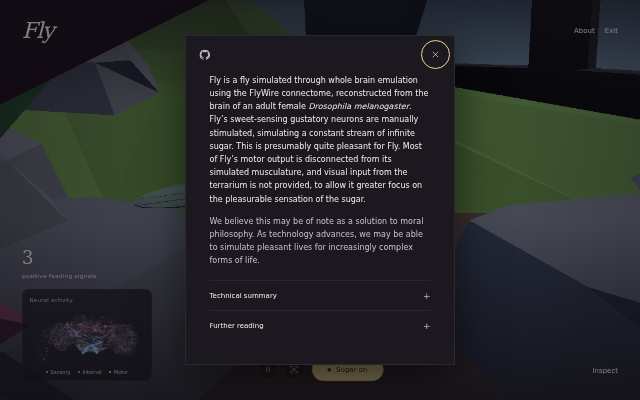
A browser artwork: a MuJoCo flybody fly sits in a terrarium while a whole-brain spiking model of FlyWire gets constant sweet-taste input. Activity in proboscis, head and antenna motor neurons moves the matching body joints. | B | Download: 36.04 MB transferred in our browser check (6 Oct 2026; largest file colidx.bin.gz 7.12… | Ran Our browser check, 10 Nov 2026: 36.15 MB downloaded; brain ran in your browser (WebAssembly). Headless Chromium 154, Linux, no GPU; not a play test. All browser checks |
Open Code No licence file |
| Neural Canvas (Fruit Fly Simulation) Xenova (Hugging Face Space; commit author 'Joshua') Catalogue entry neural-canvas |
You paint neuron positions on a map of the brain, or press walk/turn/fly buttons. The browser then runs a Shiu-style spiking model of the whole MaleCNS v1.0 brain and nerve cord, and descending-neuron firing rates move an animated NeuroMechFly body. | B | Faster with a GPU Press 'Download & start': only then are about 77 MB of connectome arrays fetched, and the simulation runs in a Web Worker (WebGPU if available, JavaScript otherwise). The copy of this demo at fruitfly.live answered on 30 and 31 Oct with a security certificate made for its hosting service's own addresses, not for fruitfly.live, so browsers refuse to open it; this looks like a setup problem at that address, which we did not check further. The Hugging Face version is the one we link. Download: about 77 MB of connectome arrays (sum of manifest parts 76,667,180 bytes), fetched only… |
Started, then our screenshots timed out Our browser check, 24 Oct 2026: 86.18 MB downloaded; brain simulation not seen in our check. Headless Chromium 154, Linux, no GPU; not a play test. Our screenshot requests timed out from about 143 seconds after the click, so we have no picture of the page for the rest of our watch. All browser checks |
Open Code MIT app code per LICENSE file; MaleCNS data CC BY 4.0; body and kernels Apache-2.0). Space metadata says apache-2.0 |
| Vial (fly-vial) Raphael Rocha (RaphaelSR) Catalogue entry vial |
A virtual-pet game where you feed, clean and train a 3D fly. A web worker runs a LIF simulation of the whole FlyWire brain, pruned to connections of 5 or more synapses. Firing of chosen descending and motor neurons sets reflex animations, and a small REINFORCE policy learns 'tricks' from descending-neuron activity. | B | Download: 7.43 MB transferred in our browser check (6 Oct 2026; largest file conn.bin.gz 6.84 MB).… | Ran Our browser check, 10 Nov 2026: 7.43 MB downloaded; brain ran in your browser (Web Worker). Headless Chromium 154, Linux, no GPU; not a play test. All browser checks |
Open Code MIT code); LICENSE notes web/data/ (FlyWire v783-derived) keeps its data licence |
Browser demos with partial, stand-in or scripted brains (13)
Fun to watch, but most of the visible behaviour comes from a small circuit, a synthetic network, scripts or a replay, or we could not check how it works (grades C, D and U).
| Name | What it is | Grade | What you need | Our check | Links |
|---|---|---|---|---|---|
| Fly Dino (flyjump) Mert Cobanov (cobanov) Catalogue entry fly-dino |
Plays the original Chromium Dino game. Eight hand-made game-state numbers feed an 80-neuron subgraph taken from MaleCNS v1.0 and run as a leaky tanh rate model. The activity of 16 descending neurons goes to a trained 243-parameter readout (16-12-3), which picks run, jump or duck. | C | Download: 3.81 MB transferred in our browser check (6 Oct 2026; largest file model.bin 1.71 MB).… | Ran Our browser check, 10 Nov 2026: 3.83 MB downloaded; brain ran on a server, by our tool's label (not confirmed). Headless Chromium 154, Linux, no GPU; not a play test. All browser checks |
Open Code Custom licence Cobanov Template Attribution License 1.0 (free use incl. commercial; visible linked credit required; not OSI-approved) |
| fly-jumpshot ("ts fly ballin"): a fly learns basketball on a MaleCNS-pruned controller Kxnar (GitHub) Catalogue entry fly-jumpshot |
A browser simulation in which a flying fruit fly learns to grab a basketball and shoot it. The controller is a small rate network whose two hidden layers are 256 sensory-fed and 512 motor-driving MaleCNS v1.0 cell types, wired with log-compressed real synapse counts and transmitter signs; per-cell gains and biases and the read-out weights are searched by the cross-entropy method. The author's hand-off notes say scoring was still 0% when written; no result files are committed. | C | A recent desktop browser | Page responds HTTP 200, 30 Oct 2026. Not played by us. |
Open Code MIT |
| FlyBrain snedea Catalogue entry flybrain-app-snedea |
A 2D browser pet fly you can feed, touch, blow air at, or expose to light and temperature. A Web Worker runs spikes over the full FlyWire brain graph, and a panel shows them. What the fly does on screen is chosen by a threshold state machine and hand-coded steering, with the network's group activity as one input. | C | Download: ~12.4 MB (connectome.bin.gz) plus small metadata | Ran Our browser check, 30 Oct 2026: 12.72 MB downloaded; brain ran where: unclear. Headless Chromium 154, Linux, no GPU; not a play test. All browser checks |
Open Code MIT |
| FlyDrones SpikeCalls Catalogue entry flydrones |
A Python package and a browser demo. Camera optic flow drives chosen fly visual neuron types in a LIF network, and six descending-neuron groups are read out as throttle and yaw for a simulated or real drone. The browser demo runs 'MiniFly', an 850-neuron hand-wired stand-in; MaleCNS v1.0 is an optional path in the Python package. | C | Download: ~1.2 GB MaleCNS data (optional; MiniFly needs none) | Page responds HTTP 200, 30 Oct 2026. Not played by us. |
Open Code MIT |
| FlyWire Pong zonzujiro Catalogue entry flywire-pong |
A browser page in which a 1,230-neuron network with FlyWire FAFB v783 topology plays Atari Pong (the official ALE emulator in WebAssembly) against the built-in computer player. Selected visual neurons receive a brightness and motion encoding on an 11x11 grid; two descending neurons (DNp15, DNp01) feed a small action decoder. The weights were trained (supervised start, then PPO) in a separate project; the page runs inference only and includes an inspector for every decision. | C | Download: repository about 13.5 MB, including an 11 MB ALE source archive… | Page responds HTTP 200, 30 Oct 2026. Not played by us. |
Open Code GPL-2.0 |
| making-fly-play-chess mncrftfrcnm Catalogue entry making-fly-play-chess |
A chess player that turns the board into 782 numbers, pushes them for six steps through a fixed 8,192-neuron patch of the FlyWire v783 wiring (tanh rate units), and scores each legal move with a linear readout trained by self-play on 1,024 randomly chosen cells. A Gradio board lets you play it in Colab, and an optional FlyGym view moves a 3-D fly's joints from readout-weighted activity. A comparison notebook trains the same setup on rewired wiring and on classical features. | C | Faster with a GPU | Page responds HTTP 200, 30 Oct 2026. Not played by us. |
Open Code Apache-2.0 |
| MaleCNS: Music in the Body, a browser music piece driven by a rate network on the MaleCNS v1.0 wiring matsuo-koya Catalogue entry music-in-the-body |
A browser music piece. The MaleCNS v1.0 wiring (connections of weight 5 or more, no self-connections; 163,997 bodies, 6,236,393 directed edges) is run in a Web Worker as a leaky tanh rate network with random input weights and biases and a sine drive. Four group means of the activity steer pitch centre, loudness and accents inside a scripted composition grammar (Satie, ambient, minimal). The listener can switch to a rewired graph (edge sources rotated, degrees and weights kept) or to no recurrence. The author makes no fly-behaviour claim. | C | Download: about 52 MB graph file (51,859,144-byte CSR, VALIDATION.md line 4), fetched when play is… | Page responds HTTP 200, 10 Nov 2026. Not played by us. |
Open Code none stated no LICENSE file at 76f9e58; DATA_LICENSE.md covers the MaleCNS-derived data only |
| Same Smell anzal1 Catalogue entry same-smell |
Shows, side by side, subsets of about 600 neurons of the cVA pheromone pathway from a male (MaleCNS v1.0) and a female (FlyWire v783) brain, spiking in a slowed-down LIF model after a 'puff'. The first descending-neuron spike triggers a puppet animation, but the code fixes the kind of reaction (lunge or pause) by sex. | C | Download: ~11 MB (data/real JSON ~10 MB plus 0.6 MB bundle) | Page responds HTTP 200, 30 Oct 2026. Not played by us. |
Open Code No licence file |
| webgpu-fly abgnydn Catalogue entry webgpu-fly |
A WebGPU browser demo: keys stimulate named descending neurons in a whole-brain FlyWire v783 LIF simulation, and the spikes pass by cell-type name into a MANC nerve-cord LIF simulation. The averaged leg motor output scales a hand-written tripod gait on a flybody MuJoCo/WASM body, and by default it also sets the body's velocity directly. | C | Needs a capable GPU (WebGPU) Download: ~315 MB (brain.bin 126 MB, vnc.bin 43 MB, flybody bundle 140 MB, walking policy 5 MB;… |
Page responds HTTP 200, 30 Oct 2026. Not played by us. |
Open Code MIT |
| CyberLarva ChenYvhang Catalogue entry cyber-larva |
A 3D larva crawling in an editable habitat. The online page runs a simple animation: the larva heads for the nearest food with a sine-wave crawl, and no neurons are simulated. A separate local Python/MuJoCo build can load the Winding et al. L1 larval connectome if the user prepares the data. | D | Download: not stated (browser page is small: three.js + ~180 KB GLB); the local build needs the… | Page responds HTTP 200, 30 Oct 2026. Not played by us. |
Open Code MIT |
| Claim: Fly Connectome Explorer (flyproject.io) not stated (site owner of flyproject.io) Catalogue entry flyproject-connectome-explorer |
A browser page that calls itself 'a real fruit fly brain, one circuit at a time'. A 3D fly in a small world reacts to things you place: a looming shape (jump), heat (flee), water and food smells, walls and a predator; it has a 'see live brain' view and a separate Minecraft-mod page. The page's own JavaScript loads circuit files (for example circuit/escape.json) and contains leaky integrate-and-fire code next to hand-written behaviour code. No repository, licence or author is given, and we did not grade the page code. | U | A recent desktop browser | Loaded, but showed no activity Our browser check, 20 Oct 2026: 40.42 MB downloaded, mostly 3D model files. Headless Chromium 154, Linux, no GPU; not a play test. All browser checks |
Open No code repository |
| Claim: OrigoZero "Fruit Fly" world (whole MaleCNS brain in the browser) lumi (world author on OrigoZero) Catalogue entry origozero-fruit-fly |
An OrigoZero browser world by 'lumi'. The page says all 164,587 neurons of the MaleCNS v1.0 connectome (25,563,197 connections) run as leaky integrate-and-fire units on the GPU and drive a fly in an arena you can walk into, with tools to stimulate, silence or ablate any cell type and five one-press experiments (for example, taste pegs to the proboscis motor neurons, with an auditory control). It credits Berg et al. 2026 for the data and Shiu et al. 2024 for the model constants. No source code for the world is linked: the OrigoZero GitHub organisation lists platform repositories only. So these are the page's claims, not checked by us. | U | Needs a GPU (in the browser, per the page) | Page responds HTTP 200, 30 Oct 2026. Not loaded: needs a GPU (our check machine has none). |
Open No code repository |
| flybrain.info Lab not stated (flybrain.info, English/Russian site) Catalogue entry flybrain-info-lab |
A section of the flybrain.info site where you pick one of 8 stimuli (sugar, bitter, water, sound, looming, geosmin, light, 'runaway') and watch a 3D cloud of FlyWire neurons flash. The browser plays back spike runs computed offline with the site's own numpy re-implementation of the Shiu et al. model; nothing is simulated live. The same site is also a project directory (competitor listing). | U | Download: not stated (brain.bin plus 8 small replay files) | Page responds HTTP 200, 30 Oct 2026. Not played by us. |
Open No code repository |
Run real research code in a free online notebook (4)
Google Colab notebooks run the code on a free cloud computer. You need a Google account. You can change a value and run the cell again.
| Name | What it is | Grade | What you need | Our check | Links |
|---|---|---|---|---|---|
| Drosophila_brain_model (Shiu et al. 2024) Philip K. Shiu et al. (Scott lab, UC Berkeley, with FlyWire) Catalogue entry shiu-drosophila-brain-model |
A leaky integrate-and-fire model of all proofread neurons in the FlyWire adult brain, run in Brian2. You activate or silence chosen neurons by FlyWire ID and read out spike rates of every other neuron; the paper tests these predictions against fly experiments. | A | A recent desktop browser | Page responds HTTP 200, 30 Oct 2026. Not played by us. |
Open Code MIT |
| flyvis Turaga Lab (HHMI Janelia) / Lappalainen et al. Catalogue entry flyvis |
PyTorch model of the fly visual system (optic lobe motion pathways). Wiring and synapse signs come from an EM column connectome; unknown neuron and synapse parameters are trained on an optic-flow task, and the model responses are then compared with published recordings. | A | Faster with a GPU | Page responds HTTP 200, 30 Oct 2026. Not played by us. |
Open Code MIT |
| connectome_interpreter Yijie Yin et al. Catalogue entry connectome-interpreter |
A Python library (on PyPI) that turns wiring diagrams into testable hypotheses: effective connectivity across several synapses, activation spreading and path finding, sized to run whole-brain (about 140,000 neurons) analyses on a laptop or in Colab. | n/a | A recent desktop browser | Page responds HTTP 200, 30 Oct 2026. Not played by us. |
Open Code MIT |
| NAVis navis-org (Philipp Schlegel et al.) Catalogue entry navis |
Python library for loading, analysing, comparing and plotting neuron morphology (skeletons, meshes, dotprops), with NBLAST, transforms between brain templates, and loaders for neuPrint, MICrONS, H01 and others. | n/a | A recent desktop browser | Page responds HTTP 200, 30 Oct 2026. Not played by us. |
Open Code GPL-3.0 |
Interactive results and benchmarks (16)
Pages where research projects show their results and control tests. Read these to see how the wiring is tested.
| Name | What it is | Grade | What you need | Our check | Links |
|---|---|---|---|---|---|
| ASCEND: a preregistered re-engine of the Shiu et al. 2024 FlyWire v783 whole-brain LIF model, with readout selectivity tested against nine matched null networks euroized (ASCEND contributors) Catalogue entry ascend |
A NumPy CPU engine and CUDA kernels that reproduce the Shiu et al. 2024 Brian2 leaky integrate-and-fire model of the whole FlyWire v783 brain (138,639 neurons), with preregistered phases. Committed Phase 0 and 1 results show spike-identical reproduction on CPU and sugar to MN9 and Johnston's organ to DNg62/DNge078 responses. A preregistered baseline test runs the same stimuli on nine null networks (weights permuted, targets permuted with degrees kept, uniform random wiring; 3 seeds each) and scores readout selectivity on 6 cells. Real-time GPU speed is not yet measured. | A | A recent desktop browser | Not confirmed Not confirmed by our link check (29 and 30 Oct). Not played by us. |
Open Code MIT LICENSE); ascend/reference/ vendors Shiu et al. model.py under its own licence (ascend/reference/LICENSE.shiu |
| Connectocopter (fly connectome drives a simulated drone-rover) TheJustas228 Catalogue entry connectocopter |
The unmodified Shiu et al. FlyWire v783 whole-brain LIF model (138,639 neurons) reads the sensors of a simulated FPV quadcopter that can also roll on wheels, in MuJoCo. Identified descending neurons decide when to escape, turn, stop or reverse; a conventional flight and drive controller turns those decisions into thrust and wheel speed. Nine tasks are benchmarked against a hand-written baseline, neuron silencing and a degree- and sign-preserving rewired connectome. | A | A recent desktop browser | Page responds HTTP 200, 30 Oct 2026. Not played by us. |
Open Code MIT |
| Connectome ping pong (fly tennis) castor639 (Warpfield) Catalogue entry fly-tennis |
Two simulated flies rally a ball on a fly-scaled tennis court. Each runs the MaleCNS v1.0 brain and nerve cord (163,903 neurons, edges with 5 or more synapses) as an untrained flyvis-style rate network. A geometric model of FlyGym's 721-ommatidium eye feeds the medulla columns; a decoder reads the ball's bearing from small-object medulla cells (Mi1, Tm3, T2, T3) and moves the fly along its baseline. Matches are compared with a shuffled-wiring control, a parked fly and a descending-neuron (DNa01/02) decoder. | A | A recent desktop browser | Page responds HTTP 200, 30 Oct 2026. Not played by us. |
Open Code MIT |
| Flight-test the fly Mutaqin Aryawijaya (aryawidjaja) Catalogue entry flight-test-the-fly |
A study that runs a 20,556-neuron FlyWire v783 subcircuit (every neuron within 4 hops of the motion-sensing T4/T5 cells to the steering neurons DNa02 and DNg02) with the Shiu et al. 2024 spiking model in Brian2 as the rudder yaw damper of a simulated aircraft (a 2-state Dutch-roll model and the JSBSim Cessna 172). The yaw rate sets T4/T5 Poisson rates; the rudder follows the left-right difference of DNa02 firing. Every result is compared against degree- and sign-preserving shuffles of the wiring, a type-preserving shuffle, the airframe with no controller and a classical yaw damper, with hypotheses fixed in advance. | A | A recent desktop browser | Page responds HTTP 200, 30 Oct 2026. Not played by us. |
Open Code MIT |
| Fly Self Driving suanmiao (built with agents in a Kylon workspace) Catalogue entry fly-self-driving |
The traced MaleCNS graph (165,122 neurons, 25.6 M edges) runs as a recurrent rate network. Frozen random maps connect pixels to optic-lobe sensory cells and ventral-cord motor cells to steering. One gain per synapse and one leak per neuron (25.7 M parameters) are trained by imitating a pure-pursuit expert plus DAgger, to drive a ray-cast street with traffic. Code includes a randomly rewired graph control and linear and MLP baselines. | A | A recent desktop browser | Page responds HTTP 200, 30 Oct 2026. Not played by us. |
Open Code MIT |
| fly-arithmetic: a 2,000-neuron FlyWire rate network as a reservoir for XOR and digit arithmetic, vs a random network krezio Catalogue entry fly-arithmetic |
Takes about 2,000 FlyWire v783 neurons grown out from the right-side olfactory projection neurons, simulates them as a rate network and trains only a readout to answer XOR, addition, subtraction and multiplication of digits, compared over 10 seeds with an Erdos-Renyi network of the same size, a network with no connections and plain machine-learning models on the raw input. A companion website reruns the simulation in the browser and lets visitors train their own readout. | A | A recent desktop browser | Ran Our browser check, 30 Oct 2026: 2.05 MB downloaded; brain ran where: unclear. Headless Chromium 154, Linux, no GPU; not a play test. All browser checks |
Open Code MIT |
| flybench Brandon Cho Catalogue entry flybench |
A benchmark of 37 cited fly behaviours (reflexes, sparseness, escape, odour steering and more) that scores whole-brain spiking simulations of FlyWire v783 and MaleCNS v1.0. Every task can also be run on degree-preserving, random and sign-shuffled wiring, and the score gap is reported as 'specificity'. Since 20 Oct 2026 the published Shiu et al. graph of FlyWire v783 is a second pinned connectome beside the benchmark's own Codex build. | A | A recent desktop browser | Page responds HTTP 200, 29 Oct 2026. Not played by us. |
Open Code MIT |
| Flybrain (prove-ai): seven MaleCNS v1.0 projects, from a connectome-driven garden game to a connectome language model tested against degree-rewired graphs prove-ai Catalogue entry flybrain-prove-ai |
One repository with seven projects on MaleCNS v1.0 and a project site. FlyWorld is a 3D garden game in which small flies run a 10,203-neuron LIF sub-circuit with hand-made encoders and decoders; FlyVision is a fly-eye garden viewer with neural simulation off and a structural atlas that places visual neurons in eye columns from wiring; the connectome language model compares the real 512-neuron subgraph with degree-rewired graphs, a random graph, a GRU and a no-recurrence model on text prediction; Flycodes uses the whole connectome as a fixed reservoir for code writing; the MaleCNS atlas and sugar circuit audit inspect the data. The README reports two learning experiments as null results. A mirror at the same commit: AUW160150/flybrain. | A | A recent desktop browser | Page responds HTTP 200, 31 Oct 2026. Not played by us. |
Open Code No licence file |
| FlyLab: compound-perturbation rate and LIF models on MaleCNS v1.0 cuts, each prediction tested against degree-preserving, weight-permuted and random-graph ensembles pinkysworld Catalogue entry flylab-pharmacology |
A computational pharmacology package that turns typed receptor evidence for a compound into gain changes on named MaleCNS v1.0 circuits (MN9, DNp01, labellar taste neurons) and simulates them with a deterministic rate model or a leaky integrate-and-fire model. Each predicted drug effect is compared with null ensembles: transmitter-label permutation, weight permutation over the real edges, degree-preserving rewiring and an Erdos-Renyi graph with the same size and weights. Committed derived files include MaleCNS cuts and an exploratory scale study on 5k-50k-cell cuts. It runs as a CLI, a local server and a browser build on Pyodide. | A | A recent desktop browser | Page responds HTTP 200, 30 Oct 2026. Not played by us. |
Open Code MIT |
| The Fly's Hash Function realgauravvyas Catalogue entry flys-hash-function |
Tests whether the measured hemibrain projection-neuron to Kenyon-cell wiring works better as a FlyHash similarity-search hash than the random matrix used in the literature, with several matched null matrices. A second study tries a mushroom-body readout on sudoku sub-steps. | A | Faster with a GPU | Page responds HTTP 200, 30 Oct 2026. Not played by us. |
Open Code No licence file |
| BioReservoir IG Digital Lab (igdigitallab) Catalogue entry bioreservoir |
Runs the MaleCNS v1.0 connectome as a fixed spiking reservoir (Brian2 LIF, Shiu et al. port). Question text is embedded, projected at random onto sensory neurons, and the left/right bias of descending neurons is read as a yes/no answer. Runs are pre-registered and compared with rewired, random-graph, no-brain and coin controls. | B | A recent desktop browser | Page responds HTTP 200, 30 Oct 2026. Not played by us. |
Open Code Apache-2.0 |
| Fly Brain Simulation (tac76): the Shiu-style FlyWire v783 whole-brain LIF model turns a NeuroMechFly body away from a looming threat, compared with brain-off runs tac76 Catalogue entry fly-brain-simulation-tac76 |
Every 20 ms the apparent size and expansion of a threat on each eye drive LPLC2 and LC4 looming neurons as input to the Shiu et al. 2024 LIF model on the full FlyWire v783 brain. DNa01/DNa02 left-right activity is mapped to a turn and giant-fibre (DNp01) activity to a speed-up of a NeuroMechFly body in MuJoCo, walked by FlyGym's gait controller. Encoding and mapping constants were chosen by a documented calibration sweep; the brain model is untuned. Each brain run is compared with the same scene and seed with the brain switched off. A web gallery replays recorded runs. | B | A recent desktop browser | Page responds HTTP 200, 10 Nov 2026. Not played by us. |
Open Code MIT LICENSE, copyright 2026 tac76); data terms in DATA_LICENSE.md |
| FlyArm yusenthebot Catalogue entry flyarm |
A frozen MaleCNS v1.0 connectome (166,700 neurons, 10.5 million connections, run as a rate network on Apple Silicon with MLX) is the recurrent core of a controller for a simulated Franka arm in MuJoCo. Only an encoder into the 1,846 ascending neurons and a linear decoder from the descending and motor neurons are trained, by imitation and then PPO. It reports multi-step manipulation and FrankaKitchen results, lesions against size-matched random sets, and early degree-preserving shuffle comparisons that the author says do not yet establish a wiring advantage. | B | A recent desktop browser | Page responds HTTP 200, 30 Oct 2026. Not played by us. |
Open Code Apache-2.0 |
| Oruk Labs: a 499-neuron MaleCNS circuit with a trained readout labels emotion in human voices, tested against scrambled wiring (write-up only) Oruk Labs (Nathan Roll) Catalogue entry oruk-fly-speech-emotion |
A speech experiment by a voice-AI company: 499 strongly connected central-brain neurons from MaleCNS v1.0 form a fixed recurrent network, sound is fed in through a fixed random projection, and only a linear readout is trained to predict 31 listener labels. The authors report that the same circuit with scrambled wiring scored the same. No code is published, so we could not inspect it. | U | A recent desktop browser | Page responds HTTP 200, 30 Oct 2026. Not played by us. |
Open no code published |
| FastBrain (ArcadiaE/fly-brain): a GPU speed-up fork of the Eon Systems whole-brain LIF benchmark, with a live browser console ArcadiaE Catalogue entry fastbrain-arcadiae |
A fork of eonsystemspbc/fly-brain (the Shiu et al. 2024 whole-brain leaky integrate-and-fire model on FlyWire v783 with several simulator back ends). The fork adds an event-driven CUDA engine (FastBrain) as a seventh benchmark back end, a validation script over stimulus, duration, seed and time step, a local live console for stimulating and silencing cell types, a 3D replay export and a project site. The README states that 0.5 s of activity is computed in 0.98 s on a 6 GB laptop GPU. The committed benchmark tables in data/ are the upstream multi-framework timing runs; the fork's validation numbers are stated in the README, and no file with them was found in the tree. | n/a | A recent desktop browser | Page responds HTTP 200, 30 Oct 2026. Not played by us. |
Open Code GPL-2.0-or-later |
| Wired Different (ConnectomeLens) Dhruvin Sarkar Catalogue entry wired-different |
A gradient-boosted classifier uses graph and neuropil features of the MaleCNS cell-type graph to rank which cell types are annotated as sex-related. It is tested against 500 degree-preserving randomised wirings. | n/a | A recent desktop browser | Page responds HTTP 200, 30 Oct 2026. Not played by us. |
Open Code MIT |
Explore the real connectome data (9)
Official data browsers. You can look up single neurons and their connections. Some need a free sign-in to download.
| Name | What it is | Grade | What you need | Our check | Links |
|---|---|---|---|---|---|
| BANC brain-and-nerve-cord connectome Lee lab (Harvard) and the BANC community; Bates, Phelps, Kim, Yang et al. Catalogue entry banc |
Connectome of one adult female fly's brain and ventral nerve cord in a single animal, so signals can be traced from sensors through the neck to motor circuits. The linked repository holds the paper's analysis code and a metadata snapshot. | n/a | Codex (Google sign-in) | Page responds HTTP 200, 30 Oct 2026. Not played by us. |
Open Code No licence file |
| Codex (FlyWire Connectome Data Explorer) Murthy Lab, Princeton Catalogue entry flywire-codex |
Flask web app behind codex.flywire.ai for searching neurons, cell types, connectivity, pathways and statistics in the FlyWire whole-brain connectome. | n/a | A recent desktop browser | Page responds HTTP 200, 30 Oct 2026. Not played by us. |
Open Code Apache-2.0 |
| FlyWire FAFB whole-brain connectome FlyWire Consortium (Princeton: Murthy and Seung labs; Janelia; Cambridge and others) Catalogue entry flywire-fafb |
Proofread wiring diagram of one adult female fruit fly brain, including both optic lobes but not the nerve cord. It is the data behind the Shiu whole-brain model and most FlyWire-based demos. | n/a | Codex explorer; Google sign-in required for apps and downloads | Page responds HTTP 200, 30 Oct 2026. Not played by us. |
Open No code repository |
| Hemibrain connectome Janelia FlyEM and Google Connectomics Catalogue entry hemibrain |
Earlier dense connectome of a large part of one female fly's central brain (no optic lobes, no nerve cord), including the mushroom body and central complex. Still widely used for learning and navigation circuits. | n/a | neuPrint explorer | Page responds HTTP 200, 30 Oct 2026. Not played by us. |
Open No code repository |
| Larval L1 brain connectome (Winding et al. 2023) Winding, Pedigo, Barnes et al. (Cambridge, MRC LMB, Janelia, Johns Hopkins) Catalogue entry larva-l1 |
Complete synapse-level wiring of the brain of a first-instar fruit fly larva: about 3,000 neurons, small enough to run whole on any laptop. It is the usual choice for reservoir-computing experiments. | n/a | CATMAID (L1 Larval CNS) per the paper's data statement | Page responds HTTP 200, 30 Oct 2026. Not played by us. |
Open No code repository |
| MaleCNS connectome (male central nervous system) Janelia FlyEM with Cambridge (Zoology), MRC LMB and Google Research Catalogue entry malecns |
Proofread connectome of one adult male fly's whole central nervous system: brain, optic lobes and ventral nerve cord joined through the neck. Its September 2026 paper set off the wave of game and meme projects. | n/a | neuPrint explorer (account needed for API token); also Codex MCNS v1.0 | Page responds HTTP 200, 30 Oct 2026. Not played by us. |
Open No code repository |
| MANC male adult nerve cord connectome Janelia FlyEM, Cambridge Connectomics Group and Google Research Catalogue entry manc |
Dense connectome of the ventral nerve cord of one adult male fly, the part that runs legs, wings and most motor output. Used for walking and descending-neuron studies. | n/a | neuPrint explorer (account needed for API token); also Codex MANC v1.2.1 | Page responds HTTP 200, 30 Oct 2026. Not played by us. |
Open No code repository |
| VFB course (marginli/bsc-vfb): nine-part Chinese-language course on using Virtual Fly Brain, with probe scripts and a recompute of the Nern et al. 2025 visual-system cell-type census from VFB data marginli Catalogue entry bsc-vfb |
Static course site (index plus nine parts: templates and registration, names, region queries, connectomes, NBLAST and FlyCircuit, API and AI agents, an agent run, reading the agent's code). Probe scripts save every number and interface name the pages quote into out/; audit scripts check the pages against them. The recompute package uses VFB data to re-count Nern et al. 2025 visual-system cell types and lists mismatches. No simulation and no behaviour. | n/a | A recent desktop browser | Page responds HTTP 200, 30 Oct 2026. Not played by us. |
Open Code none stated no LICENSE file; README says teaching use, non-commercial |
| Virtual Fly Brain (VFB) Virtual Fly Brain consortium (University of Edinburgh, University of Cambridge and partners) Catalogue entry virtual-fly-brain |
An online atlas and query hub for Drosophila neuroanatomy that brings light-microscopy images, neuron types and connectome data from several datasets into one browsable, searchable site. It offers a 3D browser, Python and R clients, and a Model Context Protocol (MCP) server so that LLM tools can query it. | n/a | A recent desktop browser | Page responds HTTP 200, 30 Oct 2026. Not played by us. |
Open Code several: VFB3-MCP MIT VFBquery Apache-2.0; database and ontology repositories CC-BY-4.0 (per GitHub licence detection |
Look at a simulated fly body (1)
A body model without a brain: the controllers are written by the user.
| Name | What it is | Grade | What you need | Our check | Links |
|---|---|---|---|---|---|
| FlyGym (NeuroMechFly v2) Neuroengineering Laboratory (Ramdya lab), EPFL Catalogue entry flygym |
Python library for NeuroMechFly, a MuJoCo body model of the adult fly with vision, smell, leg adhesion and joint sensing. Users compose flies and scenes and plug in their own controllers; version 2 also offers GPU batch simulation through MuJoCo Warp. | n/a | Faster with a GPU | Not confirmed Not confirmed by our link check (29 and 30 Oct). Not played by us. |
Open Code Apache-2.0 |
If a demo stays blank: the demos we checked downloaded 3 to 34 MB in their first minute, and some need WebGPU or a graphics card. Try a recent desktop browser, wait for the download to finish, and read the demo's own notes. Phones and older laptops may not run the larger models. The Codex and neuPrint data browsers ask you to sign in for some features.
Download and run (level 3)
These games, desktop apps, brain engines and bodies run on your own computer. Many need gigabytes of connectome data, and some need an NVIDIA GPU or a Mac. We have not run them in this release; the facts come from their code and documentation. Research code and data tools are in the Projects catalogue.
| Project | Kind | Grade | Runs on | Download | Code and licence | Last upstream activity |
|---|---|---|---|---|---|---|
| Flybrain (fly-brain-sim): a Numba/JavaScript port of the Shiu FlyWire model with browser apps and scrambled-wiring controls Entry fly-brain-sim |
Browser demo | B | Python (NumPy, Numba) simulator and lab server; Next.js web app GPU: CPU (README: one simulated second in about 9 s on one core) |
not measured (116 tracked files, including circuit-pack binaries) | Code not stated |
|
| Open Fly Entry open-fly |
Browser demo | B | browser page with a WebAssembly game; Colab notebook for the Brian2 path GPU: none |
Shiu v783 files (about 100 MB) fetched by the workflow or notebook | Code Apache-2.0 |
|
| Fly x Jev Entry fly-x-jev |
Browser demo | C | browser front end plus a local Python 3.9+ server that proxies the TypeSafe API GPU: none |
repository with prebuilt arena/data/ (size: see gh_meta) | Code MIT |
|
| Brain Runners Entry brain-runners |
Game | A | Python 3.12 (uv) for the fly; browser front end for viewing GPU: none |
about 105 MB Shiu et al. data plus Python dependencies | Code MIT |
|
| duth-x-stepmania: a MaleCNS looming-escape circuit as StepMania's second player, with rewired-circuit controls Entry duth-x-stepmania |
Game | A | Python with uv (NumPy, SciPy); the default chart path and the OutFox key-injection probe are macOS-specific GPU: runs on CPU (NumPy/SciPy) |
about 2.6 MB repository (shallow clone) | Code MIT |
|
| Fly Touhou: a MaleCNS v1.0 rate circuit with a 320-parameter evolved readout plays a Touhou bullet-hell, against a degree-preserving rewired circuit Entry fly-touhou |
Game | A | browser app with a Node.js training script (train.js) GPU: not stated; rate circuit of 80-600 units |
small: the circuit graphs and checkpoints are JSON files in the repository (public/data/) | Code MIT LICENSE; README licence section); Touhou assets and spell-card values belong to ZUN / Team Shanghai Alice |
|
| Flybrain (yyk2007): a MaleCNS v1.0 whole-CNS rate model with a trained logistic flap decoder flies a 3D gate course, with silenced and presynaptic-shuffled checks Entry flybrain-yyk2007 |
Game | A | Python backend with a Vite/three.js front end (README; Launch Flybrain.command) GPU: not stated |
about 1.1 GB MaleCNS download, prepared into a 205 MB graph (README) | Code No licence file no LICENSE file in the tree at 8ab0452; THIRD_PARTY.md covers data and fonts only |
|
| flybrain-intransitive: the untrained MaleCNS v1.0 LIF connectome scores rock-paper-scissors-chess moves through looming and small-object inputs, against scrambled wiring Entry flybrain-intransitive |
Game | A | Python (requirements.txt) GPU: not stated |
not measured (MaleCNS v1.0 files via scripts/download_data.sh) | Code MIT LICENSE, copyright 2026 charbelkassab |
|
| FlySnake: MaleCNS v1.0 LIF network plays Snake through a trained descending-neuron readout; held-out test vs rewired graph Entry flysnake |
Game | A | local live play needs Python 3.11+ and Node 22 (README) GPU: not stated in the README part read |
not measured | Code not checked in this pass |
|
| Fruit Fly Plays Fruit Ninja: a 4,386-neuron MaleCNS circuit with a fitted readout, against a rewired circuit and a pixel heuristic Entry fruit-fly-plays-fruit-ninja |
Game | A | Python 3.12+, local server opened in a browser; refitting used Google Colab (README) GPU: no GPU for playback or inference; the delivered readout was fitted on a Colab L4 GPU (README) |
none needed to run: the compact graph and fitted readouts are in the repository; rebuilding needs about 1.1 GB of MaleCNS data (README) | Code MIT README line 87; LICENSE file |
|
| Matcha Fly: a tea-ceremony game on a MaleCNS v1.0 spiking model, with a pre-registered lab and shuffled-wiring controls Entry matcha-fly |
Game | A | Python virtual environment for the lab (README lines 29-34); web/ for the game GPU: not stated in the README |
508 MB of wiring for the whole-brain lab stage, fetched by the lab's data command (README line 32) | Code none stated no LICENSE file at 69fffdf; the README states the licence of the connectome only |
|
| Digital Fly in Terraria (MaleCNS fly with a body) Entry fly-terraria |
Game | B | Terraria with tModLoader (Windows .cmd launchers); native C++ runtime, optional CUDA GPU: optional |
repository plus a 131 MB Git LFS synaptic checkpoint; MaleCNS feather files downloaded separately | Code MIT |
|
| DOOMFLY Entry doomfly |
Game | B | Linux, macOS GPU: none |
MaleCNS v1.0 tables (several GB RAM; download size not stated) | Code MIT |
|
| Flappy Fly (MaleCNS connectome readout plays a Flappy-style game) Entry flappy-fly |
Game | B | Python 3.11 with Pygame; CPU on Apple Silicon, CUDA only when flybrain reports an NVIDIA backend (README) GPU: CPU path is the default; about 4.5 ms per brain step in the author's v6 evaluation file |
about 260 MB of connectome data on first brain load (README, approximate) | Code No licence file |
not known |
| Fly Brain Minecraft Entry fly-brain-minecraft |
Game | B | Windows, macOS, Linux GPU: none |
~23 MB connectome inside the mod jar (README); build from source with JDK 21 (no release jar) | Code MIT code); LICENSE appends a data note: male-cns:v1.0 data CC BY 4.0 |
|
| fly-connectome-reservoir: frozen MaleCNS LIF network drives escape in a fly-swatter game through a hand-designed decoder; reservoir test vs target-permuted wiring Entry fly-connectome-reservoir |
Game | B | README: reproducible Windows CPU reservoir experiment; one timing on an Intel i9-13900HX GPU: REPORT.md: GPU detected but not used or measured |
not measured | Code not checked in this pass |
|
| Fly-NAF Entry fly-naf |
Game | B | Windows, or Linux on X11 with the game under Wine; needs Five Nights at Freddy's 1 GPU: CUDA optional; about 3.6 frames per second on CPU (README) |
FlyWire v783 files fetched separately; needs the game | Code GPL-3.0 |
|
| Fly64 Entry fly64 |
Game | B | macOS GPU: none |
~1.1 GB brain data, plus a user-supplied SM64 ROM and sm64ex build | Code No licence file |
|
| FlyArena Entry flyarena-banc |
Game | B | Windows GPU: required |
not stated (BANC 888 files downloaded at setup) | Code Custom licence FASL-1.1 (view and run for non-commercial use; modified redistribution or commercial use need the author's written permission) |
|
| FlyBrain · Flappy (escape reflex) Entry flybrain-flappy |
Game | B | Python 3.10 or newer with numpy, pandas and PyTorch (CPU is enough); launchers are Windows .bat files; the server itself is standard-library HTTP GPU: optional |
repository about 53 MB at HEAD, mostly the 50.5 MB whole-brain asset data/spiking_full.npz | Code No licence file |
not known |
| Flyhard (The Driving Fly) Entry flyhard |
Game | B | Linux GPU: required |
~1.1 GB MaleCNS weights table plus CARLA 0.9.16 runtime | Code MIT |
|
| FlyKart Entry flykart |
Game | B | local Python server opened in a browser; Windows via WSL2; macOS runs on CPU in slow motion GPU: NVIDIA GPU for real time; since 2026-09-29 an accelerated CPU path (docs/cpu-performance.md) runs without one, more slowly |
about 1.2 GB connectome download; about 8 GB disk including PyTorch/CUDA | Code MIT |
|
| Fruit Fly Plays Terraria (adriandbf): Shiu et al. FlyWire v783 whole-brain LIF model fights the Moon Lord through an imitation-trained descending-neuron readout Entry fruitfly-terraria-moonlord |
Game | B | Terraria + tModLoader v2026.07.3, Python 3.12+ (README badges) GPU: numba CPU engine (README) |
not measured | Code MIT README licence badge; LICENSE file not read |
|
| Stonkfly Entry stonkfly |
Game | B | macOS, Linux GPU: none |
MaleCNS v1.0 tables, 'several GB' (README); 16 GB RAM recommended | Code MIT |
|
| fly-plays-games (Pokémon Red chapter; formerly fly-plays-pokemon) Entry fly-plays-games |
Game | C | Python with PyBoy on a laptop CPU; setup uses Unix shell commands; Windows not stated GPU: FlyBrain accepts --device cpu, cuda or auto; README says it runs on a laptop CPU |
brain.npz and weights.npz about 260 MB on first use, plus the fly.ai repository; Pokémon Red ROM must be supplied by the user | Code MIT |
|
| flybrain (Game Boy fly) Entry acamilo-flybrain |
Game | C | Node.js library (tests and a noise-frame example run in plain Node) plus a Rust service and Linux stream infrastructure; no Raspberry Pi build found GPU: CPU kernel by default; optional CUDA LIF kernel in the Rust service (flybrain-core) |
connectome artifacts in repo about 11 MB (data/fafb-v783); ROM not included | Code Apache-2.0 |
|
| FlyBridge Entry flybridge |
Game | C | Windows GPU: required (NVIDIA CUDA for training) |
repo about 70 MB with checkpoints and demonstrations; Minecraft Java 1.21.4 must be owned separately | Code MIT |
|
| FlyCNS Tic-Tac-Toe Entry flycns-tictactoe |
Game | C | Python command line GPU: none |
small; needs a neuPrint token to fetch the sub-circuit | Code MIT |
|
| FlyCraft Entry flycraft |
Game | C | Windows GPU: required |
~600 MB weight cache built on first run (README) plus CUDA PyTorch | Code GPL-2.0 |
|
| flypoker Entry flypoker |
Game | C | local server: Docker, or Python 3.10+ with pip install -e . GPU: none |
repository about 3 MB of data (circuit.npz 1.6 MB uncompressed arrays, brain.stl mesh) | Code No licence file |
|
| FlyWireGBA Entry flywire-gba |
Game | C | Game Boy Advance ROM: mGBA emulator (any desktop OS) or a GBA flash cartridge GPU: none |
ROM 16 MiB (16,777,216 bytes, docs/validation.md) | Code MIT |
|
| Fruit fly vs Jev: Roblox maze race Entry fruitfly-roblox |
Game | C | Python server plus Roblox Studio; the Studio place file is not included, only the scripts GPU: the brain runs on CPU (device='cpu') |
about 260 MB of connectome data downloaded by the flybrain package on first launch; LLM opponent needs a paid OpenRouter key | Code MIT |
|
| Fuli Yingmeng WIP: a 2,000-neuron MaleCNS v1.0 slim graph with trained per-synapse gains and readout, plus a looming escape reflex, dodging Touhou-style bullets (fork of fly-touhou) Entry fuli-yingmeng-wip |
Game | C | Node.js game in the browser plus Node training scripts (README) GPU: not stated; CPU training scripts |
not measured | Code MIT LICENSE, copyright 2026 leimi, from the upstream |
|
| Kick the Fly Entry kick-the-fly |
Game | C | Windows, Linux GPU: none (NumPy; optional Numba/torch) |
about 90 MB (Windows exe) / 110 MB (Linux AppImage), plus connectome tables on first build | Code MIT |
|
| NeuroCraft Fly Entry neurocraft-fly |
Game | C | not stated GPU: not stated |
not stated (only ~32 MB of demo media available) | Code MIT |
|
| FlyBrain-HalfLife Entry flybrain-halflife |
Game | D | Windows, Linux GPU: optional (PyTorch CUDA; CPU lite mode) |
repository about 15 MB; no connectome download needed | Code MIT |
|
| Fly Brain Maze: the Shiu-style FlyWire v783 whole-brain LIF model smells vinegar and steers a fixed-speed walker through 3D mazes via a fitted 40-DN readout Entry fly-brain-maze |
Desktop app | B | Python 3.10+ server; browser version in live/ runs every brain in Web Workers (README) GPU: README: one fly runs at about real time on a laptop CPU |
about 230 MB of FlyWire data via get_data.py (README 'Run it') | Code MIT LICENSE, copyright 2026 Burak Cebe); three.js vendored under its own licence |
|
| FlyGift: a macOS fly-swatting gift driven by a whole-FlyWire LIF simulation on the Apple GPU Entry flygift |
Desktop app | B | Swift and Metal on Apple silicon; the README says first launch needs macOS security steps GPU: Apple GPU via Metal |
about 95 MB of connectome binaries in the repository (README lines 121-127) | Code MIT |
|
| NeuroPest: a desktop fly pet driven by a FlyWire v783 LIF network, with committed probe tables Entry neuropest |
Desktop app | B | Windows, Linux GPU: optional |
FlyWire v783 connectome about 135 MB on first launch (README line 41) | Code PolyForm Noncommercial 1.0.0 |
|
| DesktopFly Entry desktop-fly |
Desktop app | C | macOS, Windows GPU: none |
~1.2 MB repo tree incl. data (clone metadata tree_bytes) | Code MIT code); LICENSE adds that data/ is CC BY-NC 4.0 (FlyWire-derived) and data/DATA_LICENSE.md puts the MaleCNS extract under CC BY 4.0 |
|
| pianist-fly Entry pianist-fly |
Desktop app | C | Linux GPU: none |
~1.1 GB MaleCNS v1.0 data (not stated exactly) | Code MIT |
|
| FlyBrain Robot Bridge Entry flybrain-robot-bridge |
Desktop app | D | Linux, macOS, Windows GPU: none |
~3 MB repository (mostly images); no connectome download | Code MIT |
|
| Fly With Me (Fly Brain DJ) Entry fly-with-me |
Art | B | local Python server opened in a browser GPU: none |
about 400 MB of connectome data on first run (README) | Code Apache-2.0 |
|
| Bad Apple Fly Entry bad-apple-fly |
Art | C | macOS, Linux GPU: none |
~1 GB connectome tables (README) | Code No licence file |
|
| Let It Flyppen (five FlyWire brains with trained readouts play a Tame Impala song) Entry let-it-flyppen |
Art | C | Python 3.10 via uv with CUDA torch (pinned for basic-pitch on Windows); Three.js stage in the browser at localhost GPU: README: an NVIDIA GPU is needed |
about 135 MB of connectome data plus separation models (README, approximate) | Code No licence file |
not known |
| neurafly Entry neurafly |
Art | C | Rust (stable), Linux desktop with PulseAudio or PipeWire, Unicode braille terminal GPU: none |
18 MB connectome file (data/flywire_net.bin) plus the binary | Code MIT |
|
| FLYBRAIN Bad Apple x DOOM Entry flybrain-bad-apple-doom |
Art | D | local Python server and WebGL browser viewer GPU: WebGL browser |
about 800 MB FlyWire download and 460 MB of processed indices; about 3 GB free disk (README) | Code No licence file |
|
| drosophila-brain-mlx Entry drosophila-brain-mlx |
Brain model or engine | A | macOS GPU: required |
~90 MB upstream FlyWire v630 files + ~114 MB compiled pack; ~1.1 GB for MaleCNS | Code MIT |
|
| dotFly Entry dotfly |
Brain model or engine | C | Windows, Linux GPU: none |
~300 MB FlyWire v630 files, or ~3 GB MaleCNS v1.0 plus checkpoints | Code GPL-3.0 |
|
| fasterfly Entry fasterfly |
Brain model or engine | n/a | Linux GPU: required |
not stated (needs MaleCNS v1.0 feather tables, traced-only weights) | Code MIT |
|
| fly-brain Entry eon-fly-brain |
Brain model or engine | n/a | Linux GPU: required |
~100 MB connectome data in repo; ~580 MB weight caches generated; spike bundle (600 parquet files) on Google Drive | Code GPL-2.0 |
|
| flybody Entry flybody |
Fly body | n/a | Linux GPU: optional |
not stated (optional figshare data) | Code Apache-2.0 |
For the full list with filters, open the Projects catalogue and tick "Try in browser, no install" or choose a platform.