Is AI a Bubble? · Dated investigation
Older capacity can earn again—but it does not become free
A new contract can preserve a useful service. What remains for investors depends on the costs, rights and claims that survive with it.
Updated as new research is ready
Older service can keep earning. The remaining claim still needs to earn its price.
The evidence now supports selective persistence more concretely: an older GPU design wins a new contract, and a previously occupied data center supports a different customer. That weakens a blanket assumption that the next processor generation or the end of a first contract makes the earlier build-out worthless. It does not establish a universal useful life, a complete second-cycle cash return or a sufficient value for every ownership claim.
The strongest favorable observation comes from CoreWeave’s August earnings call: its CFO reported a recently signed A100 contract extending into 2029. The machine design dates to 2020; the statement does not date the particular equipment or disclose the price and full costs. Austin supplies a different kind of evidence: a formerly used data center became a Core Scientific hosting operation under a lease, with identifiable historical customer-payment and expense records. CW CALL · CS AUSTIN · CS25Q1
Those records allow a bounded calculation rather than a resale guess. From a 31 March 2025 historical anchor, disclosed fees through 2029 leave about $10.43 million of present-value room for additional net costs and investment under flat direct expenses, a 10% assumed return and the stated expense-to-cash convention. Annual expense growth of 3% reduces that room to about $5.70 million. Neither amount is today’s price of Austin, verified owner cash or a measured original investment return. The inputs, exclusions and signed cash correction decide what those numbers mean.
The counterweight is equally concrete. A reused facility still incurs rent and operating costs. Converting other Core Scientific sites destroyed some previously capitalized structures. Customer-funded construction brings later fee credits, and financing places claims on continued cash. Useful operation can survive while an original investor fails to recover everything paid. CS24 · CS25 · CS26
The revised whole answer is more favorable to selective commercial survival, not to costless residual value. The relevant asset is a competitively useful service with enforceable rights, maintained equipment and net receipts after continuing costs. A functioning building or a signed term is evidence for part of that proposition—not proof of all of it.
Scope: the U.S.-centered commercial generative/frontier-AI build-out since 2023. The cases share the CoreWeave commercial network and are not independent observations in a representative industry sample. No stock recommendation, current property appraisal or systemic-loss probability is supplied.
A contract for an older design is not a machine-age record
In the corrected 11 August 2026 call, CoreWeave’s CFO described earlier-generation re-contracting and an A100 agreement extending into 2029. Management described pricing as attractive and earlier capacity as largely sold out. A seller-reported signed contract is stronger evidence of commercial choice than a marketplace listing, but the underlying agreement and its complete economics were not disclosed. CW CALL
The favorable inference is important: a customer can choose older-design service even when later designs exist. A newer generation need not remove every profitable task for its predecessors. The missing observations are just as specific: the actual units’ installation dates, whether the customer is the same one renewing, any replacement within the term, the contract’s scale and net price, and the maintenance and collection record.
Evidence and interpretation
Four clocks—not one lifetime
Scroll horizontally to inspect the figure.
There is therefore no nine-year record of realized profit merely because a 2020 design appears in a contract running into 2029. Nor does management’s general account of first-term repayment prove that every facility has amortized by its first customer expiry. The financing investigation retains the loan-specific favorable full-amortization case and the contrasting shorter-contract structures. A newly reported contract does not replace their payment schedules.
Compare the service the customer can actually use
A working cluster includes memory, storage, networking, orchestration, maintenance and reliability. A faster processor may be a necessary replacement for one task and an uneconomic premium for another. The relevant comparison is the same accepted work at the required quality and response time, not a bare hardware-speed ratio. CoreWeave’s maintenance policy includes critical platform and networking work and permits unplanned maintenance; it does not quantify the cost or failure rate of this A100 service. CW MAINT
| Bundle | Posted hourly node tariff | Memory | Local storage |
|---|---|---|---|
| Eight A100 GPUs | $21.60 | 80 GB per GPU | 7.68 TB per node |
| Eight H100 GPUs | $49.24 | 80 GB per GPU | 61.44 TB per node |
These are posted tariffs, not achieved renewal prices or assured capacity. Only if both bundles deliver equivalent required work and migration costs nothing must the newer node complete it more than 2.28 times as fast to reduce that rental bill: $49.24 ÷ $21.60 = 2.2796. This is a required speedup, not a measured performance result. CW PRICE
Old rental cost = $21.60 × old-node hours
New rental cost = $49.24 × old-node hours ÷ realized speedup
                 + incremental migration cost
Different storage, quality, memory or latency requirements can invalidate that simple comparison. Migration increases the required advantage. An old bundle that cannot perform the required task is not a feasible bargain. Conversely, an adequate old service can be attractive to the buyer while still covering its operator’s avoidable costs. The tariff test is a buyer-side illustration—not a GPU-owner return model.
Reuse can preserve a site without preserving all its old capital
Austin was a tier-three facility formerly occupied by Hewlett Packard. The March 2024 announcement described hosting for CoreWeave up to 16 MW; the headlease disclosure described a 20-MW facility and an eight-year term. Those descriptions do not make 16 ÷ 20 a utilization measurement. Core Scientific held leased operating rights, not free perpetual ownership. CS AUSTIN · CS24
This is re-tenanting of a previously used facility and evidence of continued operation—not a completed second term of Core Scientific’s own hosting agreement. The older-design CoreWeave contract supplies the separate re-contracting observation. Neither case should be rewritten into a completed five-year second GPU cycle.
Historical contractual perimeter
A reused building still has a landlord
Scroll horizontally to inspect the figure.
The attractive mechanism is that existing serviceable infrastructure can shorten the route to a new customer. The remaining rent, staff and maintenance are the corresponding economic constraint. What can be sold or distributed depends on the rights the operator actually holds, including any consent needed for assignment—not simply the building’s physical existence.
A different route: convert owned sites and replace what no longer fits
The June 2024 approximately 200-MW Core Scientific/CoreWeave package concerned other, owned-site conversions under twelve-year contracts. It included an estimated $300 million of customer-funded, Core Scientific-owned infrastructure, credited against no more than half of monthly hosting fees until repaid. Two five-year extension options were opportunities, not exercised renewals. The original package does not establish every later site’s terms. CS CONVERT
That allocation can fund a productive conversion, but it is not free capital plus an unchanged stream of future fees. Part of the later fee is the recovery of money already provided. A valid comparison must identify what the customer funds, what the operator owns, and how the credit reduces later receipts.
The 2025 annual report’s restated comparisons also show $122.869 million of 2024 impairment and $11.359 million in 2025 for assets committed to demolition in mining-to-colocation conversions. Separately reported $4.442 million of demolition expense in 2025 is a different item, not verified same-period cash. A carrying-value write-down, physical work and cash paid during a period are not interchangeable. CS25
This is not evidence that all conversion is wasteful. A valuable location can support a new business while some old buildings or infrastructure lose their carrying value. It is also not an Austin impairment or a resale curve for A100, H100 or GB300 GPUs. Crediting all original capital as surviving would be too generous; treating every component as worthless would be too blunt.
Later filings report construction placed into service and more billable customer power. Those observations support real delivery, but the enlarged colocation portfolio is no longer the Austin-only perimeter. Its margin cannot be multiplied by Austin’s remaining fees or described as Austin’s measured improvement. CS26
Use the matched single-site accounts, not the newest portfolio total
The principal calculation uses earlier disclosures because their revenue and service-cost discussion identifies Austin. The 2024 comparison covers a partial first hosting year; the first quarter of 2025 provides a complete quarter. Later amended filings supply the inspected record. Reading them in 2026 does not turn the operating observation into a 2026 account. CS24 · CS25Q1 · CS25
| Measure | 2024 partial first year | January–March 2025 |
|---|---|---|
| Fixed license revenue | 17.498 | 5.995 |
| Maintenance and other revenue | 0.073 | −0.008 |
| Power reimbursement | 6.807 | 2.586 |
| Total revenue | 24.378 | 8.573 |
| Total service cost | 21.709 | 8.106 |
| Depreciation inside service cost | 0.003 | 0.067 |
| Gross profit | 2.669 | 0.467 |
The small negative maintenance/other entry is retained with its sign. Matching power reimbursement and expense can be removed from both sides without changing gross profit. Neither the removed reimbursement nor gross profit is an extra net cash receipt. Cash collection timing and performance can still matter even where the accounting amounts match.
Expense-to-cash boundary
Remove pass-throughs without inventing cash
Scroll horizontally to inspect the figure.
The calibration includes rent, personnel, maintenance and noncash compensation. It is not a complete allocation of corporate support, tax, incremental investment or working capital. Four times a quarter is a transparent modeling starting point, not a verified annual cash run rate. The model exposes these remaining differences as a signed cash correction rather than hiding them inside a confident margin.
A smaller schedule is not a bank receipt
At 31 March 2025, remaining minimum customer payments totaled $151.521 million. The 2025 bucket had fallen from $23.254 million at December to $17.569 million; later buckets were unchanged. The schedule therefore rolled off by $5.685 million, while recognized quarterly license revenue was $5.995 million. The $0.310 million difference is a schedule-to-recognition comparison—not a verified collection or an unpaid invoice. CS24 · CS25Q1
Straight-line recognition, scheduled due amounts and actual deposits are different records. The public evidence does not supply the complete single-site bank reconciliation. No additional advance is added to the disclosed remaining schedule, and no apparent missing receipt is manufactured from those two different measurements.
The alternative IREN non-Horizon lead has favorable operating evidence but a less useful matched boundary: its May 2025 release described 1,896 mixed H100/H200 GPUs, $3.6 million of March-quarter cloud revenue and a $28 million May 5 run-rate metric. A changing mixed fleet and differently dated measures cannot establish one vintage’s renewal economics. That is why the new quantitative comparison uses Austin instead. IR25Q3
What can the remaining fees absorb?
Question answered: under the stated expense-to-cash convention, how much room do Austin’s disclosed April 2025–2029 fees leave for extra net cash costs and incremental investment, before dividing the result among financial claims and owners?
Anchor: 31 March 2025. The exercise uses amended historical disclosures filed in March 2026 and inspected on 29 September 2026. It is not a forecast claimed to have been made with information available in March 2025, a backtest, a September 2026 appraisal or a measured project IRR.
| Calendar bucket | Minimum fees | Expense calibration | Before extra net costs |
|---|---|---|---|
| April–December 2025 | 17.569 | 16.359 | 1.210 |
| 2026 | 23.952 | 21.812 | 2.140 |
| 2027 | 24.670 | 21.812 | 2.858 |
| 2028 | 25.410 | 21.812 | 3.598 |
| 2029 | 26.173 | 21.812 | 4.361 |
The fee buckets come from the disclosed schedule. Flat expenses are assumed. The 2025 row covers nine months; subsequent rows cover a year. For discounting, every row is placed at its calendar year-end—0.75, 1.75, 2.75, 3.75 and 4.75 years from the anchor. This is not an exact monthly cash calendar. CS25Q1
Leave the missing cash bridge signed and visible
Start with annual direct expense C = $21.812 million. Let g be its assumed annual growth from 2026; let D be a constant annual net cash-cost correction; and let K be an extra upfront refit or other incremental use. The year fraction h is 0.75 initially and one thereafter. The illustrative return r is 10%.
Budget B = sum of discounted:
  scheduled fees − h × C × (1 + g)^i − h × D
  then subtract upfront incremental spending K

i = 0 … 4; payment times = 0.75 … 4.75 years
No terminal sale. No annual schedule invented for “thereafter.”
D can be positive or negative. Actual cash rent versus recognized rent, compensation, tax, working capital, corporate support and maintenance outside the calibration can move the cash result in either direction. D = 0 is a convention, not evidence that missing costs are zero. Removing noncash compensation from a cash reconciliation would not remove dilution or other ownership consequences.
The underlying rent is already inside C. Deducting the whole $91.2 million headlease schedule again would double-charge the finite test. The separate approximately $66 million fee-minus-rent comparison covers the whole remaining term at an earlier date; it is not another component of this budget. Financing claims have not been allocated from this pre-allocation result.
Conditional historical cost budget · not an appraisal
How much room remains for the unmeasured costs?
Scroll horizontally to read the complete drawing.
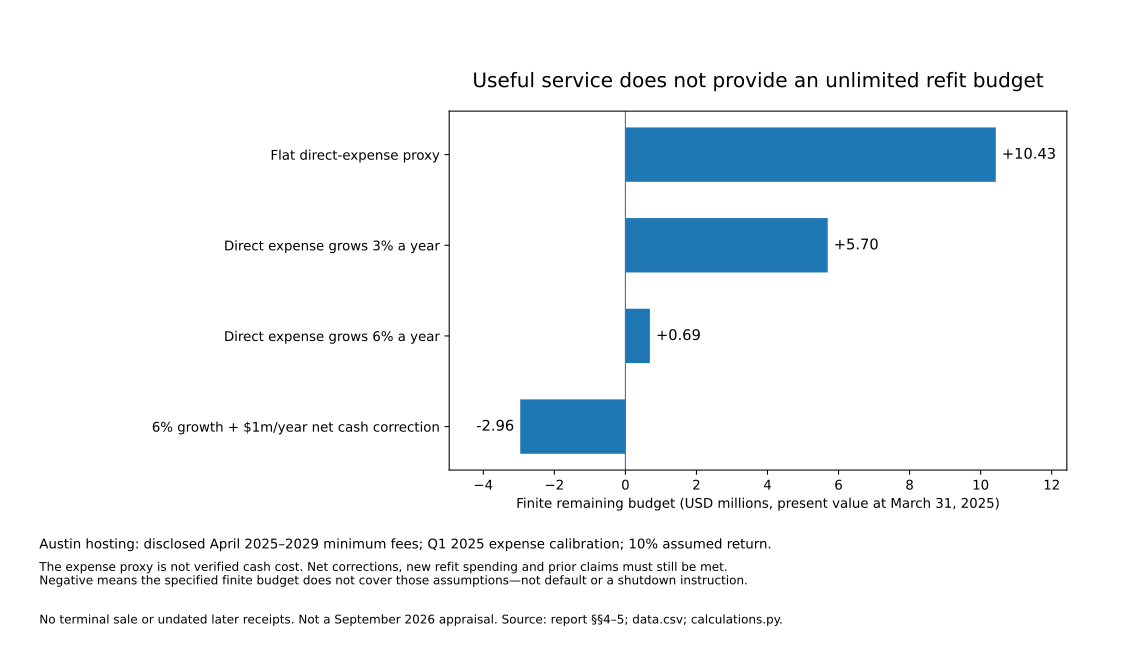
| Expense case | Budget, present-value USD m | Total constant annual net correction that exhausts it |
|---|---|---|
| Flat direct expense; D = 0 | 10.427 | 2.857m/year |
| Expense grows 3% a year; D = 0 | 5.695 | 1.561m/year |
| Expense grows 6% a year; D = 0 | 0.690 | 0.189m/year |
| 6% growth plus D = 1m/year | −2.960 | The assumed correction exceeds the preceding limit |
The 3% expense path roughly follows the known fee progression. The 6% path tests costs rising faster. Neither is a forecast of inflation or maintenance. With no extra correction, expense growth of about 6.40% a year exhausts the budget under this convention. The flat-cost budget is about $11.05 million at an 8% hurdle and $9.86 million at 12%; those hurdles are assumptions, not estimated company financing rates.
Each additional dollar of upfront K uses one dollar of the calculated present-value budget. That makes the result useful for a future documented repair or refit proposal after a defensible D is supplied. It does not supply a missing quote, value a building, or turn accounting depreciation into a replacement bill.
What the endpoint does not mean
The disclosed $33.747 million “thereafter” fees and their associated costs are outside the finite window. They are not assumed worthless. Rent is not assumed to disappear in 2029. The model does not sell the service at that point and then collect its fees again. CS25Q1
A positive B is conditional room for costs before claim allocation, not proof of adequate liquidity on every date or unrestricted shareholder distributions. A negative B means the specified finite combination needs different costs, receipts or investment—not that the company defaulted or should shut the site. A lease or customer liability may survive shutdown; the calculation does not establish a costless exit.
This is the measured advance over a generic residual percentage: an identifiable schedule and expense base make the missing cash-cost mapping consequential. They constrain a continuation proposal without pretending the missing map has already been observed.
Continuing value belongs to particular rights—and can support new claims
The June 2026 filing reports that certain CoreWeave license agreements were assigned to CW SPV, an indirect CoreWeave subsidiary, while CoreWeave remained a primary obligor. This is an observed contractual restructuring, not a sale to an independent replacement customer. It does not establish a transfer price or that every facility, power or customer right can be sold freely. CS26
The continuing parent obligation is favorable protection for the host. It also preserves common customer-network dependence: the service still relies on entities in the CoreWeave family. An operating contract, its assignability and the price of dismantled equipment remain different things.
Customer construction cash has a later counterpart
| Component | Signed movement | Meaning |
|---|---|---|
| Opening balance | 553.878 | An opening liability balance, not new-period cash |
| Cash received | +181.149 | Current cash funding inside this reconciliation |
| Amounts billed and earned | −58.710 | Reduction, not another new receipt |
| Straight-line adjustment | −24.029 | Noncash earned base fees not yet billed |
| Closing balance | 652.288 | Reconciled ending balance |
The filing expressly identifies the $24.029 million adjustment as noncash. These are portfolio observations, not Austin-only accounts. They demonstrate why cash received earlier cannot be counted again when credited service is delivered. Conversely, deducting an entire deferred balance from an already credit-adjusted future schedule can understate the remaining cash. CS26
Advance funding can make a productive conversion possible and reduce a near-term cash need. It does not eliminate the costs of completing and maintaining the promised service. The original $300 million customer-funded package and this later portfolio reconciliation have different scope and dates; they are not amounts to add into an independent-demand total.
A useful asset is not automatically unencumbered equity
Core Scientific Finance issued $3.3 billion of 7.75% secured notes in May 2026. The June filing identifies $344.8 million in a restricted debt-service reserve and initial annual amortization of 11.5% of original principal, beginning under the specified semiannual-date rule after rent commencement and revenue-credit abatement. This is not an Austin-only payoff schedule. Specified finance-group subsidiaries, including Austin, support the security; the parent has a specified completion guarantee. CS26
The timing structure and reserve can support financing through transition. They also mean some continuing value serves existing claims before equity. The reserve is not simultaneously unrestricted money for replacement or shareholder distribution. The entire later multi-entity note issue is not subtracted from a March 2025 Austin calculation as though it were that site’s standalone liability.
No new covenant cushion, complete financing waterfall or beneficial-holder map is established here. The financing and payer-budget investigations remain the references for their separately dated payment mechanisms. Economic usefulness, an enforceable transferable right and owner access to cash require different evidence.
Keep, replace or transfer: compare the remaining alternatives
Historical recovery asks whether the original investment earned enough. Continuing operation asks whether future receipts cover the necessary future costs and obligations. A new owner asks whether the remaining claim justifies the price paid now. These tests can give different answers without contradiction.
Once an initial build is paid for, its historical purchase cost is not another cash bill merely because the owner reconsiders the business. But “sunk” does not cancel remaining rent, maintenance, debt or customer commitments. An optional refresh must outperform the best feasible continued use after equipment, retrofit, migration, downtime and genuinely usable disposal proceeds are counted once.
The A100 observation makes continued operation without an immediate whole-generation purchase a more concrete possibility. Austin shows why rights and operating costs still matter. The conversion record shows why a useful location may require replacement of only some components. None supplies a dollar continuation value for a different Childress installation.
| Assumption | Original full-investment recovery test | Forward ownership-price test |
|---|---|---|
| Replacement equipment and retrofit | $6.0bn | $4.3bn |
| Annual sales at full paid use | $4.0bn | $3.2bn |
| Favorable paid utilization | 90% | 90% |
| Variable cash cost | $1.0bn at full use, scaled by utilization | 25% of sales |
| Fixed annual cash cost | $0.2bn | $0.25bn |
| Annual cash under those favorable assumptions | $2.50bn | $1.91bn |
The 22 September physical-recovery investigation asks about recovering the original combined investment. The 26 September ownership investigation values remaining cash at its chosen model date. Their replacement costs, sales and cash allowances remain assumptions. They are not a before-and-after market forecast or evidence that a full refresh is mandatory.
The original-recovery end-value requirements of about $2.81 billion and $3.42 billion remain conditional thresholds. The forward ownership bridge’s approximately $16.88 billion other-portfolio requirement also remains a requirement, not an appraisal or observed loss. The Austin budget neither verifies nor replaces any of them. Scaling it by megawatts would mix leased and owned rights, service boundaries, contracts, costs and dates.
What changes is the evidence for the decision set. Keeping a suitable older service deserves a branch alongside replacement, re-letting and retirement. Valuing that branch still needs matched fees, actual service costs, maintenance, supported remaining life and retained rights. A new contract headline supplies only part of that record.
More support for survival—not a guarantee of full recovery
The serious favorable path
An installed and validated service avoids some of the cost and delay of rebuilding. A customer finds it adequate and competitively priced; a performing contract sustains payment; maintenance and the rights to operate remain affordable. An existing location similarly supports a new tenant rather than lying idle. The provider can retain positive cash without repeating the entire original outlay immediately.
The reported A100 contract and Austin’s hosting and operating record now support those mechanisms more concretely. The finite Austin convention shows how rising fixed fees and controlled expenses could fund additional work without an assumed terminal sale. The customer-persistence investigation supplies the complementary lesson: buyers and suppliers can both gain, while no participant receives the entire outside dollar as profit.
The serious adverse path
Older hardware remains functional but no longer meets the most valuable task requirements. A new tenant needs costly cooling or electrical work. Service costs outgrow protected fees, or credited construction payments leave less new cash than revenue implies. The operator may continue serving customers while original equity earns too little, and contractual creditors may still be paid.
The conditional Austin stress does not assert that any of those failures occurred. It makes one possible cost mismatch explicit. A later buyer paying less for the remaining rights could earn an adequate return even after the original owner disappointed. Neither useful operation nor an asset transfer retroactively makes the original price sound.
The blanket “nothing survives” account is less convincing; so is the assumption that survival supplies whatever value a financial model needs. Selective continuation has real documentary support. The unresolved investment question is how much net value remains after keeping the service useful, honoring its rights and obligations, funding transitions and allocating financial claims.
This is not a finding that all assets are overvalued or all debts are safe. Confidence is stronger in the existence of selected commercial continuation than in a universal residual curve or complete second-cycle return. The connected case selection limits independent corroboration and any industry-wide inference.
What has—and has not—changed
The advance comes largely from closer reconciliation of older documents and a specific August contract statement, not a claim that the economy changed between two 29 September evidence cutoffs. Earlier demand, financing, ownership and payer findings remain dated and accessible. Their models are not silently recalculated with the new service examples.
The NVIDIA–Energy Global forward still establishes an obligation with receipt unverified in the relied-upon evidence; no nonpayment inference follows. CoreWeave’s 22 September financing closing remains established by the later closing record, without becoming a current unspent cash balance. The correction record identifies those separate claims.
The observations that would decide more
| Evidence to obtain | What it would test | What would not substitute |
|---|---|---|
| Matched A100 contract and deployment record | Net fees, term, actual machine age, maintenance and whether a refit is required | Design introduction or a general “sold out” statement |
| Austin collections and actual cash costs | Where the signed cash correction lies relative to the finite budget | A newer multi-site gross margin |
| Specific refit, continued-use or transfer proposal | Incremental expenditure versus the best feasible alternative, including rights and downtime | An isolated component asking price or depreciation schedule |
| Completed conversion cost and remaining customer credits | Which capital and cash really survive for each claimant | Adding advances to unadjusted future fees |
| Documented retained financial claims | Who receives the remaining value and bears a shortfall | An arranger logo, gross facility ceiling or generic contagion claim |
The strongest additional favorable evidence would pair repeated adequate net fees with controlled maintenance and retained rights. The adverse evidence would be a cost or collection burden exceeding the remaining budget, a necessary expensive refit, or an inability to transfer the service that supports the cash. Those observations could change the interpretation without needing a crash or every new fleet to finish its lifetime.
Public disclosures do not provide a complete initial-cost ledger, single-site bank reconciliation, actual full-service cash margin, machine-by-machine age or repair history, freely assignable package, or net sale bid. The A100 agreement and full service-level terms were not publicly inspected. No inference of no value or no payment is made from missing information.
The research inspected the cited filings, announcements and relevant transcript pages. It did not obtain the full training-performance whitepaper from its landing page, and no numerical speed claim is taken from it. No paid model, private account, site visit, buyer outreach or new performance test is represented as completed. The following source notes preserve the evidence status and dates.
Sources, dates and reproducible work
Evidence was inspected for this investigation on 29 September 2026, a retrieval-day boundary. Publication, operating, model-anchor and financing dates above remain separate. Numerical inputs are source-linked in the companion ledger; assumptions and inherited scenarios retain their status.
CW CALL
Corrected Q2 2026 earnings call, August 11, 2026; pp.7–8. Corrected Q2 2026 earnings-call transcript, 11 August 2026, pp.7–8. Issuer-reported newly signed older-design contract and return narrative; the contract, serial-number age record, achieved price and lifetime cash were not supplied.
CW PRICE
North America on-demand eight-GPU instance table; inspected September 29, 2026. North American on-demand eight-GPU instance table as inspected on 29 September 2026. Posted tariffs and configurations, not executed renewal prices, capacity availability or equal-service performance measurements.
CW MAINT
Published planned and unplanned maintenance policy; inspected September 29, 2026. Maintenance policy inspected on 29 September 2026. General planned/unplanned platform work; not the A100 contract or a measured cost, failure or uptime series.
CS AUSTIN
March 6, 2024 Austin hosting announcement. 6 March 2024 hosting announcement. Former Hewlett Packard facility, leased operation and CoreWeave relationship; not exact physical age, collected cash or completion of a second hosting term.
CS CONVERT
June 3, 2024 original approximately 200-MW conversion package. 3 June 2024 original approximately 200-MW owned-site conversion package. Twelve-year agreements, estimated funded infrastructure and fee credits; extension options are not exercised renewals and these terms are not imputed to every later project.
CS24
2024 Form 10-K/A, filed March 2, 2026; Note 8 lease tables and Austin discussion. 2024 Form 10-K/A, filed 2 March 2026. Historical Austin headlease and remaining customer schedules, including issuer-rounded rent. Not current cash or a contemporaneously available March 2025 investment compilation.
CS25Q1
March 2025 Form 10-Q/A, filed March 2, 2026; Notes 5 and 12; Austin colocation discussion. March 2025 Form 10-Q/A, filed 2 March 2026; original quarter report filed 7 May 2025. Note 5, segment disclosure and Austin revenue/cost discussion. Matched single-site schedule and expense, not a full cash ledger.
CS25
2025 Form 10-K including restated 2024; pp.56, 60, 79, 83–89 and 105. 2025 Form 10-K including restated 2024 comparisons. Pages 56, 60, restatement/asset notes and p.105 segment table. Relevant tables inspected in the research. Impairment and demolition concern mining-to-colocation assets, not an Austin or general GPU resale measurement.
CS26
June 2026 Form 10-Q, filed July 28, 2026; property, lease, debt, deferred-revenue and assignment notes. June 2026 Form 10-Q, filed 28 July 2026. Portfolio construction, license assignment, deferred-revenue and debt notes. Later pooled accounts and restricted finance, not a new Austin-only cash schedule or beneficial-holder register.
IR25Q3
May 14, 2025 release; March-quarter cloud results and May 5 ARR. 14 May 2025 results, March-quarter cloud revenue and May 5 operating ARR. Mixed, changing H100/H200 platform; not a fixed-vintage renewal cohort or annual collections.
Earlier dated investigations
Whole-system foundation · 18 September; Demand and monetization · 19 September; Financing and loss transmission · 20 September; Physical recovery · 22 September; Ownership prices · 26 September; Payer cash and flexibility · 27 September; Customer dollar and renewal · 29 September. All dates are 2026 evidence boundaries, not common financial observation dates.
Inspect or reproduce the calculation
Download the 94-record input ledger (CSV) · Download the calculation companion (Python) · Download the finite-budget drawing (SVG).
The ledger and code are reader adaptations of the investigation’s inputs and equations. Public source labels and continuity links are used; calculations remain local, with no live price feed. The chart retains the supplied drawing and adds accessible description. Reproduction checks test the arithmetic, not the truth of assumptions or eventual outcomes.
python continuation-calculations.py --data continuation-data.csv