Is AI a Bubble?
What today’s ownership prices require
A real business can still be an expensive investment. The test is cash that can reach owners after reinvestment and funding.
Later funding evidence · 27 September 2026. The payer-budget analysis excludes $3.8bn of restricted short-term investments and uses Microsoft’s full lease-payment schedule. The valuation here permissively credited the broader cash/short-term pool and retains its frozen assumptions and outputs. Its growth requirement is revenue growth; no revised valuation is implied by this note. The new work tests the feasibility of funding and spending normalization rather than silently recomputing the model. Resources, cash payments and investment
The answer: real businesses, demanding ownership expectations
There is a well-supported commercial AI expansion. There is not yet an equally well-established case that every ownership price will earn a satisfactory return. Useful applications, paying customers, substantial supplier earnings and accepted computing capacity contradict the idea that nothing real is being sold. They do not establish how much cash a particular shareholder will receive after operating costs, replacement, financing and dilution.
The most directly supported vulnerability is not that AI stops working. It is that customers obtain better or cheaper service while some suppliers, infrastructure owners or investors earn less than their commitments and entry prices require. A strong customer can keep paying a contract that earns it a poor return; a project can repay its lender yet contribute too little to justify the operator’s whole share price. Those are different outcomes from insolvency or a system-wide credit crisis. Whole-system assessment · 18 September 2026 foundation; Independent demand · 19 September 2026; Financing and loss transmission · 20 September 2026; Physical capacity and recovery · 22 September 2026.
The ownership tests make that distinction concrete. At its dated reference price, IREN needs a substantial value contribution from outside the named Microsoft project, even after a favorable replacement cycle is paid for. Microsoft needs sustained revenue growth alongside adequate cash capture and a reduction in investment intensity, not merely another profitable quarter. A frontier-company owner must finance the period before distributions, or accept a smaller claim if other investors supply the money. These are conditional requirements, not target prices or forecasts.
The favorable interpretation remains serious. Broad paying demand, falling delivery costs, successful hardware renewal and valuable retained facilities can support returns. Microsoft has a large operating business that makes this case more observable than a story based entirely on distant distributions. IREN has other operating and contracted activities with genuine possibilities; the analysis does not assign them zero value. The question is what they must produce, net of the investment still needed to produce it. Microsoft annual filing · year ended 30 June 2026; IREN annual filing · year ended 30 June 2026; IREN results and operating update · August 2026.
Our weighted assessment is commercial substance with material, unevenly supported ownership expectations. Confidence is stronger in real activity and documented payment mechanisms than in complete future owner cash. There is moderate support for concern about the execution required by the selected prices, but not enough evidence for a universal overvaluation amount, a calibrated crash probability or a precise private common-share fair value.
The scope is the U.S.-centered commercial generative/frontier-AI build-out since 2023, including material international suppliers and funding. These deliberately contrasting companies are not a statistically representative sector sample. This chapter is an economic investigation, not a stock-selection service.
Start with the price, the date and the actual claim
A reverse valuation asks: what future cash would make this specified price work? Solving that equation does not show that the outcome will happen. Nor does an ambitious answer prove a bubble. The useful test is whether growth, cash margins, investment, financing and ownership rights can plausibly coexist.
The public-price tests freeze the 24 September 2026 completed U.S. session, selected while the following session was live. These are not September 26 trades or a final September 25 close. Each price is paired openly with an older filing share count. The resulting capitalization is arithmetic, not a claim that a same-instant fully diluted count has been reconstructed.
| Reference ownership claim | Price or financing reference | Count or transaction boundary | Reference value |
|---|---|---|---|
| IREN ordinary shares | $46.15 per share, September 24 | 394.058648m outstanding, August 14 | $18.186bn common equity |
| Microsoft common shares | $497.93 per share, September 24 | 7,425.545491m outstanding, July 23 | $3,697.402bn common equity |
| NVIDIA common shares | $224.58 per share, September 24 | Approximately 24.1bn outstanding, August 21 | Approximately $5,412bn common equity |
| OpenAI financing | $852bn post-money, March 31 | Announcement of $122bn committed financing | Not a September common-market quotation |
| Anthropic financing | $965bn post-money, May 28 | $65bn round, including previously committed funding | Not a completed IPO price |
IREN historical-price record · 24 September 2026; Microsoft historical-price record · 24 September 2026; NVIDIA historical-price record · 24 September 2026; IREN annual filing · year ended 30 June 2026; Microsoft annual filing · year ended 30 June 2026; NVIDIA quarterly filing · quarter ended 26 July 2026; OpenAI financing announcement · 31 March 2026; Anthropic Series H announcement · 28 May 2026.
A share is a claim after debt and other prior rights. Cash and separable holdings can add value, but a restricted account is not automatically distributable. Private preferred rights can differ from public common stock. Convertibles, awards and future capital can change the owner’s fraction. A vendor market-cap field based on a different share count cannot silently replace those distinctions.
There are also two investment questions. Original recovery asks whether the full historical expenditure earned its cost. Buying today asks whether the remaining assets, cash and obligations justify the price today. Sunk expenditure is not a new bill for the purchaser. But a past cash balance cannot remain unchanged while the model assumes that the same money has already reduced the remaining build cost.
The public models use 8%, 10% and 12% required-return assumptions; the frontier test also uses 15%. These are sensitivity choices, not measured company costs of capital. Lower rates make distant cash more valuable. The model should expose that dependence, not hide it in a single number called fair value.
IREN: from a valuable contract to the whole share price
The new evidence locates resources and restrictions
The June annual accounts isolate the Microsoft financing subsidiary, IE US Hardware 3 LLC. It had $1.724bn restricted cash, $1.487bn equipment book value, $1.128bn payables/accruals, $0.918bn debt carrying value and $1.013bn deferred revenue. Assets less liabilities gave approximately $0.214bn book equity. This is a useful borrower-level boundary, not a project appraisal or the amount needed to complete the entire deployment. Equipment book value is not cash already paid, and the facility investment has a different perimeter. IREN annual filing · year ended 30 June 2026.
The same filing identifies $1.623480bn of consolidated lease advances received before commencement. Its larger total deferred-revenue figure also includes amounts that can be receivable. The model does not allocate the whole group receipt to Microsoft. It uses the subsidiary’s $1.013120bn deferred balance as a dated allocation proxy for advance already received, and labels that choice an assumption. No September bank record or phase-by-phase collection ledger was obtained.
This is deeper reconciliation of June evidence, not a newly occurring September payment. Similarly, the ATM program’s 47.165838m shares and $2.492057bn gross proceeds at June recur, rounded, in the August update. They are not a second $2.5bn receipt. The August outstanding share count already includes issued Mirantis consideration shares; adding them again would inflate dilution. IREN annual filing · year ended 30 June 2026.
The customer SOW names an Inc.; later financing names an LLC. Current accounts establish the group/project connection, but a separate conversion or assignment instrument was not established. Ordinary distributions face common-terms conditions covering reserves, defaults/cash traps and specified acceptance/consultant tests. Separately permitted sponsor reimbursements mean the correct conclusion is neither “all collected cash is immediately a dividend” nor “nothing can reach the parent before every phase is complete.” Microsoft / IE US Hardware 3 statement of work · November 2025; IE US Hardware 3 common terms agreement · 29 May 2026.
Reconcile the financing claims before valuing the remaining operations
| Mixed-date IREN bridge | US$ bn | Boundary |
|---|---|---|
| Paired common equity | 18.185807 | September 24 price × August 14 count |
| Convertible principal plus funded GPU debt | +7.683699 | June debt at face; not all committed financing |
| Finance-lease liabilities | +0.243796 | June financing claim |
| Unrestricted cash | −5.895591 | June cash credited once |
| Operating-value requirement | 20.217711 | Before separately crediting restricted resources, hedges or later net changes |
IREN historical-price record · 24 September 2026; IREN annual filing · year ended 30 June 2026.
This is not an estimated September market enterprise value. Debt market values, conversion choices, option rights, working liquidity and post-June changes can alter the bridge. The group’s $13.810bn capital commitments are also not all Childress, nor an extra liability to add on top of the same purchases already charged in future cash.
Two conservation rules prevent a false gain. A $1bn payment for already-budgeted construction reduces both cash and cost to complete by $1bn; under the time-zero convention the effects cancel. Drawing the $2.707bn that was conditionally undrawn at June would create cash and a matching financing claim. It can help liquidity without creating free operating value. Fees, interest and restrictions still matter. IE US Hardware 3 credit agreement · 29 May 2026; IE US Hardware 3 note purchase agreement · 29 May 2026; IREN annual filing · year ended 30 June 2026.
What the remaining first contract contributes under stated assumptions
The SOW’s tranche table contains $9.664199424bn fees, including a 20% advance credited after the first 24 service months. Future collections must deduct those credits even when the advance arrived earlier. The slightly higher general contract ceiling is not substituted for the smaller table total. Section 3.2(e) protects aggregate fees through service-end extensions after delayed starts; delay does not automatically delete a final year at a fixed expiry. Credits, termination and financing-date mismatches remain separate risks. Microsoft / IE US Hardware 3 statement of work · November 2025.
The forward model assumes four equally weighted phases: one service month has elapsed for the first; the other three begin in three months; each has sixty service-equivalent months. These are timing approximations, not reconstructed invoices. It uses 20% of gross fees for project cash costs and $4bn remaining construction/equipment spending, neither a measured margin nor a verified cost-to-complete figure. That remaining burden must cover applicable unpaid supplier invoices as well as completion spending; those same payables must not be deducted a second time in the ownership bridge. Unallocated corporate burdens remain in the other portfolio’s net value. The hurdle is 10%.
| Central forward Childress component | Present value, US$ bn |
|---|---|
| Remaining invoices, after advance credits | 6.134680 |
| Unreceived advance, using the dated subsidiary proxy | 0.903478 |
| Future project cash-cost allowance | −1.499361 |
| Assumed remaining capital burden | −4.000000 |
| First-term value before financing claims | 1.538798 |
This is a forward scenario. It does not deduct the original $8.6–9.0bn budget again. The earlier full-cost study asked whether the entire original investment was recovered; its $2.81bn/$3.42bn continuation requirements are not appraised assets to add here. IREN Microsoft project presentation · November 2025; Physical capacity and recovery · 22 September 2026.
With remaining burdens of $2bn, $4bn or $6bn, first-term values are approximately $3.54bn, $1.54bn or negative $0.46bn. Other required value before continuation is correspondingly $16.68bn, $18.68bn or $20.68bn. The rows are alternative net economic burdens—not different post-June payments while holding old cash constant. A negative future project value in a scenario is not a default finding.
A replacement cycle earns its place; it is not a free terminal asset
A favorable optional second cycle charges $4.3bn replacement and retrofit, then assumes five additional years, 200 MW IT, $16m annual revenue per fully paid MW, 90% paid utilization, variable cash costs of 25% of revenue and $0.25bn annual fixed costs including maintenance. These future prices and costs are assumptions. There is no sale value after that cycle.
The case generates $2.88bn annual revenue and $1.91bn annual net project cash. After renewal investment, its value at the model date is approximately $1.80bn. At $8m/MW and 65% utilization, the additional cycle instead destroys about $1.40bn of incremental present value. An owner not compelled to renew would decline it: its voluntary exercise value is zero, not a forced negative investment. This is a scenario decision, not a market-priced option.
Conditional ownership test · not appraised asset values
One contract does not explain the whole share price
On a narrow screen, scroll the figure horizontally.
The favorable extension brings the named project to about $3.34bn, leaving $16.88bn net value for the rest of IREN. That rest includes other cloud customers, sites, mining, software and future development, after the costs needed to obtain their cash. It is not assumed worthless. Immediate full credit for all $1.724bn restricted cash would lower the requirement to $15.16bn, a permissive resource bound rather than observed release status.
Timing matters even when fees survive. Starting the unstarted phases immediately rather than in three months gives about $1.64bn first-term value; starting them in twelve months gives about $1.25bn. Combining twelve months with a 25% cash-cost share gives about $0.90bn. Including the same favorable renewal assumptions, other value required is approximately $16.75bn, $17.26bn and $17.62bn, respectively. These preserve service duration and move service costs too; they do not forecast site delays or quantify undisclosed penalties.
What the wider portfolio would have to earn
IREN’s August release described $1bn operating ARR, $4bn contracted ARR associated with 2026 capacity, and a roughly 0.8-GW IT target for 2027. Those are annualized operating metrics and targets, not a completed cash account. They give the rest of the company a plausible business scope, not its valuation. IREN results and operating update · August 2026.
A bounded test assumes fifteen years of level annual net cash, first received at the end of model year three, with a 10% hurdle. Net cash includes continuing replacement, taxes and corporate costs. Additional initial build costs are charged separately at present value. The following asks what supports the $16.88bn residual requirement:
| Other remaining initial build, PV | Required annual net cash | Revenue at assumed 40% complete continuing cash margin | Paid utilization at hypothetical 600 MW and $20m/MW-year |
|---|---|---|---|
| $0bn: permissive lower-build bound | $2.69bn | $6.71bn | 56.0% |
| $5bn | $3.48bn | $8.70bn | 72.5% |
| $15bn | $5.07bn | $12.68bn | 105.7%: infeasible at these inputs |
The 600 MW subtracts the named 200 MW from the 0.8-GW target; it is not observed available capacity. Price and margin are assumptions. A low remaining-build case needs evidence of earlier investment, lower costs or other assets—not selection because it makes the share price work. Different profitable activities could help; extra nominal MW without their cost cannot.
Financing changes the owner’s fraction as well as the company’s cash
A simplified full-share conversion of the remaining 2029/2030 notes removes about $0.446bn face and adds about 29.741m shares. At the reference price, the gross additional equity claim exceeds removed face by approximately $0.927bn. Actual settlement alternatives and hedges matter. The roughly $0.240bn older-cap offset in the companion is only conditional intrinsic arithmetic at assumed remaining hedge notional—not option fair value, a verified hedge inventory or extra cash to add to later capped-call carrying value. IREN annual filing · year ended 30 June 2026.
NVIDIA’s thirty million IREN investment rights at a $70 strike have no intrinsic value at $46.15. They do not thereby have zero option value or potential dilution. Likewise, conditional executive awards are not already-issued shares. A separate $2bn primary issue at $46.15 would leave existing holders about 90.1% of the enlarged count; at $30, about 85.5%. The company also receives $2bn. Percentage dilution at a fair price is not automatically destruction of wealth: return on the new cash and the new investors’ rights decide that.
IREN conclusion: a genuine operating and contracted business remains, but a major part of the ownership case depends on the rest of the portfolio. The missing evidence is a matched funded-cash, remaining-build and net owner-cash plan—not another isolated payback or equipment benchmark. No precise whole-company fair value is established.
Microsoft: growth must coexist with reinvestment
A new cash convention, not a new date on the old model
The earlier whole-system illustration solved for growth of a cash residual. The new test separates revenue, pre-investment cash capture and reinvestment, then allocates operating value to claims. Its result is a required revenue-growth rate, not the old cash-growth rate and not evidence of market repricing when compared with it. Whole-system assessment · 18 September 2026 foundation.
| Fiscal 2026 starting bridge | US$ bn | Treatment |
|---|---|---|
| Reported operating cash flow | 182.935 | Consolidated; includes working-capital timing |
| Stock compensation allowance | −12.405 | Economic compensation charged once |
| After-tax net-interest adjustment | −0.203 | Accrual-based proxy; assumed 19% marginal tax |
| Pre-investment economic cash proxy | 170.328 | Approximately 51.33% of revenue |
| Cash property/equipment investment | −115.948 | Cash investment |
| New finance-lease assets | −24.608 | Economic investment, not a cash purchase |
| Residual economic cash proxy | 29.772 | Not reported free cash flow |
Microsoft annual filing · year ended 30 June 2026; Microsoft fiscal-year results · July 2026.
This combines cash and economic-investment conventions. It is not a claim that Microsoft’s actual distributable cash fell to precisely $29.772bn. Cash taxes, accruals, working capital, compensation and lease timing need fuller reconciliation. Its purpose is to make leased expansion count as investment rather than invisible financing.
Cash-model boundary · no invented cash flows
Count the investment and the ownership claim once
On a narrow screen, scroll the figure horizontally.
The claim bridge adds $36.5bn June debt fair value and $66.594bn finance-lease liabilities to $3,697.402bn paired equity, then subtracts $76.843bn cash and short-term investments. That gives $3,723.653bn operating value required, before a separate holding credit. Using $46.136bn debt face instead would add $9.636bn. Neither debt figure is a September bond quote; crediting all cash is also permissive because operations need liquidity. Microsoft annual filing · year ended 30 June 2026; Microsoft historical-price record · 24 September 2026.
What must grow—and what must decline as a share of sales
The scenario uses a 49% pre-investment cash share of revenue, below the historical proxy. It must cover serving customers, continuing research, sales and administration, compensation, cash tax and working-capital needs. Investment begins at the observed combined ratio of 42.36% of revenue, stays there for two years, then declines linearly to a selected long-run ratio by year seven. Investment continues thereafter; it does not vanish.
There are ten years of modeled revenue growth, followed by 3% perpetual cash growth. A separately disclosed $1.1bn remaining OpenAI investment commitment is charged in year one. The formula is operating cash = revenue × (pre-investment cash share − investment share), less separately modeled funding. Both the normalized shares and the schedule are assumptions, not management guidance. Microsoft annual filing · year ended 30 June 2026.
| Assumed required return | Long-run investment: 20% of revenue | Investment: 25% | Investment: 30% |
|---|---|---|---|
| 8% | 12.06% | 14.30% | 17.11% |
| 10% | 17.28% | 19.64% | 22.61% |
| 12% | 21.74% | 24.21% | 27.31% |
Every cell is required annual revenue growth over ten years, under the same cash-share and continuation assumptions. It is not growth of an AI-only segment, a forecast or a measured cost of capital.
Conditional reverse valuation · not a forecast
Persistent reinvestment raises the required revenue growth
On a narrow screen, scroll the figure horizontally.
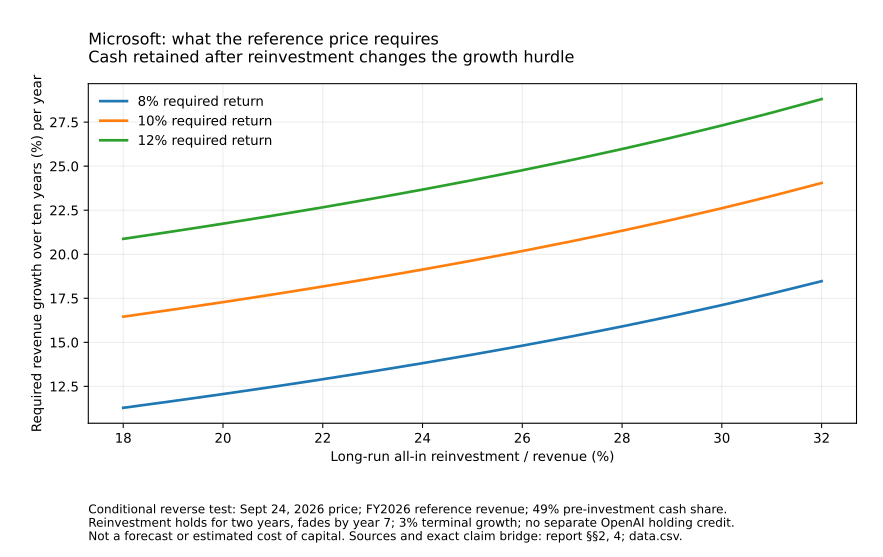
In the 10%/25% central case, year-ten revenue is about $1.995trn and annual operating cash after investment is about $478.7bn. Approximately 72.9% of value comes after year ten. A finite comparison retains ten more years at 3% growth, then gives no value after year twenty. The required first-decade growth rises to 26.22%. That does not predict Microsoft shuts down in twenty years; it reveals dependence on continuing franchise cash.
The favorable case has an operating foundation
Microsoft reported roughly 18% fiscal-year revenue growth. Management also described substantial Azure growth and about 90% of Microsoft Cloud revenue outside the largest frontier-model companies. This supports a broad operating-business case rather than a single financing loop. It is not a ten-year growth forecast or an AI-only independent-demand measure. Microsoft earnings call · 29 July 2026.
At an 8% hurdle, 18% annual revenue growth, 51% pre-investment cash share and 20% long-run investment, the model more than supports the reference price. At 18% growth with a 10% hurdle, 49% cash share and 25% investment, modeled equity covers about 88% of the reference. At 12% growth, a 12% hurdle, 45% cash share and 30% investment, coverage is about 24%. These combinations are sensitivity cases, not probabilities, target prices or a forecast range.
The difficult condition is persistent high growth while investment intensity falls without weakening service, competitiveness or replacement capacity. That is demanding, not arithmetically impossible. A building-life accounting change does not prove the GPUs last twenty-five years or that capital can normalize on the assumed schedule. Microsoft earnings call · 29 July 2026; Whole-system assessment · 18 September 2026 foundation.
Value the OpenAI interest consistently
The base gives no separate realizable credit to Microsoft’s OpenAI holding. Crediting an assumed $100bn or $200bn, after sale costs but before the separately charged $1.1bn commitment, lowers central required growth from 19.64% to 19.29% or 18.93%. These are resource sensitivities, not appraisals of a liquid quarter of OpenAI’s headline value. A credit already net of that commitment requires removing the duplicate charge. Microsoft annual filing · year ended 30 June 2026.
Commercial receipts and an investment interest are separate legs. They can both legitimately have value, but OpenAI’s own valuation must bear the cloud payments that support Microsoft’s receipts. Investment remeasurement gains cannot be counted as new customer cash. The accounts’ ownership, distribution and liquidation structure does not justify simply capitalizing every headline twice.
Microsoft conclusion: the price rests on a serious current business and plausible favorable paths. It still requires sustained growth, cash capture and capital normalization. Present profit alone does not validate that combination; a low current cash yield alone does not refute it.
Frontier ownership: pay for the years before distributions
A reported cash-use forecast is not a current financing shortfall
OpenAI’s $852bn March reference and $122bn committed round do not establish September unrestricted cash. Reuters reported on September 18, citing Financial Times coverage and presentation material, projected negative free cash flow of approximately $278bn during 2026–30, alongside revenue forecasts of $36bn in 2026 and $350bn in 2030. The underlying presentation was not obtained. These are attributed forecasts, not observed cash outflows. OpenAI financing announcement · 31 March 2026; Reuters on OpenAI’s projected cash use · 18 September 2026.
Subtracting $122bn from $278bn would not identify an exact funding hole today. Periods, cash already spent or remaining, installment conditions and accounting definitions are not reconciled. Instead the model makes additional financing beyond existing resources a visible assumption. OpenAI’s management case—better capability, more paid uses and lower serving costs—is economically coherent, but does not supply the missing complete margin. OpenAI commercial argument · 8 September 2026.
Anthropic supplies a bounded contrast, not a copy of OpenAI’s presumed burn. Its $965bn May reference, $65bn round and rapid reported monetization are distinct; $15bn in that round was already committed hyperscaler funding. Complete comparable cash statements and preferred/common distribution rights were not established for either company. These are common-equivalent expectation tests, not fair values of private common shares. Anthropic Series H announcement · 28 May 2026.
Pro-rata funding raises the cash the owners need back
Assume no distributions in years one through five. Existing owners contribute an additional amount in year three, pro rata, beyond resources already in the company. From year six, complete owner cash grows at 3% annually. With reference value E, funding B and required return r:
First annual cash = [E + B/(1+r)^3] × (r − 0.03) × (1+r)^5.
The $100bn and $200bn funding alternatives are assumptions, not estimates extracted from the burn report. Complete owner cash is after serving, research, distribution, taxes, replacement, working capital and relevant financing. A compute commitment enters once as the appropriate economic cost; it is neither omitted nor deducted twice.
| Required return | Assumed extra funding, year 3 | Required annual owner cash, year 6 | Revenue at assumed 30% complete cash margin |
|---|---|---|---|
| 10% | $0bn | $96.1bn | $320.2bn |
| 10% | $100bn | $104.5bn | $348.4bn |
| 10% | $200bn | $113.0bn | $376.6bn |
| 15% | $0bn | $205.6bn | $685.5bn |
| 15% | $100bn | $221.5bn | $738.4bn |
| 15% | $200bn | $237.4bn | $791.3bn |
Assumed funding and margin · not a financing forecast
A distant cash stream still needs an intervening funding plan
On a narrow screen, scroll the figure horizontally.
A 10% hurdle is a permissive private-equity comparison, not an observed investor requirement. At a 20% complete cash margin rather than 30%, the 10%/$100bn case requires $522.6bn revenue. Strong revenue can support the lower-hurdle case only if a large fraction survives all continuing costs and further funding stays contained. The research has not measured that fraction.
Delaying first distributions two years raises first annual cash required from $104.5bn to $126.5bn, holding the funding date fixed and without silently assuming extra intervening losses. A finite alternative pays for fifteen distribution years starting in year six, with no value afterward. It needs $166.7bn first-year cash, or approximately $555.6bn revenue at 30%. The perpetual base puts all value beyond the initial five-year non-distribution period; finite life exposes that reliance rather than forecasting an actual corporate end date.
Applying the permissive no-extra-funding convention to Anthropic’s $965bn reference requires about $108.8bn first annual cash, or $362.6bn revenue at 30%. It does not import OpenAI’s forecast into Anthropic or resolve unknown security rights.
Not joining the next round means a smaller claim—not the same cash call again
For an assumed $100bn primary round at pre-money values equal to half, equal to, or twice the $852bn reference, nonparticipating existing holders keep approximately 81.0%, 89.5% or 94.5%. At the central hurdle, company-wide first distributions must then be about $118.6bn, $107.3bn or $101.7bn to support the unchanged original outlay.
The model does not also charge those holders the contribution they declined to make. The company receives capital; the owner gives up part of future cash. Preference rights, discounts, further rounds and conversion can change that allocation. A favorable high-price future round would help old holders, but assuming one is always available would build the desired conclusion into the model.
Frontier conclusion: rapid monetization and financing create a plausible path, not an established complete return. A business may improve while an existing holder’s prospective return weakens through additional capital needs, priority or expensive entry pricing. The service need not be fictitious for the ownership expectations to be fragile.
Financing and IPOs: establish whose cash actually improves
The closing has evidence; the calendar alone was not enough
The September 20 financing investigation correctly left CoreWeave’s September 18 priced offering unreceived, with closing expected September 22. A later current report now confirms $4.2bn issued on September 22, including the exercised $0.5bn option. Approximately $4.137bn net of purchaser discounts, less $566.2m capped-call cost, leaves $3.5708bn before other expenses. CoreWeave closing disclosure · 22 September 2026 event; Financing and loss transmission · 20 September 2026.
Completed financing · not operating cash generation
The face amount is not the cash left for investment
On a narrow screen, scroll the figure horizontally.
The 2.875% coupon implies about $120.75m annual cash interest. At the initial conversion rate, full share settlement would correspond to roughly 42.92m shares; that is not actual issuance and settlement alternatives apply. Capped calls mitigate specified conversion exposure while consuming cash now. The closing demonstrates capital access, not full investment recovery or a comprehensive September cash balance.
Preparation, proposed pricing and cash received remain different stages
| Issuer or transaction | Evidence established at the September 26 inspection | What it does not establish |
|---|---|---|
| OpenAI | Confidential draft submission announced June 8; September 12 statement ruled out a 2026 IPO; September 15 reporting discussed further private capital | A priced/closed IPO, final later date or completed $1.2trn round |
| Anthropic | Confidential submission announced June 1; September 11 reporting described large IPO and anchor-investor discussions | Final price, primary/secondary allocation or received IPO cash |
| SB Energy / SE Global Holdings | Public registration exhibits; September 25 reporting of postponed formal marketing | Company-confirmed withdrawal, insolvency or an operating-service failure |
| CoreWeave | September 22 follow-on convertible issuance confirmed | An IPO, operating revenue or proof of owner returns |
OpenAI confidential-submission announcement · 8 June 2026; Reuters on OpenAI’s timing statement · 12 September 2026; Reuters on possible OpenAI private financing · 15 September 2026; Anthropic confidential-submission announcement · 1 June 2026; Reuters on Anthropic IPO discussions · 11 September 2026; SE Global Holdings registration exhibits · September 2026; Reuters on delayed SB Energy marketing · 25 September 2026; CoreWeave closing disclosure · 22 September 2026 event.
The Anthropic reporting included an offering up to $100bn, a potential valuation near $2trn and possible NVIDIA participation. These were attributed proposals, not a new closed reference replacing the $965bn May round. Similarly, the reported SB Energy delay and reasons remain attributed; the company did not confirm the reported rationale, and the full prospectus body was not accessible in the research.
An IPO headline can describe two different cash recipients. Primary issuance funds the business, net of fees and restrictions. Secondary sales principally pay existing holders. Both may offer an investor an exit, but only the primary component supplies new company resources. A larger capitalization does not itself fill a bank account.
Three separate NVIDIA instruments, three different boundaries
The SE Global Holdings share-purchase agreement concerns a separate $1.5bn nonvoting subscription following a qualifying IPO. The condition requires at least $1.5bn gross primary issuer proceeds, excluding selling-holder sales; the agreement includes termination provisions and a May 15, 2027 outside date. An all-secondary $1.5bn offering would not satisfy the primary condition. A qualifying $1.5bn primary offering plus the separate subscription could supply $3bn gross if both close. Neither amount is established as received here. SE Global Holdings / NVIDIA share purchase · 17 August 2026.
The Energy Global prepaid forward is different. The supported correction remains:
NVIDIA entered into a $1.5bn prepaid-forward contract with Energy Global, LP. The agreement requires payment within three business days after its date. The documents inspected for this investigation do not verify receipt.
Obligation established; receipt unverified is not evidence of nonpayment. No distinct receipt-confirming disclosure was established in the ownership investigation. This is a preserved correction, not a new missed-payment discovery, and the amount enters none of the model cash. Energy Global / NVIDIA prepaid forward · 17 August 2026; Independent demand · 19 September 2026.
The phase-dependent residual-value/credit-support arrangements are different again. A lifetime ceiling is not funded debt, current callable cash or expected loss. Support may improve recovery for one party while transferring correlated risk to NVIDIA; its fuller activation and remedy analysis remains in the financing investigation. The IREN investment rights discussed earlier are yet another instrument, not these SB Energy receipts. Financing and loss transmission · 20 September 2026.
The whole question: whose success, whose loss?
Customer usefulness is the strongest established part of the case. The earlier support, coding and office investigations include both positive and negative evidence with distinct workers, methods and tool vintages. Repeat buying is additional evidence, not a complete census of independently financed final demand. More useful work can coexist with weak supplier capture. Independent demand · 19 September 2026.
Supplier profitability is real but not an ownership verdict. NVIDIA’s July quarter had $96.221bn revenue and $63.734bn operating income. A bounded half-year proxy—operating cash less property/intangibles and stock compensation—is $66.033bn. Doubling it gives $132.066bn; the paired equity reference is approximately 41 times that annualized proxy. This is not trailing-year free cash flow or a full valuation. The $42.404bn first-half equity purchases also show that cash generated is not automatically cash distributed. No guarantee ceiling is deducted as current debt. NVIDIA quarterly filing · quarter ended 26 July 2026; NVIDIA historical-price record · 24 September 2026.
Strong contracts can protect lenders. The DDTL 4.0 Meta take-or-pay and projected full-amortization case remains a substantive favorable finding. It is not actual covenant headroom, an owner return for the operator, or proof that the customer’s purchase is attractive. Full-cost recovery then asks about facilities and replacement as well as chips. Ownership value asks whether the remaining cash and the entire portfolio justify the particular claim’s price. None of these questions can be answered by substituting another one. Financing and loss transmission · 20 September 2026; Physical capacity and recovery · 22 September 2026.
The familiar arguments are strongest when they identify those mechanisms and weakest when they skip them. Technological progress can create customers without giving each supplier pricing power. Scarcity can support current fees without ensuring the next contract. Cheap compute can expand usage while lowering the returns of older capital. Related financing can fund real service while leaving several claims dependent on the same future payer. A successful IPO can fund sound investment or transfer expensive ownership; it validates neither automatically.
A sustainable expansion combines paid value, lower delivered cost, disciplined construction and renewal, and enough retained cash to fund an increasing share of investment. The Microsoft and IREN favorable cases show that such outcomes are not mathematically excluded. The evidence supports parts of that conjunction, not a guarantee that all conditions will persist.
A second path is useful technology with poor investment or ownership recovery: services improve, but competition, replacement and entry price absorb the benefit. Equity may be marked down or diluted while contracted lenders are paid. Existing assets may remain worth operating for a new owner even when their original purchase was disappointing. This is the most directly supported mechanism of vulnerability in the selected cases—not a probability forecast for the entire industry.
A funding contraction with wider credit losses needs further steps: payment or delivery failure, inadequate reserves/cures, unavailable capital and weak collateral or guarantor recovery. Transmission then depends on actual exposures, leverage and liquidity at the ultimate holders. A common customer shock can impair invoices, ownership and indemnities together; those are connected claims, not separate losses to sum indiscriminately. A share-price fall, project default and system-wide crisis are not interchangeable. Financing and loss transmission · 20 September 2026.
The revised answer therefore remains conditional but useful: commercial activity is established more strongly than the net cash required by many ownership expectations. The unsupported leap is from adoption, a first contract or today’s profit to durable owner cash without charging the intervening investment and funding.
What would change this assessment?
| Observation to obtain | Sustainable interpretation strengthened by | Concern strengthened by | Main ambiguity |
|---|---|---|---|
| IREN phase collections, reserve releases and remaining bills in subsequent filings | Matched cash after credits, completion costs and permitted distributions | Repeated extra funding, delayed or trapped cash | Accounting acceptance is not a bank receipt |
| Wider IREN portfolio’s remaining build and recurring costs | Independent support for adequate net cash after replacement | Requirements beyond feasible capacity at attainable prices | The $16.88bn is a conditional requirement, not an observed hole |
| Microsoft results and full lease/investment data over several periods | Growth with lower economic investment intensity and durable competitiveness | Heavy continuing renewal or weaker cash capture | Accounting classification is not physical cost reduction |
| Lab financial statements and public prospectuses when available | Complete margins and controlled extra funding | Larger cash needs, weaker rights for existing holders | Run rates and adjusted profit do not establish owner cash |
| Actual offering pricing, closing, primary proceeds and restrictions | Usable capital on sustainable terms | Conditional funding against fixed near-term obligations | Exiting holders’ proceeds do not fund the issuer |
| Second-cycle contracts, transfers and replacement bills | Profitable net renewal and transferable facilities | Lower prices, short terms or expensive retrofit | A posted rate is not long-duration realized cash |
The right update is new cash, cost, rights or transaction evidence—not an automatic daily quotation refresh. The ownership tests may change substantially when those missing inputs arrive. A later date on the same balance sheet does not supply them.
The strongest counterevidence to concern would be repeated cohorts earning complete costs, durable cash margins and enough remaining owner cash at the prices paid. Stronger evidence for concern would be recurring funding needs, expensive renewal and weaker capture that leave even useful services unable to support those claims. No single successful contract validates every price; no single failure makes every application a bubble.
Evidence boundaries and reproducible work
This is a purposive public-document investigation. It connects supplied filings, contracts, issuer releases, rating analysis and attributed reporting; it does not independently re-estimate confidential microdata or provide a market-wide census. The study evidence retains its earlier dates. Public-source inspection belongs to the underlying research, not a new source-verification exercise by these reader pages.
Mixed dates matter. September prices, older share counts and June or July financial statements are identified separately. The models do not produce a synchronized current balance sheet, a complete fully diluted share count or an actual project IRR. No observation is made current simply by a September 26 retrieval label.
Model choices matter. IREN uses equal phases, an advance allocation proxy, assumed remaining spending and optional renewal. Microsoft uses an economic lease convention, compensation allowance, tax proxy and assumed investment fade. The frontier models use assumed additional funding, margins, rights and distribution dates. These choices are visible parameters, not measured outcomes. Finite tails expose dependence on continuation; they do not remove it.
Access limits remain substantive. The full SB Energy registration body exceeded the research browser’s size limit; some issuer gateways or large presentations were inaccessible. Certain FT-origin claims were inspected through Reuters, not full original investor documents. Private capitalization rights, current restricted balances, exact cash distributions and complete cohort cost/collection schedules remain unavailable. A missing disclosure is not proof of default, nonexistent preparation or zero value.
Download the 118-record source and assumptions ledger, reproducible calculation companion and Microsoft expectation figure. The public ledger and code are reader adaptations of the supplied research, with matching numerical inputs and model results, not claimed identical private files. Earlier ledgers and calculations remain attached to their dated investigations.
The companion uses Python 3.10 or later and the standard library for calculations. Run it beside the ledger with python valuations-calculations.py --data valuations-data.csv. It tests conservation of advances and credits, cash/debt symmetry, the separation of sunk and remaining spending, optional renewal, revenue-growth roots and funding/dilution alternatives. Arithmetic checks verify implementation; they do not verify the assumptions or the original disclosures.
Sources and inspection limits
Source inspection boundary: . Original document dates, financial periods and access limitations are preserved below. Company statements, forecasts and research assumptions are not interchangeable.
IREN historical-price record · 24 September 2026
Stock Analysis daily history. The completed-session row was selected while the following session was live. Revisable vendor history, not an independently reconstructed exchange tape. The price is paired with an August share count, not same-instant diluted capital.
Microsoft historical-price record · 24 September 2026
Stock Analysis daily history; the same completed-session rule. Price paired with the annual filing’s July 23 issued count. Not a final September 25 quotation or a September 26 trade.
NVIDIA historical-price record · 24 September 2026
Stock Analysis daily history; paired with the filing’s rounded August 21 count. Used for a bounded supplier comparison, not full securities underwriting.
IREN annual filing · year ended 30 June 2026
Filed August 27. Cover share count; consolidated statements; notes on revenue and advances, borrowing, the Microsoft financing variable-interest entity, derivatives, share capital, awards and commitments. The June borrower balance is not a phase-level receipt ledger or a September cash statement. Book values are not market appraisals.
Microsoft / IE US Hardware 3 statement of work · November 2025
Tranche table and sections 3.2(a), 3.2(e), credits and termination provisions. The smaller $9.664199424bn table total, rather than the slightly larger general ceiling, anchors the model. Inc. in the customer contract and LLC in later financing are retained as a legal-identity limit; no separate conversion instrument was established.
IE US Hardware 3 credit agreement · 29 May 2026
Delayed-draw commitment, pricing and funding conditions. $1.545bn capacity is not a current cash balance; read with the common terms and borrower accounts.
IE US Hardware 3 note purchase agreement · 29 May 2026
Up to $2.1bn, the notes’ 5.96% coupon, 2031 maturity and conditional funding/escrow provisions. An issuance, escrow balance, release and project payment are distinct events.
IE US Hardware 3 common terms agreement · 29 May 2026
Distribution Conditions and sections 6.6, 9.2 and 9.11. Reserves, restricted payments, acceptance and consultant conditions govern ordinary distributions; permitted sponsor reimbursements are separately provided for. Missing current certificates and redactions prevent a current dividend calculation.
IREN Microsoft project presentation · November 2025
Original $5.8bn equipment/ancillary and $2.8–3.2bn facility budgets. Estimates, not final as-built costs or present remaining expenditure. Previously incurred capital is not charged a second time in the forward model.
IREN results and operating update · August 2026
Release, tables and definitions inspected in the underlying research. August acceptance and annualized capacity metrics retain their dates. Neither a future target nor ARR is actual collected annual cash. The full separate large presentation was not completely retrieved.
Microsoft annual filing · year ended 30 June 2026
Cover count; cash flow and balance sheet; debt, interest, leases, investments and OpenAI disclosures. Financial tables were visually checked in the research. The economic proxy is not a reported cash-flow metric; accrued financing and assumed tax remain approximations.
Microsoft fiscal-year results · July 2026
Reported total-company revenue and cash-flow inputs. These do not disclose AI-only distributable cash.
Microsoft earnings call · 29 July 2026
Management growth, cloud-customer mix and investment/lease discussion. Statements are attributed; one year’s growth is not a ten-year forecast, and building-life accounting does not establish accelerator longevity.
NVIDIA quarterly filing · quarter ended 26 July 2026
Cover share count, earnings, cash flows, stock compensation, equity purchases and contingent support. Annualizing a selected half-year residual is not reported trailing free cash flow or a full supplier valuation.
OpenAI financing announcement · 31 March 2026
The issuer described the round as closed with $122bn of committed capital at $852bn post-money. That does not establish September unspent cash, all installment receipts or equivalence of every investor’s rights to common equity.
OpenAI commercial argument · 8 September 2026
Management’s account of capability, use, serving efficiency and investment. A favorable mechanism to test, not independent verification of sustainable cash margins.
Reuters on OpenAI’s projected cash use · 18 September 2026
Attributed coverage of Financial Times reporting and presentation material: approximately $278bn negative free cash flow in 2026–30; revenue forecasts of $36bn in 2026 and $350bn in 2030. The full underlying presentation was not obtained. These forecasts are not observed outflows or the model’s additional funding call.
Anthropic Series H announcement · 28 May 2026
Dated $965bn post-money reference and $65bn round, including $15bn previously committed by hyperscalers. Revenue-run-rate statements are not annual audited financials; preference rights are not fully established here.
OpenAI confidential-submission announcement · 8 June 2026
Company-stated draft S-1 submission. Not a public final prospectus, pricing or completed proceeds.
Reuters on OpenAI’s timing statement · 12 September 2026
Attributed public statement ruling out a 2026 IPO. Not a verified later offering date or evidence of insolvency.
Reuters on possible OpenAI private financing · 15 September 2026
Discussion-stage $1.2trn valuation reporting, not a completed transaction or available issuer cash. Underlying private agreements were not obtained.
Anthropic confidential-submission announcement · 1 June 2026
Company-stated draft submission. No final pricing, primary/secondary allocation or receipt follows from it.
Reuters on Anthropic IPO discussions · 11 September 2026
Attributed proposals concerning an offering up to $100bn, a possible valuation near $2trn and NVIDIA participation. No final prospectus or binding subscription confirming those proposals was established.
CoreWeave closing disclosure · 22 September 2026 event
Current report, items 1.01/2.03: $4.2bn issued including the exercised option; net proceeds, capped-call cost, coupon and conversion terms. The filename’s September 17 date does not replace the event in the body. No complete later cash balance or converted-share issuance is inferred.
SE Global Holdings registration exhibits · September 2026
Original September 1 index and September 4 exhibit amendment. The full registration-statement body exceeded the research browser’s size limit. The inspected exhibits are not a complete prospectus capitalization or proceeds table.
Energy Global / NVIDIA prepaid forward · 17 August 2026
Section 1(f) establishes a $1.5bn payment obligation within three business days. The controlling correction found no receipt confirmation in that contract; no distinct confirmation was established in the ownership investigation. Receipt unverified is not evidence of nonpayment.
Reuters on delayed SB Energy marketing · 25 September 2026
Source-attributed postponement of formal marketing and investor scrutiny. Not a company-confirmed withdrawal, a final offering price or a default announcement. Reported reasons remain attributed.
Whole-system assessment · 18 September 2026 foundation
Preserved financial periods, cash-growth illustration and broad economic explanation. The dated feed-only valuation is not refreshed or relabeled revenue growth; the NVIDIA receipt correction governs current reliance.
Independent demand · 19 September 2026
Contrasting customer outcomes, payment evidence and conditional capture tests. No new universal productivity percentage or complete measured provider margin is inferred here.
Financing and loss transmission · 20 September 2026
Documented contractual protections, projected amortization and conditional recovery tests. September 22 closing is a separately sourced later event; old inputs remain intact.
Physical capacity and recovery · 22 September 2026
Original full-budget, service-extension and replacement tests. Required continuation values are not appraised assets to add to the new forward ownership calculation. No actual project IRR or representative residual-price curve is claimed.