Is AI a Bubble? · Dated investigation
Completion and cash before stabilization
The cash has to be usable before the milestone.
The answer
Financing a build is not the same as financing the interval before it earns usable cash. But that interval is not an unexplained hole. Customer reimbursement, reserves, sponsor support and qualifying early equipment finance can bridge it. The selected accounts also show construction moving into service. The question is whether each resource can reach the right account before the corresponding bill—not merely whether an announced financing is large.
Core Scientific's June 30, 2026 $383.758 million customer-funding receivable matches incurred customer-related construction obligations within the source's rounding. The company describes collecting reimbursement before paying vendors. That is neither unrestricted cash nor automatically a $383.758 million parent-funded shortfall. A failure of the matching or payment sequence creates a bridge requirement; the existence of both sides of the account does not. CQ
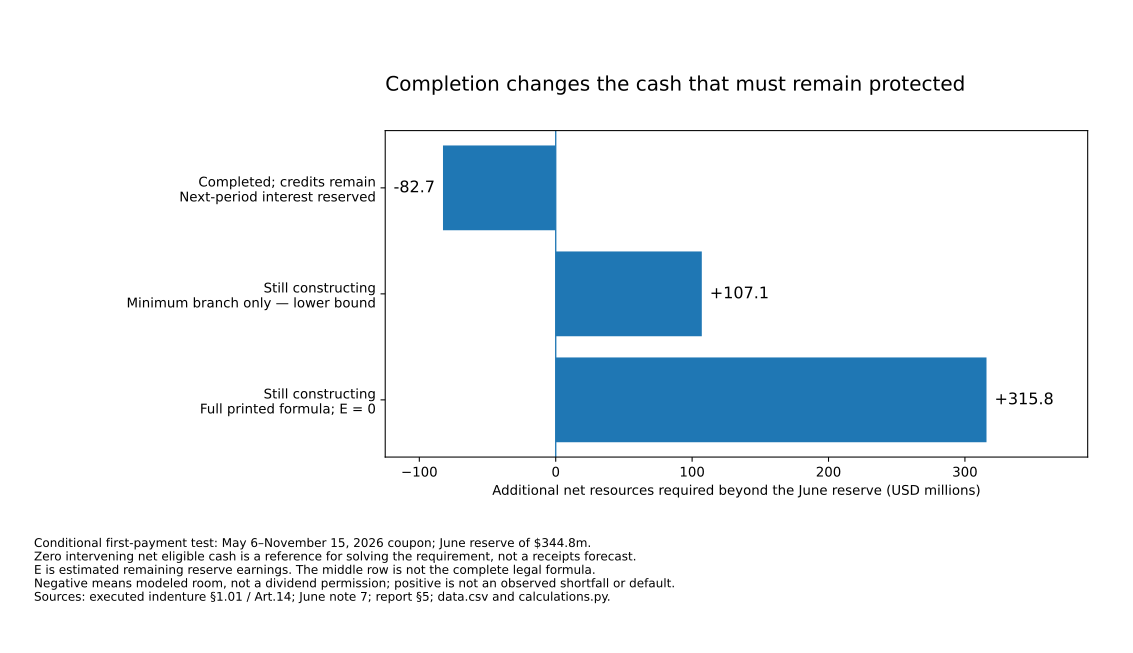
At Core Scientific Finance I LLC, particular additional-debt and parent-distribution permissions depend on Final Commencement, rather than the financing closing or first billable hall. The reserve regime changes too. Using the June reserve only as a reference, the construction-period minimum branch produces a conditional $107.094 million additional-resource requirement at the first coupon date. The full printed formula with zero estimated remaining reserve earnings produces $315.825 million. These are different branches of an explicitly bounded calculation, not observed shortages. The reported reserve and the full formula remain unreconciled; neither breach nor compliance is established. IND
The important favorable contrast is IREN–Microsoft. A qualifying route can permit finance when at least 97% of a tranche's servers have been delivered by the specified deadline, before customer acceptance, provided other conditions are met. A separate first-tranche exception permits specified advance use before any tranche is accepted. An acceptance-only model would exclude legitimate funding and overstate the equity bridge. Escrow, liquidity and spare-inventory conditions nevertheless remain. CTA
The whole answer remains a real commercial expansion with uneven investment and financing risk. These findings strengthen the productive-bridge case while tightening the assumption that enough usable resources survive construction. A sound path combines delivery, correctly sequenced funding and adequate receipts after costs and credits. A strained path can involve useful demand but delayed eligibility, unreimbursed work or more cash retained for creditors than owners expected.
This does not settle the tenant's complete return, original capital recovery or the price of an ownership claim. The investigation covers selected mechanisms in the U.S.-centered commercial generative/frontier-AI build-out since 2023, not a representative industry sample or an economy-wide funding total. Earlier evidence of paid persistence, provider capture, useful older capacity and investor realization remains part of the assessment. BASE
1. Before a steady-state cash model can begin
The earlier joint-cash investigation tested a documented financing against its later maturity. Its assumed eligible opening resources were not an observed post-construction balance. This chapter asks what happens before those resources could exist: which costs must be paid, what the customer must accept, and when funding becomes usable.
A contractor earning payment, equipment passing tests, a customer's fee becoming due and a borrower gaining permission to distribute cash are different transitions. Even on the same campus, different agreements can govern them. The April operating illustration locates the expected transition; it does not establish that every milestone has been achieved.
For a completed project, “pays its own bills” means that net collections after credits and refunds cover the relevant operating cash costs, maintenance, financing payments and required reserve movements, without repeatedly requiring sponsor contributions for those uses. It does not require all expansion to have been funded out of prior profits. Nor does passing that operating test prove an adequate return on the original investment.
The analysis therefore starts with observed accounts, identifies the operative contractual conditions and then solves a resource requirement. Its 95-record ledger separates reported observations, contract terms, issuer estimates, administrative records and assumptions. The calculation companion reproduces the accounting, timing, reserve and funding-route tests without retrieving live data.
2. The facilities, the borrower and the dates
Core Scientific Finance Holding LLC is Finance I's direct parent. The financing subsidiaries include Core Scientific Austin LLC, Dalton LLC, Denton LLC, Marble LLC and Muskogee LLC. The April detail covers six facilities: Austin 16.5, Denton 262, Dalton 1 30, Dalton 4 145, Marble 65 and Muskogee 70 MW of critical IT capacity. That totals 588.5 MW, commonly rounded to about 590 MW. Denton is inside the total—not another exposure to add. SUP IND
CoreWeave is the contractual customer. Neither an undisclosed Microsoft, Meta or OpenAI workload nor a portion of those businesses' budgets is assigned to these halls. The Meta-supported DDTL 4.0 facility studied earlier is a different instrument. GECC's disclosed CoreWeave holdings do not establish that it owns Finance I's notes. BASE
| Record | Economic date and boundary | What it supplies—not what it proves |
|---|---|---|
| Financing supplement | April 21, 2026; proposed financing and estimated physical project costs | Facilities, credits, contributions and proposed support; the coupon and operating path are illustrative. |
| Executed notes and closing | May 6, 2026; Finance I and named obligors | The 7.75% coupon, issue price, cash restrictions and closing—not subsequent construction completion. |
| Consolidated accounts | June 30, 2026, with first-half flows | Actual resources, restrictions, incurred construction accounts and commitments—not a standalone project cost-to-complete certificate. |
| Denton power update | September 10, 2026; furnished issuer disclosure | Specific electrical-capacity classifications—not independently obtained utility consent or tenant acceptance. |
| Building A fit-out registration | Registered August 19; status retrieved October 4 | One named work package and planned dates—not its financing allocation or the whole campus's completion date. |
| IREN comparison | November 2025 customer/supplier terms; May 2026 financing; June accounts | Different delivery, financing, escrow and acceptance stages—not a synchronized October cash balance. |
The dates identify different kinds of evidence. The retrieval cutoff does not turn them into one simultaneous snapshot. The subsequent analysis keeps group resources separate from subsidiary cash and physical project budgets separate from the financing agreement's defined budget. CQ SUP CLOSE IND POWER TDLR CTA IQ
3. Match the construction bill before calling it a gap
A receivable with a matching obligation
The June customer-funding receivable was $383.758 million, versus $337.158 million at December 31. June accrued customer-funded construction was $302.183 million, with a separately rounded $81.6 million customer-related accounts-payable amount. Subtracting the exact accrual from the receivable implies $81.575 million, which rounds to that disclosure. The implied figure is a calculation—not a newly reported exact payable. CQ
The company describes collecting reimbursement before paying vendors and settling the corresponding obligations soon afterwards. It reports no required credit-loss allowance on the receivable at those dates. That accounting assessment does not guarantee collection of every future invoice.
This is substantive favorable funding evidence. The receivable cannot be counted as spendable surplus while its bill is ignored. But the entire bill cannot be described as a parent cash shortage while its documented reimbursement is ignored either. Customer-related construction differs from both unrestricted resources and the operator's own capital expenditure.
Observed amount · conditional payment ordering
The same matched bill can have a different cash bridge
Scroll horizontally on a narrow screen to inspect all labels.
The ordering test holds the $383.758 million observed amount fixed and assumes eventual reimbursement in full. Collecting first needs no external bridge for this matching block. Paying one-quarter first requires $95.940 million; paying half first requires $191.879 million; paying everything first requires $383.758 million. Every version ends with zero net cash from the matched block.
Those are payment-order sensitivities, not observations of late reimbursement or early vendor payment. No specific invoice dates are invented. An enforceable vendor deadline, disputed reimbursement, unapproved change order or actual collection delay could require interim operator resources. A permanent disallowance would change ultimate cost as well as timing. The favorable reported practice is not permission to ignore a vendor's actual due date.
The receivable is not added to customer advances as a second independent receipt. A construction contribution can also reduce later service fees through credits. Financing a build and buying its subsequent service can be economically connected without becoming two unrelated pools of outside demand. SUP BASE
Remaining commitments, incurred costs and an acquisition
The June accounts disclose approximately $1 billion of expected future cash expenditure under purchase and construction commitments. $264 million is inside that amount, passed through to the customer as invoiced, substantially within twelve months. The commitment perimeter includes existing conversion sites and new development for prospective customers; it is not solely Finance I. CQ
Timely matching would leave an approximately $736 million net non-pass-through use within that bucket. This is a conditional resource reference with rounded source inputs—not an exact remaining-project budget. Its overlap with incurred invoices is not fully disclosed.
Likewise, $105.658 million of accrued capital expenditure and $127.520 million of property/equipment included in accounts payable and accrued expenses are not independent bills to sum. The broader disclosure can overlap both the narrower accrual and future commitments. Only a demonstrated or explicitly assumed uncounted portion belongs in an added cash-use term. CQ
The proposed Polaris acquisition has another boundary: $421 million base consideration, $120 million already escrowed and a possible additional $40 million for specified extra firm-power rights. Deducting all $421 million from unrestricted June cash would count the escrow twice. Treating the $301 million unescrowed base as extra to the $1 billion bucket requires a non-overlap assumption. No subsequent closing or unconditional payment of the extra $40 million is inferred. CQ
April's $5.5 billion physical project estimate and $4.4 billion customer cash and contributed assets do not fill those gaps by subtraction. Their date, perimeter and inclusion of noncash assets differ. The indenture's Full Budgeted Cost of Construction also includes construction-period interest, reserves and financing-related costs. It is not automatically the physical-cost estimate. SUP IND
What the group accounts actually establish
The January–June consolidated cash account reconciles, in USD millions:
311.378 opening cash + 230.949 operating cash
− 1,182.891 investing cash + 3,191.955 financing cash
= 2,551.391 closing cash, including restrictions.
Closing cash includes $1,769.735 million unrestricted and $781.656 million restricted. The restricted amount contains the disclosed $344.8 million note reserve and $120 million Polaris escrow. Their arithmetic remainder, $316.856 million, is not automatically available for Finance I; the subtraction does not establish its legal allocation or release conditions. CQ
This is a financed construction phase, not evidence that the service is uneconomic merely because operating plus investing cash is negative. The statement separately records debt proceeds, the $1 billion bridge repayment, issuance costs and other financing uses. The May issue price gives $3,275.250 million before fees for $3.3 billion face. Face debt, cash proceeds and a permitted distribution to a parent remain different quantities. CQ CLOSE
| Nested group-resource assumption, before other net uses | Remaining reference, USDm |
|---|---|
| June unrestricted cash less the $736m net commitment reference | 1,033.735 |
| Also treat the $301m unescrowed Polaris base as incremental | 732.735 |
| Also treat all $127.520m identified PPE payables as uncounted in those uses | 605.215 |
| Also include the conditional $40m acquisition payment | 565.215 |
These are nested assumptions, not four measured cash balances. They omit later net operating cash, other debt and lease payments, new projects, distributions, financing and any valid reserve releases. The rounded commitment input also limits the economic precision of the results. No row certifies that group resources are transferable to the project.
A useful conditional statement is: other net cash uses and required support must fit inside $1,033.735 million, less uncounted PPE bills and incremental acquisition cash, plus other net resources. Every term needs an amount, date and permissible account, without overlap. This shows why a further requirement need not mean insolvency: sponsors can have resources and choices even when the exact allocation is not public.
There is real physical progress too. Core Scientific reports $465.3 million of construction placed in service during the half-year and $1,101.176 million of construction in progress at its end. These accounting observations show service starting alongside unfinished work. They do not measure completion of every financed hall, customer acceptance of every phase or productive GPU utilization. CQ
4. Which milestone changes access to cash?
Three events that must not be collapsed
Final Commencement requires the relevant rent-start conditions under all the datacenter leases, with full lease payments beginning to accrue. It is not the notes closing, a photograph, a group billable-capacity total or the first customer invoice. An individual operating phase can earn receipts before the whole portfolio reaches that milestone. Those receipts still have costs and may be reduced by credits. IND
The First Installment Payment Date has a further condition: the first semiannual payment at least fifteen days after the later of Final Commencement and exhaustion of specified tenant revenue credits. Completion can therefore precede principal installments. A later construction date does not automatically move the legal maturity. Stable net collections also require more than contractual commencement: cash must actually arrive after the relevant offsets and costs. IND
Contractual design · not a current completion certificate
One build, different financing milestones
Scroll horizontally on a narrow screen to inspect all labels.
Permission after completion is not a resource for reaching completion
Section 4.04(a)(17) permits a particular additional-debt amount based on Full Budgeted Cost of Construction less original notes, only after Final Commencement, subject to at least 1.10-times defined prospective debt-service coverage and the other terms. It supplies neither an unconditional draw nor a lender commitment. Its entire capacity cannot be inserted into a budget for the work needed to meet its own gate. IND
Other debt permissions exist, including specified intragroup and other baskets. The finding is not a ban on all precompletion borrowing. Nor is the budget-minus-notes difference a verified funding amount: the defined budget, eligibility and actual financing availability still need evidence. The relevant question for the last contractor bill is which resource is usable before that bill—not whether post-completion debt permission looks large.
The waterfall lets the project operate and finish
The revenue-account ordering first pays defined operating expenses, a definition that includes development, capital expenditure, taxes and specified administration. Debt payments and reserve funding follow, then other permitted uses. Power pass-through has separate treatment. Gross fees are therefore not debt-service cash before those uses are deducted. IND
A reserve deposit leaves cash protected; it does not extinguish the debt. Excess reserve amounts may move under the agreement, but release to another company account is not automatically a public-shareholder dividend. Important parent-distribution routes, including specified retained excess cash, depend on Final Commencement. Issue-date, tax, administrative and other exceptions also exist. Neither “everything is trapped” nor “everything unspent is distributable” describes the terms.
Completion support transfers a burden rather than erasing it
The May closing disclosure records uncapped parent completion support for the specified projects other than Austin when proceeds and other available funds are insufficient to finish them. It also describes interim security over identified parent assets and rights not yet transferred into the financing structure. That is material protection during the transition. CLOSE
It is expressly not a parent guarantee of the notes. No model reserve requirement is therefore labeled an automatic legal call under the completion guarantee. The complete separate guarantee and current claim/release records were not obtained. The narrower supported conclusion is a documented sponsor backstop for completion, not general parent repayment of note principal. IND CLOSE
Valid sponsor funding still consumes resources that might otherwise support new projects or owners. Suppliers can be paid while the sponsor earns less than expected. A useful completed asset and a disappointing parent return can coexist.
5. The first coupon and the cash that must remain
A payment plus a remaining stock
The calculation uses May 6's executed 7.75% coupon and $3.3 billion original principal. It assumes no redemption or amendment and no principal installment due on the first payment date. The May 6–November 15 interval is 189 days on the note's 30/360 basis, producing $134.26875 million interest. A regular half-year coupon is $127.875 million. The first future semiannual principal installment, once its separate gates are met, is $189.75 million. The legal-holiday provision governs the actual business-day payment. IND
Let R0 = $344.8 million, using the identified June reserve as a reference—not claiming it remains untouched in November. Let N be intervening net cash eligible for this purpose after construction and operating uses, including actual eligible investment income. Let S be other eligible support, without also keeping that same resource at the parent. Then:
R0 + N + S ≥ first coupon + required closing reserve
The right side combines a payment with cash protection that must remain. It does not charge the reserve as another operating expense or a second principal payment. Negative N increases the requirement. Setting N to zero below solves a reference condition; it is not a prediction that no customer collections occur.
The minimum is not the full construction formula
The construction minimum combines the next coupon and first future installment:
127.875 + 189.750 = 317.625 million.
The full printed construction expression also includes a specified $343 million amount, described as an issuer estimate of construction-period interest less project funds available for debt service, adjusted for interest paid and estimated remaining reserve earnings. After the first coupon, with no earlier note interest payment, it becomes:
Required closing construction reserve
= max(317.625, 526.35625 − E), in USD millions.
E means estimated remaining earnings on reserve amounts during construction. It is not another current receipt to add to N. The contractual formula does not establish the current value of every input. IND
After construction, the specified payment-date reserve instead includes the next payment's interest and any principal installment then due. The favorable case below assumes Final Commencement is achieved while customer credits still prevent principal installments: its closing reserve is therefore $127.875 million. A principal payment actually due would have to be included.
| Conditional state at first payment | Closing reserve, USDm | First coupon plus reserve, USDm | Additional net resources beyond June reference, before N and S, USDm |
|---|---|---|---|
| Completed; credits remain, so no next-date principal | 127.875 | 262.144 | −82.656 |
| Still constructing; minimum branch only, a lower bound | 317.625 | 451.894 | 107.094 |
| Still constructing; full printed formula with E = 0 | 526.356 | 660.625 | 315.825 |
The negative result means modeled room in this narrow calculation—not permission to extract $82.7 million. The middle result is only the minimum branch. The full-formula result assumes zero remaining reserve earnings; it is not the issuer's actual determination. The mathematical switch to the minimum occurs at E of at least $208.73125 million in this setup. That switch point is not an earnings forecast or a claim that such earnings are plausible.
Conditional first-payment comparison · USD millions
Completion changes the cash that must remain protected
Scroll horizontally to read the supplied figure at inspection size.
An unresolved reconciliation—not a breach finding
The disclosed reserve has not been fully reconciled to the printed construction formula. The June cash stock is rounded. The formula uses forward estimates; the complete determination, collateral allocation, later movements and amendment/waiver record were not obtained. The definition also recognizes specified pledged cash/equivalents and letters of credit, while the account covenant has its own wording. No undisclosed letter of credit is presumed to exist, and no covenant failure is inferred from missing records. IND CQ
This limitation does not justify deleting the higher formula branch. $107.094 million is a necessary minimum-branch reference under the stipulated construction state, not sufficient headroom for all financing tests. $315.825 million belongs to the explicit full-formula inputs. Actual eligible protection and the applicable determination could change the result.
Every $100 million of genuinely eligible net interim cash or support reduces the signed requirement by $100 million; every $100 million of additional unfinanced completion uses increases it by the same amount. A reserve release cannot pay a contractor and remain protected for noteholders simultaneously. Retention can be prudent before any failure to pay occurs.
The test stops at this pre-stabilization boundary. It does not revise the earlier 2031 maturity calculation or treat first-period room as proof that later refinancing is unnecessary. A feasible payment-date equation also does not establish cash sufficiency at every earlier contractor deadline.
6. Denton: a power classification is not acceptance
Denton combines physical, contractual and administrative evidence about different parts of the same location. April's supplement identifies a $104.4 million estimated licensor contribution for 69.6 MW, inside the wider 262-MW IT project. Its ground lease runs to December 31, 2035 with extension conditions, recurring rent and a power-linked termination provision. These are not unrestricted freehold rights. SUP
The ground-lease assignment becomes effective on the relevant utility's consent to the power right-of-use arrangement. Customer-contract assignments also have linked property/lease and power conditions. Signing an assignment does not demonstrate effectiveness. Interim parent collateral addresses part of that transition, without proving every consent is complete. SUP CLOSE
The September 10 update is favorable against a blanket grid-pause interpretation. Core Scientific reports 297 MW of existing electrical power conditionally approved as longstanding Base Load, Pathway (a), outside Batch Zero. Another 74 MW was incorporated into and validated by the 2025 Regional Transmission Plan, also outside Batch Zero. POWER
That is an issuer-furnished account of regulatory classification, not an independently acquired ERCOT/DME consent or a customer-acceptance certificate. Those electrical quantities must not be subtracted from April's maximum PPA capacity or divided by IT load to invent a missing-power amount or utilization ratio. Dates and definitions differ.
Denton · administrative and contractual evidence
Two records narrow different questions
Scroll horizontally on a narrow screen to inspect all labels.
The Texas Department of Licensing and Regulation record TABS2026028247 identifies Core Scientific DTO – Building A Fit-out at the same Jim Christal Road address. Registered August 19, it lists $110 million estimated cost, 27,678 square feet, a planned September 1, 2026 start and May 31, 2027 completion, with “Review Complete” status. The form names Core Scientific as owner, no assigned tenant and “No” for private funds supplied by the tenant. TDLR
This is a named accessibility-review registration, not a complete construction, funding or acceptance account. It does not establish a campus-wide delay until May 2027, another $110 million bill outside the April budget, or that the customer funds none of the broader campus. The link from this work package to the financed contractual phase remains unknown. The record therefore sits beside the financing test, not inside it as an extra cash use.
Delay remedies also need the right contract. The April remaining-site terms allow credits after adjusted scheduled commencement: $20,000 per eligible day in days 31–60, then $30,000 per day, with a later termination route. For one eligible, nonterminated contract, a stipulated 90-day adjusted delay gives $1.5 million credits. That is not an observed credit. Austin, Denton and Marble were described as already commenced in April; a new fit-out registration does not apply this example to all Denton capacity. SUP
The evidence thus resolves part of a broad grid concern while leaving narrower fit-out, consent and phase-acceptance questions open. It supports neither a declaration of full delivery nor a payment-failure conclusion based on a planned completion date.
7. IREN: legitimate finance before acceptance
The supplier clock and customer clock differ
The November 2025 filing describes Dell's approximately $5.8 billion equipment/ancillary purchase, payable in installments within 30 days of tranche shipment, with an IREN guarantee. It names IE US Hardware 3 Inc.; the May financing names IE US Hardware 3 LLC and identifies the November Microsoft contract. These documented references do not establish an otherwise uninspected corporate-conversion history. I8K CTA
The supplier purchase agreement, amendments and later purchase-document definitions control together. Product delivery, title and supplier payment do not automatically wait for Microsoft's acceptance of the complete service. The 30-day summary is a dated starting point, not a universal statement about every later purchase order. DELL
The Microsoft statement of work requires a qualifying delivery notice, minimum quantity and testing. Its five-day acceptance period has rejection and cure provisions; it does not deem an arbitrary partial shipment accepted after five days. Some quantities and payment periods are redacted and remain unfilled. SOW
Customer upfront funding is part of the service price, credited against later fees after the first 24 service months. Qualifying delayed-start provisions can extend service to preserve fees, but do not themselves extend lender maturity or pay interim carrying costs. The earlier finding that Exhibit F disapplies the generic purchase-order termination route remains intact. SOW BASE
Funded, committed and released are separate states
The May package provides a $1.545 billion delayed-draw facility and $2.1 billion note programme. June accounts distinguish $413 million drawn loans and $525 million funded notes from the remaining $1.132 billion and $1.575 billion conditional commitments. Thus $938 million was funded and $2.707 billion not yet drawn/funded at that date. Neither the undrawn commitment nor a funded note still in escrow is automatically usable supplier cash. IQ CTA
Section 3.3(o) supplies a genuine pre-acceptance route: at least 97% of tranche servers delivered no later than 45 days before expiry of the applicable delivery-delay window, with the stated extensions. Another route permits finance after equity and eligible advances have funded the purchase and the customer subsequently accepts it. Other conditions—including model/sizing, certificates, insurance and ratable loan/note funding—still apply. CTA
IREN agreement · scoped routes, not a complete eligibility engine
Funding can cross the supplier–acceptance gap
Scroll horizontally on a narrow screen to inspect all labels.
| Stipulated delivery and acceptance state | What the scoped logic test establishes |
|---|---|
| 96% timely delivered, not accepted, purchase not equity-funded | The specified delivery route is not met. |
| 97% delivered by the qualifying deadline, not yet accepted, all other credit-event conditions met | The documented route can be met before acceptance. |
| 97% delivered too late under the adjusted deadline, not accepted | The percentage alone does not establish eligibility. |
| Purchase funded with equity/eligible advances and then accepted, other conditions met | The alternative reimbursement route can be met. |
These are condition tests, not actual tranche delivery percentages. The calculation does not supply a missing certificate or presume a waiver. Yet omitting the valid early route would materially overstate the required equity bridge.
Advance use has a separate first-tranche exception. Ordinarily it is tied to the corresponding tranche, delivery/title and acceptance or the timely 97% alternative. Before any tranche has been accepted, any upfront amount may be used to acquire the first tranche's servers and related equipment without the specified utilization conditions. Other restrictions and the customer's obligation survive. The exception helps finance the first service before acceptance; it is not an unrestricted claim on every advance. CTA
The necessary interim equity condition is the maximum, over payment dates, of cumulative supplier, completion, interest and reserve uses less cumulative legally usable advances, released finance and other resources, floored at zero. The new evidence classifies those resources instead of inventing redacted invoices. Blocked escrow and undrawn funding stay excluded until eligible; the early-delivery route and first-tranche exception are included when their own conditions hold.
Early finance still carries costs and protections
Escrow release requires the credit-event conditions or their waiver. The note-purchase package specifies interest-bearing escrow earning SOFR plus five basis points, with earnings belonging to the company. A fee-letter example is not a current SOFR observation or actual funded balance. CTA NPA
On June's funded $525 million notes alone, the 5.96% coupon gives $31.29 million annual gross interest before amortization. It is not interest on all future commitments. Actual net carry also depends on time outstanding, escrow earnings, floating-loan interest, hedges and fees. Neither complete offset by earnings nor the full gross coupon as net carry is established. IQ NPA
The June group had approximately $5.896 billion unrestricted cash and $1.724 billion restricted cash. Those are not all resources of the Microsoft borrower. Annual operating cash of $2.100418 billion included a material $1.8417 billion deferred-revenue timing contribution; neither amount is an AI-only recurring margin. Group strength supports a favorable path without removing account restrictions or competing uses. IQ
Acceptance reduces one support requirement; spares can preserve another
From first facility funding and before commitment termination, §5.26 requires parent Unencumbered Liquid Assets: $200 million before first acceptance, then $150 million, $100 million and $50 million as the first three tranches are accepted, with final acceptance/termination conditions specified. The definition includes qualifying marketable securities and available parent revolving commitments as well as cash. It is not automatically a segregated bank balance; a step-down is not a cash receipt. CTA
Separately, the borrower must have excess server inventory or a contractual right of access equal to at least 0.80% of then-contracted servers, tranche by tranche. An extended cure for this particular spare-inventory covenant requires, among other conditions, no resulting customer rebates/delay credits, eligible funding sources and an additional $25 million debt-service reserve for each thirty-day extension, up to $75 million. CTA
A qualifying sixty-day cure requires $50 million of additional protected funds. This is not a generic delay fee, monthly construction charge or an observed breach. Reserving cash preserves the specified option rather than making the amount disappear from the balance sheet. Sponsor contributions and permitted transfers are alternative sources, not amounts to count twice.
The contrast is consequently substantive in both directions. Legitimate early finance can bridge supplier payment and service acceptance; acceptance can reduce parent support. But delayed eligibility, spare deficiencies or refunds can keep cash committed longer. A strong customer contract does not itself pay every supplier bill.
8. Two coherent paths—and where pressure moves
Productive completion, correctly sequenced
The favorable path starts from documented mechanisms: reimbursement before vendor payment, actual construction entering service, a better-defined Denton power position and qualifying IREN finance before acceptance. Remaining work can be funded by customer payments, permitted financing and bounded sponsor contributions. Receipts from operating phases, after costs and credits, can replenish reserves. Final Commencement can change the reserve regime and unlock particular permissions. CQ POWER CTA
The payment-date test supplies a finite condition. In its full-formula, zero-remaining-earnings construction case, $315.825 million of eligible net interim resources satisfies coupon plus closing reserve without another unmodeled source. The completed/credits-remain case needs less protection. Neither outcome is predicted; funds also need to exist at earlier contractor dates and be transferable under the actual terms.
Success would strengthen the case for financed expansion becoming productive service—not require every new asset to have been paid for from old profits. It would still leave the earlier maturity, full-cost recovery, tenant-margin and ownership-price questions to their own evidence.
Useful demand, but a strained bridge
The adverse path does not require customers to stop valuing AI. A contractor must be paid before reimbursement; a rejected or late tranche misses funding eligibility; a change order is not reimbursable; or extra protected funds are needed for the spare-inventory cure. The shortage of usable resources can arrive before later receipts or post-completion debt permission becomes available.
The $191.879 million pay-half-first bridge and the reserve requirements measure different pressures. They are not automatically additive. Entity, date, cash allocation and overlap must be reconciled before calling their sum a group need. A payment transferred between two participants also does not create two independent economic losses.
Permitted sponsor funding, retained distributions, reduced uncommitted development, a documented bridge, an agreed extension or corrected delivery could resolve the mismatch. A calculated spending reduction is not proof that contracts permit it. Failed service acceptance can change billing without establishing default by a solvent customer. BASE
If remedies and funding do not suffice, pressure could reach suppliers, service availability, reserves or creditors. This investigation does not establish that those failures have happened. A weaker sponsor return, additional finance and creditor loss remain different outcomes. Completion support can transfer a specified burden without turning into a general guarantee of every note.
9. What changes in the whole answer
The evidence is more supportive of documented construction bridges, and less supportive of treating future resources as usable today. Commercial value, net receipts, legal cash availability and timed investment must fit together. A large financing announcement alone cannot establish that conjunction.
The construction matching account shows how incurred vendor work can be funded without an equal parent injection, while the ordering test identifies when that advantage would fail. The reserve and debt-permission analysis constrains what can survive for the earlier post-construction cash plan. IREN establishes the converse: excluding genuine pre-acceptance funding can manufacture a gap.
| Earlier supported finding | How the completion evidence changes its use |
|---|---|
| Strong payers can protect valid invoices | Retained; payer strength does not synchronize vendor due dates, acceptance and draw eligibility. |
| Paid persistence and provider capture can be real | Retained; those observations do not supply collections or margins for these specific halls. |
| Useful older service can continue earning | Retained; a historical continuation budget is not funding for today's unfinished work or a current collateral appraisal. |
| Holders can absorb losses but face funding constraints | Retained for actual instruments; GECC is not assigned a holding in Finance I's notes. |
| Retained cash and finite refinancing can make later claims compatible | Still conditional; eligible opening resources must survive remaining construction, credits, carry and reserve needs first. |
| Full recovery and ownership prices require more than creditor payment | Unchanged; additional sponsor resources or longer lock-up can weaken returns even when service fees survive. |
The earlier investigations and their dates remain accessible. No previous recovery model, security price or 2031 calculation is silently refreshed. No reserve result, permit budget or newly classified source status is inserted as an appraisal or observed impairment. BASE
The April coupon is an illustration, not an executed obligation
The earlier joint-cash input row N_ASSUMED_COUPON_APRIL classified 0.0825 as contractual although its metric, report and April footnote 5 described a pre-pricing assumption. The completion ledger classifies that April 8.25% as issuer_illustration. May's 7.75% remains a separate executed contractual record. SUP IND
This corrects source status, not the earlier debt-calendar arithmetic: that calculation already used the executed-coupon key. The earlier files remain unchanged. The $16.5 million annual difference on unchanged face is an all-else-equal calculation—not evidence that April's assumed coupon was debt then outstanding. This label repair is not the chapter's new construction-funding finding.
The other standing corrections remain controlling: NVIDIA–Energy Global establishes an obligation, with receipt unverified and no inference of nonpayment. No $1.5 billion receipt enters these calculations. CoreWeave's later September 22 financing closing remains an actual dated event, not an October unspent-cash balance. These are separate from the IREN advances and supplier arrangements. BASE
10. What would settle the remaining uncertainty?
The most consequential next evidence is a matched completion certificate and cash statement: remaining bills by legal obligor, customer reimbursements and credits, reserve determination and eligible accounts, effective site rights and actual releases. Repeated successful matches would strengthen the productive-build interpretation. Missed eligibility, unreimbursed work or sponsor injections needed for recurring rather than construction uses would strengthen the fragility diagnosis. Neither one snapshot nor a selected case gives a sector default probability or crash date.
The unresolved boundaries are specific. A contract formula is not a current certificate. The reported reserve remains unreconciled to the complete formula and other eligible protection. Full remaining-cost, guarantee, account-control, approved-change-order and draw/release records were not obtained. Public absence of those records does not mean no certificate or permission exists.
Group cash is not project cash. The $1 billion bucket includes more than Finance I. Construction receivables, accrued costs, future commitments and acquisitions cannot be added without mapping overlap. Customer-contributed equipment cannot pay an unrelated bill; a protected reserve cannot also be unrestricted owner cash.
The matching test uses event order, not invented invoice dates. The reserve test is necessary at the specified payment date, not sufficient for every intermediate obligation. Its zero-interim-cash reference does not forecast no receipts or assert the borrower remains in construction. June's $60.843 million incurred interest less $12.050 million capitalized equals $48.793 million expensed; separately reported cash interest net of capitalization is $12.846 million. Adding capitalized expense to the cash figure would not verify total cash paid. CQ
The research inspected available HTML for the April supplement, May closing/indenture, June Core Scientific accounts and customer/supplier terms. Some full-page IREN, Denton and state-record requests failed; specific indexed original passages were used, with the parent-liquidity definition also checked in an identified filing reproduction. A scanned-contract image could not be retrieved. No complete visual audit of every document, private certificate, site visit or actual tranche cash reconstruction is claimed. The source notes retain those inspection boundaries.
The result is a bounded completion-to-cash explanation—not certification that the build has completed or that every financial claim is safe. Numerical reproducibility checks implementation; it does not establish future assumptions, complete costs, legal transaction permission or universal investment returns.
Sources and inspection boundaries
The research’s external retrieval boundary is . Economic dates and the level of inspection are separate. Links below identify original documents or explicitly identified reproductions. The data ledger provides narrower input locators.
CQ · Core Scientific · June 30, 2026 Form 10-Q
Open the source. Cash flows and supplements; Notes 3–7 and 10; liquidity/investing discussion. The research inspected HTML and reconciled the relevant tables and narrative. Note 5 supplies the receivable/obligation match and collect-before-pay description; Note 10 supplies the commitment and acquisition boundaries. Consolidated accounts are not a Finance I completion certificate.
SUP · Core Scientific · financing supplement, April 21, 2026
Open the source. Exhibit 99.2: portfolio, restructuring, sites, licensing, contributions/title/credits, remaining-site delay terms, completion support and table footnotes. Available HTML inspected by the research. Footnote 5 is the assumed 8.25% coupon; estimates and proposed terms do not establish later execution or current performance.
CLOSE · Core Scientific · closing report, May 6, 2026
Open the source. Items 1.01–1.02: completed notes, proceeds, completion support and bridge repayment. The full separate completion-guarantee instrument and current claim/release records were not obtained. Completion support must not become a general guarantee of the notes.
IND · Finance I, Finance Holding and subsidiary guarantors · May 6, 2026 indenture
Open the source. Exhibit 4.1. Section 1.01 definitions of Construction Period, Final Commencement, First Installment, Full Budgeted Cost, Debt Service Reserve Required Amount and Required Top-Up; sections 4.04–4.05 and 4.22–4.23; Article 14 and note form. Contractual design, not a current compliance certificate. The printed reserve expression is retained with its unclosed reconciliation.
POWER · Core Scientific · September 10, 2026 power disclosure
Open the source. Form 8-K Item 7.01. The research inspected indexed original text; a direct full-page request failed. This is a furnished issuer account of Denton’s classification, not independently obtained utility consent, final interconnection certification or customer acceptance.
TDLR · Texas Department of Licensing and Regulation · TABS2026028247
Open the source. Architectural Barriers Project Details: Core Scientific DTO – Building A Fit-out, registered August 19, 2026. Official indexed record read; direct opening failed. Planned dates, estimate and review status retain that status. Discovery pages did not establish actual commencement, completion or financed-phase allocation.
IQ · IREN · annual filing for June 30, 2026
Open the source. Original Form 10-K: liquidity, balance sheet, cash flow, GPU financing and Note 23. Specific indexed primary passages were inspected; full-page opening failed. June funded/unfunded amounts, restrictions and advance effects are not October cash or the financing borrower’s unrestricted resources.
I8K · IREN · November 3, 2025 filing for November 2 agreements
Open the source. Form 8-K Item 1.01. Original HTML inspected. The dated supplier-payment summary must be read with the underlying agreement and amendments; it is not a later payment receipt.
SOW · Microsoft / IE US Hardware 3 · Partner Statement of Work
Open the source. Filed Exhibit 10.3: delivery/acceptance, section 3.2 fees, advances and end-date protection, remedies and Exhibit F. Available text inspected. Redacted quantities and periods are not filled with assumptions. Generic purchase-order termination does not override Exhibit F.
DELL · IE US Hardware 3 / Dell · purchase agreement and amendments
Open the source. Filed Exhibit 10.4: delivery/title, invoicing/payment and amendment hierarchy. HTML inspected. Product delivery is not acceptance of the complete GPU service. Later referenced schedules that were not obtained are not reconstructed from boilerplate.
CTA · IE US Hardware 3 LLC · Common Terms Agreement, May 29, 2026
Open the source. Exhibit 10.37: sections 3.3(o)–(r), 5.21(c), 5.26, 7.1(p), 9.11 and definitions of Upfront Amount Utilization Conditions and Unencumbered Liquid Assets. Substantial indexed original passages inspected; full-page retrieval failed. The liquidity clause and definition were also checked in an identified filing reproduction. No current credit-event certificate, waiver, complete private model or additional cash source is inferred.
Identified filing reproduction used for the liquidity clause and definition.
NPA · IE US Hardware 3 LLC · note purchase agreement, May 29, 2026
Open the source. Exhibit 10.36: escrow/release definitions, maturity and Schedule 3 escrow section 1(d). Indexed original passages inspected. Fee-letter illustrations do not supply a current SOFR rate or actual funded balance.
BASE · Earlier investigations · preserved dated evidence
Open the source. The whole-system, demand, financing, physical-recovery, ownership, payer, customer-capture, continuation, holder and joint-cash investigations supply continuity at their original dates. Their reports and companions remain unchanged. In particular, the NVIDIA receipt correction and later CoreWeave closing retain distinct meanings. Prior models are not reclassified as fresh observations.