Is AI a Bubble? · Dated investigation
Where an investment loss becomes a funding problem
Who actually holds the loss? Follow the investment—and the funding of the investor who holds it.
The answer
Some AI-related gains have already reached investors as cash, and some investment losses can remain with shareholders without causing a creditor default. But patient shareholder capital does not make a leveraged holder immune to funding pressure. Its own loan covenants, collateral valuations and payment dates can constrain it while substantial net assets remain.
This chapter replaces an arranging-bank network with an identifiable holder. Great Elm Capital Corp. (GECC) reported five CoreWeave-related loan, bond and private-fund positions worth $23.311 million at June 30, against $110.418 million of net assets. That is 21.1% of its net assets, although only 8.3% of its total assets. These are meaningful exposures for this holder, not an estimate of total AI credit or a recovered register of the DDTL 4.0 loan studied earlier.12
The favorable evidence is concrete. GECC reported $9.5 million of cumulative cash distributions from its CoreWeave-related equity investment against an original $6 million investment, while retaining an interest. Those receipts are not merely an unrealized valuation gain. They also do not make the remaining interest risk-free, establish CoreWeave's complete operating return, or remain available as cash after being spent or distributed.4
The adverse mechanism is equally specific. GECC funds investments partly with its own unsecured notes and a City National Bank secured revolving facility. A decline in investment value first reduces GECC's shareholder capital, but can also reduce permissible leverage or eligible collateral. A borrowing-base deficiency has a contractual cash-payment or deposit remedy; it is not necessary to wait for the fund's equity to become zero. A separate future covenant change brings a maturing GECC note series into the bank's coverage denominator before that series matures.356
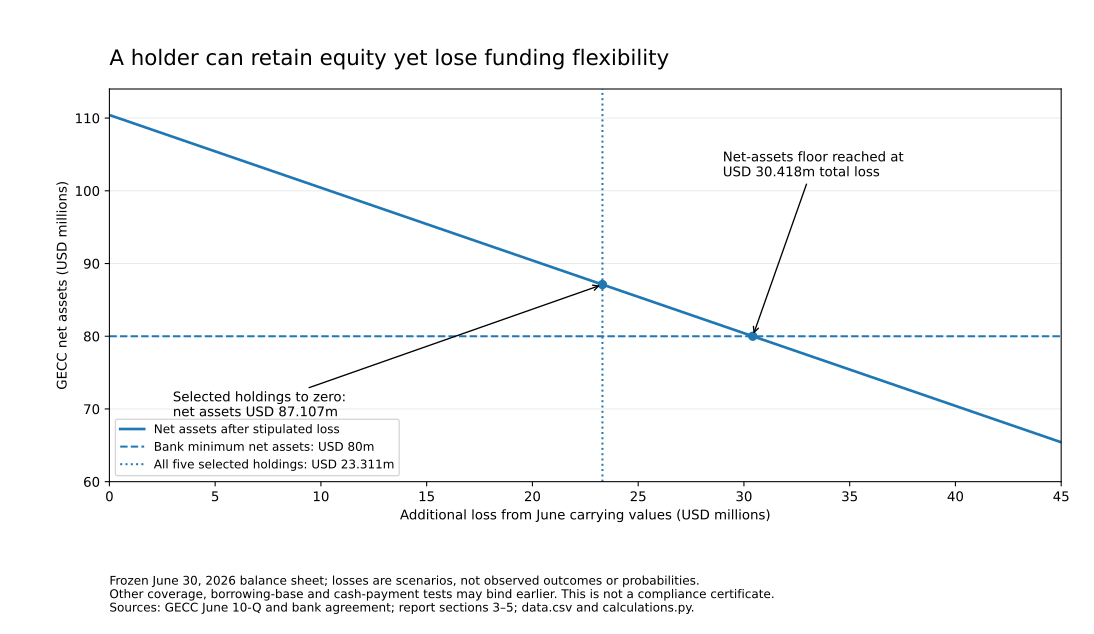
The new numerical result is a loss-and-funding perimeter, not a default forecast. Writing all five selected positions down to zero in the frozen June accounts would leave $87.107 million of net assets, still $7.107 million above the bank's $80 million minimum-net-assets covenant. That narrow result does not certify every other coverage test or a usable cash buffer. A further stipulated $10 million loss elsewhere would put net assets below that covenant while still far above zero. Repaying debt can improve leverage, but cannot by itself restore lost net assets.
NVIDIA illustrates a different form of exposure: an operating company's equity investment and conditional support, backed by operating cash, securities and its own debt rather than a fund's portfolio borrowing base. A mark on shares held is not automatically a new cash payment. An activated guarantee can be a cash payment, and its peak funding requirement can exceed its ultimate loss after recoveries. Neither a profitable supplier nor a large guarantee ceiling alone answers which of these events will occur.10111415
Updated whole-pool assessment: real customer value, provider cash and selective infrastructure persistence remain supported by the earlier investigations. This holder-side evidence adds actual investor realization and identifiable capital buffers, strengthening the case against treating every AI financial claim as empty or immediately contagious. It also identifies a credible amplification mechanism: correlated investment marks and weak collections can reduce a holder's financing flexibility before they become losses for its own creditors. The evidence does not establish a sector-wide credit crisis, its probability, or that all concentrated exposures are safely contained.
The scope remains the U.S.-centered commercial generative/frontier-AI build-out since 2023, following financial claims where relevant. The selected holders are informative mechanisms, not a representative statistical sample. This is neither investment advice nor a forecast of securities prices.
1. Follow the held claim, not the manager's logo
The earlier financing chapter distinguished a borrower, collateral agent, arranger and guarantor. This chapter asks the next question: which legal balance sheet actually contains a claim, and what claims are senior to that balance sheet's shareholders?
A bank that arranged a facility may have distributed most of it. A manager can oversee funds without putting their entire portfolios on its own corporate balance sheet. A private fund interest can contain shares, cash and other rights; it is not automatically equivalent to the same number of directly owned common shares. These distinctions determine whose capital changes when the investment changes value.
The preferred starting point was the DDTL 4.0 borrower, CoreWeave Compute Acquisition Co. VIII, LLC. Searches of borrower disclosures and holder-side investment schedules did not establish its complete current beneficial-lender register. The accessible-holder comparison instead uses GECC's disclosed positions in different named CoreWeave borrowers, together with NVIDIA's documented investment and support exposure. GECC is not asserted to hold DDTL 4.0. Its positions therefore do not inherit that facility's Meta-specific underwriting or limited-parent-guarantee structure.178Financing
The useful boundary is twofold. A disclosed holder schedule establishes an observed position at its reporting date. It does not establish every ultimate investor behind the holder, every subsequent sale, or the sector's unreported remainder. Nevertheless, matching that schedule to the holder's balance sheet and credit agreement permits a substantive absorption test now.
Explanatory diagram · boundaries matter
Owning the loan is only half the financing chain
Scroll horizontally when needed to inspect the labels.
2. The actual GECC positions and the protection underneath them
2.1 Five positions at one date
Amounts below are USD millions, except the stated fund-unit count. Cost, face and fair value are intentionally separate. Fair value is the holder's reported valuation, not a binding liquidation bid.
| Claim held by GECC at June 30, 2026 | Funded face | Cost | Fair value | Holder-listed maturity / claim boundary |
|---|---|---|---|---|
| CoreWeave Compute Acquisition Co. II, LLC — first-lien secured loan | 9.888 | 9.866 | 10.234 | July 31, 2028 |
| CoreWeave Compute Acquisition Co. IV, LLC — first-lien secured loan | 2.093 | 2.070 | 2.145 | May 16, 2030 |
| CoreWeave Financing DDTL V, LLC — first-lien delayed-draw term loan | 2.664 | 2.590 | 2.812 | November 14, 2031 in holder schedule; borrower facility summary says November 15 |
| CoreWeave, Inc. — unsecured senior notes | 2.000 | 2.000 | 1.973 | July 15, 2032; 9.625% issuer coupon |
| CW Opportunity 2 LP — private-fund interest | Not debt | 3.351 | 6.147 | 3,350,968 LP units, not CoreWeave common-share count |
| Selected total | 16.645 of debt | 19.877 | 23.311 | Not a complete inventory of the holder's AI exposure |
Source: GECC's June schedule; borrower filings for the bond coupon and DDTL V comparison. The holder rounds the bond rate to 9.63%. The one-day DDTL V maturity difference and the holder's acquisition-date field are retained rather than silently converted into a supposed verified repayment calendar. Neither affects the loss arithmetic here.198
The three secured loans account for $15.191 million of fair value and $14.645 million of face. The bond adds $1.973 million of fair value; the LP interest adds $6.147 million. Summing the held interests once is appropriate for this holder's exposure. Adding the LP's underlying assets again would duplicate the same economic position.
This is a minimum identified CoreWeave-related perimeter, not a maximum for every direct or indirect AI risk GECC might have. The rest of its portfolio has not been classified exhaustively by AI sensitivity. No percentage of its total investments is extrapolated to a national private-credit total.
The historical comparison prevents a misleading deleveraging claim. Co. II face declined from $11.813 million at December 2025 to $9.888 million in June; Co. IV declined from $3.314 million to $2.093 million. Together, those balances fell $3.146 million, but GECC also held the newer DDTL V and unsecured note positions in June. A lower balance in an old loan does not establish that the overall borrower-family exposure disappeared. The period-end schedules alone do not divide the decline into amortization and secondary sales.1
2.2 Security and guarantees differ across the claims
CoreWeave's annual filing identifies Co. II with DDTL 1.0 and Co. IV with DDTL 2.0/2.1. It describes parent guarantees for these facilities. The May DDTL 5.0 filing names CoreWeave Financing DDTL V, LLC, describes GPU and related infrastructure expenditure for customer contracts, and specifies parent and borrower-subsidiary guarantees, substantially all borrower-group assets as security, and an equity pledge.78
This is materially different from taking the limited non-recourse carve-out guarantee of DDTL 4.0 and applying it to every CoreWeave loan. It is also different from assuming that a first-lien label guarantees full recovery. The priority concerns a defined collateral and guaranty perimeter. Other senior claims, enforcement costs, asset condition, continuing customer payments and the value of a correlated parent guarantee remain consequential.
The unsecured CoreWeave note has a corporate claim but no equivalent first lien on those project assets. GECC's private-fund interest is farther from a fixed repayment promise. Its value can fall even while the loans and bonds continue to be paid. A common operating shock can affect all five positions, but it need not produce the same percentage loss on each.
The DDTL 5.0 filing gives a 1.35-times debt-service coverage requirement, with commencement conditions, while its June debt note describes expected amortization beginning in November 2026 and expected final payment before the contractual final maturity. These are contractual and reporting statements, not an obtained current compliance certificate. This report does not need to invent that certificate to locate the holder's exposure.89
What the earlier economic work contributes: Payer cash and spending flexibility supports the importance of payer resources but does not establish that a particular strong payer supports every loan above. Customer dollar and renewal supplies evidence of value capture, not the named borrowers' complete net receipts. Older capacity and continuation makes continued useful service and orderly re-use plausible, but its Austin expense calibration and older-design observation cannot appraise these loans' collateral. Those findings condition the favorable and adverse mechanisms; they do not set the recovery percentages.Payer cashCustomer captureContinuation
3. The holder has creditors too
Explanatory diagram · boundaries matter
Capital, borrowing permission and cash are not one cushion
Scroll horizontally when needed to inspect the labels.
3.1 Net assets are capital, not a cash account
GECC is a publicly traded, externally managed, closed-end business development company. An ordinary secondary-market sale of its common shares changes the shareholder, not the amount of cash held by GECC. This avoids an automatic investor-redemption demand of the sort associated with redeemable funds. It does not remove GECC's debt maturities, covenants, investment commitments or operating costs.3
At June 30, GECC reported $279.982 million of assets, $169.564 million of liabilities and $110.418 million of net assets. Its investments included $3.966 million of short-term money-market holdings; separately reported bank cash was $1.669 million. The combined $5.635 million is much smaller than net assets. It is not all surplus: there were investment-purchase payables and unfunded commitments, and bank account-control provisions can restrict movements.235
The debt stack behind the portfolio was:
| GECC's own creditor claim at June 30 | Principal, USDm | Coupon / maturity | Relevant protection or constraint |
|---|---|---|---|
| City National Bank revolving facility | 11.000 | Conditional facility; maturity provisions amended in June | Secured by the defined collateral; borrowing base, cash control and covenants |
| GECCI unsecured notes | 56.500 | 8.50%; April 30, 2029 | Corporate unsecured claim; future bank-covenant inclusion matters |
| GECCH unsecured notes | 41.400 | 8.125%; December 31, 2029 | Corporate unsecured claim |
| GECCG unsecured notes | 57.500 | 7.75%; December 31, 2030 | Corporate unsecured claim |
| Total principal | 166.400 | Not the $161.853m debt carrying amount | Face and carrying values differ by discounts/issuance-cost treatment |
The fund's unsecured noteholders stand behind the bank with respect to pledged collateral, subject to the actual agreements and applicable priority rules. The bank is not automatically a direct holder of all underlying CoreWeave loans; it is a creditor of the fund that holds them. An adviser logo does not replace either claim.35
The selected asset and funding maturities are not perfectly matched. Co. II's listed final date precedes the 2029 GECC notes, while Co. IV, DDTL V and the unsecured CoreWeave bond have later final dates. Earlier loan amortization and the rest of GECC's portfolio can supply cash; final dates alone do not establish the amount needing refinancing. They do explain why a holder can face a funding decision while the assets it owns are still contracted and operating. A full maturity-gap forecast would require the missing collection and portfolio-roll-forward detail.
A July notice contemplated redeeming $6.5 million of GECCI on August 19. This investigation did not establish a distinct settlement record for that notice. The quantitative perimeter therefore freezes June balances and does not quietly reduce either cash or debt as if the subsequent payment had been verified. It also does not infer that the redemption failed.3
3.2 Successful cash realizations are genuine—but not endlessly reusable
GECC's reported CoreWeave-related cash distributions provide a substantive favorable countercase. Cumulative distributions of $9.5 million exceed the original $6 million investment by $3.5 million before the wider costs and timing of holding it. This observation supports an investor realizing value, not just displaying a higher paper price. It is not an internal-rate-of-return calculation, a claim that every recipient earned the same return, or proof that the distributions came solely from CoreWeave's operating surplus.4
Two accounting errors would obscure this finding. First, subtracting the already-received distributions from the current $6.147 million LP fair value would understate what can still be marked down. Second, adding all cumulative receipts to June cash would pretend that money already used elsewhere remains unspent. Historical return and current loss capacity answer different questions.
The fund also reported repayment/redemption of the remaining GECCO note series during the first half. That is observed funding management, not a prediction that every later maturity will refinance. Conversely, it would be wrong to retain the repaid series as a future bill merely because an older financing description listed it.3
Its cash-flow statement requires an investment-company interpretation. Approximately $36.6 million of first-half operating cash included portfolio sales and principal proceeds of roughly $92.1 million, against about $60.4 million of purchases. Those movements are useful cash but are not equivalent to recurring customer-generated operating cash at Microsoft or Meta. A stressed holder may collect principal successfully; it may also find that reinvesting, selling or refinancing on previous terms becomes harder.3
3.3 Adviser support is a transfer, not a guarantee
GECC's reported quarterly net investment income benefited from an approximately $0.9 million incentive-fee waiver, following a larger first-quarter waiver. Forgone fees help GECC but reduce what the adviser receives. They are not an unlimited promise to replenish the portfolio, and their continuation cannot be assumed. GECC, its adviser Great Elm Capital Management, and the wider Great Elm Group are separate economic perimeters. Assets under management are not the manager's spendable capital.43
This report does not add a manager's ownership interest in GECC to GECC's underlying CoreWeave exposure as a second independent loss. A fall in the same asset can reduce the fund's net assets and the value of a shareholder's stake: that traces the loss to an owner rather than creating another underlying dollar lost.
4. The contractual route from a mark to a cash problem
4.1 Three constraints, not one reassuring coverage ratio
The bank agreement separately requires at least $80 million of net assets, 150% general asset coverage, and 300% bank asset coverage, tested on its specified basis. Its Net Assets definition refers to the amount in GECC's filed accounts. The borrowing base is another test: it applies eligibility, advance rates and other limitations to collateral, not simply the total market value of every asset.56
These constraints can bind at different times. An equity holding can lose value and reduce net assets without previously contributing to an eligible loan borrowing base. A loan can remain valuable in the accounts yet lose borrowing eligibility or have its advance contribution reduced. Conversely, a temporary trading-price decline need not cause immediate nonpayment by a borrower. The applicable valuation and reporting process matters.
The agreement requires periodic portfolio valuations and contains consequences for missing required valuation information. It also subjects eligible categories to different advance rates and concentration rules. This report did not obtain GECC's actual current borrowing-base certificate, loan-level eligibility classifications or pledged-asset allocations. It therefore does not multiply the five positions by a selected advance rate and present that as their observed financing capacity.5
4.2 A borrowing-base deficiency can require cash while equity remains positive
Section 2.2(c)(iv) requires a deficiency to be addressed promptly, within a maximum of 15 days, through the specified repayment and/or cash-deposit alternatives. Bank-controlled accounts receive collateral proceeds; transfers during defined defaults or deficiencies face restrictions and consent provisions. Restricted-payment clauses have exceptions, including relevant tax/regulatory provisions, so this is not represented as an unconditional prohibition of every distribution.5
The sequence is economic as well as legal: weaker asset values or eligibility reduce supported borrowing; the holder must supply cash, eligible resources or a permitted adjustment; raising that cash can reduce new lending or require sales. A sale at a discount can reduce net assets again. If payments continue and the holder has sufficient unencumbered resources, the same process may end in an orderly adjustment without loss to the bank.
A stock-market decline in GECC alone is not the borrowing-base calculation. It can make fresh equity more expensive, but the contractual trigger is in the holder's assets, covenants or payment performance. The report does not insert an automatic loan call merely because public shareholders mark down GECC shares.
Explanatory diagram · boundaries matter
The funding constraint can arrive before final maturity
Scroll horizontally when needed to inspect the labels.
4.3 The bank's refinancing clock starts before the note maturity
The June amendment sets the revolver maturity at the earlier of June 8, 2029 and March 31, 2029 if GECCI has not been refinanced by that date. It also changes the bank coverage denominator: beginning November 1, 2028, outstanding GECCI principal is included until repaid or refinanced, alongside credit extensions and specified other near-maturity debt. The numerator uses the defined loan-party investment values and controlled cash, excluding direct advance proceeds.6
With June principal amounts held fixed solely to show the mechanics, the 300% test would require $202.5 million of qualifying numerator once $56.5 million of GECCI joins an $11 million bank draw: 3 × (56.5 + 11). The same frozen draw alone requires $33 million. This is not a forecast of November 2028 holdings, a claim that the covenant is currently breached, or the separate borrowing-base advance calculation. It shows why refinancing a holder's own notes can matter well before the underlying AI assets stop operating.
The extension gives the holder time, which is favorable. The springing condition prevents interpreting that extension as unconditional funding through the latest calendar date. Actual repayments, refinancing, retained capital and portfolio values can change the result substantially.
5. What the holder can absorb—and what can bind earlier
The input ledger and calculation companion retain entities, units, dates, evidence status and source locations. All figures in this section are USD millions and are frozen-balance-sheet tests, not expected losses or current covenant certificates.
5.1 A measured capital buffer, with a deliberately narrow meaning
Let N = 110.418 be reported net assets and L an additional loss from the selected June carrying values. Before any other earnings, tax effect, fees, contributions or distributions:
net assets after loss = N − L.
Against the bank's $80 million minimum, the measured initial room is $30.418 million. This is capital capacity under that one test, not cash in the bank and not the amount of loss the fund can take before every financing condition changes.
A face-debt/NAV coverage proxy, 1 + (N − L)/166.4, reproduces the issuer's reported 166.4% after rounding. It is useful for sensitivity but is not an obtained bank or statutory computation. The face/carrying-value reconciliation and a lower unadjusted-book sensitivity are explained in §5.4; neither is concealed behind an assertion of certified headroom.23
| Conditional treatment of the June positions | Additional loss | Remaining net assets | Room above $80m minimum | Reported-ratio-reproducing coverage proxy |
|---|---|---|---|---|
| No change | 0.000 | 110.418 | 30.418 | 166.36% |
| LP interest falls 50%; debt values unchanged | 3.074 | 107.345 | 27.345 | 164.51% |
| Secured-loan values fall 20%, bond 40%, LP 60% | 7.516 | 102.902 | 22.902 | 161.84% |
| Net workout recovery: secured debt 80% of face; bond 40%; LP zero | 10.795 | 99.623 | 19.623 | 159.87% |
| All five selected positions written to zero | 23.311 | 87.107 | 7.107 | 152.35% |
| Selected positions zero, plus $10m loss elsewhere | 33.311 | 77.107 | −2.893 | 146.34% |
These scenarios deliberately distinguish marks from recoveries. The percentage markdown row applies to June fair values; the workout row assumes net recovery percentages of contractual face. Its $12.516 million recovery is a stipulated total after costs, not a bid, collateral valuation or a sum of separate guarantor and asset payments. No probabilities are attached. The additional non-CoreWeave loss is an explicit common-stress sensitivity, not measured correlation.
The favorable implication is real: the selected exposure is material, yet moderate differentiated losses do not exhaust this holder's capital. The adverse implication is also real: the bank net-assets requirement can fail while $77.107 million of equity remains. The full-wipe row is not an assurance that all financing tests would still pass. In particular, collateral eligibility, the exact general-coverage computation and available cash can bind earlier.
5.2 Liquidity and leverage are not the same buffer
A separate illustration assumes a future valid borrowing-base calculation of $8 million against the unchanged $11 million draw. The $8 million is an assumption, not GECC's observed June base. The resulting deficiency is $3 million. Its size is more than half the $5.635 million bank-cash/money-market pool, leaving $2.635 million if the full cure were paid from that pool before any other uses.
This is not a demonstrated ability to allocate all the pool to the bank. June accounts also report $5.340 million payable for investments purchased and approximately $6.1 million of unfunded commitments; their exact near-term coincidence, restrictions and offsets were not reconstructed. Those amounts must not all be declared due within the illustrative 15-day period. They do show why a positive net-asset figure cannot establish free cash for a cure.23
A repayment uses cash and reduces debt equally; it does not create another investment loss. A required cash deposit instead reduces available liquidity without necessarily reducing total group cash. The distinction survives the scenario: a $3 million cure is not added to a $3 million asset markdown as if both were independent losses.
The $50 million revolving commitment likewise is not $39 million of unconditional spare cash above the draw. Under the reported-ratio proxy alone, the full-selected-writeoff case leaves about $7.814 million of additional debt room, before the bank's borrowing base, other conditions and fees. Undrawn authority can contract when it is most needed. A fresh equity issuance brings resources and ownership dilution; it is not free repair, and an ATM programme is not a committed purchaser.
5.3 Selling and repaying can repair one constraint while worsening another
In the final table row, restoring the 150% proxy by equal asset realization and debt repayment at carrying value would require $12.186 million of repayment. That leaves the $77.107 million of net assets unchanged—still below the bank's $80 million floor. The latter needs retained earnings, new equity, recovery of asset value or an agreed contractual change, not merely a smaller debt denominator.
If assets sell at an assumed 10% discount to carrying value, the same proxy exercise requires selling approximately $17.409 million of book assets, producing $15.668 million of cash for repayment and another $1.741 million of loss. The extra loss makes the net-assets problem worse. This is the amplification mechanism, not a prediction that GECC will conduct such a sale.
The algebra is X = [(k−1)D−N'] / [(k−1)−k×d], where X is carrying value sold, d the sale discount, k the coverage minimum, D debt and N' stressed net assets. It presumes the selected debt can be repaid, collateral released and proceeds applied without added costs. Those are not verified transaction permissions. The calculation diagnoses how a forced-disposal discount changes the required adjustment; it is not an executable restructuring plan.
5.4 Coverage precision has a disclosed accounting limit
GECC reports debt face of $166.400 million, including the revolver, versus $161.853 million carried as debt on the balance sheet. The $4.547 million difference largely reflects note discounts/issuance costs; the note label gives $4.546 million because of displayed rounding. It is not a newly incurred portfolio loss.
The proxy above combines net assets with face debt and reproduces the published rounded ratio. A literal unadjusted reconstruction using book assets less other liabilities and the face denominator yields 163.62%, lower by that $4.547 million in numerator terms. Its arithmetic loss room to 150% is $22.671 million, versus $27.218 million in the reported-ratio-reproducing convention. This is a disclosure-reconciliation sensitivity, not two equally authoritative covenant certificates or an allegation that the issuer's reported compliance was wrong.23
The distinction is consequential only near the edge: all selected positions at zero give 152.35% in the proxy but 149.62% in the unadjusted-book sensitivity. This is why the report does not claim that a full loss of the identified exposure is assured to fit every coverage constraint. The moderate-mark and net-workout cases remain above 150% under both computations. The separate $80 million net-assets comparison is directly grounded in the reported balance and the agreement's definition; actual borrowing eligibility and a current compliance certificate remain unavailable.
Frozen June balance sheet · conditional losses
One covenant can bind while substantial equity remains
Scroll horizontally when needed to inspect the complete figure.
6. NVIDIA: a mark on an investment is not the same as a call on support
6.1 A documented ownership claim, with an honest date limit
NVIDIA's Schedule 13G/A identifies 47,213,353 CoreWeave Class A shares on January 23, 2026, with sole voting and dispositive power. Its 11.5% figure concerns that class, not every class's voting power. CoreWeave's corresponding current report records the completed sale of 22,935,780 additional Class A shares at $87.20, approximately $2 billion of issuer capital. This is a real holder-side equity exposure and a separately evidenced financing receipt, not a supplier logo or an undrawn promise.1011
The January share count is not silently updated to October. A later portfolio-filing route was located but its original information table could not be retrieved reliably; a secondary valuation was not substituted for the missing primary record. Accordingly, this report does not value a claimed current CoreWeave stake against NVIDIA's July balance sheet. It shows the narrower, reproducible exposure: a $10 change per share would change the value of that fixed January block by $472.134 million, absent transactions. That is a sensitivity of the identified claim, not an observed loss or a cash call.
Equity absorbs residual business outcomes after the issuer's prior claims. A fall in CoreWeave's share price can reduce NVIDIA's investment value without a CoreWeave loan default or any new payment by NVIDIA. Conversely, an investment can realize gains even while a new buyer pays a demanding price. The GECC cash realization and NVIDIA's new primary subscription illustrate different positions in the same ownership market; they are not evidence that all holders have the same cost basis or return.
The January subscription also precedes NVIDIA's January 25 opening balance for the following reported half-year. It is therefore not added again to that half-year's investing uses. A historically paid investment is neither an unspent liquidity reserve nor a second current-period expenditure.
6.2 The operating holder's resources and prior claims
NVIDIA's July 26 accounts provide a different funding perimeter from GECC's. Amounts in this subsection are USD billions, not the millions used for GECC.
| NVIDIA reported quantity | July 26, 2026 / stated half-year | Meaning for absorption |
|---|---|---|
| Cash and cash equivalents | 22.443 | Bank-cash boundary; not all excess cash |
| Marketable debt securities | 34.143 | Additional potentially liquid investments; conversion, timing and operating needs still matter |
| Marketable equity securities | 42.783 | Exposed to market prices; not all CoreWeave or AI investments and not bank cash |
| Nonmarketable securities, including equity-method investments | 51.157 | Different valuation and liquidity characteristics; not an immediately spendable buffer |
| Total assets / total liabilities / stockholders' equity | 320.272 / 91.288 / 228.984 | Accounting capital and prior claims, not a liquidation waterfall |
| Current plus long-term debt, carrying amounts | 33.366 | Already within liabilities; not subtracted a second time from reported equity |
| Half-year operating cash flow | 74.421 | A realized period flow, not a promise of the next half-year's cash |
Sources: the July balance-sheet table, cash-flow table and related notes. The nonmarketable category is not described here as entirely direct private equity; it includes equity-method investments.121314
The cash statement reconciles:
10.605 opening cash + 74.421 operating − 35.124 investing − 27.459 financing = 22.443 ending cash.
Operating cash is substantial, providing real support for the favorable absorption case. It is not simply accounting net income: the reconciliation removes investment gains and incorporates material receivable, inventory and other working-capital movements. Financing also matters. The half-year includes $24.896 billion of net debt-issuance proceeds, $39.044 billion of cash share repurchases and $6.290 billion of dividends. Strong operating cash can coexist with borrowing and significant optional owner distributions.13
Cash plus marketable debt securities totals $56.586 billion. Calling that an available starting pool is a sensitivity convention, not a conclusion that the entire amount can be paid to one beneficiary without consequences. Operations, tax, existing liabilities, continuing investment and settlement timing also use resources. The filing identifies securities and foreign-resource qualifications; no guaranteed conversion of every security at its reported value is assumed.1214
A 10% markdown of the entire reported marketable-equity category would be a $4.278 billion gross valuation change, equivalent to approximately 1.87% of July stockholders' equity before tax and other effects. This does not identify the CoreWeave portion or forecast a loss. The immediate cash effect of the mark alone is zero. A decision to sell, a separately documented collateral requirement, or an additional investment commitment would be a different event. GECC's particular bank covenants cannot be transplanted to NVIDIA.
Explanatory diagram · boundaries matter
An investment mark need not require cash; a guarantee call can
Scroll horizontally when needed to inspect the labels.
6.3 Conditional support can require cash even when an equity mark does not
The NVIDIA–SB Energy support arrangement studied in Financing and loss transmission creates a separate conditional exposure. The disclosed up-to-$105 billion lifetime ceiling concerns specified rent and power obligations across phases; first service commencement begins in NVIDIA fiscal 2029, and the covered amount declines under the terms. It is not current funded debt, $105 billion immediately payable, or an expected loss. The operating parties, phase conditions, remedy routes and reimbursement rights remain those in the filed package, not a general promise to cover any OpenAI or infrastructure loss.15Financing
That difference is economically important. A holder of a share can ordinarily suffer a mark without wiring more money. A guarantor can be required to fund a valid call. The loss may later be reduced by enforceable recoveries, but the initial cash demand must still be financed. A reimbursement claim on the same distressed customer is not equivalent to cash already received from an independent solvent party.
For a transparent liquidity comparison, assume—not estimate—that eligible, activated obligations generate $10 billion of gross payments, followed later by $4 billion of net recoveries. Against the July cash/debt-securities pool alone, before all other uses:
56.586 − 10 = 46.586 after the gross call; + 4 = 50.586 after delayed recovery.
The peak cash need is $10 billion; nominal net cash outlay is $6 billion. The four-billion recovery is assumed net of realization costs; no separate asset-sale or indemnity receipt is added on top. Timing, tax, provisions, currency and any financing costs would affect the complete economic loss. This is not a model of the actual phase activation or a prediction that a call occurs. In the favorable path with no valid call, neither outflow is booked.
NVIDIA's cash generation and ability to reduce discretionary repurchases are genuine containment mechanisms. Its debt and existing commercial commitments mean they are not unlimited resources. An adverse case is correlated: weaker customer finances reduce investment values, weaken demand for future systems and make support more likely to be called. Those are distinct claims on one holder, but they must be reconciled rather than added indiscriminately. In particular, a guarantor's payment and a beneficiary's recovery settle the same underlying unpaid obligation, not two independent sector losses.
The Energy Global prepaid forward remains separate. Its $1.5 billion contractual obligation is established; receipt remains unverified in the inspected evidence, with no inference of nonpayment. Neither the January CoreWeave subscription nor the July investment accounts verify receipt under that different agreement. No forward receipt enters this report's resources.Demand
7. What is contained, and what could spread?
The strongest favorable explanation
The selected evidence supports more than an abstract claim that losses might be absorbed. GECC has realized cash from its equity investment; the named loans have defined priority and, in the matched facilities, parent support; its closed-end common capital does not require repayment whenever a shareholder wants to sell. A performing borrower can keep paying contractual interest and principal while the holder allows value to recover rather than selling into a weak market.
At the June faces and rates, the four GECC debt positions have a static annual coupon run rate of approximately $1.926 million. This is not a cash forecast: floating rates, amortization, prepayment, withholding, accrual and nonpayment can alter actual receipts. It shows the income channel that remains available in a continued-performance case instead of assuming every exposure is a speculative resale bet.19
The moderate-loss and net-workout illustrations preserve substantial net assets and remain above the 150% level under both disclosed coverage conventions. Actual collection of principal, a smaller portfolio, retained earnings, voluntary reductions in distributions or an orderly refinancing can preserve financing flexibility. A financier does not have to avoid every investment loss to pay its own creditors.
NVIDIA has a different source of resilience: an operating business generating cash, securities that may be monetized, and discretionary uses that can be reduced. Its share investment and contingent support do not have identical cash triggers. The favorable interpretation therefore gains support from both realized receipts and distinct funding structures—not merely from a large consolidated balance sheet.
The adverse explanation requires additional, identifiable steps
The important sequence is weak economic cash → a particular claim's deterioration → a holder restriction or payment demand → an adjustment or creditor loss. Each arrow needs evidence. A stock markdown alone skips several steps.
| Initial event | First affected claim | What can convert it into holder funding pressure? | What is not established here? |
|---|---|---|---|
| A CoreWeave-related LP interest is marked down while loans perform | GECC's residual equity value and shareholder NAV | Reduced general leverage room or the minimum-net-assets test; effects depend on the rest of the balance sheet | That the LP units were pledged, a bank immediately demands cash, or CoreWeave missed a payment |
| A project loan loses value or expected receipts | GECC's debt investment; recovery depends on its collateral and guarantee | Borrowing-base eligibility or values fall, cash collections slow, or a covenant fails | Current deficient collateral, actual lender acceleration, or a calibrated recovery fraction |
| GECC has to cure a collateral deficiency | GECC cash and its secured-bank obligation | A cash repayment/deposit, constrained transfers, or sale of other assets under permitted terms | That its whole portfolio is instantly liquid or all unused facility capacity can be drawn |
| NVIDIA suffers an equity mark or a valid support call | Investment value in the first case; cash and contingent obligations in the second | A call has a cash timetable; simultaneous operating weakness and commitments limit absorption | That every mark triggers a call, all $105bn is active, or gross support equals ultimate loss |
The first adverse adjustment can be less new lending, fewer new orders or lower shareholder distributions rather than a missed payment. That can still transmit a financing slowdown to suppliers and borrowers. Loss for GECC's own creditors requires a further shortfall after its capital, permitted asset realizations, refinancing and applicable priority. The bank's collateral claim and unsecured noteholders' residual corporate claim need not suffer together or by the same amount.
A wider event would require correlated exposures large relative to multiple holders' capital, common collateral markdowns, financing withdrawal or cash demands that cannot be met without damaging sales. This investigation establishes a mechanism and one measured holder perimeter, not its prevalence. It does not identify all bank, insurance, pension or private-fund exposures. Nor can a small disclosed fund's percentage be multiplied by aggregate private-credit assets to create an AI loss estimate.
The FSB's May 2026 private-credit analysis is consistent with that distinction: long-term fund capital can limit direct redemption pressure, while leverage, bank links, valuation uncertainty and liquidity mismatches can create other vulnerabilities. It is a framework for asking where the transmission occurs, not an AI-specific holder register or proof that this selected portfolio will trigger a systemic event.16
The evidence-weighted answer is therefore more precise, not automatically more bearish. There are identifiable investors with actual realizations and capital that can absorb loss. There are also documented conditions under which the same holders must preserve liquidity or shrink before becoming insolvent. The weakest broad claims remain “all the finance is fictitious” and “patient capital or strong counterparties prevent financial spillovers.” Neither survives the distinction between the investment and the funding of its holder.
8. What this changes in the earlier findings
The earlier dated investigations remain accessible with their original evidence periods. This chapter does not redate their corporate cash, experiments, physical capacity or ownership models.
| Earlier conclusion and exact area | Contribution of this chapter |
|---|---|
| Whole-system foundation §§4, 8: financing can concentrate risk, while corporate resources can absorb it | Strengthened with holder evidence. The GECC portfolio and its own debt show where a selected risk sits; no industry aggregate or default forecast is added. |
| Demand and monetization §§6–8: customer benefit, captured cash and financing are different; NVIDIA receipt correction | Preserved. Actual investor distributions are a new financial observation, not an estimate of independently funded customer demand. The forward correction remains controlling. |
| Financing and loss transmission §§3–6: loan-specific protections and conditional transmission; ultimate holders unresolved | Materially advanced, using an explicit substitution. Named retained Co. II, Co. IV and DDTL V positions are matched to holder funding. They are not a recovered DDTL 4.0 register and do not inherit its Meta-specific terms. |
| Physical capacity and investment recovery §§7–12: complete recovery needs costs, replacement and realizable continuation | Preserved, not replaced by a haircut. The workout percentages are scenarios. No holding value or bank advance rate becomes an appraisal of a GPU fleet. |
| Ownership prices and cash §§6, 8–9: ownership claims differ; later CoreWeave closing established | Extended to the holder's own claims. Historical cash realization, current retained value and new financing are kept separate. The September 22 closing remains a later verified event, not current unspent cash. |
| Payer cash and spending flexibility §§4–9: funding capacity, permission to change spending and investment return differ | Applied to financing holders. Repayment algebra does not establish permission to sell pledged assets; balance-sheet capital is not a cash cure budget. |
| Customer dollar and renewal §§2–7: paid persistence and provider capture are real but not universally attributable | Preserved. Application retention and embedded monetization are not used to calibrate the borrowers' or holder's loss probabilities. |
| Older capacity and continuation §§2–7: older service can persist; finite expense-derived continuation is not an appraisal | Preserved as favorable operating context. The A100 observation and Austin budget are not transported into the selected collateral recovery assumptions. |
References: the earlier dated investigations and their applicable source notes.FoundationDemandFinancingCapacityOwnershipPayer cashCustomer captureContinuation
For continuity, Ownership prices and cash's closing record establishes $4.2 billion of CoreWeave notes issued September 22, $4.137 billion after purchaser discounts and approximately $3.5708 billion after capped-call costs, before other expenses. The record updates Financing and loss transmission's earlier correctly dated unsettled status. It does not establish that these proceeds remained unspent on October 2, repair a loss at GECC automatically, or identify GECC as a holder of that particular issue.Ownership17
The implication for the whole bubble question is that the location and financing of ownership matter alongside useful demand and asset recovery. A successful early investor does not validate today's ownership price. A poor original investment can leave a useful asset that pays a later creditor. A holder can retain positive equity and still reduce credit supply. These possibilities are now tied to observed positions and contractual constraints rather than offered only as general warnings.
9. The observations that would change the conclusion
The next useful evidence concerns the actual restriction or payment link—not simply whether another financing announcement is large.
| Discriminating observation | Claim and source to revisit | Direction and unresolved issue |
|---|---|---|
| Updated GECC holdings, net assets, collections and fund-unit realizations | Next investment schedule, cash statement and release | Continued contractual receipts and realized cash strengthen containment; concentrated impairments weaken it. Period-end value alone does not locate cash or explain every sale. |
| Borrowing-base and covenant computation, or a disclosed waiver/cure | GECC bank amendment, current report and compliance disclosures | Establishes whether collateral, net assets or coverage actually binds. Aggregate unused commitment is not enough. |
| Completion of subsequent note redemptions/refinancing and their cash use | GECC closing/current reports and later debt note | A smaller principal balance can reduce a future covenant demand, but the paired cash use must be recorded. A notice alone does not establish settlement. |
| Net recovery or amendment of a named underlying loan | Borrower and holder disclosures for the same legal instrument | Can replace scenario recovery assumptions. Parent support, collateral and customer cash must not be counted as three separate recoveries of the same principal. |
| Dated NVIDIA holding changes, activated support, payment and recovery | Original ownership reports, quarterly notes and matched support documents | Resolves current retained shares and actual cash exposure. The lifetime ceiling and the January share count cannot do this. |
| Other disclosed holders with matched funding and capital | Original fund, bank or insurance accounts and financing terms | Tests whether the observed concentration and financing mechanism generalize. A larger sample can strengthen containment as well as reveal common exposure. |
These observations would test the transition from investment loss to financing constraint. A joint cash-flow comparison can use the measured holder perimeter; it should not turn the selected percentages into economy-wide loss rates.
10. Methods and source limits
Selection. The primary case is a disclosed holder rather than a financing arranger. GECC provides matched positions, liabilities and contractual restrictions; NVIDIA provides a contrasting operating-company equity/support mechanism. The preferred DDTL 4.0 register remained unavailable, so the alternative is explicitly identified. Neither is a statistically representative sample of AI financing, and the identities of all ultimate noteholders or shareholders are not established.
Dates. The June holder accounts are the primary measured loss perimeter. Later disclosed events are identified separately rather than incompletely rolled into a purported October balance. NVIDIA's January ownership record, July resources and August support disclosure cannot be combined as a synchronized current portfolio. The evidence cutoff records inspection, not a blanket financial refresh.
Valuation and cash. Losses are applied to the actual recorded fair values or separately to face-based assumed net recoveries. The base models hold other assets, liabilities, fees, taxes, distributions and financing constant to isolate a constraint. They do not claim that real taxes or fees are zero. Interest effects, income lost during a workout and sale timing would matter to a full forecast. The net-assets, coverage and borrowing-base calculations answer different questions; no modeled result is presented as a compliance certificate.
Data quality. The GECC face/carrying reconciliation is made explicit because a ratio reproduced by a proxy does not establish its legal computation. The holder/borrower DDTL V date differences are not silently corrected. The NVIDIA interactive cash-flow presentation repeats a purchase-category label; the contested category is not used in the analysis, while the opening-to-closing cash totals reconcile. A full investment classification is not inferred from that duplicated label.
Access actually achieved and not achieved. The GECC holdings and balance tables, original release and matched borrower filings were directly inspected. The large full GECC filing exceeded a browser limit; its issuer-authored text was read in a reproduction and cross-checked against the SEC tables. The bank's executed restated agreement was available in a contract reproduction. The June amendment's relevant original clauses were available in indexed filing/exhibit material, while repeated whole-page requests failed. This is not represented as an acquired current collateral or covenant certificate. NVIDIA's original January ownership and subscription filings were accessible; its July statements and notes were available through original SEC tables/indexed text, with some direct opening attempts failing. The later 13F information table and a distinct prepaid-forward receipt confirmation were not established. The FSB report was read with the relevant pages visually checked. No restricted account, paid source or private investor document was accessed.
Quantitative limits. There is no calibrated probability distribution, current liquidation bid, estimate of system-wide AI losses or claim that the selected guarantees are immediately callable. GECC's loan coupons are rates at a snapshot, not a realized yield. The support call, recovery and liquidation discounts are stated assumptions. A guarantee payment followed by recovery is counted once through the net cash effect; a cash repayment changes assets and debt equally rather than creating a second loss. New financing is not customer revenue.
Sources, assumptions and reproducibility
Source inspection for this investigation was on 2 October 2026; reporting dates remain separate. Reproductions are used for issuer or executed-document text, not the host’s generated summaries. The source notes retain access limits. Calculations reproduce conditional tests; their precision is not a compliance certificate or a probability.
113-record source-linked ledger · Calculation companion · Net-assets sensitivity figure
The public ledger and code adapt source locations and filenames for readers while preserving the supplied inputs, equations and tests. The standard-library calculations run with Python 3.10 or later; Matplotlib is needed only for optional figure regeneration. Keep the code and CSV together. Units are USD millions in the code; NVIDIA’s resource comparison is displayed above in billions.
python holder-calculations.py --data holder-data.csvSource 1
GECC, June 30, 2026 Form 10-Q, schedule of investments. SEC interactive investment schedule, June and December comparative rows for CoreWeave Compute Acquisition Co. II and IV, CoreWeave Financing DDTL V, CoreWeave notes, CW Opportunity 2 LP and the money-market investment. Reported amounts in thousands converted to USD millions. Security type, cost, face/units and fair value are different fields; the underlying complete LP portfolio and later trading were not obtained.
Source 2
GECC, June 30, 2026 statement of assets and liabilities. Original SEC table, cash, investments, notes, revolver, payables and net assets, with December comparative. Debt carrying value is not note principal. The separate short-term investment category is included within total investments.
Source 3
GECC, Form 10-Q for June 30, 2026, filed August 5. Canonical SEC filing; accessible reproduction of the filed document. Notes on borrowings, commitments and related parties; cash-flow statement; liquidity and senior-securities tables. The original whole-page route exceeded the browser content limit; relevant reproduced text was checked against accessible original SEC tables and the release. The reported coverage ratio is not a supplied calculation certificate.
Source 4
GECC, second-quarter 2026 results, August 5, 2026. Issuer release filed as Exhibit 99.1, CoreWeave cash distributions, original investment, fee waiver, net assets and financing discussion. The $2.6m quarterly distribution is inside the $9.5m cumulative amount; it is not added again.
Source 5
GECC / City National Bank, Fifth Amendment dated August 13, 2025, with amended and restated loan terms. Executed document reproduction, definitions including Net Assets and borrowing base; §2.2(c)(iv), deficiency repayment/deposit; account-control and valuation provisions; §6.7 financial covenants; restricted-payment/transfer and default provisions. Read with the later amendment, not as unchanged June terms. The host's generated summary is not used as contract evidence.
Source 6
GECC / City National Bank, Sixth Amendment, June 8, 2026. Filed Exhibit 10.1; indexed reproduction of the original current report and exhibit; contract reproduction. Relevant indexed original clauses specify conditional maturity and the GECCI inclusion date in the bank coverage denominator. The $50m capacity was established by the earlier amendment, not newly raised in June. Repeated direct whole-page requests failed; no private compliance/borrowing-base certificate was obtained.
Source 7
CoreWeave, Form 10-K, year ended December 31, 2025. Original filing, debt note identifying DDTL 1.0 and DDTL 2.0/2.1 legal borrowers and parent guarantees. Loan identity is used to distinguish these investments from DDTL 4.0, not to claim their current balances equal year-end balances.
Source 8
CoreWeave, May 15, 2026 current report. Original filing, Item 1.01, DDTL 5.0 borrower, purpose, collateral, guarantees, pricing, final maturity and commencement of the coverage covenant. The holder's schedule differs by one day on final maturity; the report does not invent the missing cash calendar.
Source 9
CoreWeave, June 30, 2026 Form 10-Q. Original filing, Note 10: DDTL 5.0 expected amortization and the 9.625% July 2032 notes. Relevant original indexed note text was inspected; expected payments and legal final maturity are retained separately.
Source 10
NVIDIA, Schedule 13G/A concerning CoreWeave, January 26, 2026; event date January 23. Original ownership filing, cover rows 5–11 and Item 4. The 47,213,353-share block and class percentage retain their January date. No same-count October holding is asserted.
Source 11
CoreWeave, January 23, 2026 current report. Original subscription/closing disclosure, NVIDIA's share purchase, completed issue and price. The calculated share-price product reconciles to the rounded $2bn amount; it is not the separate Energy Global forward.
Source 12
NVIDIA, July 26, 2026 Form 10-Q, balance sheet. SEC interactive table, cash, marketable debt and equity securities, nonmarketable securities, debt and stockholders' equity. Original indexed table values were inspected; repeat direct opening failed. Nonmarketable securities include equity-method investments and are not treated as freely available cash.
Source 13
NVIDIA, July 26, 2026 Form 10-Q, six-month cash flows. SEC interactive table, operating, investing, financing and opening/closing cash; issuance proceeds, repurchases and dividends. The indexed table's duplicate purchase label is not resolved by inventing an equity-purchase category. The aggregate cash bridge and the explicitly named financing lines carry the argument.
Source 14
NVIDIA, Form 10-Q, quarter ended July 26, 2026. Canonical filing, investments, debt, liquidity, repurchase discretion and commitments/contingencies, including subsequent support. Original SEC indexed text and statement tables were available; repeat full-body opening failed. These are July resources and dated subsequent commitments, not an October consolidated exposure roll-forward.
Source 15
NVIDIA, August 17, 2026 current report and the subsequent-event discussion in its July Form 10-Q. Current-report location. The phase-dependent ceiling and service timing are retained from the matched package inspected in R3 and checked against available original indexed subsequent-event disclosure. The current-report body did not reopen successfully in this investigation. R3's lease/residual-guarantee analysis, rather than a new supposed full contract audit, supplies the detailed legal continuity.
Source 16
Financial Stability Board, Vulnerabilities in Private Credit, May 6, 2026. Original report, executive summary and bank/financing linkages discussion, including printed pp.2 and 13 visually inspected. General private-credit mechanisms, not an AI holdings dataset, a forecast for GECC or a loss probability.
Source 17
CoreWeave, current report including September 22, 2026 note issuance. Original later closing filing. R5's verified later-event record supplies the continuity: face, net purchaser proceeds and capped calls are different quantities. No new unspent-cash estimate is inferred.
Source Foundation
Whole-system foundation — 18 September 2026. Preserved dated investigation. The original foundation remains dated; the demand investigation controls the NVIDIA receipt correction.
Source Demand
Demand and monetization — 19 September 2026. Preserved dated investigation. Customer benefit, captured cash and the obligation-versus-receipt correction retain their original scope.
Source Financing
Financing and loss transmission — 20 September 2026. Preserved dated investigation. The DDTL 4.0 customer, loan-specific protection, conditional recovery and holder limits are not transferred to the different GECC-held loans.
Source Capacity
Physical capacity and investment recovery — 22 September 2026. Preserved dated investigation. Required continuation values are conditional requirements, not appraisals.
Source Ownership
Ownership prices and cash — 26 September 2026. Preserved dated investigation. Price and ownership tests remain dated. The later September 22 CoreWeave closing is established without a current unspent-cash inference.
Source Payer cash
Payer cash and spending flexibility — 27 September 2026. Preserved dated investigation. Resources, spending rights and return are separate. Funding budgets are not current cash or an executable minimum-spending plan.
Source Customer capture
Customer dollar and renewal — 29 September 2026. Preserved dated investigation. Company-wide retention, accrual profit, cash and provider-reported experiment limits do not calibrate borrower losses.
Source Continuation
Older capacity and continuation — 29 September 2026. Preserved dated investigation. Older-design contracts and Austin’s historical expense-based continuation budget support selective persistence, not collateral appraisals.