Research library updated · 31 Oct 2026
Choose the layer before you install an agent.
A decision-first field guide to a platform, an orchestrator, a harness library, and one narrowly retained exploratory local drafting CLI. Start with the smallest layer that can safely do the job. The 28 Sep handoff report shows where a draft stops and an authorized action would begin.
Make a safe first choice
Want the compiled research behind the choices? Start in the research library, read the four-layer comparison, or inspect the sources and uncertainty notes.
New research · 31 Oct 2026
Does a CE announcement lead to CE instructions or a Cloud trial?
The saved-link check follows the announcement to a comparison page. Its CE link leads to the Community Edition repository; a more prominent, labelled button leads to a 30-day Cloud trial. A controlled change to the saved CE destination failed the assertion. This does not prove live browser behavior, a false promise or conversion effect.
New research · 30 Oct 2026
Changed an email CTA or preheader?
The three-gate decision starts with the existing approved sender/editor, then considers an MJML v5.4.1 strict compile only for owned MJML templates, followed by sender-produced output and an authorized client check. The local compiler gate was unrun; no generated HTML, send or display was observed.
New research · 29 Oct 2026
Did submitted inquiries become attended, qualified conversations?
The new reconciliation report starts with the current form, CRM and calendar. It defines inquiry-based booking, host-attendance and reviewer-qualification counts, with ambiguous links held. In an executed fictional fixture, 9 canonical inquiries yielded 6 ever-linked bookings, 4 attended and 3 qualified; none are live conversion rates. Cal.diy remains a conditional private source evaluation, not a commercial install recommendation.
New research · 28 Oct 2026
Ask one optional question after a campaign?
The one-question decision starts with the approved site form or survey link. If that route lacks necessary review/export, evaluate a plain Formbricks link privately. The report separates source claims from observed behavior and keeps volunteer comments apart from conversion or representative-response claims.
New research · 27 Oct 2026
Should a campaign page stay public, be retired, or remain private?
The control and receipt table separates a public page excluded from Google Search, a retired URL, and content protected from logged-out visitors. It also separates today’s server response from Google’s later indexed state. This is a documentation review; no authorized page or Search Console property was checked.
New research · 26 Oct 2026
Does one-click unsubscribe point to the right list?
The executed fictional header check accepted valid A and B messages and rejected all nine planted unsafe headers, including a cross-list route and an account-wide one-click route. Use it as a pre-send comparison against an independent list mapping, not as a DKIM, POST, mailbox, consent, Listmonk or delivery test.
New research · 24 Oct 2026
Will a two-newsletter merge revive an opt-out?
The executed fictional reconciliation returned the independently expected 3 conditional and 15 no-send slots and rejected four planted unsafe target states. It checks a local mapping, not Listmonk’s import, recipient query or real permission evidence. Keep a real sender inert until source, target and cutover records are reconciled.
New research · 19 Oct 2026
Search Console and a rank tracker disagree?
The SerpBear v3.1.0 decision starts with Search Console clicks, impressions and average position for a matched query, canonical page, country, device, Web search type and complete dates. A tracker adds a fixed provider snapshot only if its matched URL, checked depth and collection errors are visible. The fictional triage card separates a page-versus-domain mismatch from a real performance change. This is a source-only audit, not a live ranking test.
New research · 18 Oct 2026
Inspect one email before a real send
The Mailpit v1.31.5 source audit starts with the installed sender’s preview or controlled test, if its recipients and side effects are known. Use an isolated local SMTP sink only to inspect what the application submits. No message was sent or captured in this report; provider acceptance, inbox rendering and contact eligibility remain separate gates.
New research · 17 Oct 2026
Did the form inquiry reach the CRM?
The form-to-contact source audit starts with the existing landing-page form and CRM route. Require a durable submission ID, source and contact-preference evidence, a destination CRM ID, and a repairable held or failed state for each accepted inquiry. Mautic 7.2.1 is a conditional trial when a separate operated contact layer is needed; its documented form submission and contact IDs do not prove a CRM receipt. No form or connector was run, and current 7.2 support status is unresolved.
New research · 16 Oct 2026
Two newsletters and one opt-out ledger?
The new source audit starts with repair of the existing email service. Before any Listmonk import, preserve each newsletter opt-out and global block, hold pending and unknown-permission rows outside sendable lists, and compare target records row by row after late-event replay. In tagged v6.2.0 campaign selection, disabled is not a generic no-send state and single-opt-in unconfirmed can enter a regular campaign. No migration or send was tested.
Research · 15 Oct 2026
Is the campaign scheduled, or actually visible?
The calendar-to-receipt report reconciles approved copy with a delayed landing page, an unknown email cancellation and an already-public social post. Start with a shared calendar and versioned receipt ledger. A Vikunja board may coordinate follow-up, but a done task is not a destination result.
Small-list email · 4 Oct 2026
One welcome email? Start with the job, not a stack.
First distinguish the double-opt-in request from a separate immediate welcome, an ongoing campaign for each new subscriber, and a delayed sequence. The dated decision contract explains each boundary.
- 1Already have an operated sender?Keep it only if consent, copy approval, current opt-outs, one attempt and provider outcomes are recorded. If not, stop and repair the process.
- 2Need a new tool for one immediate post-confirmation message?Privately evaluate phpList v3.6.16 first when its operating burden fits, or Keila v0.30.3 for a form-centered route. Listmonk v6.2.0 needs a reviewed external/manual trigger and ledger. None was runtime-tested or approved to send.
- 3Existing Ghost publication siteIts native one-message welcome is a conditional alternative to another list stack only if this site proves consent, approval, suppression, one attempt, provider result and restore. Read the 5 October source audit. Do not install Ghost solely for one email by default.
- 4Need timed steps or a full lifecycle?Define a separate scheduler, suppression and recovery contract; then use the four-layer guide below. A one-message finding is not a sequence finding.
Before any send: prove DOI, just-in-time suppression, named approval, duplicate hold, provider reconciliation and restore without replay. A download URL is not access entitlement. Read the 4 October report →
Need client sign-off before a social post?
A Postiz draft preview can collect comments, but the 7 October source audit finds no documented enforced approval gate. Keep sign-off outside Postiz and restrict scheduling access. A no-channel draft is not established. This is not a tested or shortlisted publishing choice.
Can a newsletter visit be tied to a signup?
The 8 October Umami v3.4.0 audit traces a generic UTM-tagged site arrival, a separately instrumented signup-confirmed signal and the report counts. It supports a synthetic post-click pilot, not a verified account, email delivery, revenue or causal ROI claim. No instance or browser path was tested; Umami is not added to the four-layer shortlist.
What can self-hosted Plausible CE say about a newsletter signup?
The 9 October Plausible CE v3.2.1 source audit traces a generic UTM-tagged pageview, a separately instrumented signup-confirmed event and a goal rate. It is a synthetic-pilot candidate for post-click measurement, not evidence of delivery, a verified account or causal ROI. Run the patched v3.2.1 image and check the /storybook exposure boundary before any real deployment. No instance or browser path was tested.
Promoting a five-page site?
Start with a manual route and metadata check. The 10 October SiteOne v2.5.1 source audit makes crawler use conditional on owner authorization and an external exact-scope guard. The tool's --url-list can bypass robots and URL filters, and a five-page check cannot rely on its site-wide noindex critical alert. No crawler was run.
One newsletter or print link?
Use the approved direct HTTPS URL with stable UTMs if it can be sent or printed as-is. The 11 October YOURLS 1.10.6 source audit treats a private short link as a conditional redirect service, not an outcome tracker. Core edits have no second-approval or rollback ledger; a 301 may remain cached after retargeting. No redirect was tested.
Checking AI-written campaign copy?
For one draft, use an approved-facts card and a human checklist. If exact URL, prohibited-phrase and length rules recur, a small reviewed script may be enough. The 12 October promptfoo 0.124.1 source audit explains when an assertion matrix may justify its extra storage, executable-config and network surface. No eval was run, and passing rules would not approve copy or publication.
Does one campaign image need a DAM?
Start with a restricted folder, a versioned asset register and a three-placement ledger for email, landing page and social. The 13 October ResourceSpace decision report compares this with a manifest/script and self-hosted DAM. Its expiry field is warning-only by default; configured plugins and cron can change DAM state, but external copies still need channel owners. Source-only; no 11.0 install or fixed artifact was inspected.
A changed offer across English and Spanish?
Use one approved source-copy card and a bilingual register before adding a translation system. The 14 October localized-offer report traces a revised claim through landing, email and social placements, with an explicit stop/go decision for each. A queued email needs a verified stop receipt; an already-live post needs a visible correction decision. Weblate 2026.10.1 was assessed from release and versioned documentation only, not tagged code or a working instance.
Four layers, four different operating boundaries
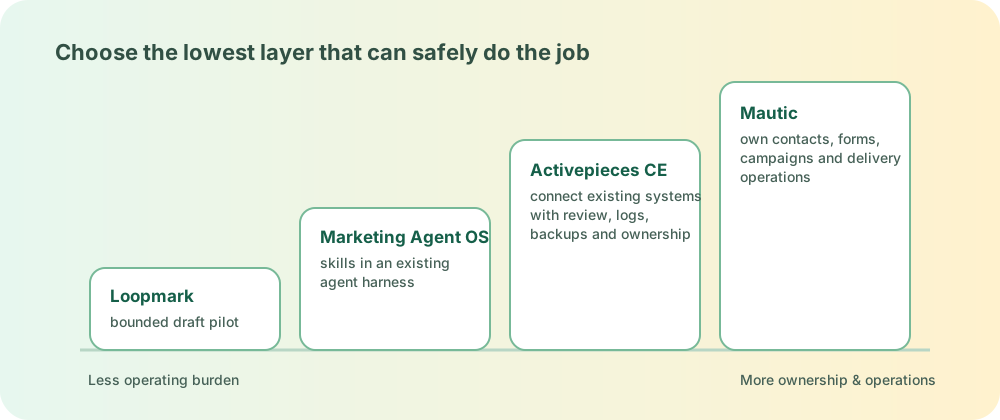
The starter shortlist
Mautic
For self-hosted contacts, forms, campaigns, and lifecycle email when you can operate the database, mail transport, scheduler or worker, and recovery.
Not for: a quick drafting experiment or a simple SaaS-to-SaaS link.
Activepieces CE
For human-reviewed flows across systems you already own. Its deployment and secrets still need an operator.
Not for: a CRM, consent ledger, or mail service.
Marketing Agent OS
For reusable marketing instructions inside an approved coding-agent harness.
Not for: a hosted app, scheduler, credentials vault, or campaign delivery system.
Loopmark Agent
For a technical solo operator’s small local drafting experiment with fictional data and social credentials absent.
Not for: team approvals, a managed scheduler, CRM work, or production/unattended publishing.