Social image accessibility · 7 Nov 2026 · tagged-source inspection
Postiz CLI 2.0.27: image alt text reaches the source-level JSON handoff
Keep the approved native composer and check the final image description there. In the Postiz CLI 2.0.27 tagged source, a nonempty, index-matched --alt value becomes image[].alt in the post object passed to a JSON POST. That does not establish the released package bytes, an actual request, or a description visible on Instagram.
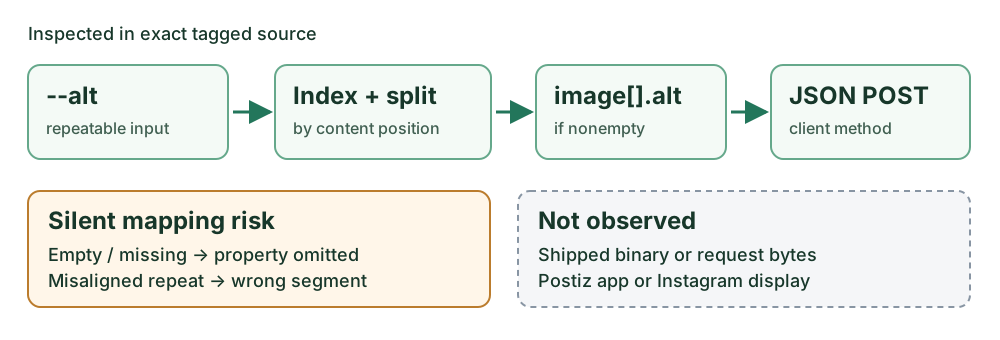
What the exact tag shows
| Stage | Finding | Evidence |
|---|---|---|
| Option | posts:create registers --alt as a string option. -c and -m are separate repeatable inputs. | Tagged command definition |
| Mapping | The non-JSON path normalizes content, media and alt arrays; it chooses media and alt by content index, comma-splits each chosen list, and adds alt only for a nonempty trimmed entry. | Tagged post builder |
| Handoff | The post builder calls api.createPost(postData). The API method prepares POST /public/v1/posts with JSON content type and JSON.stringify(data). | Tagged API method |
| JSON file | The file branch parses the supplied object and sends it through the same API method. It does not comma-split an existing image[].alt string, but the inspected code does not validate its image shape or wording. | Tagged post builder |
Repeated --alt entries are selected by content-array position, not independently paired with each image. A missing or empty matching entry omits the property; extra comma-separated entries are unused. Leaving out a placeholder for an earlier -c can attach a later description to the wrong content segment. A description containing a comma is better supplied as a JSON string than as comma-split --alt input. These are source-logic conclusions, not observed CLI behavior.
Version and release boundary
The 2.0.27 release dated 30 October points to commit 425474e. Its package manifest declares version 2.0.27, a built dist/index.js binary and a prepublish build. The publish workflow checks tag/version equality before publishing. The first-party npm page listed 2.0.27 on 7 November. These facts do not establish the shipped tarball's contents or an installed binary. Registry/tarball acquisition failed at DNS, so package integrity, SHA-256 and executable behavior were not checked.
The tagged LICENSE says AGPL v3 or later and package metadata says AGPL-3.0. This describes the agent/CLI repository metadata, not the separately deployed app, dependencies or tarball notices.
How narrow was the local check?
A dependency-free structural assertion checked option registration, indexed mapping into image[].alt, the post object and the JSON POST call in saved tagged files. The baseline passed. An in-memory change from property alt to notAlt triggered the expected failure. Saved source bytes matched the retrieved Git blob IDs. The assertion can detect that specific link break; it is not a parser run, mocked request or behavior test.
The package tarball and binary could not be obtained. No CLI was installed or run, no HTTP bytes were captured, and no Postiz app, provider API, account, draft, scheduled post or published post was used. Stored OAuth credentials take precedence over POSTIZ_API_KEY in tagged configuration source; any future loopback test needs an isolated credential store.
What the release claims—and what remains open
The release note says the Instagram integration sends alt_text for image posts and carousels, not video or stories. That is a first-party release claim. No compatible deployed app build or Instagram account path was traced here. Other channels' treatment is untested.
- In a controlled setting, acquire the released 2.0.27 tarball and record registry integrity, file hashes and
postiz --version. - With a clean credential store and verified no-external-egress boundary, capture the released CLI's loopback-only request for one ordinary alt, one JSON alt containing a comma, and one omitted or misaligned negative control.
- Only with separate channel authorization, check a draft/read-back or final post description. Do not infer display from a CLI request alone.