Is AI a Bubble? · Dated investigation
Buyer demand and budget substitution
What do buyers keep paying for? Real purchases can replace existing budgets rather than add to them.
The answer
The buyer evidence strengthens the case for economically motivated AI demand outside the immediate infrastructure-financing chain. It also shows why a winning AI supplier's sales are not necessarily additional spending across the economy. A public service can buy documentation assistance to increase useful capacity without dismissing employees. A commercial business can move work from agencies into AI-assisted internal production, retain part of the saving, and subsequently spend more on other marketing. Both are intelligible reasons to continue using AI. Neither requires the whole benefit to become a model provider's revenue.
The strongest evidence added here is a priced post-pilot decision by North Northamptonshire Council, supported by its operating record and an inspectable signed agreement, contrasted with Klarna's marketing-production substitution and subsequent expense accounts. These are buyer records, not a survey of adoption or another supplier retention percentage. The council's executed annual extension is £48,000 before contractual VAT; the relevant operating claim concerns increased therapy assessments, not a verified payroll reduction. Klarna's disclosed agency spending fell from $33 million in 2022 to $8 million in 2024, while its later reported marketing expense moved in the other direction. The different periods and cost boundaries are essential.[1][3][10]
The new numerical result is an account of what the purchase must accomplish, and where expenditure actually moved. The council calculation converts a real fee and its scoped outcome claim into two different requirements: preserving cost per assessment through more output, or genuinely avoiding expenditure for the same output. The Klarna reconciliation separates referral commissions from the rest of marketing expense, then checks the latest inspected quarter rather than extending a 2024 saving indefinitely. The computations do not identify undisclosed invoices, complete incremental AI costs or a causal productivity effect.
The favorable interpretation has specific support: a buyer commits money after an initial pilot; service staff describe operational benefits; and another buyer reports reductions in pre-existing outside purchases. The main alternative is narrower than “nobody pays”: continuation may partly reflect a locked term, switching costs, capacity expansion rather than savings, or a combination of AI and ordinary cost cutting. That alternative limits the inference about open-market renewal and supplier pricing power. It does not turn the documented purchase or the displaced budget into fictitious commerce.
The whole-pool conclusion therefore becomes stronger on the existence of rational outside-buyer demand, but not proportionately stronger on the amount of cash available to recover the entire build-out. Evidence of valuable substitution is unfavorable to the claim that AI has no economic customers. It is equally unfavorable to treating all displaced wages, agency savings, internal benefits and successive vendor receipts as one expanding revenue pool. Which provider retains cash after its own costs remains a separate question. No sector-wide demand total, valuation verdict or crisis probability follows from these two selected cases.
1. The perimeter: two decisions, not a customer census
The standing investigation concerns the U.S.-centered commercial generative/frontier-AI build-out since 2023, including material global customers and suppliers. This chapter's principal procurement case is British; the commercial case is global. They test economic mechanisms relevant to that build-out, not the prevalence of those mechanisms in U.S. budgets. Amounts remain in their original currencies and are never added together.
North Northamptonshire Council, or NNC, purchases a service used in adult social care. The relevant chain is public service resources → an application supplier → the supplier's own delivery costs. Residents' better care or shorter waits are benefits, not another application invoice. The procurement identifies Beam Up Ltd as the contracting supplier; this research does not identify the model, hosting invoice or accelerator fleet serving this particular account.
Klarna is examined as the buyer/producer of its own marketing, not as the seller of every financial service it provides. Its economic customers and bank funding are outside the immediate model/cloud/chip financing chain, although its business is not independent of financial conditions. The annual report describes a payments and banking business with consumer deposits, borrowing and capital transactions. Its financial resources cannot be relabeled pure retained operating profit, and no specific funding source is earmarked to an unseen AI invoice.[12]
The case selection is evidence-led. Walmart's own technical account describes catalog work and quality controls but did not yield a matched purchase or renewal budget in this inspection. The named JPMorgan lead likewise did not produce an adequate buyer-cost record here. Neither company's reputation substitutes for the missing comparison. The public-sector purchase record provides the stronger direct case. Klarna supplies a different spending decision with financial evidence; its marketing work is distinct from the earlier demand investigation’s customer-support assistant.[16][17]
These choices broaden the immediate evidence beyond another infrastructure borrower, without creating two independent representative samples. A council and a financial-services company face different objectives, constraints and buying processes. Agreement between them would establish a possible mechanism, not an industry success rate.
2. NNC: what was purchased, what persisted, and what is actually known about payment
Buyer-budget explanation · evidence and assumptions kept separate
One purchase, four different claims
Scroll horizontally on a narrow screen to inspect the complete figure.
The official procurement notice records a one-year extension of a pilot, signed September 3, 2025, for September 8, 2025–September 7, 2026. It was a below-threshold award without competition. That is an affirmative priced continuation decision. It is not evidence of competitive tender savings or proof that the first pilot was free. The notice inconsistently repeats £48,000 in both its excluding- and including-VAT fields.[1]
The signed package covers 11,900 recording hours and 100 reports, unlimited users, support and required onboarding. These are capacities and included services, not observed utilization. The order specifies advance payment; the general invoice clause also refers to 30 days. Fees exclude VAT and are generally non-refundable. Renewal is automatic for twelve months unless written notice is given at least 60 days before expiry; renewal price increases require 90 days' notice. The exit provisions include a ten-day window to request a backup and customer-paid reasonable return expenses.[2]
A short evidence ledger
| Record | What it positively establishes | Remaining boundary |
|---|---|---|
| Official 2025 notice and signed order | A named buyer, supplier, priced extension, service period and contractual capacity. | Not a bank receipt, complete buyer cost or observed hours consumed. |
| Council's June 2026 board record | A therapy-service outcome claim after deployment, discussed in the context of constrained capacity. | No matched staffing, case-mix or causal evaluation. |
| Published supplier-spending reproduction | A £57,600 NNC/Beam Up Ltd entry dated October 3, 2025. | Original CSV and invoice join were not obtained; attribution remains to the reproduction. |
| September 2026 procurement aggregators | A reported £51,000, five-month, broader Beam package. | Original new notice/order were inaccessible; not verified unchanged-service renewal or payment. |
The spending reproduction's amount is arithmetically consistent with £48,000 plus 20%: £9,600 more than the contractual net fee. That consistency is useful corroboration, not an invoice match or a determination of recoverable tax. The council publishes monthly expenditure files, but its October CSV could not be retrieved. Consequently the research does not promote this row to a verified payment under the identified contract. Nor does failed retrieval establish nonpayment.[8][7]
The later procurement record merits space because it changes the persistence question. Aggregators identify notice 088675-2026, the same procedure identifier, a September 14, 2026 award and a term ending February 13, 2027. Its scope includes Notes, Talk and Interpret, with some features subject to written activation. This supports an attributed indication of broader continuation, not proof of twelve further months at the old price.[9]
A price comparison without matching the package would be misleading. The old and reported new values differ by 6.25%, but their simple value-per-term-month figures are £4,000 and £10,200. Neither calculation is a quality-adjusted price increase: duration, scope and entitlements changed or remain unobserved. The monthly figures are normalization arithmetic, not a billing schedule. Likewise, the original automatic-renewal clause and the later reported replacement cannot be counted as two cumulative obligations without knowing notices and amendments. No £99,000 annual run rate or duplicate old/new liability is asserted.
Voluntary choice and in-term protection answer different questions
The deliberate extension is stronger evidence of willingness to commit than an unused seat, free trial or procurement authorization with no contract. Once entered, however, the term can protect the supplier even if the buyer later discovers a better alternative. That protection is commercially meaningful, but it is not a new voluntary endorsement each month.
Under the original notice periods, a price change served at the latest permitted point would leave approximately thirty days before the nonrenewal deadline. That is a planning window derived from the terms, not evidence that such a price notice was sent. A buyer must evaluate the next period before its ability to avoid that period expires. An account remaining active after the deadline can reflect satisfactory value, administrative inertia or switching costs; the available evidence does not allocate those explanations.
This directly advances the customer-renewal investigation's standard-terms discussion: here there is an actual buyer's signed order rather than a hypothetical application of a supplier's general website terms. It still does not yield every later amendment or convert contract persistence into a product-wide retention rate.[19]
3. The care workflow: more capacity can be valuable without a cash saving
At the June 23, 2026 Health and Wellbeing Board meeting, officers said that Magic Notes had contributed to 14% more therapy assessments since rollout. The same record describes stretched funding and service capacity. It does not say that staffing was held fixed, identify the measurement window, report case-mix adjustments or attribute the entire increase solely to the tool. The board noted the work; it did not certify an investment return.[3]
A separate CQC assessment, published March 4, 2026, reports staff descriptions of clearer, more consistent records and more time for direct engagement. This is an independent inspector's account of staff evidence, not an independently randomized test of Magic Notes or validation of the later 14% claim. The quality statement's wider judgment about the authority is not a product accuracy score.[4]
The council's own privacy notice describes the operating boundary. Staff obtain consent, use the recording/summarization tool, then copy material into the case-management system and edit it. Refusal leads to manual recording rather than refusal of service. Transfer into the internal system is required within fourteen days; the AI system has a sixty-day retention period. Thus neither human review nor the old care-record system disappears merely because transcription is automated.[5]
These observations support a sensible favorable mechanism: less attention spent preparing documentation can be redirected to assessments and interaction, especially where people are waiting. The benefit need not be a reduction in today's wage bill. Conversely, more assessments can require additional care provision downstream. Saving documentation effort does not establish a reduction in the authority's whole social-care expenditure. That downstream consequence is unmeasured here and must not be treated as either an avoided cost or a zero.
The cost comparison that matters
A useful buyer account retains three kinds of cost.
First are payments to the service supplier, net of credits and adjusted for tax actually borne. The purchased bundle is the starting price; there is no observed allocation between audio, reports and included support. Additional consumption outside it would require its own treatment. Dividing the whole fee by all permitted recording hours yields approximately £4.03 per allowed hour at full use. With half the allowance used, the allocated fee becomes approximately £8.07 per used hour. Neither is the supplier's stand-alone transcription tariff, and neither establishes actual use.
Second are buyer resources that the product does not replace: staff learning and attendance time, configuring usable templates, maintaining permissions and data quality, reviewing/editing records, handling exceptions and preserving a manual route. Some are existing costs that continue; some may be incremental. Only the incremental or differently used portion belongs in a comparison with the old process. Vendor-delivered training already included in the bundle must not be charged again as a new vendor fee, while the staff time attending it is a different resource.
Third are change and exit costs: moving records, checking their completeness, setting up a replacement, operating two systems during transition and retraining users. These are analytical cost categories, not claimed extra bills discovered in this case. Their relevance follows from comparing two complete ways of producing the same care record. The signed export provisions make migration something to plan, not proof of permanent captivity. No estimate of NNC's switching cost or legal conclusion about record portability is supplied.
An unsuccessful recording, an uncorrected summary and an assessment requiring later rework can consume the time initially saved. The meaningful output unit is therefore an accepted assessment or adequate record at the necessary standard—not an audio hour or generated page. The observed workflow establishes that people still make this conversion; the public evidence does not measure its full resource cost.
The budget source is an existing public service, not a documented investment by the AI supplier. The council's budget highlights simultaneously describe service investment and planned efficiencies/income generation. They do not earmark a particular grant, saving or tax receipt to Magic Notes. Nor does the record establish that no introductory commercial concession existed. The defensible statement is a priced commitment by a public operating buyer, not an audited decomposition of its tax funding or proof of an undiscounted market price.[6]
4. What would justify the council's next purchase?
This is a prospective buyer-budget diagnostic anchored to the signed annual fee and the scoped outcome observation, not an estimate of the realized return on the completed term. It avoids selecting an arbitrary social-worker wage and multiplying it by invented saved hours.
Let:
F = £48,000, the signed net annual package fee used as a historical reference price;K, the additional annual buyer burden not already counted in that fee or in the net performance comparison, including unrecovered tax where applicable;q, a sustained increase in comparable accepted output from unchanged underlying resources, attributable to the purchased workflow;C, the annual cost of those comparable resources in the no-tool alternative.
The reported therapy result is not itself a measured q. For the favorable test only, set q = 0.14, assuming that the whole observed increase is attributable, quality and case mix are comparable, resources do not rise, and the effect persists over the prospective year. Those conditions are additional assumptions. Charging the whole council package to therapy is deliberately conservative about allocating the fee, but assuming the whole reported improvement is causal is favorable. They must not be mistaken for a single conservative estimate of actual ROI.
Two counterfactuals · not an observed return or payroll saving
A 14% output gain answers two different budget questions
Scroll horizontally on a narrow screen to inspect the complete figure.
Keep the workforce and provide more service
Suppose the no-tool process produces Q adequate assessments for C, while the tool-assisted process produces (1 + q)Q for C + F + K. Cost per assessment does not increase when:
(C + F + K) / ((1 + q)Q) ≤ C / Q, or F + K ≤ qC.
With no extra burden included yet, the reference fee requires a comparable annual resource base of £342,857 at a sustained 14% uplift. This number describes the scale at which the fee could preserve unit cost. It does not establish that the actual team has that budget or that its bank account saves the fee. Additional assessments must also be worthwhile; lower unit cost alone is not a requirement to produce unwanted work.
Keep output fixed and avoid genuinely adjustable expenditure
A different favorable assumption is that the same improvement permits resource use to fall to C / (1 + q) while maintaining Q. Then the available resource reduction is:
C × q / (1 + q), not qC.
At 14% higher throughput, the potentially released fraction is approximately 12.28%, before the new fee and additional burden. The fee-only threshold becomes £390,857 of comparable annual resource cost. Even this calculation becomes a cash-saving argument only if hiring, agency work, overtime or another payment can actually be avoided. With unchanged salaried staffing, the resource opportunity may instead become more output, better interaction or reduced workload.
| Explicit prospective assumption | Resource base required to preserve cost per assessment while expanding output | Resource base required to cover the same cost through adjustable resources at fixed output |
|---|---|---|
| 14% sustained attributable uplift; £48,000 fee; no additional burden included | £342,857 | £390,857 |
| Same uplift; £12,000 assumed additional burden | £428,571 | £488,571 |
| Only half the reported uplift retained, 7% assumed; same £12,000 burden | £857,143 | £917,143 |
The £12,000 and half-attribution choices are sensitivity tests, not measured costs, confidence intervals or probabilities. At zero attributable improvement there is no throughput-based threshold that can justify a positive fee: another benefit or different evidence would be needed.
A useful illustration makes the distinction concrete. At an assumed £500,000 comparable resource base and £60,000 total incremental burden, the full-uplift expansion test has £10,000 of room before losing its unit-cost advantage. The adjustable-resource test has only about £1,404. At 7%, both fail the stipulated cost test. These are alternative counterfactuals; their benefits cannot be added together. Failure means the stated combination needs more benefit, lower cost or better performance—not that the council is insolvent or the technology has no use.
This calculation changes the demand inference in a specific way. A modest contract can be rational even when no employee leaves, but the observed 14% cannot simply be booked as a 14% payroll saving. The decisive missing measurement is the comparable resource base, net additional burden and accepted output, not another survey asking whether staff like AI. Better records and less after-hours documentation can also support the purchase, but those benefits need their own evaluation rather than an invented monetary price.
Renewal versus recovering the original implementation cost
A renewal decision should compare the future costs and benefits of retaining the tool with the future costs and benefits of an alternative. Already-spent training cannot be recovered by cancelling. It remains part of the historical investment result, but is not a fresh payment every renewal. New migration or retraining may genuinely favor staying.
This creates a distinction between rational persistence and intrinsically superior technology. A tool can be worth retaining because it works adequately inside an established workflow, even when a clean-sheet competitor is cheaper. That is a durable source of application value, but not evidence that every upstream model enjoys the same protection. Conversely, a provider can lose the next order if the buyer's retained benefits no longer exceed its actual future cost, despite high past utilization.
5. Klarna: the buyer moves production in-house
Klarna's marketing record tests a different decision. Rather than sell an additional AI line item to a shopper, it uses AI-assisted production to make its own marketing materials. The relevant alternative is purchased creative, translation and related agency work, together with internal staff and tools—not the absence of marketing altogether.
The final prospectus links cost management, centralization and AI adoption, and discloses the historical agency reduction noted above. Total sales-and-marketing expense fell from $381 million in 2023 to $328 million in 2024, a different comparison from the 2022–2024 agency subset. The filing therefore supports real budget substitution, but not the inference that every dollar of either decrease was caused by AI.[10]
The later Form 20-F gives a more constrained attribution: $7 million less spending on external marketing suppliers in Q1 2024 than Q1 2023, of which management attributes 37% to AI. Multiplication yields $2.59 million attributed to AI and $4.41 million left outside that attribution. The latter is not assigned to a particular cause here. The filing also estimates $10 million of AI-powered marketing savings for 2024. That estimate is not added to the quarter, agency decline or total expense decline.[11]
The chronology matters. The 2024 announcement, as reproduced, described approximately $10 million on an annualized basis. The later filing describes an annual estimate. Repetition and a change in the reporting period are not independent causal confirmations. There is still no publicly inspected reconciliation of each contract cancellation, model invoice and internal production cost. What becomes more credible is a buyer making actual changes to an established expense base rather than merely contemplating AI adoption.
What production replaced—and what remained
The accessible reproduction of Klarna's 2024 statement identifies image-generation and editing tools, more frequent image refreshes, and a claimed development cycle shortening from six weeks to seven days including brand, image-quality and legal checks. Its separate $1.5 million quarterly image-saving claim and annualized components are recorded but not stacked onto the filing's attribution. The original newsroom body was blocked by a verification page; the reproduction is identified as such, not called a freshly inspected original release.[15]
There is also a denominator discrepancy to preserve. The reproduction describes 37% of a sales-and-marketing saving; the later 20-F identifies the $7 million external-marketing-supplier decrease as its denominator. The calculation here follows the latter explicit definition. Whether the earlier wording reflects a different perimeter or a condensed presentation is not established. The promotional annualized components are not treated as an independently reconciled addition to the filing.
That description supplies a credible operating counterfactual: stock imagery, external creative production and longer turnaround versus AI-assisted internal production with finishing and approval. It does not establish equal campaign quality, equal customer conversion or a labor-hour saving equal to the calendar-time change. Thirty-five fewer calendar days are not thirty-five person-days of payroll. Faster production can instead enable a timely campaign, more variants or cheaper localization. Those are plausible benefits without a new AI invoice to the consumer.
The missing costs are economically important. For a complete comparison, procurement of the tools or model calls must be joined to staff production and prompt iteration, finishing, brand validation, localization checks, rights/compliance review, storage, integration and rework. Existing staff and systems cannot be priced as new costs in full if the old process also needed them. Equally, moving an agency's work inside the firm does not make the internal resources free. The relevant amount is the change relative to a matched alternative.
A useful conservative interpretation is that broad procurement pressure and centralization explain much of the reduction, while AI supports a smaller subset. A favorable interpretation is that adequate output can genuinely be produced with lower external expenditure and that the gain persists. Both are compatible with the reported expense changes. Neither is established by assuming that all agency work was unnecessary, all internally generated images were adequate, or all avoided fees became model-vendor revenue.
Where voluntary persistence can actually be observed
The buyer describes implemented vendor-spending reductions and carries the AI-production account into a later annual filing. That is stronger than an announced trial. It is weaker than a dated, product-specific renewal register. The research did not obtain the tool subscriptions, cancellation notices, negotiated discounts, credit balances or subsequent supplier substitutions underlying those totals.
Accordingly, the continuing decision is best understood as retaining an internal method and reallocating production purchases, not verified repeated renewal with the same model vendor. The workflow may preserve its value even if the buyer changes the underlying tool. This is favorable for the buyer and potentially for its internal application layer; it is ambiguous for any particular upstream supplier's future pricing power.
The public descriptions also give no basis for treating every model purchase as a free trial or a perpetual subsidy. Nor do they prove that every price was undiscounted. Missing commercial terms remain missing. The buyer's reported reduction in outside costs survives that uncertainty; the size of its all-cost gain does not become known merely because the reduction is plausible.
6. Marketing savings and a growing budget
The subsequent accounts help test two misleading interpretations: that AI savings must continuously reduce the whole marketing line, and that any later increase disproves the earlier substitution.
The 2025 annual accounts show $414 million of sales-and-marketing expense versus $328 million in 2024. Within those totals, distribution-partner referral commissions were $109 million and $81 million. The report's displayed-endpoint reconciliation is therefore:
328 + (109 − 81) + [(414 − 109) − (328 − 81)] = 414, or 328 + 28 + 58 = 414.[12]
| USD millions; rounded reported expense | 2024 | 2025 | Calculated change |
|---|---|---|---|
| Distribution-partner referral commissions | 81 | 109 | +28 |
| Remaining sales-and-marketing basket | 247 | 305 | +58 |
| Total sales and marketing | 328 | 414 | +86 |
The issuer separately prints an $87 million change; this bridge uses its rounded endpoints. The one-million difference is retained as a rounding boundary, not alleged misstatement. The remaining basket includes non-AI activities and noncash expense; it is not the amount paid to AI providers. The annual disclosure says technology costs include hosting, licensing and amortization, so the marketing line alone cannot identify all AI-production costs.[12]
Reported annual expense · not a cash waterfall or AI-cost allocation
A smaller production bill can coexist with a larger marketing budget
Scroll horizontally on a narrow screen to inspect the complete figure.
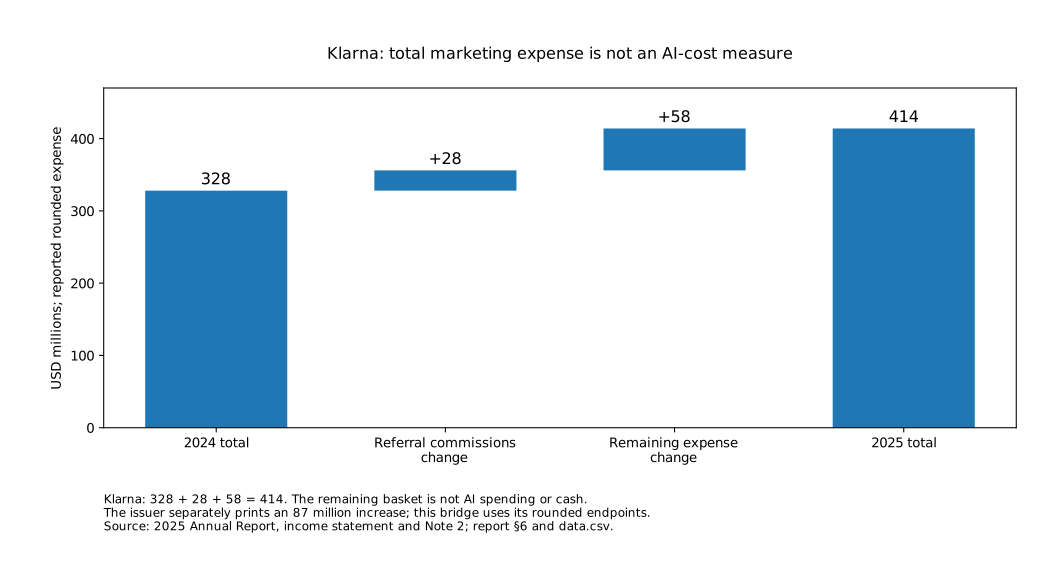
The figure's positive increments are expense categories, not estimated AI benefits. It is entirely possible for unit production cost to fall while customer acquisition, partnerships or other activities use more resources. The fact that a buyer can reinvest a saving is not proof that reinvestment occurred dollar-for-dollar in a specific category; fungible corporate funds prevent that claim without a more specific account.
The latest inspected quarterly reconciliation reaches the same interpretive boundary. Q2 2026 sales-and-marketing expense was $128 million versus $93 million a year earlier. Of the displayed $35 million increase, $8 million corresponds to the increase in the share-based-payment adjustment, leaving approximately $27 million in the remaining expense comparison. This is an arithmetic decomposition, not a causal attribution. The publisher's adjusted figure is $111 million, whereas subtracting its rounded $18 million adjustment from $128 million gives $110 million; its rounding warning is preserved. Neither adjusted number is a cash ledger.[13]
Klarna reported a positive $27 million operating result for that quarter versus a $46 million loss in the comparator. This is favorable group operating evidence, not a demonstrated return on the marketing AI tools. Its August release also describes planned launch-related marketing investment ahead of associated volumes. That forecast is not another observed purchase or proof that earlier AI savings funded it.[13][14]
What the saving could support after omitted costs
A bounded full-cost test can use the company's quarterly AI-attributed reduction, while refusing to supply a fictional model margin. Let U be the net incremental production, software, integration, review, quality and change costs not already deducted in management's saving estimate. Then the claimed quarterly gain survives a complete-cost reconciliation only when:
U ≤ $2.59 million.
This is a maximum unaccounted-cost envelope, not measured surplus. With an explicitly assumed $2 million of such additional burden, the claim leaves $0.59 million; at $3 million it leaves a $0.41 million mismatch. No probability is assigned. If management's estimate already includes a cost, charging that cost again would be wrong. If the estimate is a gross avoided vendor bill, omitting the incremental internal cost would be equally wrong.
A stricter evaluation would match accepted campaign assets, usable localizations, delivery dates, brand/legal acceptance and subsequent commercial outcomes. The reported cycle and spend reductions do not provide all those denominators. They nevertheless identify where an economically real benefit can lie: buy less external production while keeping an adequate or better marketing service, rather than “create a new market equal to the entire former agency bill.”
There is no requirement that the winning AI supplier collect all $2.59 million. A smaller fee can sustain a useful supplier and leave substantial buyer surplus. The supplier must still pay its own serving, development and distribution costs; none is inferred from Klarna's reduction. Passing gains to the buyer can deepen demand while limiting the financial return available farther upstream.
7. Compare the two decisions without combining their gains
Cash-budget identity · no currencies or case totals combined
Useful demand need not be additional spending
Scroll horizontally on a narrow screen to inspect the complete figure.
Both cases involve real organizations choosing how to perform existing work. Their benefits, funding and constraints differ.
| Decision dimension | NNC documentation assistance | Klarna internal marketing production |
|---|---|---|
| Unit worth examining | Adequate care record or accepted assessment, including review and exceptions. | Accepted creative/localized asset and useful campaign outcome, including finishing and approval. |
| Strongest buying evidence | Signed priced extension after a pilot; later broader continuation is separately attributed. | Buyer-reported implemented outside-supplier reductions and subsequent financial accounts. |
| Principal benefit supported | Capacity and record-quality mechanism; realized cash saving not established. | Budget substitution and shorter production-cycle mechanism; complete causal net saving not established. |
| Important persistence constraint | A committed term and advance notice make current payment different from the next voluntary choice. | Internal workflow can persist while underlying model/tool vendors change; exact commercial renewal terms unavailable. |
| What is not allocated | Consumed hours, actual invoice join, attributable net workload gain and full buyer cost. | Tool fees, all internal production costs, exact contract cancellations and comparable quality-adjusted campaign return. |
The appropriate budget identity is:
change in buyer spending = new external AI payments + other incremental cash costs − old cash expenditure actually avoided.
This is not an identity for all welfare or for company profit. More time with a service user, lower stress or better creative flexibility may be valuable without appearing in cash. For an economic comparison, the value of retained staff time and other noncash resources must be handled explicitly, and not counted once as additional output and again as removed payroll.
The same identity also explains why substitution is not evidence against demand. A supplier selling a cheaper replacement can attract a durable customer even when the customer's total budget falls. What it challenges is an inflated claim about the amount of new spending available to support every supplier. Adding the old vendor's lost revenue to the new vendor's gain, or adding the buyer's saving to the winning supplier's revenue, would manufacture a larger economic inflow.
NNC does not supply a measured old-software bill displaced by the purchase. Its observable change is buying assistance for a workflow that retains human and case-management components. Klarna supplies a documented old external-spending category, but not a complete division of the saving among employees, application tools and upstream models. These are different degrees of budget-substitution evidence and should not be compressed into one replacement percentage.
Lock-in is neither the whole explanation nor irrelevant
A signed term gives the supplier a claim today; successful work gives the buyer a reason to sign again. Migration costs can reinforce that reason without making the original tool optimal in isolation. A reasonable renewal analysis therefore compares the best feasible alternative, including the transition, rather than a frictionless product from a price list.
The reverse risk is that administrative persistence outlasts the benefit. A missed nonrenewal window or an unfinished migration can maintain revenue temporarily. That can delay a provider's recognition of weaker demand. It cannot justify treating every continuing invoice as coerced or economically irrational. In these cases, the outcome and expenditure records supply positive reasons for persistence, while the unobserved comparison prevents a precise allocation between value and inertia.
8. What changes about the whole bubble answer?
The favorable update is on the customer side, not a new infrastructure valuation. There is a documented priced buyer decision outside the immediate financing chain and a commercial buyer's account of shifting an established production budget. The evidence makes “only suppliers pay one another” less satisfactory as a blanket explanation of demand. It also gives a concrete reason why demand can survive without every purchase creating an immediate payroll reduction.
The unfavorable implication for expansive financial narratives is that buyer value is not an entitlement to equivalent supplier revenue. Some gain can remain in the public service, some can remain at the commercial buyer, and some can accrue to an application layer capable of replacing expensive external work. More useful output can therefore coexist with lower spending on one supplier class. the customer-renewal investigation’s provider-capture question remains consequential even as the evidence for customer rationality strengthens.
This leads to a more precise set of judgments.
Real demand versus financing-supported demand. The selected customer decisions have an operating purpose outside constructing or funding model capacity. That is substantive counterevidence to an entirely self-referential demand story. It does not establish the independently funded share of any frontier provider's revenue. The council's appropriation/allocation and Klarna's fungible resources have not been traced to each supplier payment.
Productivity versus expenditure. A useful tool can increase output at unchanged staffing; a different tool can substitute for a purchased service. The first does not automatically release cash and the second does not automatically increase total demand. Both can justify a supplier's continued sale at a price consistent with buyer benefit and alternatives.
Durability versus contractual duration. The executed term establishes one period's obligation. A later expanded contract can be evidence of continued buying but not a like-for-like renewal price. Long-lived demand requires continuing net value when choice is available, not just a provider's ability to enforce an old term. Repeated allocation to an internal method may also preserve demand for AI generally while changing the vendor receiving it.
Sustainable supplier returns versus public benefit. The research still does not establish complete model margins, cohort recovery or fair ownership prices. It neither imports a software gross margin into a frontier laboratory nor allocates NNC or Klarna to an unidentified data center. The capital and financing tests from earlier reports remain necessary, with their original dates and conditional inputs.
A serious sustainable path is now more concrete: buyers select suitable tasks, retain review where it adds value, avoid more expensive alternatives or expand worthwhile service, and purchase at prices that leave both buyer benefit and adequate provider contribution. A serious adverse path is equally specific: realized quality-adjusted gains are smaller than reported volume gains; change and review costs absorb the apparent saving; or the benefit is real but competition and budget substitution prevent some suppliers from retaining enough to recover their capital.
The evidence presently favors selective economically supported adoption over indiscriminate paid expansion. This is not a forecast that every buyer rationally optimizes, that every tool survives renewal, or that the broad build-out is fairly priced. It is a stronger explanation of who can pay for useful AI and why—together with a stricter boundary on how much of that value can be counted as new financial resources.
9. Continuity and discriminating observations
The earlier demand investigation's benefit/payment distinctions remain controlling. Its Klarna support example concerned an assistant, a workload-equivalent claim and a different expense line; this chapter does not silently replace that evidence with marketing savings. The new council calculation uses an actual signed fee and a buyer-specific outcome claim, not the earlier demand investigation’s assumed wage, annual working weeks or list-price seat calculation.[17]
The customer-renewal investigation established provider-side recurrence and the need to separate company metrics from AI products. The new work changes the acquisition direction: an executed buyer order, buyer operating records and the buyer's outside-supplier expenditures. No NNC contract becomes Beam's retention rate, no therapy outcome becomes company NDR, and no Klarna cost reduction becomes the application vendor's margin. Seagate's infrastructure-demand correlation remains intact; it is not the new principal outside buyer.[19]
The payer-cash investigation supplies the distinction between resources, permitted spending changes and adequate returns. That distinction now operates at the procurement decision and the budget counterfactual. The completion investigation remains a completion-funding chapter; no documented relationship links these selected buyer workloads to its financed projects, so its reserve and acceptance conditions are not imported into this model.[18][20]
The NVIDIA–Energy Global treatment remains obligation established, receipt unverified in the relied-upon evidence; nonpayment not inferred. Later CoreWeave closing evidence retains its later established status and does not become current unspent cash. the completion investigation’s repair distinguishes the April 8.25% illustration from the May executed 7.75% coupon; neither enters this chapter's buyer calculations. Earlier reports retain their dated findings and calculations.
The observations most likely to change this chapter's weighting are identifiable. For NNC, a matched renewal order and invoice, actual usage, a comparable assessment/staffing series and the cost of review or avoided agency work would discriminate capacity expansion from cash saving. A material deterioration in quality or a documented decision to stop after the available exit point would weaken the favorable persistence account; a clean renewal with retained net performance would strengthen it.
For Klarna, matched production volumes and acceptance criteria, tool and internal-cost allocations, and contemporaneous contracts for the replaced work would test the net saving. Evidence that the same quality costs less after full internal costs would strengthen the substitution case. Evidence that lower external bills are outweighed by internal costs, losses of campaign effectiveness or repeated rework would weaken it. A later increase in the total marketing line alone would settle neither question.
These observations can also provide a useful unit for the next cost/efficiency investigation: accepted records or campaign assets after review, not raw tokens. This identifies a useful evidence boundary, not a forecast that those records will become public.
10. Method, limits and inspection boundary
What is observed, calculated and assumed
The accompanying data contains a compact source-linked ledger. Each row preserves entity, unit, period, evidence status, source and qualification. Calculations reproduce the fee/capacity diagnostics, notice-window arithmetic, two distinct resource thresholds, attribution boundary and expense reconciliations. They run without network access; optional figure generation uses Matplotlib.
The most secure source observations are the signed purchase and the disclosed financial figures at their stated boundaries. The council's outcome is an attributed buyer claim, and the CQC passage reports staff evidence. Klarna's AI attribution is a management estimate, even when repeated in a securities filing. Ratios and decompositions are analytical arithmetic. Sustained causal uplift, additional buyer burden and hypothetical resource budgets are explicitly analytical assumptions. Neither displayed precision nor a passed script turns an assumption into a measurement.
There is no sampled frequency estimate, causal re-estimation, private survey, new interview or paid experiment. No vendor console, patient record, account credential or private invoice was accessed. The analysis is economic interpretation of public procurement and company records, not advice about an individual's care, a legal dispute or a security transaction.
Acquisition and coverage limits
The public-sector alternative is deliberate, not an implicit claim that all private buyers have similar procurement. The two cases are selected for their documentary usefulness, not randomly drawn. Neither measures national AI spending, the outside-funded share of lab sales or the demand for a particular infrastructure cohort.
The 2025 NNC notice and complete parsed contract were accessible. PDF screenshots failed; visual inspection of the source pages is not claimed. Council minutes and the CQC passage were available as indexed original excerpts, while full-page requests failed. The council privacy and budget pages were readable. The original monthly expenditure CSV and later FTS notice could not be retrieved. Their secondary reproductions remain clearly lower-status evidence, and the quantitative budget result does not depend on promoting either to a primary payment record.
Klarna's smaller SEC-hosted 2025 annual report was readable; the main Form 20-F exceeded the browser's content limit. Relevant original indexed filing paragraphs and the final prospectus excerpts were inspected for marketing claims. The June 2026 expense reconciliation was available in the indexed original earnings exhibit; full-page and inherited PDF requests failed. The original 2024 marketing release was blocked by a verification page, so its workflow detail is attributed to an accessible reproduction. Source-page images also failed. No successful source-image audit or complete re-reading of the oversized filings is claimed.
Reported aggregate expense is not a settled-invoice ledger. Rounded figures explain why a displayed subtraction may differ from the issuer's adjusted change. Missing allocations remain unassigned rather than set to zero. A company may genuinely save against a counterfactual while spending more in absolute terms; conversely, a cost reduction can arise from mix or reorganization without a causal AI effect of the same size.
The earlier demand, payer-cash, customer-renewal and completion investigations retain their original evidence dates and conditional inputs. Their earlier numerical illustrations do not calibrate the new buyer tests. This chapter adds buyer-budget evidence; it does not independently re-audit those earlier sources or replace their calculations.
Source notes
Source 1
UK Find a Tender, Magic Notes — 12 Month Contract Extension of Pilot, notice 053743-2025, published September 4, 2025. Scope, signed date, term, procedure, supplier and inconsistent VAT fields. Full notice read. It links the executed order below.
Source 2
NNC / Beam Up Ltd, signed Magic Notes subscription agreement, signatures September 2–3, 2025; effective September 8. Order form pp1–2; general terms §§9, 14 and relevant buyer/service provisions. Complete PDF text parsed; screenshot attempts failed. Terms are summarized for the economic comparison, not a legal opinion on enforceability or later variations.
Return to citation: ↩ 1
Source 3
NNC Health and Wellbeing Board, Digital Innovation in Adult's Services, item HWB/52, June 23, 2026. Original indexed minutes inspected, including the therapy-only 14% statement, funding/capacity context and decision to note the work. Full page unavailable. No underlying study dataset obtained.
Source 4
Care Quality Commission, NNC assessment: Learning, improvement and innovation, March 4, 2026. Original indexed passage on staff accounts of Magic Notes inspected. Not an independent causal estimate or validation of the later board percentage; full page unavailable.
Return to citation: ↩ 1
Source 5
NNC, Adult social care, quality assurance and safeguarding privacy notice, updated July 7, 2026 as served. §5: consent, manual route, copying/editing and storage/transfer periods. Full text read; describes policy, not measured compliance on individual cases.
Return to citation: ↩ 1
Source 6
NNC, Budget, updated March 2, 2026. 2025/26 highlights and 2026/27 approval reference. Public operating-budget context only; no Magic Notes appropriation or payment-source allocation supplied.
Return to citation: ↩ 1
Source 7
NNC, Expenditure, monthly spending-file index inspected October 5, 2026. The linked October 2025 CSV failed retrieval, including the container download. No original transaction row is claimed read.
Return to citation: ↩ 1
Source 8
Govfiles, Beam Up Ltd supplier-spending records, page 3, indexed excerpt accessed October 5, 2026. NNC entry dated October 3, 2025: £57,600, NASS Management Team / Professional Fees and Hired Services. Secondary transcription; invoice linkage, tax basis, reversals and completeness not independently established.
Return to citation: ↩ 1
Source 9
TenderSignal record 56184767 and Tenderline procedure record, indexed records accessed October 5, 2026; both identify FTS 088675-2026, published September 18. Value, term and broader scope are attributed records. Original FTS notice and new executed terms were not successfully retrieved. Aggregators may share one underlying source; agreement is not independent confirmation.
Return to citation: ↩ 1
Source 10
Klarna Group plc, final prospectus, Form 424B4, 2025 offering. Indexed original sections “Flexible and Low-Cost Base” and annual results of operations inspected: agency spending, centralization/AI interpretation, and 2023–2024 marketing expense. These describe earlier periods, not October 2026 spending.
Source 11
Klarna Group plc, Form 20-F, year ended December 31, 2025, 2026 filing. Indexed original Business Overview, “Generative AI Enhances Our Productivity and Drives Increasing Efficiency,” including the $7m reduction, 37% attribution and $10m annual estimate. Full body exceeded the retrieval limit; no private underlying attribution work inspected.
Return to citation: ↩ 1
Source 12
Klarna Group plc, 2025 Annual Report, SEC Exhibit 99.3, year ended December 31, 2025. Readable HTML text; income statement, management expense comparison and Note 2 pp92–95 used for commissions and cost definitions. Cash/funding sections provide context, not allocation of an AI invoice. Embedded page-image requests failed. Rounded disclosed values are preserved rather than silently forcing them to match separately rounded changes.
Source 13
Klarna, Q2 2026 earnings release, filed SEC exhibit, August 18, 2026. Indexed original printed p17 expense/adjustment and operating-result reconciliations, with the publisher's rounding warning. Unaudited, company-wide; full-page and PDF retrieval failed. This is a new marketing use of the dated quarter, not rediscovery of the earlier demand investigation’s support expense.
Source 14
Klarna, Second-quarter 2026 results, August 18, 2026. Original release's prospective third-quarter launch/marketing explanation, inspected in indexed text. Guidance is not an observed third-quarter expense or procurement result.
Return to citation: ↩ 1
Source 15
Klarna's newsroom original May 28, 2024 marketing announcement was located through its index but its body required verification. Financial IT's June 4, 2024 reproduction was read for the workflow, cycle, quality/legal checks and annualized-versus-quarterly claims. Attributed company communication, not independent validation; not added to later filing estimates.
Return to citation: ↩ 1
Source 16
Walmart Global Tech, Using LLMs to manage product catalogs, May 20, 2025. Original technical account inspected as a selection lead. It did not provide the matched procurement/renewal budget needed for the principal buyer case in this investigation. No catalog count or notional staffing multiple is used as a financial input.
Return to citation: ↩ 1
Source 17
Independent demand and monetization, evidence cutoff September 19, 2026. Buyer-benefit/payment distinctions, scoped support and office evidence, and the receipt correction. Prior experiments and hypothetical wage/cost models are not new observations here.
Source 18
Payer cash and spending flexibility, September 27, 2026. Resources, contractual spending flexibility and returns remain separate. Prior corporate budgets are not imported into the selected buyer accounts.
Return to citation: ↩ 1
Source 19
Customer dollar and renewal, September 29, 2026. Application capture, company-versus-product retention, Seagate’s correlation and precise expense/cash treatment retained. Its source-specific working-capital correction remains unchanged.
Source 20
Completion and cash before stabilization and its companions, October 4, 2026. Milestone/cash eligibility and the April-versus-May coupon-status repair are preserved. Neither supplies a documented supplier relationship to NNC or Klarna marketing.
Return to citation: ↩ 1